USAF/USN 6th Gen Fighters - F/A-XX, F-X, NGAD, PCA, ASFS News & Analysis [2008- 2025]

Status
Not open for further replies.
get what you are saying but I don't believe we are baked in yet on what the future numbers of F-35 are.
I’d be happy to be proven wrong and one day the AF will actually present a budget with a dramatic ramp in intended F-35 program. It would buck the trend that has been established since pretty much day one of the production program.
 
We're probably better off looking at 1985-1989, Reagan's second term for the appropriate levels of spending.
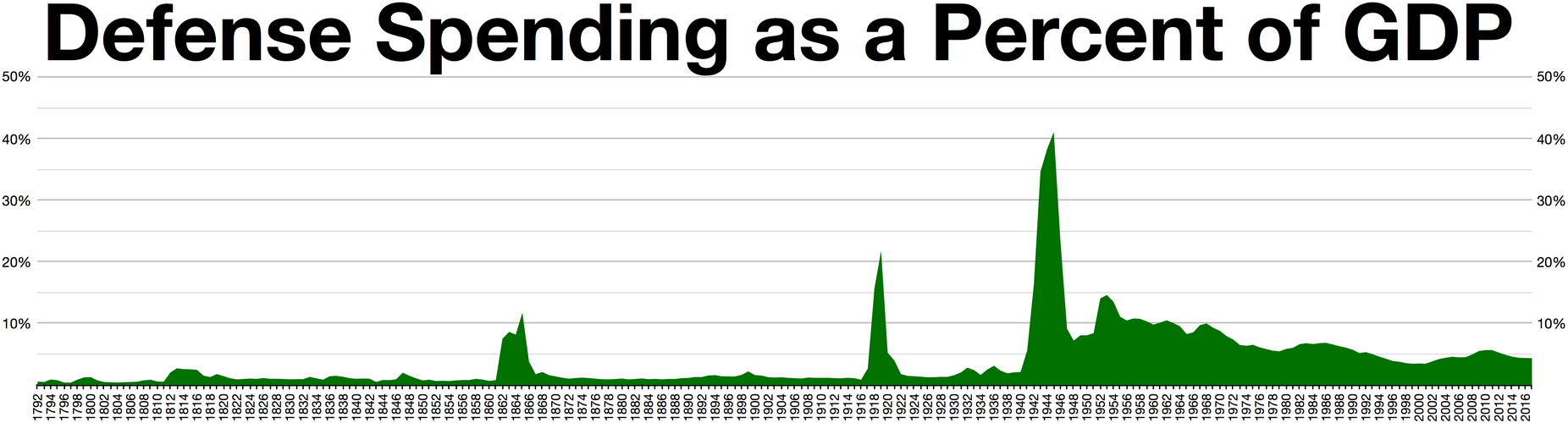
Perhaps although that wave really started in the late 1970s and carried forward into production in the late 80s. I find this graphic from the Military budget of the US wiki page quite interesting. We talk about shrinking force sizes but the budgets to support that, even though it notionally looks big, isn't really large on comparison to most of the cold war. It could be argued the force size was historically significantly larger but systems today are so more capable than they were then that it probably cancels each other out. Ie we can talk about a single F-35/22/NGAD/B-21 destroying targets that would have taken a wing or more of aircraft to accomplish.

Defense_Spending_as_a_Percent_of_GDP.png
 
Would not surprise me to see an even larger buy of later blocks of F-35, and the older (still functional but not as fancy blocks) sold or leased to allied nations on the cheap.

Perhaps the USAF should take a page out of France's AdA and MN in regards to Rafale by selling the early block F-35As to foreign customers and replace them with the latest block F-35As.
 
When did the USAF become the USN? That's just a very obvious losing strategy.

Kendall outlined several options that were studied and explained that none of them were being pursued at this time. No one is proceeding with a focus on an F-35 successor.
 
Kendall outlined several options that were studied and explained that none of them were being pursued at this time. No one is proceeding with a focus on an F-35 successor.

He said NGAD was not in active development and they were focussing on the bomber, intercontinental missile and drone projects rather than new manned aircraft, though he says he personally believes a new manned aircraft would eventually be required contrary to Trump administration rhetoric that the future was drones only not manned aircraft.
 
F-35s that can control CCAs have not been built yet, and there is currently no plan for when that will be or how.
Thats the same for any platform though rather than just F-35? In the short term there are the highly portable tablets being used for trials, but understandably no one wants to commit to putting that interface/code into the cockpit of a fighter before they have to - given the multi year multi 100m $ effort. I am unclear where such is included in the CCA program.
 
Thats the same for any platform though rather than just F-35? In the short term there are the highly portable tablets being used for trials, but understandably no one wants to commit to putting that interface/code into the cockpit of a fighter before they have to - given the multi year multi 100m $ effort. I am unclear where such is included in the CCA program.

No. They believe they can do it with the F-22 and have a plan for it, but it's not clear if it's actually been funded, F-22 CCA integration is so far not the in CCA plans though (it may not need to be).

It is, however, very clear that controlling CCAs from a tablet isn't going to work. They've tried it, it sucks.
 
He said NGAD was not in active development and they were focussing on the bomber, intercontinental missile and drone projects rather than new manned aircraft, though he says he personally believes a new manned aircraft would eventually be required contrary to Trump administration rhetoric that the future was drones only not manned aircraft.

He did not say NGAD was "not in active development", and in fact Kendall and the AF have stated that even during the "pause" NGAD was continuing forward with the already scheduled work and people were getting paid.

What he did say about NGAD was:

Frank Kendall: And the Air Force wrote requirements for an aircraft that is essentially an F 22 replacement. And for the last few years, that's what we've been working on. We're now at the point where we commit to going forward to finish design and go into production of that or not. And this is really the most important milestone for almost any program. And two things made us rethink the that that that platform. One was budgets. You know, under the current budget levels that we have. Um, it was very, very difficult to see how we could possibly afford that platform that we needed another 20 plus billion dollars for R&D. And then we had to start buying airplanes at a cost of multiples of an F-35 that we were never going to afford more than in small numbers.

Frank Kendall: So it got on the table because of that. And then the operators in the Air Force senior operators came in and said, you know, now that we think about this aircraft, we're not sure it's the right, right, right design concept. Is this what we're really going to need? So we spent 3 or 4 months doing analysis, bringing in a lot of prior chiefs of staff and people that had known earlier in my career who I have a lot of respect for, to try to figure out what the right thing to do was at the end of the day. The consensus of that group was largely that there is value in going ahead with this, and there's some industrial base reasons to go ahead. But there are other priorities that we really need to fund first. So this decision ultimately depends upon two judgments. One is about is there enough money in the budget to buy all the other things we need? And NGAD and is NGAD the right thing to buy? Um, the alternatives to the F-22 replacement concept include something that looks more like an F-35, follow on similar, something that's much less expensive, something that's a multi-role aircraft, multirole aircraft that is designed to be a manager of CCAs and designed more for that for that role. And then there was another option we thought about, which is reliance more on long range strike.

Frank Kendall: That's something we could do in any event. So that's sort of on the table period. As an option. It's relatively inexpensive and probably makes some sense to do more that way. Um, but but but the but to keep the industrial base going to get the right concept, the right mix of capability into the Air Force. Um, and do it as efficiently as possible. I think there are a couple of really reasonable options on the table that the next administration is going to have to take a look at. Uh, people have talked about not doing another crewed aircraft. Um, I don't think we're quite there yet. I think that could be considered. Uh, we could just continue to rely on F-35 and keep it going. And for the foreseeable future and focus on CCAs. I'm not quite ready to do that personally, but the next administration could take a look at that. A very prominent industrialist has made a comment about that. Um, you all know what I'm talking about. Uh, the, uh, the the the the culture and the history and the legacy of the Air Force, which I've been steeped in for particularly for the last few years, but for my whole my whole life, really, uh, is about the role of the pilot and letting go to some degree of that, I think is an incredibly difficult emotional thing, emotional thing for people to do. So we'll all I'll, I'll be convincing from the outside and we'll all watch to see how this all plays out over the next few months.
[/quote[

 
He did not say NGAD was "not in active development", and in fact Kendall and the AF have stated that even during the "pause" NGAD was continuing forward with the already scheduled work and people were getting paid.

What he did say about NGAD was:

They announced a Pause last July for a 3-4 month review (its now way past that) and in November they told Congress they weren't awarding new contracts for the next stage of development for the airframe, only moving ahead with the subsidiary CCA development via testing in VENOM F-16's (this element only compromises 20% of the previously allocated project funds).

They are spending just $276 million in 2024 and $815m in 2025 from previous NGAD program allocations of $1.9bn and $2.4bn respectively.
 
Original SARs, for example 2013, has the build rate at 80 frame a year all the way through to the late 2030s. While I agree consistent procurement has been a rock show to date there are, as you know, reasons why.

Were the USAF to commit to an F-35/CCA plan then could easily see the F-35 getting back to the 80 a year number or even approaching 100 with some additional investment. Given later SARs already extended out the build to 2043 and also the potential absence of a viable replacement means it becomes almost the only option.

Then NGAD can wholly invest in CCAs and push that as fast and as far as it can go.
Buying 100 of a futur obsolete fighter in face of J-36 is a non sense , there is no issue insteed building the NGAD , the F-35 is not powerfull enough and to short legs for fighting big fighter like the new Chinese one.
 
They are spending just $276 million in 2024 and $815m in 2025 from previous NGAD program allocations of $1.9bn and $2.4bn respectively.

That will obviously change (FY25) if the incoming administration decides to pursue the path of a manned NGAD platform which seems to have been the path forward recommended by blue ribbon committee established by the Air Force to look into its 'options'. In an ideal world, this review should have wrapped up in November and a decision made in December..a roughly 4-6 month timeframe for the pause.

But the current AF leaders have decided to punt to incoming administration which has realistically added about a year to the program if they go back and enact the original plan (source selection). The Trump administration has not yet announced its SecAF candidate. It could well be that the incoming AF leadership isn't even in place till the spring..and even when in place, decides to have another review to help develop a path forward (can't blame them for that really).

Kendall has stated that the teams are funded to preserve that option within the decision space. I read that as a 'hold in place' level of funding as opposed to anything that moves the program forward which would entail actually selecting a winner and funding them to go into next steps of the effort.
 
Last edited:
Still got the House for 2 years.

…by a historically low margin such that any budget hawk or culture war ideologue can overturn the apple cart. Johnson’s return to the Speaker position required personal calls from Trump and the sober realization the House majority was going to eat itself otherwise. I do not see the ‘Freedom caucus’ allowing more money for defense without cuts to entitlements, and I do not see the moderates in purple districts dying on that hill for the party. I cannot think of a scenario where USAF gets significantly more money for NGAD, Sentinel, etc.
 
Buying 100 of a futur obsolete fighter in face of J-36 is a non sense , there is no issue insteed building the NGAD , the F-35 is not powerfull enough and to short legs for fighting big fighter like the new Chinese one.
I think we can reserve judgement on the capability of any of the new Chinese aircraft for now. They could all turn out to be wonder beaters or underpowered dogs with systems issues... I still expect the F-35 to be very competitive for many years to come.
That will obviously change (FY25) if the incoming administration decides to pursue the path of a manned NGAD platform which seems to have been the path forward recommended by blue ribbon committee established by the Air Force to look into its 'options'. In an ideal world, this review should have wrapped up in November and a decision made in December..a roughly 4-6 month timeframe for the pause.

But the current AF leaders have decided to punt to incoming administration which has realistically added about a year to the program if they go back and enact the original plan (source selection). Kendall has stated that the teams are funded to preserve that option within the decision space. I read that as a 'hold in place' level of funding as opposed to anything that moves the program forward which would entail actually selecting a winner and funding them to go into next steps of the effort.
Some of that feels a bit like sour grapes from Kendall. He wanted to stay on but isn't part of the future plans for the new Administration. I don't think he has done anything untoward, he loves the USAF too much for that, but he could have made the decision and made the new Administration live with it.
 
…by a historically low margin such that any budget hawk or culture war ideologue can overturn the apple cart. Johnson’s return to the Speaker position required personal calls from Trump and the sober realization the House majority was going to eat itself otherwise. I do not see the ‘Freedom caucus’ allowing more money for defense without cuts to entitlements, and I do not see the moderates in purple districts dying on that hill for the party. I cannot think of a scenario where USAF gets significantly more money for NGAD, Sentinel, etc.

The outgoing SecDef Loyd Austin called for (back in November) a hike in FY26 defense spending to the tune of about $50 Billion.

Outgoing U.S. Defense Secretary Lloyd Austin has recommended a boost in defense spending by about $50 billion more than the current 2026 projections, a move that could push the defense budget beyond $1 trillion in the coming years, Bloomberg News reported on Monday.
LINK

And then there's this from the H/SASC. There seems to be some movement to get more defense dollars for FY25 and 26 which I assume would run through the rest of the incoming administrations term if that's the path they pursue. An annual $25-50 Bn increase over Biden's FYDP might not be a lot of money but might just be enough to sway decisions on NGAD and some other holdups.
The chairs of the House and Senate Armed Services committees are pushing for a major defense spending boost in Republicans’ reconciliation package.

Senate Armed Services chair Roger Wicker is proposing $120 billion more for the Pentagon. And House Armed Services Chair Mike Rogers plans to make the case to President-elect Donald Trump this weekend at Mar-a-Lago that a defense addition should be rolled into the GOP-only package. LINK

We have a Dem appointed SecDef and GOP majority HASC and SASC both kind of saying the same thing. We might still not get a funding boost, but this is as much a 'bi--partisan' support that you can expect for this kind of a thing in today's political appointment.
 
Last edited:
1000nm missile just call for being able to fight your so wanted air dominance.
In 1942, the USAAC didn't base the entire 8th AF out of reach of the Nazi. They stand right at the reach of Luftwaffe bombers and heavy fighters. It involved a litany of CAP everyday by RAF and pursuit fighters during the war. We only remembered the epic deep escort and strike, that's it.
Idem over Henderson field. The air supremacy was not granted. Marines and Army Air corps had to fight every day in the air and on the ground to guarantee the safe operations of projected air power that had become epic with the time.

As said earlier, there is only one way out: remember the Cactus AF.
 
Perhaps although that wave really started in the late 1970s and carried forward into production in the late 80s. I find this graphic from the Military budget of the US wiki page quite interesting. We talk about shrinking force sizes but the budgets to support that, even though it notionally looks big, isn't really large on comparison to most of the cold war. It could be argued the force size was historically significantly larger but systems today are so more capable than they were then that it probably cancels each other out. Ie we can talk about a single F-35/22/NGAD/B-21 destroying targets that would have taken a wing or more of aircraft to accomplish.

View attachment 755845

Where is this chart from?
 
WW3 is absolutely on the cards within the next 10 years - the incoming administration will have to increase defense spending somehow.
 
WW3 is absolutely on the cards within the next 10 years - the incoming administration will have to increase defense spending somehow.

Congress is the organization that would have to do that. And quite honestly that seems unlikely.

Some tough decisions need to be made about what to keep and what to retire and Congress needs to allow the USAF to make those decisions if it will not provide more money.
 
Congress is the organization that would have to do that. And quite honestly that seems unlikely.

Some tough decisions need to be made about what to keep and what to retire and Congress needs to allow the USAF to make those decisions if it will not provide more money.

The Air Force has already made those decisions. It will have a much smaller fighter force of 4 (manned) types + possibly NGAD by about 2027.
 
The Air Force has already made those decisions. It will have a much smaller fighter force of 4 (manned) types + possibly NGAD by about 2027.
F-22A, F-35A, F-15EX, no F-16? NGAD by 2027?
 
Last edited:
So here’s the transcript, with interesting parts bold.

And two things made us rethink the that [NGAD] platform. One was budgets. You know, under the current budget levels that we have, it was very, very difficult to see how we could possibly afford that platform that we needed another 20 plus billion dollars for R&D. And then we had to start buying airplanes at a cost of multiples of an F-35 that we were never going to afford more than in small numbers. So it got on the table because of that. And then the operators in the Air Force, senior operators, came in and said, “You know, now that we think about this aircraft, we're not sure it's the right design concept. Is this what we're really going to need?” So we spent 3 or 4 months doing analysis, bringing in a lot of prior chiefs of staff and people that had known earlier in my career who I have a lot of respect for, to try to figure out what the right thing to do was at the end of the day. The consensus of that group was largely that there is value in going ahead with this, and there's some industrial base reasons to go ahead. But there are other priorities that we really need to fund first. So this decision ultimately depends upon two judgments. One is about is there enough money in the budget to buy all the other things we need and NGAD? And is NGAD the right thing to buy? The alternatives to the F-22 replacement concept include something that looks more like an F-35 follow-on. Something that's much less expensive, something that's a multirole aircraft that is designed to be a manager of CCAs and designed more for that role. And then there was another option we thought about, which is reliance more on long range strike. That's something we could do in any event. So that's sort of on the table period, as an option. It's relatively inexpensive and probably makes some sense to do more that way. But to keep the industrial base going to get the right concept, the right mix of capability into the Air Force, and do it as efficiently as possible, I think there are a couple of really reasonable options on the table that the next administration is going to have to take a look at.

So this seems interesting since Gen Wilsbach, ACC commander last year said that there’s currently no F-22 replacement. So does this mean that a smaller cheaper NGAD replaces F-35, and F-22 just retires without a replacement? For industrial base reasons it seems like an aircraft will be selected just not sure if it will be F-22 or F-35 follow on, but if the latter then CCAs will be a lot more important.
 
There's been lots of talk about 6th generation fighters lately... but what exactly is required for the title?Alex Hollings from Sandboxx just uploaded this video about what is a 6th generation fighter:


F-22, F-35, F-15EX, F-18E/F, no F-16? NGAD by 2027?

The continued use of legacy aircraft has become costly to both fly and repair. Streamlining the current fighter fleet by transitioning to NGAD, F-35 Lightning II, F-15EX Strike Eagle, F-16 Fighting Falcon and right-sizing the A-10 Thunderbolt II will ensure the capability, capacity and affordability required to meet the peer threat.

https://www.af.mil/News/Article-Dis...ommander-speaks-on-fighter-roadmap-at-afa-21/

Kelly's presentation form that AFA event (2021) is worth watching/rewatching again.
 
F-22, F-35, F-15EX, F-18E/F, no F-16? NGAD by 2027?
Just F-15EX, F-16, F-22, F-35 if I'm counting correctly. Ideally, NGAD would be less of a concept and more something actually being manufactured by that point, but probably not at this rate.

I'm not sure how much longer the A-10s will be around, but they don't count as fighters anyway.

A cheap fighter version of Boeing's T-7 is possible although I don't have any idea if the USAF would actually be interested in operating any.
 
A cheap fighter version of Boeing's T-7 is possible although I don't have any idea if the USAF would actually be interested in operating any.

Maybe not the USAF however I'm sure that there would be plenty of export customers in the market for a budget light fighter and/or light attack aircraft.
 
A thought just occurred to me, with the new incoming Trump administration I wonder if they will be crazy enough to go "Screw it, let's restart production of the F-22"?
 
Last edited by a moderator:
The Air Force has already made those decisions. It will have a much smaller fighter force of 4 (manned) types + possibly NGAD by about 2027.

Last I heard the A-10s were still being drawn out to 2029; maybe my information is out of date.
 
Kelly's presentation form that AFA event (2021) is worth watching/rewatching again.

In this case of course "right sizing" the A-10 force means "zero sizing". The Air Force wants them gone by I believe 2027.

ACC has been vocal that they need 60 squadrons of aircraft (currently 57). Big Air Force has responded with "We can even better than that! How about 50?" Math has not been a core competency at the Air Force in a long time. They want to get to 50 or less by removing the 7 A-10 squadrons, which Congress has a number of valid issues with.

The Air Force wants to have a smaller fighter force (less than 50 squadrons) comprised of:
F-35
F-22
F-15EX ("replacing" F-15C, also replacing F-15E)
F-16
+ NGAD (eventually replacing F-22)

With a large portion of that being the F-16.
F-15EX production is limited to 24 a year (36 if Boeing gets a $40m handout to hire more managers), with a total buy of 104 (not the original 144, and USAF calls 104 an "increase").
 
A thought just occurred to me, with the new incoming Trump administration I wonder if they will be crazy enough to go "Screw it, let's restart production of the F-22"?
It's not the same case as the F-15, which is a much simpler plane and built in much greater numbers for much longer. The tooling no longer exists and many subcontractors may have gone out of business or be unable to provide new parts. The chips and software would also be waaay out of date and out of production.
 
A thought just occurred to me, with the new incoming Fanta Fascist administration I wonder if they will be crazy enough to go "Screw it, let's restart production of the F-22"?

Why would anyone attempt to spend billions redesigning it and establish new parts streams rather than just completing the NGAD? And new build F-22 would have to be a brand new design from the wheels up anyway; maybe you could keep the engines as is more or less. But non of the subcontractor inputs exist anymore. Plus why would you want your avionics and range to be that limited?
 
Status
Not open for further replies.

Similar threads

Back
Top Bottom