USAF/USN 6th Gen Fighters - F/A-XX, F-X, NGAD, PCA, ASFS News & Analysis [2008- 2025]

Status
Not open for further replies.
Lest people get the wrong impression, titanium's not magic, nor impossibly complex to use, just possessed of slightly different properties than steel that make it better for certain jobs. It doesn't necessarily need special preparations for use, I toss my titanium-framed wheelchair in and out of the car without a thought. If a titanium airframe needs spaceflight like preparations, that's more down to the other aspects of the airframe and operating environment, not the fact it's made of titanium.
The main advantage of Ti over steel is lower weight for similar strength and temperature capability. There are a few handling issues like no chlorine solvents or cadmium plated hand tools, but it can take most day to day abuse just fine if designed properly for the specific application. Ti is much more difficult to use in the manufacturing process such as requiring inert atmospheres to weld and form, although these requirements have become pretty much industry standard after much learning on the A-12 / SR-71.
 
At a typical cruising altitude of 40-50,000 ft with an ambient static temperature of about -70 F (216 Kelvin), total/stagnation temperature is 415 F at Mach 2.5, and 583 F at Mach 2.9. That's a substantial temperature increase that's well beyond what many of the F-15's aluminum structural components such as wing leading edges can handle, and I can assure you it doesn't just take "a few seconds" to accelerate from Mach 2.5 to 2.9.
It is the duration of the heat rather than the peak heat. During a high speed run the F110 engines would hit Mach 2.5 in far less time than the best F100 engine. Less time is then less heat.

The F110 could then get "close to Mach 3" in the same duration as the F100 engine reached Mach 2.5.

So no, the F-15 is not going Mach 2.9, period. It won't melt, but it will come apart from structural failure.
Definitely no structural failure. It is rated for 9G. Flying at high speed in a straight line won't have the wings falling off. Anyway back to NGAD.
 
Yes. The TF30 has an even higher bypass ratio than the F110. This helps explain the higher thrust at Mach 2.5. The TF30 is also larger diameter than the F110. It is not surprising that the TF30 will outperform the F110 at M2.5

Generally the higher the bypass ratio the thrust with afterburner at high Mach levels.


I was saving everyone from reading a complex 5,000 word essay on the variable inlets. I was keeping things limited to bypass ratio and air flow as these are easier for members to understand.


It is also possible the F110 is the fastest by a significant margin. There has been many changes in the F-15QA and F-15E model to optimise the F110 engines.
Yes, the TF30-100 is higher bypass than the F110-129, but not by much. The F101 is higher than both, but I doubt very much that it would be a good M2.5+ engine.

And the highest performing engine in the M3+ envelope has been the J58, which functions as a very low bypass single shaft turbofan with the bleed bypass open at cruise speeds.
 
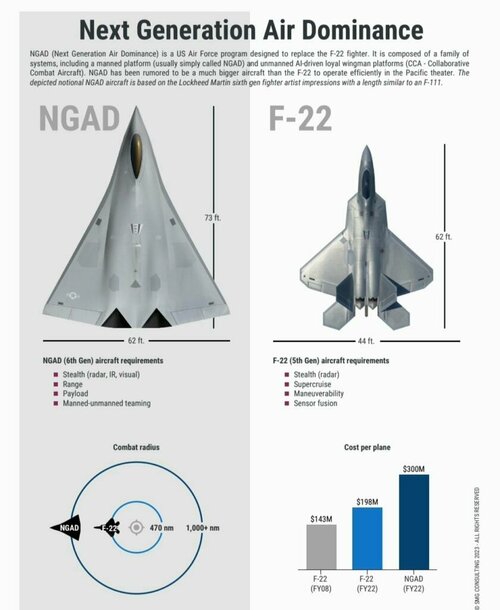
I will admit, I am expecting a higher supercruise speed for NGAD than for the F-22. Simply because the Pacific Ocean is stupid big and it takes time to fly from a base 1500+nmi from the fighting to where you're dropping ordnance. There may even be some Blackbird/XB70 style optimization for having good range at high speed, so the plane really can cruise at say Mach 2.2 for 3000nmi. Instead of the F-22 crap range while supercruising

Equally, I am expecting a physically large airframe due to range requirements, roughly F-111 sized/weight. What I hope happens is that the designers of NGAD make the weapons bays large enough for 2000lb class bombs and AGM-84s, so that the NGAD in a ground-attack loadout could pack the same load as the A-12 was intended to. Not that I totally expect the USAF to want a replacement for the Strike Eagle, but the USN will want a decent attack load.

In Air-to-air loadout, I expect the NGAD to be packing on the order of 10-12x BVRAAMs and 2-4x WVRAAMs. This is because of how long it would take to return to base and rearm. And then we start talking about the joys of CCAs as semi-disposable quivers.

At some point, probably in the 2060s or so, I expect the NGAD etc to be a single manned plane flying in control of an entire strike package of CCAs. Pre- and post-strike recon in the shape of an absurdly VLO ISR plane** marking targets, NGAD plus probably 3x air-warfare CCAs as fighter cover, maybe another NGAD plus 3x bomber CCAs or just 4x bomber CCAs for the strike, plus at least 1 Growler-replacement EW CCA.

** The kind of VLO that you look for by the "hole" in the received data, not the actual returns.
 
I will admit, I am expecting a higher supercruise speed for NGAD than for the F-22. Simply because the Pacific Ocean is stupid big and it takes time to fly from a base 1500+nmi from the fighting to where you're dropping ordnance. There may even be some Blackbird/XB70 style optimization for having good range at high speed, so the plane really can cruise at say Mach 2.2 for 3000nmi. Instead of the F-22 crap range while supercruising

Equally, I am expecting a physically large airframe due to range requirements, roughly F-111 sized/weight. What I hope happens is that the designers of NGAD make the weapons bays large enough for 2000lb class bombs and AGM-84s, so that the NGAD in a ground-attack loadout could pack the same load as the A-12 was intended to. Not that I totally expect the USAF to want a replacement for the Strike Eagle, but the USN will want a decent attack load.

In Air-to-air loadout, I expect the NGAD to be packing on the order of 10-12x BVRAAMs and 2-4x WVRAAMs. This is because of how long it would take to return to base and rearm. And then we start talking about the joys of CCAs as semi-disposable quivers.

At some point, probably in the 2060s or so, I expect the NGAD etc to be a single manned plane flying in control of an entire strike package of CCAs. Pre- and post-strike recon in the shape of an absurdly VLO ISR plane** marking targets, NGAD plus probably 3x air-warfare CCAs as fighter cover, maybe another NGAD plus 3x bomber CCAs or just 4x bomber CCAs for the strike, plus at least 1 Growler-replacement EW CCA.

** The kind of VLO that you look for by the "hole" in the received data, not the actual returns.
I'm fairly certain this is the goal. Cruising up a 60K, being VLO, and moving fast with great efficency, maybe turn performance and close in fighting will take the back burner for good. I imagine this concept being something that quickly dashes overhead undetected while dropping ordnance and being completely displace from it's release point before anyone could see where it came from. This is just the start, whose to even know what other kinds of implementations any sixth generation fighter will have. I completely agree that this will be a missileer quarterback that sends the unmanned vehicles in for the close in dirty work. We often talk of how those spooky planes from area 51 were mistaken for looking like UFOs, but what about when they start acting like it? Gives big mothership vibes.
 
I will admit, I am expecting a higher supercruise speed for NGAD than for the F-22. Simply because the Pacific Ocean is stupid big and it takes time to fly from a base 1500+nmi from the fighting to where you're dropping ordnance. There may even be some Blackbird/XB70 style optimization for having good range at high speed, so the plane really can cruise at say Mach 2.2 for 3000nmi. Instead of the F-22 crap range while supercruising

Equally, I am expecting a physically large airframe due to range requirements, roughly F-111 sized/weight. What I hope happens is that the designers of NGAD make the weapons bays large enough for 2000lb class bombs and AGM-84s, so that the NGAD in a ground-attack loadout could pack the same load as the A-12 was intended to. Not that I totally expect the USAF to want a replacement for the Strike Eagle, but the USN will want a decent attack load.

In Air-to-air loadout, I expect the NGAD to be packing on the order of 10-12x BVRAAMs and 2-4x WVRAAMs. This is because of how long it would take to return to base and rearm. And then we start talking about the joys of CCAs as semi-disposable quivers.

At some point, probably in the 2060s or so, I expect the NGAD etc to be a single manned plane flying in control of an entire strike package of CCAs. Pre- and post-strike recon in the shape of an absurdly VLO ISR plane** marking targets, NGAD plus probably 3x air-warfare CCAs as fighter cover, maybe another NGAD plus 3x bomber CCAs or just 4x bomber CCAs for the strike, plus at least 1 Growler-replacement EW CCA.

** The kind of VLO that you look for by the "hole" in the received data, not the actual returns.

The aircraft you're describing is similar to what I was expecting for the last couple of years, until the reassessment done this year in context of various fiscal pressures and review of technological availabilities.

But now it seems somewhat in the air, and everything from the manned NGAD aircraft itself, along with the new generation tanker, and the shape of CCA procurement in the near term, feels a bit unclear at present.
 
Yes, the TF30-100 is higher bypass than the F110-129, but not by much. The F101 is higher than both, but I doubt very much that it would be a good M2.5+ engine.

And the highest performing engine in the M3+ envelope has been the J58, which functions as a very low bypass single shaft turbofan with the bleed bypass open at cruise speeds.
I would disagree on the J58 being called a very low bypass engine. When at M3+ it is acting with a higher bypass ratio than most fighter jet engines. All that bleed bypass air is being dumped into the afterburner.


There may even be some Blackbird/XB70 style optimization for having good range at high speed, so the plane really can cruise at say Mach 2.2 for 3000nmi. Instead of the F-22 crap range while supercruising

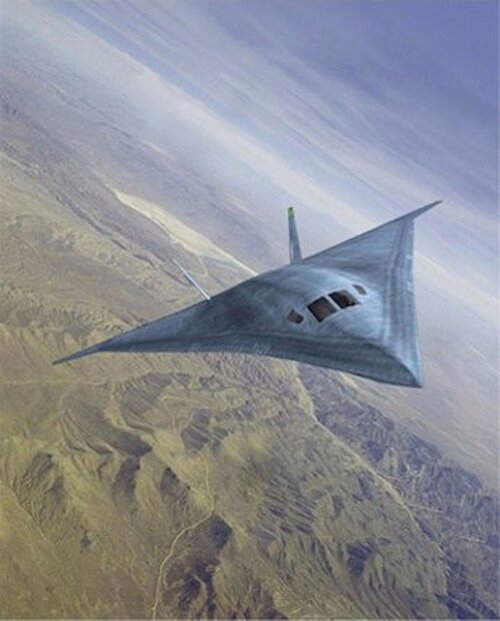
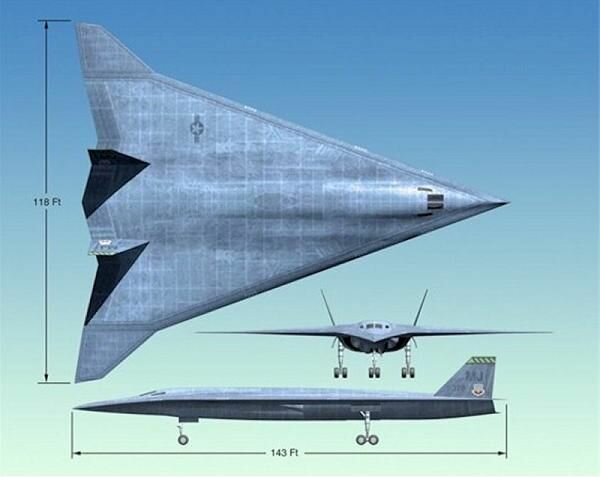
Equally, I am expecting a physically large airframe due to range requirements, roughly F-111 sized/weight.

I agree with this completely it will be very big. I always say mach 2 supercruise for NGAD because it is a nice round number.

I think NGAD will have a higher MTOW than the F-111 due to the huge internal fuel capacity in that blended, delta wing. Even the Flanker series of aircraft is very close to the F-111 in size.

Look at the SR-71 it has 37 ton of fuel in an aircraft that weighs 30 ton empty. A very high fuel fraction. Speed does not need a very high thrust to weight ratio. A high thrust to weight ratio is only needed for dogfighting.

Take all the specifications of the F-22 and SR-71 and average them to exactly half way. That is the specs of NGAD.

Length: 25.83m
Wingspan: 15.25m
Wing area: 124m2
Top operational speed: Mach 2.725
Empty weight: 25,158kg
Internal fuel: 22,600kg
MTOW: 58,009kg
Service ceiling: 75,000 feet

It probably won't be the greatest dogfighter at very low speed. But it is very easy to sustain 9G at high cruising speeds.
 
It is the duration of the heat rather than the peak heat. During a high speed run the F110 engines would hit Mach 2.5 in far less time than the best F100 engine. Less time is then less heat.

The F110 could then get "close to Mach 3" in the same duration as the F100 engine reached Mach 2.5.
How do you know the F110 can even reach Mach 2.9 without hitting some kind of temperature limit (i.e. TIT, FTIT, compressor discharge, etc.)? No F110-equipped aircraft has ever hit that kind of speed, nor were they ever designed to. The F-15E is already time-limited above Mach 2.3, the time it takes to accelerate another 0.6M above that is not a short duration at all, and the F110 is simply not designed for it.

Definitely no structural failure. It is rated for 9G. Flying at high speed in a straight line won't have the wings falling off. Anyway back to NGAD.
It's not simply the static load factor, but also things like flutter and the ability for the structure and the actuators to handle that.

You are basing your entire supposition on a single (mis)statement by a Boeing PM that he later explicitly retracted, and you are refusing to let go. This is like arguing with a creationist.
 
I think we'll see that endurance will win out over raw speed. I had thought for some time we'd see an F-111 size fighter, but I'm not real convinced anymore. Trend is moving against that and towards cheaper distributed assets. Hopefully one of the lessons we are learning watching the Ukraine situation is that we will need to be able to build our next generation of combat aircraft quickly, and at home. Cheap would be a plus, too, but I suppose if the balloon goes up, they punt the bill to our grandchildren.
 
How do you know the F110 can even reach Mach 2.9 without hitting some kind of temperature limit (i.e. TIT, FTIT, compressor discharge, etc.)? No F110-equipped aircraft has ever hit that kind of speed, nor were they ever designed to.
How do you know that it can't?

You are basing your entire supposition on a single (mis)statement by a Boeing PM that he later explicitly
We have had someone from Boeing who had to retract the restricted information they accidentally leaked and reduced it to the publicly known information. No one would say the words "close to Mach 3" if the speed was below Mach 2.5.

I have based the assumption on the F110 having
1) Higher max thrust than any F-15 engine.
2) Higher bypass ratio than any F-15 engine.
3) Higher bypass ratio has proven to give more thrust at high Mach speeds.
4) Fly by wire and intake adjustments.
5) 50 years of service history to improve things regarding flutter.

I'm only saying it's 16% faster than the 31 year old flight test data someone has provided.

Anyway. Let's get back to NGAD.
 
All fighter jets rapidly lose speed when pulling 9G. If an aircraft starts from a higher speed it can sustain 9G for longer.

An aircraft cruising at mach 2 and 60,000 ft has enough energy to trade that it can pull enough G to kill the pilot.
 
Turning the pilot into cranberry sauce isn’t good for recruitment.
It's no doubt part of a larger plan to over pilot reticence regarding unmanned projects taking over key roles.
 
We have had someone from Boeing who had to retract the restricted information they accidentally leaked and reduced it to the publicly known information. No one would say the words "close to Mach 3" if the speed was below Mach 2.5.

Let's look at the PM's statement in detail, shall we? He not only said Mach 2.9, but also said 2,225 mph, a value that would correspond to that Mach number at sea level. I don't even need to begin with how preposterous that is.

So what is more likely, that he made an error in an off-the-cuff remark, and later corrected himself on record to Mach 2.497, or that there's some deep conspiracy that somehow defies logic? I'm sure when the F-15EX -1 becomes available eventually, it will not reflect your absurd beliefs at all.

https://aviationweek.com/shownews/singapore-airshow/boeing-boasts-near-mach-3-top-speed-f-15exhttps://aviationweek.com/defense/aircraft-propulsion/boeing-withdraws-near-mach-3-claim-f-15
Not to mention, at Mach 2.9 the shock cone will be impinging on the wing structure, creating all sorts of loads that it wasn't designed for. Combine that with the severe aero heating, and it's all the more reason that the F-15EX won't touch that speed, period.
 
Yes we are about NGAD not F-15 EX
Wouldn't have gone down this rabbit hole if he didn't double down on his preposterous claims.

Back on the topic of NGAD, this article was posted a few pages ago, but here are the parts I thought was interesting.
https://www.airandspaceforces.com/c...review-future-increments-still-being-debated/
“Our original plan was—and the funding that was laid in—was for two increments. … You don’t have to get everything into this Increment 1. What we need to do is get it out there, with the minimum viable capability, on time or early, and on-budget or under budget. But Increment 2 …. we are close to getting started in earnest on that.”

There is a government analysis underway for Increment 2 “with other parties…and internal government agencies” to determine the needed attributes of the system.

“And then next year—actually this fiscal year—we will kick off concept refinement, where we then bring in industry to help us further define what those attributes are and whittle down those use cases,” Helfrich said. “It’s really the same approach that we did for CCA Increment 1.”

He also said that studies and experiments so far indicate that pilots of crewed fighters will likely be able to control many more CCAs than originally thought.

Senior USAF leaders have speculated that the CCA program could eventually achieve a rhythm of introducing a new design every two to four years, which would be better for staying abreast of both changing technological opportunities and threats.

Helfrich emphasized that Increment 2 is not a derivative or growth version of Increment 1.

Just because it’s called Increment 2 doesn’t mean it “has more capability … we’re still looking to figure out … the right balance and do the analysis” of the needed capability “to maximize low cost,” he said. The Air Force may yet decide to “change the focus” of CCAs “from a missile truck to something else,” perhaps an electronic warfare platform.

“I think it’s a little too early to say whether or not we’re going to do “Increment 1B or 1C. We’ll have to learn as Increment 1 rolls out and as Increment 2 rolls out, but we do expect them to be complementary,” and that there will be “multiple Increments in the force at the same time.”

Helfrich said the life expectancy of a CCA is also not yet determined. Early concepts called for using the craft for a number of sorties, and then divesting them on one-way missions, with the idea of avoiding the creation of a sustainment enterprise to support them.

“A lot has to do with how you use them,” he later told Air & Space Forces Magazine. While a small number of CCAs may be used for training, most of their missions would likely be practiced in simulators, and the aircraft themselves would be stored in a crate until needed for operations.

If the CCA is being treated as an attritable item, I suppose that it makes sense that their missions would be practiced in simulators rather than being expended in exercises, but I have to wonder what the fidelity of that would be, especially in LFE where I've sometimes seen "magic fairy dust" taken too far.
 
I will admit, I am expecting a higher supercruise speed for NGAD than for the F-22. Simply because the Pacific Ocean is stupid big and it takes time to fly from a base 1500+nmi from the fighting to where you're dropping ordnance. There may even be some Blackbird/XB70 style optimization for having good range at high speed, so the plane really can cruise at say Mach 2.2 for 3000nmi. Instead of the F-22 crap range while supercruising

Equally, I am expecting a physically large airframe due to range requirements, roughly F-111 sized/weight. What I hope happens is that the designers of NGAD make the weapons bays large enough for 2000lb class bombs and AGM-84s, so that the NGAD in a ground-attack loadout could pack the same load as the A-12 was intended to. Not that I totally expect the USAF to want a replacement for the Strike Eagle, but the USN will want a decent attack load.

In Air-to-air loadout, I expect the NGAD to be packing on the order of 10-12x BVRAAMs and 2-4x WVRAAMs. This is because of how long it would take to return to base and rearm. And then we start talking about the joys of CCAs as semi-disposable quivers.

At some point, probably in the 2060s or so, I expect the NGAD etc to be a single manned plane flying in control of an entire strike package of CCAs. Pre- and post-strike recon in the shape of an absurdly VLO ISR plane** marking targets, NGAD plus probably 3x air-warfare CCAs as fighter cover, maybe another NGAD plus 3x bomber CCAs or just 4x bomber CCAs for the strike, plus at least 1 Growler-replacement EW CCA.

** The kind of VLO that you look for by the "hole" in the received data, not the actual returns.

I think a large long ranged super cruiser was the original idea, though probably not with more speed or that extreme warload. I think all bets are off now.

As for demonstrator record breaking, while the discussion has taught me a lot about trade offs in engine design, I think the assumption that speed records were broken seems misguided: there are any number of very minor performance records the quote might have referred to. And in any case the demonstrator might no longer be especially representative of the program’s end product.

ETA: we are going to have a hard time pinning down what NGAD is when it seems clear USAF does not know what NGAD is.
 
Last edited:
B-21 + dual panel upscaled APG-85 in dem cheeks.

Simple and elegant.

I actually think B-21 would be ideal had it been adept in the supersonic regime. It already got all spectrum all aspec VLO, payload, range, sensors, avionics, etc nailed down.
 
Last edited:
That was one of the early designs that I actually liked the first time I looked at it.
 
I would disagree on the J58 being called a very low bypass engine. When at M3+ it is acting with a higher bypass ratio than most fighter jet engines. All that bleed bypass air is being dumped into the afterburner.
If you believe Wikipedia, the J58 bypass ratio with the bleeds open at cruise conditions was approximately 0.25, with a significant portion of the bypass bleed air being used for cooling the AB liner and not available for combustion. As I said, a low bypass single shaft turbofan with the bypass bleeds open
 
If the CCA is being treated as an attritable item, I suppose that it makes sense that their missions would be practiced in simulators rather than being expended in exercises, but I have to wonder what the fidelity of that would be, especially in LFE where I've sometimes seen "magic fairy dust" taken too far.
There is already a lot of virtual training happening and if you consider that most pilots never fire an AAM or cruise missile until combat this won't be too different.

There are two opportunities here though. Andruil's CCA was originally meant to be an adversary and I see that continuing, both platforms would be able to simulate red air. In that context then the CCAs would get rolled out for Red and Green Flags and other exercises and CCAs would operate on both sides with the same restrictions current manned red air use. Then the opportunity to use CCAs for the blue side of that training is also huge. As a cost saving the same CCAs can be rolled out for each exercise with everyone getting the opportunity to command.

Will be interesting to see the first time a CCA intercepts a Russian Bear flying off Alaska and how that interaction plays out.

Also there the opportunity to reduce training costs further. The USAF has talked about T-7s or T-50s sitting at front line units and some training happening with the platforms and reduced hour costs to 5th gen per this article https://www.airandspaceforces.com/air-force-wants-up-to-400-advanced-fighter-trainers-like-t-7s/

Pairing CCAs with this aircraft may also allow training to happen but at lower costs than with the front line 5th and 6th Gen assets.
 
ngadrange-840x1024.jpeg

This graphic is probably the best example I have seen. Very big internal fuel capacity. I wouldn't be surprised if the fuel capacity is over 20 ton.


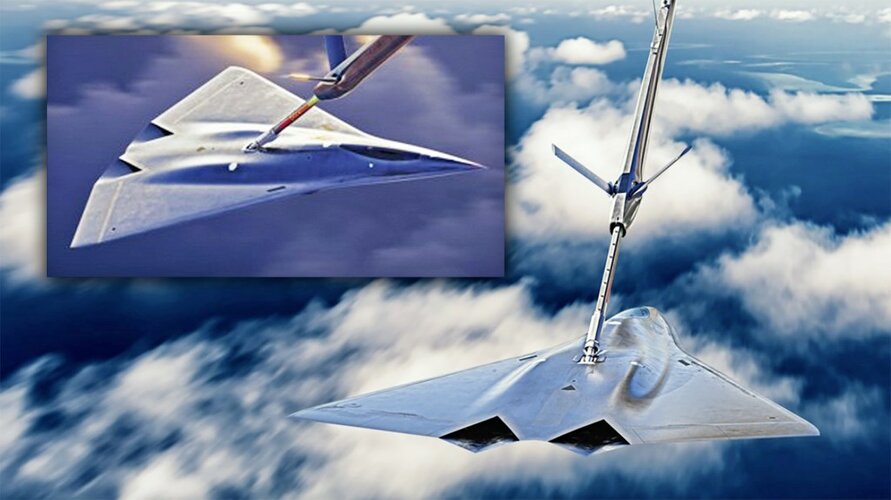
Lockheed-NGAD.jpg
 
Last edited:
It probably won't be the greatest dogfighter at very low speed. But it is very easy to sustain 9G at high cruising speeds.

I think we need to come back to this because it's relevant to how NGAD might function in combat. The traditional advantage of high speed in air superiority (other than getting the hell out of Dodge), is the ability to function as a booster stage to your own AAMs, which requires a run directly at your target. Once that's done, you need to avoid the merge, because the whole point of lobbing out an LRAAM at max speed is to avoid entering the other guy's engagement range. Then repeat against same or different targets until Winchester. This is where speed starts to work against you, both by giving you the cornering radius of a medium sized country, and by enhancing your signature.

But (and I don't know, I'm not being rhetorical*), how valuable is that high speed boost with modern LRAAMs dependent on boosting to ultra-high/ultra-thin air as quickly as possible. Does the speed boost work with the kinematics, or against it? It's going to increase skin heating if nothing else as the missile will pass through a larger volume of air on its way up.

As for any idea of sustained 9G turns, why? Avoiding the merge needs at most a 90-180 degree turn, more than that, and you're turning back into your pursuer. While for any kind of ACM, the tactical radius of a Mach 3 target pulling 9G is just going to leave it vulnerable to someone moving at their optimal speed for sustained turn rate and in a flight environment where they're able to utilised their high alpha nose pointing abilities. Popping high alpha at Mach 3 sounds like a good way to invoke the legendary 'wings fall off' button.

(And bringing back our putative Mach 3 F-15EX, it's of little use for air combat until someone carries out all the required weapon separation tests at that speed, because I can guarantee you it's outside currently tested release criteria and funny things happen when you drop things off aircraft into unknown aerodynamics).

* It occurred to me this morning and I realised immediately I don't know enough about missile kinematics to make any assumptions.
 
THIS is most likely representative of what USAF cannot afford in large numbers...
View attachment 748654
at the risk piling on yet again ...SecAF has an unenviable position as the time to mature emerging technologies may be lengthening and the risk to committing to something which will be obsolete on arrival is an issue.
some examples of hinderances to commitment:
-advent of lower cost trans atmospherics
-longer range missiles/UASs justifying non stealth/stealth standoff large platforms
-continually upgrading 5th gen fighters to fulfill most requirements
-expectations on DEW and what it can do even from a simple pod ie craft that are extremely difficult to shoot down and thus guaranteeing air superiority
-other budgetary demands (big one)
-
 
As for any idea of sustained 9G turns, why? Avoiding the merge needs at most a 90-180 degree turn, more than that, and you're turning back into your pursuer.
It will definitely be 9G rated. The problem is to maintain the same turning radius as the speed increases you need to pull more G. The SR-71 took a full country to turn around when at top speed.

One scenario
NGAD is travelling at mach 2 towards enemy territory. It detects an enemy Combat Air Patrol (CAP) directly 100 miles ahead at the 12 oclock position. NGAD fires it's missiles. NGAD now wants to perform a 90 degree turn to avoid the merge. If NGAD pulls only 4G the turn radius is so large it will still fly into the detection radius of the CAP. The enemy aircraft might launch missiles at NGAD before they are shot down by the missiles fired from NGAD. To avoid the merge NGAD needs to pull 9G and bleed airspeed to get that 90 degree turn in a short distance. This will put tremendous strain on the pilot. No doubt these turn will have to be semi-automated as it will be pulling 9G for many many seconds.

With the NGAD design I posted above the wing is blended into a thick wedge. This would be incredibly strong while providing good internal fuel volume. It would not surprise me if NGAD could pull semi-automated 10+G 90 degree high speed turns for these evasive maneuvers.

NGAD with the best radar might struggle to detect a J-20 from more than 50 miles away. It will need to turn sharply to avoid the merge.

Second Scenario
NGAD is flying into enemy territory. Ground based IR early warning sensors detects NGAD and passes the information to the radar based SAM network. The ground based radar lights up 50 miles directly infront of NGAD. NGAD needs to turn quickly to stay out of the radar detection of the SAM system.

Third Scenario
A medium range SAM system locks on and fires at NGAD. The SAM site is at the 10 oclock to the left approx 20 miles away. If NGAD is cruising at mach 2 at 60,000 feet
it can then quickly turn to the right and put the missile into a tail chase situation. NGAD will move out of the no escape zone of the missile. Pulling 9G doing this turn will significantly improve the survivability as the missile is still climbing and there is limited time.

Having a silver bullet fleet of only 20-50 of these high speed NGAD fighters makes it very complex for the enemy IADS. This alone can justify the purchase. NGAD can zip around with bursts above mach 3 baiting the enemy at high speed and getting the enemy air and ground based radars to light up. The B-21 can use the location of the enemy to penetrate and hit its deep targets. The F-22 fleet can come in and take out the rest of of CAPs. The F-35 can pound the enemy around the fringe.

I am fairly confident NGAD is already in low rate production at the Skunk Works for a small silver bullet fleet. The rumours that the USAF wants a cheaper/smaller NGAD I actually think the USAF are eyeing off the US Navy F/A-XX design. The F/A-XX design will be the closest to an F-22 replacement in terms of size and kinematics. Many assume the carriers max takeoff limit is between 35-40 ton. The F-22 is 38 ton. The slow carrier landing speed will point towards F/A-XX having a supercruise below mach 2. The US Navy needs hundreds of F/A-XX so the production volume will be higher and the US Navy will have a reasonable price limit per aircraft. The US Navy F/A-XX will be like an F-22 with a bit more range and with the latest F-35 style avionics. The USAF version would remove the wing fold mechanism, maybe a lighter landing gear. It might be 5% lighter and have 5% more fuel than the US Navy version.
 
Last edited:
-expectations on DEW and what it can do even from a simple pod ie craft that are extremely difficult to shoot down and thus guaranteeing air superiority

I'm not sure why fighter-mounted DEW keeps being discussed. The SHiELD program concluded with no plans for further test and evalution. Could the Airforce start a new program and eventually field a self-defense high energy laser? Sure, of course they could. Just as they could eventually produce a hypersonic spy plane. For now, there are no public plans for either.
https://www.military.com/daily-news...-after-scrapping-similar-gunship-project.html
 
Status
Not open for further replies.

Similar threads

Back
Top Bottom