USAF/USN 6th Gen Fighters - F/A-XX, F-X, NGAD, PCA, ASFS News & Analysis [2008- 2025]

Status
Not open for further replies.
Thanks dark sidius, the Black Budget and it's mysterious ways of operating. That is where the NGAD F/A-XX should belong like the F-117A Nighthawk back in it's early days when it was classified as a SAP Level 1 program.
The Black Budget is great for small, relatively cheap, relatively discrete projects - a few RQ-180s, 59 F-117As, etc. but also comes with drawbacks and limitations. (Look back to why the originally 'black' PWIII didn't fit the 'black' F-117A's weapons bays).


Last edited:
Why does the USAF not do a Joint program with the US Navy in the first place and share some of the technology that would go into the NGAD F/A-XX designs, if the Air Force is getting serious about saving money then that could be the way forward. A common design with shared technology would be beneficial for both services, at least that is what I am currently thinking about right now.
 
USAF and USN don't even have a common program for aircraft "open" mission systems
 
Why does the USAF not do a Joint program with the US Navy in the first place and share some of the technology that would go into the NGAD F/A-XX designs, if the Air Force is getting serious about saving money then that could be the way forward. A common design with shared technology would be beneficial for both services, at least that is what I am currently thinking about right now.

There are reasons why the USAF and USN have been pursuing their own separate NGAD programs for the better part of the past decade or so. The two programs have different goals, both the USAF and USN were burned by the JSF experience, and future operations require more than just a single platform solution (*ahem* F-35).

The F/A-XX is more of a multi-mission platform to replace the F/A-18E/F, whereas the USAF needs a long-range air superiority platform to pick up the mission set of the F-15 and F-22 before it. Can the Rhino perform air superiority? Yes. But the Raptor excels at it. Can the Raptor perform strike missions? It can and it has. But the Rhino is better suited for it. NGAD is a system of systems, it’s more than just a single air-dominance platform. It may be optionally manned or even unmanned. It’ll rely heavily on CCA. But F/A-XX will be more autonomous. It’ll work with CCA, but where are they going to stay when they’re not in use? There’s only so much space on the boat.

Secondly, you'd have too many cooks in the kitchen and there will be tradeoffs to appease the stakeholders. That was a big problem on the F-35 program. A design feature that may be beneficial for the USAF's mission may not be compatible with the US Navy's requirements and vice versa.Heavy-duty landing gear works for the Navy, but it's extra, unneeded weight for the Air Force. Folding wings are a requirement for carrier operations, but unnecessary for a land-based platform (again, unneeded weight and maintenance). So do you have two different wings, one for land and the other for the carrier? Then you lose commonality and cost-effectiveness in your production. What if the Joint-NGAD’s sea radar mode doesn't meet the requirements of what the Navy already uses? How much of a delay is that going to cause the program as a whole?

Some of the cost projections for the USAF's NGAD pointed to a platform that was potentially going to be larger than the YF-23, something approaching F-111 if not larger. That may be okay for the USAF with their nice, long runways and ample ramp space, but not for the Navy. Bigger planes means fewer planes you can take with you on the boat. It still has to fit within the confines of a carrier parking spot and be maintainable. Plus you still have to weigh low enough to recover back on the carrier without exceeding the weight limits of the arresting gear. A big reason the F/A-18E/F and F-35C have superior bring back - the amount of reserve fuel + ordnance the airframes can bring back to the carrier - compared to the F-14 is because both airframes don't weigh as much as the Tomcat.

As it currently stands, the F-35 JPO decides on what capabilities the F-35 gets in the future. Since you have the Air Force, Marines, Navy, and international partners all involved, you have multiple competing interests. So on a hypothetical Joint-NGAD program, if the Navy needs to focus on sea-search radar capabilities, and the USAF wants to focus on long range track, target, ID and engage…but the Navy has the least power since they're buying fewer aircraft, then guess who wins out?

However, the Navy controls its own fate on the Super Hornet just like how the USAF controls its own fate with F-15EX and F-22. So each program is owned by their own branch - because as much as people don't like to believe it, compromises were made to make the F-35 occur as it did, and not every compromise has aged as well as others. And that's ultimately what a lot of it comes down to. They want to focus on the unique/great capabilities of their respective programs, and not focus on having to integrate a bunch of "extra" stuff because other partner branches are also going to be reliant on that platform.

For example, because the F/A-XX and NGAD have different mission sets, the F/A-XX would have a wider portfolio of weapons that needs to be integrated onto it that NGAD just doesn't need. Being separate programs, this isn’t an issue for the USAF, but in a merged environment this changes.

We've seen this before on the F-35. Given the highly integrated nature of 5th and 6th Generation platforms. Like how do you integrate AIM-174, JSM, and AARGM at the same time without perhaps introducing compounding bugs? If the mission computer software is edited to integrate AARGM, you want to make sure the code that JSM is working with isn't going to break something that AARGM needs, and vice versa. It's been one of the biggest complaints of bugs reaching operational squadrons - new features come out, but then things break elsewhere. Imagine if Apple released a new iOS version that bricked everyone's ability to connect to WiFi - the phone still works, but you're missing a pretty important feature. No bueno.

Mind you, this is far from unique to modern fighters, which is part of why development cycles for fighters are as long as they are. But it's why its a tough nut to crack and soon you start looking at tradeoffs - do you spend the time and effort integrating JASSM on the Joint-NGAD because the Navy needs it when the Air Force doesn't and hope that doesn't set you back somewhere else more urgent?

 
Another factor to consider is that the Navy has traditionally placed a greater emphasis on loiter than the Air Force for fleet air defense purposes.

The stated fielding timeline is interesting the goal of fielding the F/A-XX by the mid-2030s, which on the surface seems rather ambitious. But I think it's also important to remember that naval aircraft tend to have somewhat shorter lifespans than land-based ones due the the rigors of carrier launch and recovery, so the F/A-18E/F Rhino fleet may need sooner recapitalization than the F-22 fleet. As far as being able to achieve that timeline, it all depends on the degree of risk and technological maturity that the Navy is pursuing.

At some point though, I do agree with the notion that you have to stop analyzing and just build a damn aircraft before the concept is studied to death. And if nothing else, I think that we should not allow the propulsion systems to stagnate.
 
Last edited:
I expect that this will end up similar to the F-22 and F-35 dynamic. For NGAD to really be 6th gen it has to push some boundaries, similar to what the F-22 did. Then a few years later the F-35 came along and used all the lessons learned to make an affordable platform that in many respects is superior to its 5th gen sibling.

Question is, if manned NGAD does go the way of the F-22, boutique expensive capability, will there be a need and an appetite for a follow on manned aircraft or will AI and CCAs be capable enough that a follow on isn't required?
 
At some point though, I do agree with the notion that you have to stop analyzing and just build a damn aircraft before the concept is studied to death. And if nothing else, I think that we should not allow the propulsion systems to stagnate.
I mentioned this once before, but at some point the DOD will build a super AI for research and development. It will be trained on centuries of military procurement history. As such, it will determine that the only sensible thing to do is to stop all new system procurement indefinitely, as by the time any new system comes out, there is already new research that can be used for new systems. The AI will recommend that we complete all possible research and development first, and build the ultimate weapon once there is nothing else to learn about the universe.
 
I mentioned this once before, but at some point the DOD will build a super AI for research and development. It will be trained on centuries of military procurement history. As such, it will determine that the only sensible thing to do is to stop all new system procurement indefinitely, as by the time any new system comes out, there is already new research that can be used for new systems. The AI will recommend that we complete all possible research and development first, and build the ultimate weapon once there is nothing else to learn about the universe.

So you want the US DoD to implement Skynet;) :D ?
 
USN can get what it wants in time by measuring it's wishlist.
Overall, both USAF and USN problems are money problems. Inflation hits badly, and both have other big invoices to sign.

USAF wants to go lighter and cheaper, because smaller flying computer node is still just as good at being a node.
USN probably doesn't, because carrier limitations strongly favour heavy tailor-made planes. They however can go OTS(f-35 components are available); no need to immediately go for new engines/radar and other big pricetag items, when you can get away with mid block f-35 technically. Just one able to go to a right place and time.

Both make sense, because largest gains now are software/intercom ones in any case, both services don't need a bleeding edge hotrod, just a sufficient platform.
 
Last edited:
USN asked for a stealth fighter for Xmas, got the F-18E.

Let's be realistic about what the Navy asks for and what it actually gets.
Making sorta twin f-35 with long loiter/dash, more range and decent oversized/bringback capability is not too dissimilar from f-18e program though.

Yes, it's a new plane and it'll cost, but it won't cost tens of billions.
At this point we started to forget that developing new platforms was actually fine in the past; it isn't fiscal death sentence unless one makes it so on purpose.
 

Rethinking FAXX -- Following the Army FLRAA Template

On second thought, the Navy FAXX may be following the Army’s FLRAA acquisition template. Mea Culpa: I am unfamiliar with any prior aircraft programs necking down to a single contractor well before MS-B, but things have apparently changed since I retired from the business.

Sources:
https://www.gao.gov/assets/820/818991.pdf
https://www.highergov.com/document/ja-flraa-capability-set-3-redacted-pdf-886f68/

The Army down-selected to 1 development contractor (Bell) in Dec 2022, not quite 2 years prior to MS-B approval in Aug 2024.

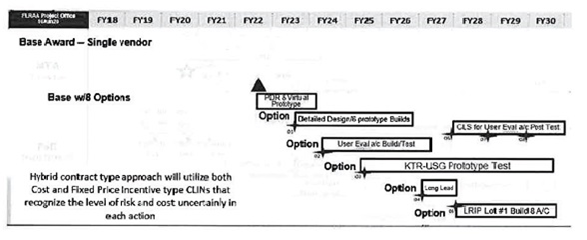
Bell was awarded a base contract with eight options over a 100-month period of performance. The initial base contract will deliver a virtual prototype and will complete a preliminary design review (PDR). Following MS-B, FLRAA will enter the EMD phase by exercising Option 1, working toward completion of CDR and the build of six prototype aircraft. The graphic shows the remaining 7 contract options, which include 3 options for yearly Contractor Logistics Support (CLS).

Picture1.png

Using the Army FLRAA approach, the Navy FAXX key milestones can be synthesized.
-----------
Concept Refinement, 3 contract awards: Mar 2020
Design Maturation, 3 contract awards: Aug 2023
System Development, 1 base contract award: Dec 2024
MS-B Approval: Aug 2026
System Development, Option 1 contract award: Oct 2026
-----------
Sources:
https://aviationweek.com/defense/bu...sign-maturation-competing-companies-announced
https://www.defensenews.com/air/202...viation-wing-must-choose-between-old-and-new/

The FAXX funding profile with an early down-select for the base contract may be feasible within the Navy's near-term budget realities. Under this plan, the big $$$ ramp-up for EMD is deferred until FY27 and beyond.

No time for major engine or advanced avionics development in this scenario, so it seems reasonable to assume that FAXX will be wrapped around the F-35 Block 4+ avionics suite and utilize a derivative turbofan, not NGAP.
 
Last edited:
The FAXX funding profile with an early down-select for the base contract may be feasible within the Navy near-term budget realities. Under this plan, the big $$$ ramp-up for EMD is deferred until FY27 and beyond.
Makes sense with their funding issues and priorities to down select to a single vendor. Perhaps more risk given earlier selection and all three primes competing have indicated they won't sign fixed price contracts so there is wiggle room ahead for whoever wins.

No time for major engine or advanced avionics development in this scenario, so it seems reasonable to assume that FAXX will be wrapped around F-35 Block 4+ and utilize a derivative turbofan, not NGAP.
An evolved F-35 was always one of the options for F/A-XX but I am inclined to believe it will be more than that. I couldn't see NG staying in if they believed an evolved F-35 was viable given it will cost a lot less than what Boeing and NG would have to build. If it is an option makes you wonder if LM will propose two options, an evolved F-35 and an all new airframe?
 
An evolved F-35 was always one of the options for F/A-XX but I am inclined to believe it will be more than that. I couldn't see NG staying in if they believed an evolved F-35 was viable given it will cost a lot less than what Boeing and NG would have to build.
I'm thinking less "F-35F Super Lightning" and more "new airframe using most of the F-35 avionics and a pair of F135 engines"


If it is an option makes you wonder if LM will propose two options, an evolved F-35 and an all new airframe?
I think the range demands are too high for FAXX, but if the USN is stupid enough to make a stretched F35 an option they're going to get it.
 
I'm thinking less "F-35F Super Lightning" and more "new airframe using most of the F-35 avionics and a pair of F135 engines"
At what point though does the aircraft become too big to land on the carrier? If I read it correctly the Advanced Arrestor gear on the Ford class is capable of up to 70k lbs landing weight and the Mk7 was around the 60k lbs mark. Super Hornet had a max landing weight of 42k lbs so there is clearance for the F/A-XX to increase in size if necessary. I think the F-14 was the heaviest fighter to land and that was maxed at 54k lbs.

Two F135s mean the aircraft won't be cheap but would keep commonality with the Cee.
I think the range demands are too high for FAXX, but if the USN is stupid enough to make a stretched F35 an option they're going to get it.
The oft mooted delta winged F-35E postulated here may have the range required but perhaps not the rest of the package needed to make it a 6th gen aircraft. Might also have a very high landing speed.
 
Last edited:
if USN satisfied off-the-shelf components, just need bigger stealth aircraft. There is a possibility for F135 X 2 engined stealth fighter-bomber.
 
A low risk approach that makes use of F-35 Block 4 mission system components (radar, EW, etc.) would make sense, but I think an airframe using two F135s may be too large. Perhaps an aircraft designed around two F110 derivatives may be more appropriate in size, especially as the base engine is quite mature and currently in production which reduces risk and cost, and can also leverage commercial CFM56 developments to improve performance and efficiency. Such a engine would not be optimized for supercruise speeds that the F-22 was designed for, but the Navy has traditionally placed a greater emphasis on loiter, so it may not be too big of a concern.
 
Perhaps an aircraft designed around two F110 derivatives may be more appropriate in size, especially as the base engine is quite mature and currently in production which reduces risk and cost, and can also leverage commercial CFM56 developments to improve performance and efficiency. Such a engine would not be optimized for supercruise speeds that the F-22 was designed for, but the Navy has traditionally placed a greater emphasis on loiter, so it may not be too big of a concern.
If a current in service engine then reusing the F414 in the EPE variant makes sense. Navy already knows and is very happy with the engine, it is significantly lighter than the F110 and I expect they will be able to, with five years of concerted dev effort, get the thrust and durability close to the F110-129. Would also be a good export market for GE given that engine size has been popular on non US fighters.
 
A low risk approach that makes use of F-35 Block 4 mission system components (radar, EW, etc.) would make sense, but I think an airframe using two F135s may be too large.
Twin f-119 projects (NATF, A/F-X, evolved tomcats) were norm, and they were by no means borderline. Maybe even swing wing, haha.
If anything, vanilla f-119 seemed to be a liability for the navy due to unnecessary focus on super cruise instead of specs that just matter more - exactly the ones where f-135 delivers.

Generation for the sake of generation is meaningless, planes aren't new iphones.
Such a plane can easily work with new oversized navy munitions (which current fleet clearly struggles with), and bring back deep strike and (proper) outer air battle, both highly relevant in the Pacific.
 
Last edited:
if USN satisfied off-the-shelf components, just need bigger stealth aircraft. There is a possibility for F135 X 2 engined stealth fighter-bomber.
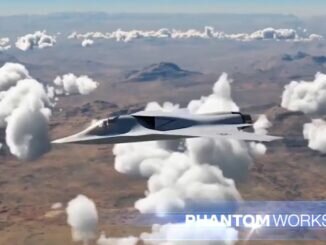
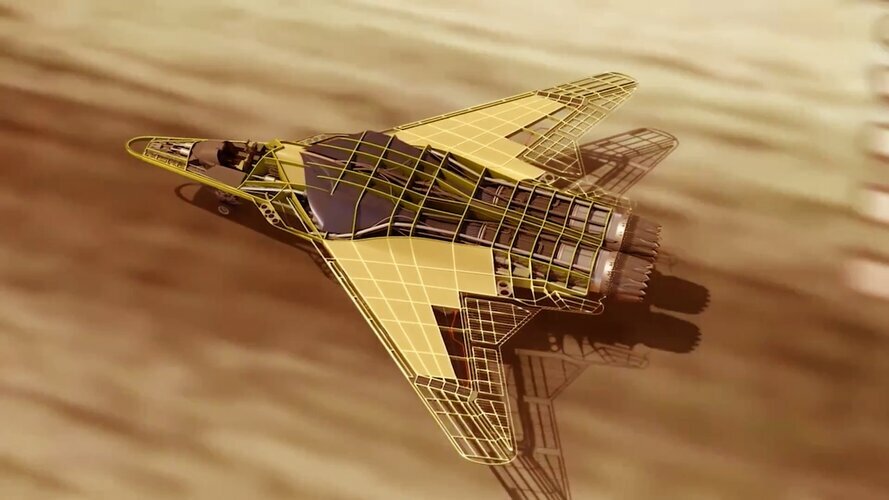
Did somebody say twin F135s?
 

Attachments

  • Phantom Works (4).mp4_snapshot_00.04_[2023.02.28_21.16.39].jpg
    Phantom Works (4).mp4_snapshot_00.04_[2023.02.28_21.16.39].jpg
    314.5 KB · Views: 109
  • Boeing_Phantom_Works_6th_Gen_Aircraft_1-326x245.jpg
    Boeing_Phantom_Works_6th_Gen_Aircraft_1-326x245.jpg
    14.4 KB · Views: 113
  • 230228-f71f63e94f41c4293c50ac8bc7dd285b (1).jpg
    230228-f71f63e94f41c4293c50ac8bc7dd285b (1).jpg
    62.3 KB · Views: 116
At what point though does the aircraft become too big to land on the carrier? If I read it correctly the Advanced Arrestor gear on the Ford class is capable of up to 70k lbs landing weight and the Mk7 was around the 60k lbs mark. Super Hornet had a max landing weight of 42k lbs so there is clearance for the F/A-XX to increase in size if necessary. I think the F-14 was the heaviest fighter to land and that was maxed at 54k lbs.
IIRC the catapults max out at 85-90k, and I was assuming that ~55k is the effective max for the arresting gear. Because most of the USN carriers are still Nimitz class, so we need to design to those limits, not the Ford limits.

But a pair of F135 engines means that the T:W ratio is dang close to 1:1 at takeoff. (where's the evil grin emoji on this forum?)
 
Did someone say "isn't there meant to be a radar in the nose?"

I suspect that there is an AESA radar in there, gone are the days of the big radome nose on traditional fighters.

AESA does not equal "magic physics".

Even with AESA antenna size is important for range and resolution (detects smaller targets at a given range, detects the same target further away), due to the reality that more antenna area = more transmit/receive modules = more range/resolution.
 
IIRC the catapults max out at 85-90k, and I was assuming that ~55k is the effective max for the arresting gear. Because most of the USN carriers are still Nimitz class, so we need to design to those limits, not the Ford limits.
Agree but I expect there is some fat so close to 60k for the Mk7 should be doable.

But a pair of F135 engines means that the T:W ratio is dang close to 1:1 at takeoff. (where's the evil grin emoji on this forum?)
Was thinking though if you are going F135 size why then go F135, you might as well use the XA100/101. More expensive again than the F135 but you would design the platform to make full use of the adaptive advantage. That is a step change in range. The timeframe to productionise that engine would be suitable for F/A-XX.
 
Agree but I expect there is some fat so close to 60k for the Mk7 should be doable.


Was thinking though if you are going F135 size why then go F135, you might as well use the XA100/101. More expensive again than the F135 but you would design the platform to make full use of the adaptive advantage. That is a step change in range. The timeframe to productionise that engine would be suitable for F/A-XX.
More is always possible(for additional usd), but here I think we did more of a thought experiment on the most affordable navair boost program.
Which is probably to do a f-14a like program: existing radar/missile, engine off the shelf, but result is still an f-4 improved in every single way - especially those that matter.

New goodies can wait, first priority is to cover up for things f-35 and bug can't do well enough in westpac.
Which is (1) operational gaps (still left from tomcat and intruder/prowler retirement) and (2) some technical issues (twin big engine design will hardly have onboard power problems, especially if we pay attention to it from day 1).
40t class naval fighter is an attractive capability, especially since heavier aircraft isn't the same as proportionally larger aircraft.
F-110s can be added later.

If it's feasible - it is simply a way how usn can field something meaningful fast enough and within available budget.
 
More is always possible(for additional usd), but here I think we did more of a thought experiment on the most affordable navair boost program.
Which is probably to do a f-14a like program: existing radar/missile, engine off the shelf, but result is still an f-4 improved in every single way - especially those that matter.

New goodies can wait, first priority is to cover up for things f-35 and bug can't do well enough in westpac.
Which is (1) operational gaps (still left from tomcat and intruder/prowler retirement) and (2) some technical issues (twin big engine design will hardly have onboard power problems, especially if we pay attention to it from day 1).
40t class naval fighter is an attractive capability, especially since heavier aircraft isn't the same as proportionally larger aircraft.
F-110s can be added later.

If it's feasible - it is simply a way how usn can field something meaningful fast enough and within available budget.

Sure a mild upgrade and spiral update other systems in over time makes some sense. Problem is we know what the USN want and it is more than you are suggesting;
advanced sensors, advanced lethality, advanced range, and being able to integrate with manned and unmanned capabilities together

Question is of those requirements what changes from the current generation?

Advanced sensors - You could argue APG-85 is probably as good a current system as can be bought today but will that be sufficient for a new build airframe in 2035... What else will be required from sensors, perhaps LIDAR, next gen EOTS and EODAS for certain.

Advanced Lethality - Is a AIM-260 and hypersonic ASM sufficient for increased lethality? Do we finally see some sort of Directed Energy Weapon especially if we have a twin engined behemoth with plenty of power generation available? It feels like 5th gen platforms are only finally now close to getting 5th gen weapons. How long would a notional 6th gen platform have to wait for weapons to match its capabilities?

Advanced Range - I expect an Adaptive cycle engine brings this. Simply building a bigger aircraft that holds more fuel but with current generation engines probably won't deliver the range increase the USN want or need.

Manned and Unmanned Teaming - No doubt that will be in place for the platform whether a minor upgrade or a full blown platform but where is the CCA that takes off and lands on a carrier going to come from? MQ-25 isn't sufficient nor capable enough for what the USN will need.

How about the EW mission. Will the F/A-XX incorporate the NGJ internally or will the USN push that mission to an unmanned platform.

Will F/A-XX be single or two seat or both?

USN likely have a good set of requirements, have three keen vendors and a slew of good technologies that are reasonably mature but their budget is the least certain aspect. Will the USN have the money to build what they want or will they have to compromise?
 
Sure a mild upgrade and spiral update other systems in over time makes some sense. Problem is we know what the USN want and it is more than you are suggesting;


Question is of those requirements what changes from the current generation?

Advanced sensors - You could argue APG-85 is probably as good a current system as can be bought today but will that be sufficient for a new build airframe in 2035... What else will be required from sensors, perhaps LIDAR, next gen EOTS and EODAS for certain.

Advanced Lethality - Is a AIM-260 and hypersonic ASM sufficient for increased lethality? Do we finally see some sort of Directed Energy Weapon especially if we have a twin engined behemoth with plenty of power generation available? It feels like 5th gen platforms are only finally now close to getting 5th gen weapons. How long would a notional 6th gen platform have to wait for weapons to match its capabilities?

Advanced Range - I expect an Adaptive cycle engine brings this. Simply building a bigger aircraft that holds more fuel but with current generation engines probably won't deliver the range increase the USN want or need.

Manned and Unmanned Teaming - No doubt that will be in place for the platform whether a minor upgrade or a full blown platform but where is the CCA that takes off and lands on a carrier going to come from? MQ-25 isn't sufficient nor capable enough for what the USN will need.

How about the EW mission. Will the F/A-XX incorporate the NGJ internally or will the USN push that mission to an unmanned platform.

Will F/A-XX be single or two seat or both?

USN likely have a good set of requirements, have three keen vendors and a slew of good technologies that are reasonably mature but their budget is the least certain aspect. Will the USN have the money to build what they want or will they have to compromise?
They must built it no choice the Super Hornet start to be a tired and old plane and the F-35 will never maintain is promise and is not enough for the Pacific theater.
 
Don't want this thread to turn into mywetdreamaircraft thread, so just a bareminimum example as logical exercise:

Literal F-35 forward fuselage with two engines outside of elongated rear bay section, making space for internal bays in-between (ideally - 2x5m - just a bit longer than vigilante linear bay, for instance).
4xAIM-174B/LRASM/JASSM-XR inside.
More heavy pylons outside for heavy hypersonics, asat, or, indeed, EW loads.

Same connectivity and fire control as basic f-35 blk iv. Maybe indeed second seat for the teaming, twin-seat f-35 wasn't built, but it was proposed - no arcane arts needed. Several times more free onboard power(and power flexibility, second engine!) for future development paths.

More fuel, higher aspect ratio wing(swing wing as an option), and more lift from the fuselage to get range (no reliance on new technology, no long research/testing, fast fielding) - if it was possible on 1960s TF30s, it's most certainly possible on ECU F135s.

Any additional technology later, to avoid budget strain and delays, because Chinese anti-ship dilemma is present now.
Basically - su-75 in reverse. It's indeed a very inelegant, brute force solution, but currently CSG desperately needs those dumb range metrics.
 
They must built it no choice the Super Hornet start to be a tired and old plane and the F-35 will never maintain is promise and is not enough for the Pacific theater.
I don't think either of those statements are accurate assessments of the situation.
 
They must built it no choice the Super Hornet start to be a tired and old plane and the F-35 will never maintain is promise and is not enough for the Pacific theater.

If readiness is the goal, the navy should reopen the F-18 production line immediately. You fight the war with the stuff you have, and right now we have F-18s. Losses in a peer war vs China will not be replaceable without a hot production line, and even a less ambitious F/A-XX won't be in production until the 2030s.
 
Was thinking though if you are going F135 size why then go F135, you might as well use the XA100/101. More expensive again than the F135 but you would design the platform to make full use of the adaptive advantage. That is a step change in range. The timeframe to productionise that engine would be suitable for F/A-XX.
Because the F135 is in production RIGHT NOW, and is common to the F35C.

Can go to the adaptive engines later on, if/when the F35s get them.

Just like the F-14 used a whole pile of off the shelf systems to be fielded faster: existing radar, missiles, engines, etc all went into the F-14A, while the -B was supposed to be the definitive version with new engines. Then you add capabilities to the radar and avionics in the F-14C...
 
Because the F135 is in production RIGHT NOW, and is common to the F35C.
The intention isn't for F/A-XX to field as soon as possible. It is intended to IOC in the early to mid 2030s. In that context there is plenty of time for the XA-100/101 to mature and be available. Commonality is good but not king, there are already a number of different engines on the boats so removing the F414 and adding the XA-100/101 won't make that much of a difference especially in the context of the rest of the changes that would come with F/A-XX replacing the SH.

Can go to the adaptive engines later on, if/when the F35s get them.
I think that ship has sailed so to speak and it won't be happening any time soon. I expect even the smaller NGAP would be a better option than the F135 given the timeline of NGAP is approx 2028.
 
Status
Not open for further replies.

Similar threads

Back
Top Bottom