USAF/USN 6th Gen Fighters - F/A-XX, F-X, NGAD, PCA, ASFS News & Analysis [2008- 2025]

Status
Not open for further replies.
Want to agree and have to agree. Aircraft carriers are terrific because of their power, range and versatility. Steel is cheap and air is free, as they say, but nonetheless, carriers still turn out to be expensive. Putting myself in the very uncomfortable shoes of an accountant, can we afford to lose them in combat, and can we afford so much effort diverted to protecting them with so much arranged against them and their priority as targets?
Mostly because all the systems that make them able to do the job at all are expensive, and more systems keep getting added to the "minimum requirements" list.

"We can't afford to build carriers if they cost that much!" says the accountant.

"Then either we make really good friends with the people that do have carriers and pray they don't decide to take over us, or we don't have a country anymore. Take your pick."
 
The economics of carrier building in the U.S. are pretty immobile. Any lesser build rate probably removes the industry. Any redesign likely costs billions of dollars. It is probably not a thing that could realistically be changed even if the current solution was blatantly sub optimal.

As for UAVs, the USN is already wondering out loud if their drones might only be built to survive a couple dozen launches and recoveries, which IMO puts a very hard ceiling on size and expense.
 
Boeing could have been selected already for NGAD, you don't invest that kind of money in new facilities not unless you have won a major or a number of other programs.
I think the same , it is still 2 years we heard a lot about Boeing and not too much about Lockheed , the F-15 EX program going very well in place of the F-35 is in difficulty.
 
Boeing could have been selected already for NGAD, you don't invest that kind of money in new facilities not unless you have won a major or a number of other programs.
When you come back to the B-21 contract we know months before that it was Northrop who win , because they communicate a lot on the B-21. 1.6 billion for a factory is a lot of money.
 
The F-35 TR-3 is delayed. The F-15EX is already delayed and extended because of that. So I don't know how Boeing is going very well with the F-15EX relative to the F-35.
F-15 EX have not real problems, start to be operational in Oregon National guard less than the F-35 problems..
 
If the US DoD goes that route then they need to rebuild ALL 187 surviving airframes and very seriously reconsider reestablishing and restarting the F-22 production line which would be rather expensive but as far as I know all of the production jigs and tooling are in a secure, controlled storage guarded by the US army.

The way I see it is the F-22 is old technology now and is in need of replacement even designing a so called F-22M modified with some sixth generation technology in a fifth generation plus aircraft would not work in the modern battlefield if that is the way that the USAF are currently thinking then that will be plane (pun intended) stupid. :mad:
I never thought we should have ended F-22 production so early in the first place and for the longest time I believe we should have restarted production of an improved variant. Yet I fear in all this time that has passed that opportunity has been wasted. Lockheed has to keep F-35 production going plus their other projects and it is critical they sort out all of this software trouble delaying deliveries and upgrades. For the amount of work it would take now to restart F-22 production now we might as well build an entirely new airframe. Although I wonder if some of the NGAD concepts bring considered might be too unorthodox or ambitious. This notion that it has to be some huge leap forward as a "6th generation" fighter when that is an even more nebulous concept that what had defined/separated prior generations of jet fighters. As for who the main contractor is, the situation seems a bit worrying considering ongoing difficulties and the degree of Industry consolidation that has occured.
 
Last edited:
F-15 EX have not real problems, start to be operational in Oregon National guard less than the F-35 problems..
You mean other than the delay to the program and Boeing running behind on deliveries and not planning on catching up? Yes, its basically a rehashing of a decades old design with most all missions systems that first flew on USAF F-15E's or have been in production for export customers, or funded elsewhere so its a different case. Boeing screwed up delivering on a quick and fairly easy program of delivering on a variant that they had already built for export (with USAF mods flying or funded via the E modernization effort). I'm not comparing the two but to the program most certainly did not go well.
 
You mean other than the delay to the program and Boeing running behind on deliveries and not planning on catching up? Yes, its basically a rehashing of a decades old design with most all missions systems that first flew on USAF F-15E's or have been in production for export customers, or funded elsewhere so its a different case. Boeing screwed up delivering on a quick and fairly easy program of delivering on a variant that they had already built for export (with USAF mods flying or funded via the E modernization effort). I'm not comparing the two but to the program most certainly did not go well.
I don't understand how Lockheed could have built a plane like F-35 who is at each time in a problem, now USAF must restart the game with a new platform like NGAD and CCA and scrap the F-35 when the Ngad ans his drone will be in the sky. I realy have a doubt that Lockheed will be able to build a thing like the SR-72 when we see the F-35 program....
 
I don't understand how Lockheed could have built a plane like F-35 who is at each time in a problem, now USAF must restart the game with a new platform like NGAD and CCA and scrap the F-35 when the Ngad ans his drone will be in the sky. I realy have a doubt that Lockheed will be able to build a thing like the SR-72 when we see the F-35 program....

No one is scraping F-35s.
 
Boeing could have been selected already for NGAD, you don't invest that kind of money in new facilities not unless you have won a major or a number of other programs.
A common myth is that contractors 'make investments' in plant, property & equipment PPE, in addition to independent research & development IR&D and bid & proposal B&P.
In fact, with few exceptions, all these costs are reimbursed by the US government by way of the negotiated rate structure, if they are deemed 'allowable' by the Defense Contract Audit Agency DCAA.
https://www.dcaa.mil/Careers/Career...e/2496672/common-dcaa-audits-forward-pricing/

Typically the total labor rates (a.k.a. burdened rates) are 2 or 3 times the direct labor rates. The true 'investment' by contractors is essentially limited to the time-value of the money float, i.e., the difference in time between when allowable costs are incurred and when allowable costs are recovered.

Existing programs at a defense contractor facility almost always are the bill payers. For example, if Boeing-St Louis is shelling out big bucks for new factories, the reality is that the F/A-18E/F, the EA-18G, the F-15EX, the MQ-25, the T-7A, etc. are picking up the tab.

As long as a contractor's costs are deemed 'allowable', the only real governor on the direct and indirect rates is the competitive climate for future business opportunities. Forward pricing of labor and material rates is a key component of a contractor's proposal for a major bid such as NGAD. If Contractor X's rates (i.e., dollars/hour) for a given work effort is higher than Contractor Y, then that can become a disadvantage during source selection.

One reason the Navy turned sour on Grumman in the late 1970s-early 1980s is because Grumman was spending an inordinate amount of IR&D, B&P and PPE for Air Force business opportunities (e.g. ATF, JSTARS) and other diversification thrusts. The F-14, A-6, EA-6, and E-2 programs were the bill payers.

Takeaways: 1) Defense contractors do not invest their own money as done in the commercial world (Boeing Defense vs. Boeing Commerical is a text book example.); 2) Contract costs are negotiated DoD-wide, not service-by-service.

 
Compared to the real capacity than Lockheed sell to USAF years ago. About the marvelous F-35 who make the end of the F-22 building line.
F-35 production had nothing to do with the F-22 purchasing. While the F-35 blk4 is held up, it nevertheless has been adopted by over a dozen nations. Fly away costs are competitive with 4.5 gen aircraft. There is no counterpart on the market.
 
The F-35 TR-3 is delayed. The F-15EX is already delayed and extended because of that. So I don't know how Boeing is going very well with the F-15EX relative to the F-35.
 
That says nothing to contradict the point made - Boeing has had delays on each F-15EX production lot leading to pushing several milestones by a year or thereabouts.
 
I don't know how Boeing is going very well with the F-15EX relative to the F-35.

Boeing are delivering operational F-15EXs, that's clearly better than LockMart is doing with the F-35 TR3 which is stuck in development hell and not ready for delivery.
 
Boeing are delivering operational F-15EXs, that's clearly better than LockMart is doing with the F-35 TR3 which is stuck in development hell and not ready for delivery.
Looks like you have a problem reading because I clearly mentioned that I'm not comparing the programs (you can't given one is a significant upgrade to a 5GFA while the other was already in production (Qatar baseline) and had its only new system in flight testing at contract award) but one can't deny that despite lack of risk (mature sub-systems, hardware, and in-service FBW upgrades which were themselves delayed at the time) Boeing still managed a nearly 1 year long delay on F-15EX milestones. I'm a huge F-15EX fan but one has to be pretty blind to look at the program and not see the Boeing screwup.
 
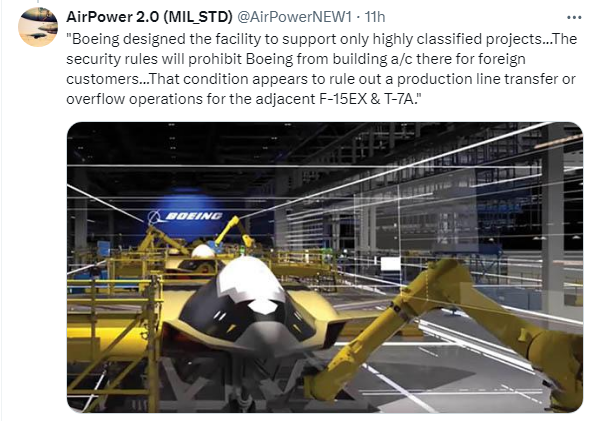
So this building is going to be part of the secretive Phantom Works?
YES it seem that , this facility is for higly classified projects.... May be Boenig have win a big classified project..What is interesting is the words "construction has started before Boeing has secured the contracts that would fund the aircraft sitting in there ...."
 
It would not surprise me dark sidius. That would explain why the building was built in the first place, a big classified project that will not be revealed for a number of years just like Lockheed's F-117A Nighthawk.
 
It would not surprise me dark sidius. That would explain why the building was built in the first place, a big classified project that will not be revealed for a number of years just like Lockheed's F-117A Nighthawk.
Not to spoil the party:

"Nordland also clarified that building construction has started before Boeing has secured the contracts that would fund the aircraft that would be built inside."

Either mis-spoke or the contact has not been awarded, otherwise they would have said Had secured surely???
 
Not to spoil the party:

"Nordland also clarified that building construction has started before Boeing has secured the contracts that would fund the aircraft that would be built inside."

Either mis-spoke or the contact has not been awarded, otherwise they would have said Had secured surely???
This is for higly classified projects may be something else than NGAD?
 
Not to spoil the party:

"Nordland also clarified that building construction has started before Boeing has secured the contracts that would fund the aircraft that would be built inside."

Either mis-spoke or the contact has not been awarded, otherwise they would have said Had secured surely???
You don't built a 1.6 billion building if you are not sure of the end of the contract.
 
You don't built a 1.6 billion building if you are not sure of the end of the contract.
They will be sure of what they will build there by the time this thing begins costing them a ton of money to build out. Its not like they would sink $1.6 Bn and then find out what's going to be built there. Majority of that capital expense can be diverted if some of their big bets don't pan out. This thing is going to take 2 years to be fully built out. Most big programs require bidders to be able to show how they plan on executing..and having these investments is something you almost always need.
 
My guess it's not "awarded" but they've been given the nod, who knows
Boeing publicly revealed their intention to support this $1.6 Bn project back in August of 2023. By this time NG had exited NGAD and the RFP was out. In order them to be viable candidate, in addition to having a design that's competitive they would have to have a plan to actually build this thing. Lockheed likewise has made hundreds of millions of capital investment to expand its Palmdale footprint. You kind of have to put up or shut up in these programs and have to show you can actually execute on your proposal. Of course, they will re-purpose it for other classified work if they do not win, or perhaps even downsize original plans significantly and look to transition other programs to this more modern facility. LM would have plans to do the same for their investments.
 
YES it seem that , this facility is for higly classified projects.... May be Boenig have win a big classified project..What is interesting is the words "construction has started before Boeing has secured the contracts that would fund the aircraft sitting in there ...."
Black programs are spread across the big three. Even though Boeing commercial is struggling (includes KC-46 since its a B767 derivative), Phantom Works is independent like Skunk Works and NG Advanced Programs are, you need the friendly competition and innovation. When I was at Northrop and affiliated with advanced Programs (AP) starting in 1986, we cross pollinated with Skunk Works, ultimately we were developing systems for the common good for the US but we have and had our friendly rivalries of course.

During the ATF competition and since I supported YF-23, I used to joke with some of my ADP buddies why they developed an F-15 (YF-22) with internal weapons carriage and an F-15-style speed brake, which was deleted but this was all in fun but the F-22 is an awesome fighter and does the job. Just like with Tacit Blue, the ADP guys with there, Northrop designed an upside-down bath tub or Airstream trailer with a whales tail, you gotta love it, you can just feel the love, good times.

There is no reason Boeing PW would not get awarded the NGAD. Also, in regards to the F-35, you will never see a tri-service aircraft program again, this started with the B-21.
 
Looks like you have a problem reading because I clearly mentioned that I'm not comparing the programs

"I don't know how Boeing is going very well with the F-15EX relative to the F-35."

You're comparing the programmes, that's what those words mean
 
A common myth is that contractors 'make investments' in plant, property & equipment PPE, in addition to independent research & development IR&D and bid & proposal B&P.
In fact, with few exceptions, all these costs are reimbursed by the US government by way of the negotiated rate structure, if they are deemed 'allowable' by the Defense Contract Audit Agency DCAA.
https://www.dcaa.mil/Careers/Career...e/2496672/common-dcaa-audits-forward-pricing/

Typically the total labor rates (a.k.a. burdened rates) are 2 or 3 times the direct labor rates. The true 'investment' by contractors is essentially limited to the time-value of the money float, i.e., the difference in time between when allowable costs are incurred and when allowable costs are recovered.

Existing programs at a defense contractor facility almost always are the bill payers. For example, if Boeing-St Louis is shelling out big bucks for new factories, the reality is that the F/A-18E/F, the EA-18G, the F-15EX, the MQ-25, the T-7A, etc. are picking up the tab.

As long as a contractor's costs are deemed 'allowable', the only real governor on the direct and indirect rates is the competitive climate for future business opportunities. Forward pricing of labor and material rates is a key component of a contractor's proposal for a major bid such as NGAD. If Contractor X's rates (i.e., dollars/hour) for a given work effort is higher than Contractor Y, then that can become a disadvantage during source selection.

One reason the Navy turned sour on Grumman in the late 1970s-early 1980s is because Grumman was spending an inordinate amount of IR&D, B&P and PPE for Air Force business opportunities (e.g. ATF, JSTARS) and other diversification thrusts. The F-14, A-6, EA-6, and E-2 programs were the bill payers.

Takeaways: 1) Defense contractors do not invest their own money as done in the commercial world (Boeing Defense vs. Boeing Commerical is a text book example.); 2) Contract costs are negotiated DoD-wide, not service-by-service.
Northrop started investing its own money way back in the early 1960's, in LO technology and Northrop (along with Lockheed) knew about the potential of stealth technology 30+ years before anyone else, this was clearly stated by the late Thomas V. Jones (former Northrop CEO) during the B-2 roll out. Some history, Northrop flew the YB-49 against radars at Half Moon Bay and by the time the radar operators got a lock on the aircraft, the YB-49 had already had destroyed the facility, and this with an all-aluminum flying wing. There is a lot of technology Northrop and Lockheed had developed over decades that more than likely no one except the special few know about. Northrop and Lockheed had true visionaries, everyone else had and has to play catch-up.
 
Northrop started investing its own money way back in the early 1960's, in LO technology and Northrop (along with Lockheed) knew about the potential of stealth technology 30+ years before anyone else,
It would be interesting, but impossible, to understand the funding split between IRAD and government contracts in this technology area. Also interesting to factor in government transfers of IP from 3rd parties (e.g. MIT RadLab).

It sort of seems that the current US combat air primes are a direct result of some fairly low scale contracts (and mostly single source) back in the 50s/60s. Apart from Boeing, which is more a result of the cash generated by their commercial business off the back of 367/KC-135 etc. enabling them to acquire other companies. But there's probably some luck/coincidence thrown in there as well.
 
Status
Not open for further replies.

Similar threads

Back
Top Bottom