USAF/USN 6th Gen Fighters - F/A-XX, F-X, NGAD, PCA, ASFS News & Analysis [2008- 2025]

Status
Not open for further replies.

Several UAVs Under Development for Next-Generation Carrier Air Wing​


By: Sam LaGrone
July 13, 2022 9:48 PM

Several new unmanned aerial vehicles are under development as part of the Navy’s air wing of the future concept in addition to the unmanned aerial tanker[...]

The new aircraft are being designed to meet growing requirements for range for carrier air wings, Rear Adm. Andrew Loiselle, the Navy’s air warfare director (OPNAV N98) ,said during a naval aviation panel at the Naval Institute, co-hosted by the Center for Strategic and International Studies[...]

[...]The next step for the Navy is to bring an unmanned aerial refueling aircraft to operate further from the carrier to extend the range of the existing airwing. The first operational MQ-25A Stingray aerial refueling UAVs are set to deploy aboard USS Theodore Roosevelt (CVN-73) by 2026[...]

As for new aircraft, he did not elaborate on the UAVs in the works. The Navy has kept mum on its research and development efforts into almost all of its new carrier air wing aircraft.

The Navy has classified the spending for the Next Generation Air Dominance (NGAD) program that is expected to produce a manned fighter to replace the Super Hornets in the 2030s.

Loiselle did define three categories of unmanned aircraft his office is considering.

The first set is something that can go into a hostile environment, high threat environment, and it can stay there, it can persist in a high threat environment.

The second set is something that can go to that high threat environment, perform a given mission, briefly – a strike mission –and then leave and have a very high chance of coming home,” he said.

“The last set is something that is at an attritable price point, a much smaller vehicle that might perform any number of different missions.
Anything from going out there with our fighter aircraft and carrying more air-to-air missiles… or we might someday integrate that type of thing into our electronic warfare, a distributed architecture that would conduct that mission. And then we might also use those same types of drones for a distributed command and control network.”

The UAVs aren’t part of the NGAD (pronounced En-JAD by the Navy, Loiselle said) program but would be part of the ongoing development of the fighter.

“They are not exclusively for that platform. Okay, there’s equal applicability in the manned-unmanned teaming concept for any small [UAS] to be used with any aircraft on our flight deck. It’s not limited to that one capability,” he said.
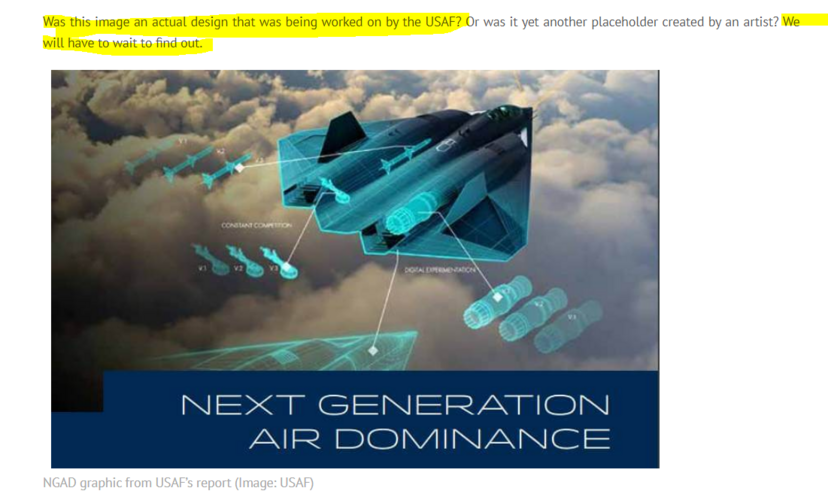
Interesting this dropped shortly after Lockheed revealed their vision for a future Family of Systems, but no Conceptual Art, no nothing this time?


From page 2:
"In addition, several other reported programs are either in development or currently undergoing experimentation. These programs include the Air Force’s B-21 Raider and the Air Force’s RQ-180."

Curious food for thought - could they be acknowledging "RQ-180" designation as the official one ?
 
Seems more likely he's just using the commonly accepted street name; the "RQ-180" is an open secret now.
 
Is the RQ-180 the one that the Iranians claimed they successfully hacked and brought down?
 
From page 2:
"In addition, several other reported programs are either in development or currently undergoing experimentation. These programs include the Air Force’s B-21 Raider and the Air Force’s RQ-180."

Curious food for thought - could they be acknowledging "RQ-180" designation as the official one ?

Congressional Research Service reports sit in an odd place. They are usually based on public information combined with some responses from the services. As such, they don't represent the official positions of the services. Their goal is to describe the nature of the choices Congress members will have to consider during their oversight of budgeting for the services.
 

I suspect they are focusing publicly so much on the unmanned component because Northrop will be getting the manned part.
 
Last edited by a moderator:
The problem the author of the article makes, among the many, is we don't have the most basic clue about the requirements of NGAD. It's the requirements that drive the design. Granted, we know it will be supersonic and it will be stealthy and it will most likely have twin engines. I say the last mainly because of the size class the vehicle is likely to be in, trying to package one engine that large would be silly. It also may have no vertical tails or variable geometry vertical tails; flat for stealth, butterfly for maneuverability. Also, it will have a crew of one. We also don't have any clue on the load out. Will it carry just enough for self defense and rely on UCAV for the offensive attack? Or will it carry as much as an F-22 and use the UCAVs as adjuncts and deeper weapons magazines? That's the balance that I think is going to be critical to the sizing of NGAD. That and the required range. Having said that, I expect it to have some form of arrow / delta or diamond wing (supersonic with a lot of volume for fuel) versus a trapezoidal wing (good for subsonic and transonic performance, but limited fuel capacity).
 
The problem the author of the article makes, among the many, is we don't have the most basic clue about the requirements of NGAD. It's the requirements that drive the design. Granted, we know it will be supersonic and it will be stealthy and it will most likely have twin engines. I say the last mainly because of the size class the vehicle is likely to be in, trying to package one engine that large would be silly. It also may have no vertical tails or variable geometry vertical tails; flat for stealth, butterfly for maneuverability. Also, it will have a crew of one. We also don't have any clue on the load out. Will it carry just enough for self defense and rely on UCAV for the offensive attack? Or will it carry as much as an F-22 and use the UCAVs as adjuncts and deeper weapons magazines? That's the balance that I think is going to be critical to the sizing of NGAD. That and the required range. Having said that, I expect it to have some form of arrow / delta or diamond wing (supersonic with a lot of volume for fuel) versus a trapezoidal wing (good for subsonic and transonic performance, but limited fuel capacity).
The only thing is, would two seats make sense for a UAV operator?
 
Given its size and the complexity of its role in battle field management, hopefully the NGAD will be 2-manned.
 
The only thing is, would two seats make sense for a UAV operator?

I was thinking that, but the USAF doesn't really like two seat aircraft for front line fighters, not to mention the cost it adds. I think they are going to try and avoid it and use a lot of AI. Also, due to networking, some of that may even be handled by AWACs. So much of it depends on how the entire NGAD system is set up to operate, it's difficult to say. I could definitely see the new Naval fighter having a two man crew, as they like the SA it offers.
 
Given its size and the complexity of its role in battle field management, hopefully the NGAD will be 2-manned.
As others say, with automation what it is it doesn't need to be. It may be a benefit but costs are already said to be astronomically high.
 
If recent lockheed graphics are to be believed, NGAD is intended to operate ahead of the drone formation.
Frankly speaking, doesn't seem to be the right spot to do the control. F-35s (from within the formation) or even F-15EXs (from behind it) can do the same just as well.
 
If recent lockheed graphics are to be believed, NGAD is intended to operate ahead of the drone formation.
Frankly speaking, doesn't seem to be the right spot to do the control. F-35s (from within the formation) or even F-15EXs (from behind it) can do the same just as well.

Way back when that was sorta the plan with the Raptor. Target something and have another plane in the back take the shot.
 
If recent lockheed graphics are to be believed, NGAD is intended to operate ahead of the drone formation.
Frankly speaking, doesn't seem to be the right spot to do the control. F-35s (from within the formation) or even F-15EXs (from behind it) can do the same just as well.

Way back when that was sorta the plan with the Raptor. Target something and have another plane in the back take the shot.
It is quite likely it is the plan once again.
Raptor can't really be expected to do it by the end of this decade (not sure it should be expected to do it against PLAAF even now).
NGAD with its (possibly) much deeper multi-band stealth and relevant datalinks - can.
 
So AETP (F-35) for GE
NGAP goes to PW
Enhanced PW F-135 mounted on Marines F-35B?

Or
Enhanced PW F-135 for all F-35
NGAP for GE
And AETP dies of a good death with PW left without an advanced modern engine design for the next decade or more.

There is probably a third solution:
NGAP is made a twin engines and GE NGAP goes on the left while PW fits the starboard side!
 
So AETP (F-35) for GE
NGAP goes to PW
Enhanced PW F-135 mounted on Marines F-35B?

Or
Enhanced PW F-135 for all F-35
NGAP for GE
And AETP dies of a good death with PW left without an advanced modern engine design for the next decade or more.

There is probably a third solution:
NGAP is made a twin engines and GE NGAP goes on the left while PW fits the starboard side!
Fourth option, GE gets NGAD and PW NGAP goes to USN 6th gen.
 
I think Congress might have a sizable fit if USAF tries to put down AETP without putting it in any aircraft.
 
For sure, but if the past is any indicator, they'll drop the ball and be stuck with F-35Cs for the next 40 years.
The Fifth Horseman is Stupidity and - stop me if you've heard this one before - Kelly Johnson's fifteenth rule of management is 'Starve before doing business with the damned Navy. They don't know what the hell they want and will drive you up a wall before they break either your heart or a more exposed part of your anatomy.'
 
Nobody has designed a clean-sheet fighter for the USN since VFX which gave birth to the F-14. 1969 was a long time ago...

The F/A-18 was a reworked YF-17 and the Super Hornet was a reworked Hornet. The F-35C is a variant of the F-35 programme and very much tied up with the basic F-35A architecture. How likely is it that the USN will get the funding to build its own 6th Gen super fighter independent of NGAD when for 50 years it's been able to piggyback on USAF development programmes?
 
Last edited:
The F-35C is a variant of the F-35 programme and very much tied up with the basic F-35A architecture. How likely is it that the USN will get the funding to build its own 6th Gen super fighter independent of NGAD when for 50 years it's been able to piggyback on USAF development programmes?
Uhhh, you know, the origins of JSF/JAST can be traced back to the joint US-UK studies on a stealth supersonic VTOL fighter that will replace Harrier?
 
Uhhh, you know, the origins of JSF/JAST can be traced back to the joint US-UK studies on a stealth supersonic VTOL fighter that will replace Harrier?
Yes I knew that. CALF and JAST were catch-alls, replace every medium-class fighter with one airframe. Not quite the same thing. Design compromises were inevitable. A larger wing and weight reduction being the necessary mitigations for the F-35C.
 
As much as I celebrate the achievements of Kelly Johnson and Ben Rich, I imagine Leroy Grumman would have responded to that with one hell of an eye roll.
Where is Grumman today? Where is Lockheed?
 
It’s worth pointing out the companies that made aircraft for the navy, Grumman, Vought almost exclusively made aircraft for the Navy. While others like McDonald Douglas would crowbar a child’s fingers open to get a shiny dime he was holding if they thought they could.
 
As much as I celebrate the achievements of Kelly Johnson and Ben Rich, I imagine Leroy Grumman would have responded to that with one hell of an eye roll.
Where is Grumman today? Where is Lockheed?

Combined with Northrop in the case of Grumman and Martin in the case of Lockheed.
It was a rhetorical question. Grumman had the choice of going out of business or getting bought out. Lockheed never left the driver's seat.
 
We knew already that airframe integration will be paramount for next Gen propulsion... And here comes the proof: GE, PW but also Boeing, LM and Northrop!


Don't think too fancy: beyond actionned flows, turbo ramjets etc... This might only translate the need for distributed exhaust and active flows controls.
 
We knew already that airframe integration will be paramount for next Gen propulsion... And here comes the proof: GE, PW but also Boeing, LM and Northrop!


" ... each an indefinite-delivery, indefinite-quantity contract worth up to $975 million to carry out the prototype phase of the Next Generation Adaptive Propulsion program ... "
"The Air Force said work on these prototype engines — including design, analysis, rig testing, prototype engine testing and weapon system integration — is expected to be done by July 2032."


So, as (IIRC) the AETP-engines are designed for / oriented towards the F-35, the 'full-scale NGAD-demonstrator' revealed by Will Roper was using (an) existing engine(s) (or a derivative) and any other/additional/future NGAD manned demonstrators or (EMD) prototypes are/will be using (derivatives of) existing engines until our timeline reaches 07/2032 ?
 
Status
Not open for further replies.

Similar threads

Back
Top Bottom