USAF/USN 6th Gen Fighters - F/A-XX, F-X, NGAD, PCA, ASFS News & Analysis [2008- 2025]

Status
Not open for further replies.
Hello everyone,

I am an intern at a consulting company mainly based in France, and I am searching on all kind of NGAD program in the world but I am looking for many more details about the program that maybe you can all here have.

Actually, I am trying to establish all of the complet ecosystem about the NGAD: which aircrafts will fight with the F-X? And even more, Which will be all the actors in the fight with the F-X? NGAD does it include multi-environment management such as maritime, spatial or even land? Namely, does the program include that the fighter and the UAV will be directly linked with soldier on the land or in ground base?

I have done lots of research but maybe you guys will learn me some new things, my actual vision of the NGAD program seems incomplete


Thank you for your consideration and sorry for my English.


Thats kinda what I was thinking, especially since the exact requirements for them will probably change fairly often
 
Last edited by a moderator:
It never seemed realistic to me to iterate through manned aircraft that quickly. By the same token UAV development already proceeds dramatically faster; the US has already gone through an entire generation of UAVs in two decades and it’s second generation is already considered obsolescent. I can easily see the UAV components of NGAD being refreshed every five years with digital design and 3D printing looking at projects like Speedracer and Gray Wolf.
 

An unknown number of companies are still competing to build the sixth-generation fighter...

Translation: More than the 3 well known companies of always. Which leaves General Atomics, Scaled Composites, Kratos and Sierra Technical as the possible bidders... No way.

Attachment
 
The USG could split the manned/unmanned elements between LMCO, NGC and Boeing. I could be wrong with this statement but I will go out on an assumed limb; LMCO, manned USAF 6th gen fighter, Boeing, manned USN 6th gen fighter, and NGC for the sophisticated unmanned platform(s), thoughts and comments always welcome.
 
It is not pre-determined and a lot is dependent on who presents what and how competitive that is. McDonnell Douglas did not win the contract to build the F-15 Eagle replacement. LM produced neither the F-16 (pre-GD acquisition), nor the F-15 or F-14 and is now the only 5th gen game in town in the US. So a lot will depend on who has a lead when it comes to the technologies and capabilities the USAF and USN are looking for in a future platform and associated family of systems. We're obviously great at looking at recent history and applying a similar logic into the future but things can change dramatically and companies often change and prioritize different capabilities. I found it interesting that the Skunk Works promoted someone with a recent ISR and unmanned? background to replace their outgoing boss who had been pivotal for their fighter portfolio.
 
Last edited:
"It would appear that technological development is now flowing both ways. The F-22 will be used as a test platform for the NGAD technologies, and where appropriate, some of the technologies developed under the program could then be employed with the Raptor. This could aid in the development of the NGAD aircraft but also serve to help maintain the F-22’s edge as other nations seek to develop fifth- and even sixth-generation fighter aircraft."

 
Last edited:
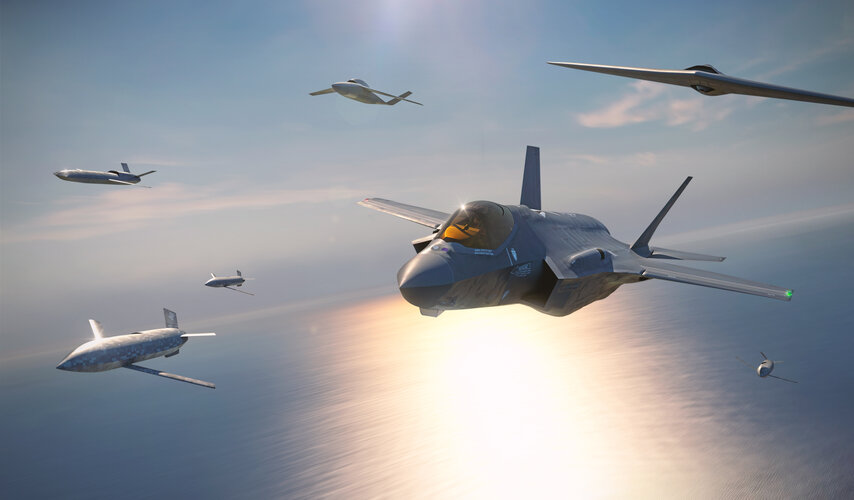
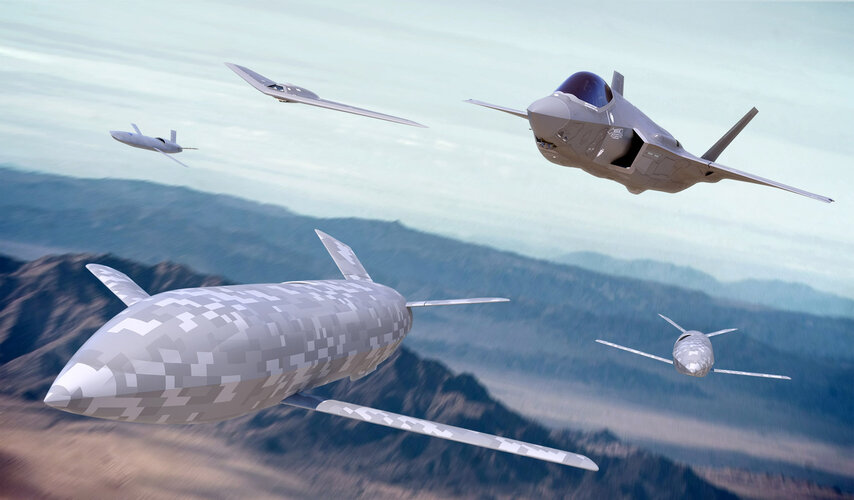
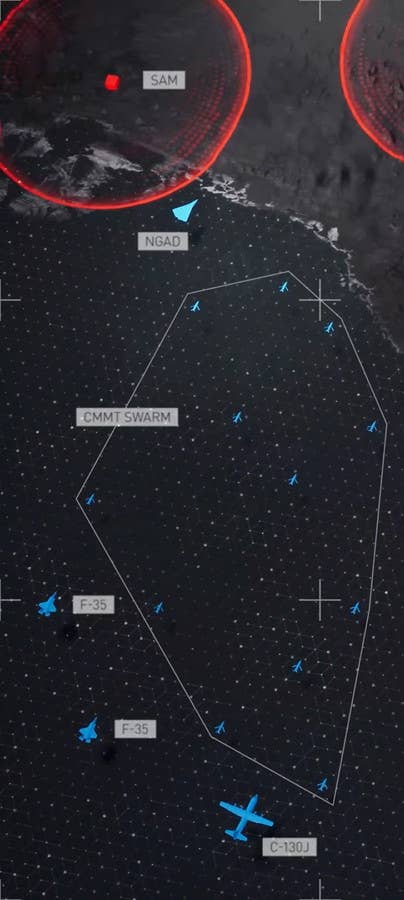
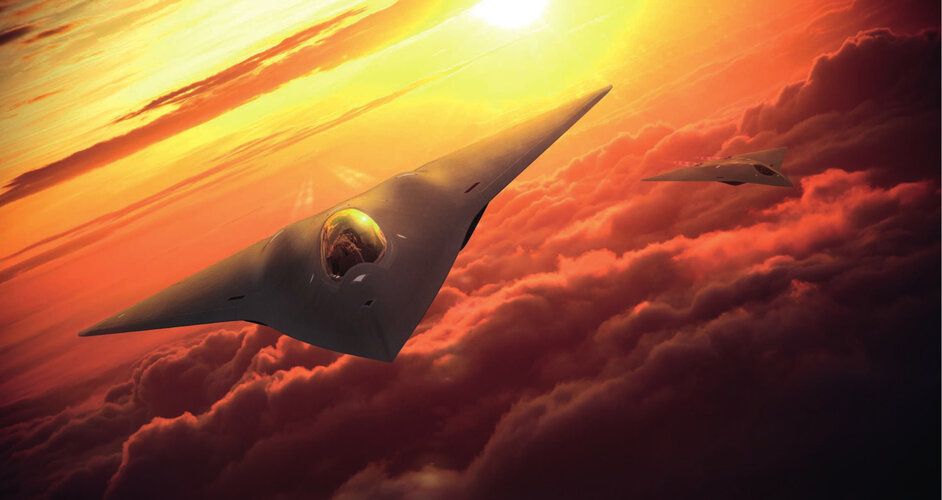
Placeholder NGAD concept via TWZ (or sneak peek into the real thing?):
cmmt-swarm.jpg

 
If this video is to be taken at face value, LMs' own opinion on F-35 stealth seems to be not very high.
Thus I wouldn't place too much trust in it.
 
Last edited by a moderator:
It seems likely to me that one of the normal big contractors gets to be the prime for the manned platform, but there seems like lots of opportunities for smaller companies to build the unmanned components. It looks likely that there will be at least three pieces to that - unmanned disposable, unmanned attritable, and unmanned..."hope we get this expensive piece of machinery back". On top of that it looks like there might be room for UAVs with specialized roles and envelopes, like high altitude ISR/communications (I would have thought "RQ-180" filled that niche but perhaps they are in too high demand and something smaller and more "tactical" is desired). I could see 2-3 different contractors providing the non-manned elements of NGAD given the diversity of need and the number of producers of UAVs who have existing products that slot in neatly to those diverse roles.
 
The F-22 will be used as a test platform for the NGAD technologies, and where appropriate, some of the technologies developed under the program could then be employed with the Raptor.
I have a suspicion the "one year" NGAD X plane was in fact a modified F-22 ........ maybe X-44, maybe. Certainly would make sense.
 
I have a suspicion the "one year" NGAD X plane was in fact a modified F-22

What if the USAF had secretly dug out of secure storage some of the F-22 production jigs and tooling and used it to be build a new F-22 with upgrades?
 
It’s hard to imagine how such an aircraft would de risk the program or that any of the same production methods would be applicable/useful.
 
The F-22 will be used as a test platform for the NGAD technologies, and where appropriate, some of the technologies developed under the program could then be employed with the Raptor.
I have a suspicion the "one year" NGAD X plane was in fact a modified F-22 ........ maybe X-44, maybe. Certainly would make sense.
Doubtful
 
I have a suspicion the "one year" NGAD X plane was in fact a modified F-22

What if the USAF had secretly dug out of secure storage some of the F-22 production jigs and tooling and used it to be build a new F-22 with upgrades?
In essence restarting a broken-down production line for ONE plane would be... <British accent>Rather expensive and perhaps a bit wasteful.</British accent>
 

How Boeing Is Positioning Itself For Advanced Fighter Competitions​

Brian Everstine
July 20, 2022

[...]Boeing is presumably in the mix for the U.S. Air Force’s Next Generation Air Dominance (NGAD) platform, which Air Force Secretary Frank Kendall told lawmakers earlier this year has entered the engineering and manufacturing development phase. But neither Kendall nor a series of Boeing officials would elaborate on anything NGAD-related when asked at Farnborough. The U.S. Navy is similarly planning its next-generation fighter.


“Fighters are in our DNA, right,” says Rik Geiersbach, Boeing Defense’s vice president for strategy. “So there was a competition 20-plus years ago for F-35. We did not stop investing in future fighter capabilities then, we don’t stop investing in future capabilities now. So the fact that there are needs that are relative to future capabilities, you can rest assured that we are right in the middle of all of that.”
 
All of these futuristic unmanned aircraft will, in fact, be "flown from the ground", whether or not they have data links and ground-based pilots. They differ from the older "Remotely Piloted Vehicles" only in that the operators are remote in time as well as space.

B R A V O ! ! !
 
Last edited by a moderator:
Speaking during a quarterly earnings call with investment analysts, Kathy Warden touted Northrop’s work building a new Air Force stealth bomber as a reason why the company should be considered a contender.

“As we think about sixth-generation aircraft, we are in the process of building the first of those, the B-21, and that's given us some fantastic experience and lessons that we believe we can apply to other sixth-generation aircraft and so we're positioned as a competitor,” Warden said. “I think our government desires to have a broad industrial base able to prime these large opportunities as possible, and we have been clear that we are investing and building our own capabilities and capacities to be able to be a contender.”

 
The AUKUS agreement was initially focused on sharing technology related to nuclear-powered submarines, but its scope has expanded in the months since. Australian ambassador to the U.S. Arthur Sinodinos noted in November that it will also include “enhanced” air and space cooperation.

“There’s so much more that’s being thought about,” Metrolis confirmed, “especially in air and space: the E-7 [Wedgetail], fifth- and sixth-gen fighters. Sixth-generation might become an AUKUS pillar.”

How exactly that might manifest remains to be seen. While the U.K. is developing Tempest and the U.S. is pursuing NGAD, Australia has yet to publicly involve itself with a sixth-generation program.

As those future decisions are made, Metrolis said there will be economic and industrial base considerations. But even more so will be the question of interoperability.

“We’re very interoperable with the U.K., more than any other nation,” Metrolis said. “

 
But that was in a simulator, it wasn't a live package fitted into a real UCAV and actually operating in real 3D space or reliant on a potentially vulnerable datalink. Indeed DARPA stated that it was possibly being 10 years away from being ready to actually 'fly' a fighter in combat.
There were some flaws, such as not observing 500ft separation distances which meant that in real combat some of those AI drones (having been programmed as 'expendable') would have flown through debris fields from their kills and actually risk damaging or downing themselves in the process. A Loyal Wingman has to be loyal and on your wing, if it dies in its own fratricide then its not really useful as a reliable wingman.

The software has to be run in the UCAV unless you want to jam up the network so that adds cost to the drone. If it is shot down, potentially your adversary can access the AI system and find out its weaknesses. That means programming it make sure its not expendable and therefore the AI must be as concerned about its own life preservation as a human and therefore desist from Hollywood epic style stunts. It can probably still perform better in dogfights than a fighter constrained by human physiology but it might blunt the edge.
Besides wouldn't a smart AI think that dogfighting is a waste of effort and no go for the long-range sniper kill if it could? One of the AI systems tested went in for the close-in cannon kill option every time, but is that necessarily the best way? Yes these systems learn but are they necessarily learning the best methods? Lots of work to be done I feel before we can elevate these from high-end gaming software to real fighter pilot brains.
But if the UCAV is flown by AI, the data link is less relevant, not that most modern fighters don't have datalinks with each other and the ground anyway.
Physical, RF datalinks may become less relevant. But the conceptual, virtual data link--the expanse of time that connects the human software-developer/pilot and his understanding of air combat requirements with the vehicle executing his software in actual air combat, becomes an ever more severe problem. If we are assuming that a given vehicle has capabilities much in advance of a 1970's vintage Ryan 147 recon drone, the software development issue becomes a huge one.

"AI" systems are currently spoken of as magic once was. When they are blithely credited with amazing, revolutionary abilities, little or nothing is said of how this will be achieved. These machines are not currently intelligent in any meaningful sense. They do not formlate decisions based on perceptions and imagined future outcomes. On the contrary, they are automata, essentially no more than sophisticated versions of the little, wind-up, hopping rabbit toys I used to get in Christmas stockings--their future actions depend entirely on the capabilities engineered into them when hardware was last refreshed and code was last updated. Given a pre-programmed input--whether a hand releasing a tight spring or an electromagnetic waveform that its human developers associate with a missile launch--the machine executes an automatic response programmed in by human developers. Denser, more integrated, faster processors, memory chips, and interconnects do not alter this reality. They just make the plastic bunny hop faster and higher.

By putting software on the platform and eliminating the remote pilot and RF link, we merely trade the synchronous, near-real-time reactions of a remote human operator, delayed by seconds due to the speed of light and limited bandwidth, for an asynchronous reaction delayed by the months or years of debugging, redevelopment, testing, and deployment that constitute reaction to an unanticipated run-time software problem.

This is not to say that more sophisticated drones can't be useful or can't do more than the old-style ones. But it does mean that there is no "AI" free lunch here. Adding autonomy requires tradeoffs.

One of these tradeoffs is the above mentioned loss of real-time control over a weapon that must function in a remote, highly dynamic environment. In exchange for autonomy, we have to rely much more heavily on the judgement of the policy makers and requirements analysts that define what systems will have to do and on the engineering managers and programmers that have to implement against requirements. These people will have to anticipate more, see further into the future, and make vastly more reliable predictions than have been the norm to date. This should be a sobering thought: historically, how often have policy, planning, and requirements correctly anticipated coming reality?

Another is loss of "situational awareness" due to too much data and too little information. Data is not information. UNtil data is filtered, processed, correlated, and applied t decision making, it is just noise. More manned fighters means more airmen monitoring sensors (from eyeballs to radar), filtering data, and assimilating results, and thus gathering usable information. A manned aircraft and a swarm of "AI" drones loaded with sensors might provide vastly more data. But the reduced number of human aircrew would result in much reduced filtering and processing to produce real-time information. The pilot would have to rely on the perspicacity, foresight, and information-forming abilities of the engineers that programmed the drones all those years before.

Another is cost vs. capability. A Ryan 147 with a camera package or a Reaper with a Hellfire offers a modest capability at modest cost. The former flies a fixed course. The latter is guided by a human via datalink and video camera. Neither is exactly cheap. But both are much less costly than a manned jet fighter. The Ukrainian off-the-shelf, hobbyist quadrotor with IR camera and a mortar bomb or RPG-warhead payload is much less costly still. All else being equal, if the target is a tank and within range, the Ukrainian solution is vastly cheaper and vastly more effective: its hard for the human operator to miss from directly above, a dead stop, and just a few meters up. But both current talk and history strongly suggest that "AI Loyal wing men" are already heading in the opposite direction, toward the cost of the jet fighter or more. The high cost and high risks of implementing autonomy seems likely to be minimally counterbalanced by any reasonably anticipated benefits. As even their proponents admit, these "loyal wing men" are likely to supplement rather than replace manned aircraft. But does the limited, supplementary roles offset the high cost of developing the platform, the high risk of relying on it in real combat, and the capabilities that air forces will have to give up (like real-time control) when fielding it?

The degree of reliance on human policy, program management, and foresight that the "AI loyal wing man" project requires is thus the key caveat that should be kept in mind when considering or advocating for these projects. I do not see the weapons systems themselves as particularly revolutionary. But the scope of the requirements-planning and software implementation effort is unprecedented. For the Manhattan Project, we started with a good grasp of the physics and could thus pursue a reasonably clear, if complicated and expensive, development effort. Here, we start with no precise definition of what intelligence, much less "artificial" intelligence, is. We are galloping along on implementation without first defining the nature of the problem or the solution, while counting on "AI" magic to handle the hard stuff. What could possibly go wrong?

 
I have a suspicion the "one year" NGAD X plane was in fact a modified F-22

What if the USAF had secretly dug out of secure storage some of the F-22 production jigs and tooling and used it to be build a new F-22 with upgrades?

I thought the tooling and jigs had been disposed off....destroyed??

I totally forgot to ask the magic questions about NGAD and 6th gen when I was all weekend and week at RIAT then Farnborough as was concentrating on helo stuff. Then again with the en masse emails on various presentations from the likes of the OEMS, ..plus press releases, not one did I see was related to our favourite topic here. Not even from the media outlets, unless I missed out on anything.

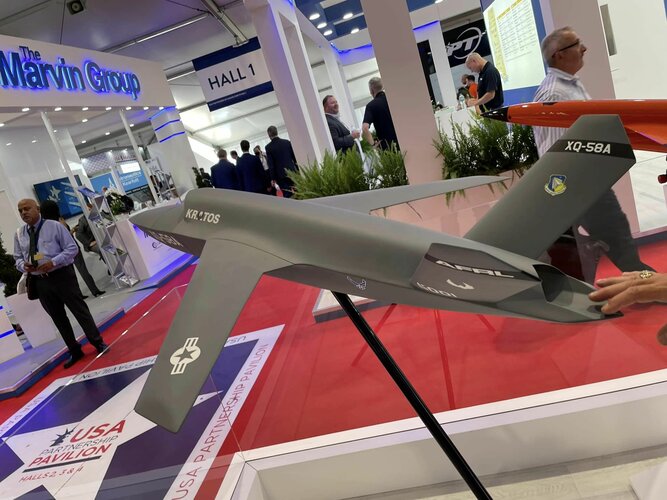
Laughingly enough I popped by the Kratos booth to talk about their programs especially the Valkyrie as it was originally a classified program. It flew for first time few years back, semi officially released to the media. I chatted with the senior executive and he was open but wry about the classified background of it.

Thing is though I can see some comparisons with NGAD in a way, for all we know the likes of AFMC - AFRL are probably pairing both whatever the 6th gen fast jet with this and Loyal Wingman in trials?

Any sightings to report lol or any thoughts please?

cheers
 

Attachments

  • 296825788_10160630743001490_7543628728788835592_n.jpg
    296825788_10160630743001490_7543628728788835592_n.jpg
    254 KB · Views: 160
In essence restarting a broken-down production line for ONE plane would be... <British accent>Rather expensive and perhaps a bit wasteful.</British accent>
Not the whole production line just enough applicable jigs and tooling to use for building an F-22 based demonstrator aircraft.

I thought the tooling and jigs had been disposed off....destroyed??

No and while that is what usually happens after a production line closes in this case the US Congress via legislation directed that the F-22 production jigs and tooling be put into controlled, secure storage to be guarded by the US Army.
 
Laughingly enough I popped by the Kratos booth to talk about their programs especially the Valkyrie as it was originally a classified program. It flew for first time few years back, semi officially released to the media. I chatted with the senior executive and he was open but wry about the classified background of it.
Eh? I thought the LCAS D program that Valkyrie won was open? It was to a BAA from AFRL.

Or do you mean some of the background Kratos brought into this?
 
In essence restarting a broken-down production line for ONE plane would be... <British accent>Rather expensive and perhaps a bit wasteful.</British accent>
Not the whole production line just enough applicable jigs and tooling to use for building an F-22 based demonstrator aircraft.
Yes. That requires the majority of the production line to be reactivated. You need all of that stuff to build an F22.
 
I think it’s fine to reduce capability if that capability isn’t useful in the current context. Most of the USAF cuts seem rational to me because they wouldn’t impact a war with China significantly. The reality is that USAF doesn’t need anything like the capability it was prepared to deploy in Europe given current events.
 
Status
Not open for further replies.

Similar threads

Back
Top Bottom