USAF/USN 6th Gen Fighters - F/A-XX, F-X, NGAD, PCA, ASFS News & Analysis [2008- 2025]

Status
Not open for further replies.
Disclaimer: newbie opinion only.

As Northrop-Grumman already has the B-21 contract (and some UAV ones) going for the USAF, I don't see them getting the NGAD as well. Kind of the ATB/ATF scenario and "don't put all your eggs in one basket" way of thinking.

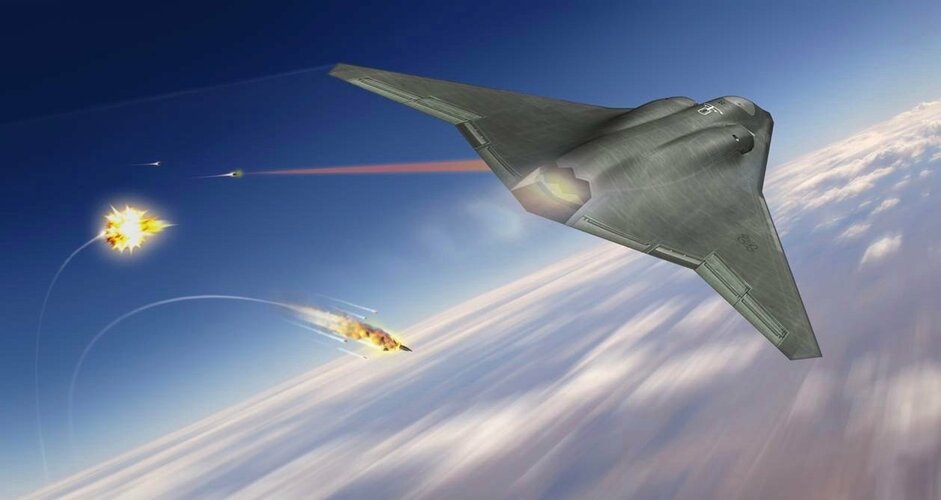
F/A-XX on the other hand, and following the success of the (strangely not pursued) X-47B demonstrator... Note that their unknown design has a beefy landing gear. And yes I know, it's just a public relations rendering.
 

Attachments

  • Screenshot_20211102-163359_Facebook.jpg
    Screenshot_20211102-163359_Facebook.jpg
    276.6 KB · Views: 263
Despite your 'newbie' claim, I think there is some historical precedent supporting your "all your eggs" thesis. Back in the day (the 1990s), Northrop had the B-2 contract and the Tri-Service Stand-off Attack Missile (TSAM). TSAM was arguably one of the larger missile contracts at that time. I recall the press speculation ahead of the YF-22/YF-23 decision was that since Northrop had the bomber and the missile, it was unlikely that they'd also get the fighter. Now things have changed quite a bit since the 1990s. Does anyone else think that this is Deja-vu all over again?
 
I wonder what are the respective advantages/disadvantages of placing the intakes above the wing. My guess would be that over-wing intakes get starved of air at high angles of attack, due to the body of the aircraft being in the way.
On the other hand, they probably create a low-pressure zone on the top of the wing, due to them accelerating the air, which means they contribute to lift.
 
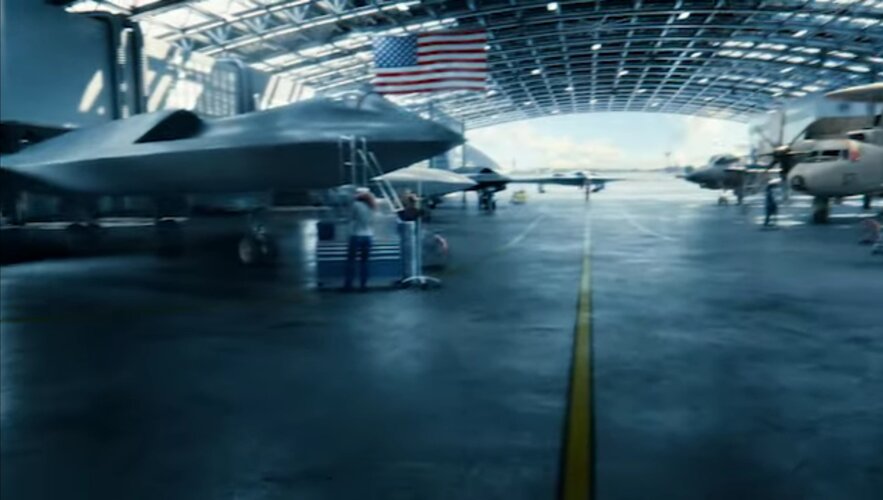
note B-21 lurking around
 

Attachments

  • Welcome to Northrop Grumman   60.mp4_snapshot_00.12_[2021.11.02_19.42.17].jpg
    Welcome to Northrop Grumman 60.mp4_snapshot_00.12_[2021.11.02_19.42.17].jpg
    886.3 KB · Views: 219
  • Welcome to Northrop Grumman   60.mp4_snapshot_00.13_[2021.11.02_19.42.44].jpg
    Welcome to Northrop Grumman 60.mp4_snapshot_00.13_[2021.11.02_19.42.44].jpg
    1.1 MB · Views: 222
I wonder what are the respective advantages/disadvantages of placing the intakes above the wing. My guess would be that over-wing intakes get starved of air at high angles of attack, due to the body of the aircraft being in the way.
On the other hand, they probably create a low-pressure zone on the top of the wing, due to them accelerating the air, which means they contribute to lift.
Its purely for LO considerations. Broadband LO generally requires the intakes to be placed inside the perimeter and on top. This drawing appears to be another view of that model they released some time ago.
 
Disclaimer: newbie opinion only.

As Northrop-Grumman already has the B-21 contract (and some UAV ones) going for the USAF, I don't see them getting the NGAD as well. Kind of the ATB/ATF scenario and "don't put all your eggs in one basket" way of thinking.

F/A-XX on the other hand, and following the success of the (strangely not pursued) X-47B demonstrator... Note that their unknown design has a beefy landing gear. And yes I know, it's just a public relations rendering.
I'd actually be surprised if NG doesn't get it. One of the reasons that has been on occasion mooted about for Northrop's YF-23 not being selected was program management experience. Yet Lockheed went way over with the F-22, is doing even worse with the F-35, and Boeing hasn't exactly shined with the KC-46. Meanwhile NG is on time and budget for B-21.

I suspect the Services, the DoD, and Congress are entirely fed up with Lockheed, and are looking askance at Boeing and their problems with both commercial and military products. Hell, at this point I suspect that if Textron decided to team with Sukhoi to build an "F-57" in the U.S. there would be mad rush to buy them just so they could return the favor and screw Lockheed over by cancelling the F-35.

But with the B-21 cruising along (so far) NG looks to be in the driver's seat to me. Even if the idea of a Cessna F-57 tickles the hell out of me.
 
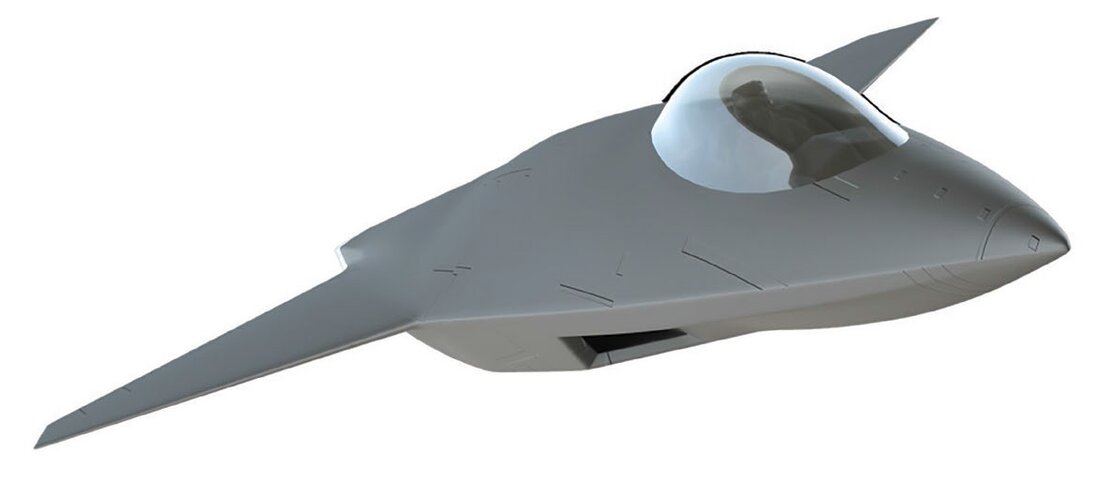
Where are the vertical fins? Retractable maybe? I cannot imagine it's a sub sonic fighter jet. Supersonic speeds are very hard (if not impossible) without a vertical stabilizer. And don't get me started on maneuverability. Yes it's great for all aspect stealth and it won't ever get into a dogfight, but one of the fighter's missions is interception. I guess you can send the F-35 for those missions.

A flying wing design with 2 retractable fins will be the best of both worlds imo.
 

Attachments

  • NGAD-fighter-jet--700x350.png
    NGAD-fighter-jet--700x350.png
    317.4 KB · Views: 178
  • Sixth-generationa-fighter-concept-Northrop-NGAD-1.jpg
    Sixth-generationa-fighter-concept-Northrop-NGAD-1.jpg
    56 KB · Views: 161
Disclaimer: newbie opinion only.

As Northrop-Grumman already has the B-21 contract (and some UAV ones) going for the USAF, I don't see them getting the NGAD as well. Kind of the ATB/ATF scenario and "don't put all your eggs in one basket" way of thinking.

F/A-XX on the other hand, and following the success of the (strangely not pursued) X-47B demonstrator... Note that their unknown design has a beefy landing gear. And yes I know, it's just a public relations rendering.
I'd actually be surprised if NG doesn't get it. One of the reasons that has been on occasion mooted about for Northrop's YF-23 not being selected was program management experience. Yet Lockheed went way over with the F-22, is doing even worse with the F-35, and Boeing hasn't exactly shined with the KC-46. Meanwhile NG is on time and budget for B-21.

I suspect the Services, the DoD, and Congress are entirely fed up with Lockheed, and are looking askance at Boeing and their problems with both commercial and military products. Hell, at this point I suspect that if Textron decided to team with Sukhoi to build an "F-57" in the U.S. there would be mad rush to buy them just so they could return the favor and screw Lockheed over by cancelling the F-35.

But with the B-21 cruising along (so far) NG looks to be in the driver's seat to me. Even if the idea of a Cessna F-57 tickles the hell out of me.
I feel like the B-21 being on time and budget, especially compared to the F-35 is due to it not having a laundy list of conflicting requirements generated by not only the 3 branches, but also half the Western world, while simultaneously being the testbed of a new paradigm of aircraft.

Imo, if Lockheed mismanagement or not, the F-35 program was doomed to be a horrorshow the day the requirements were laid down.
 
Hello!!!
The sixth generation fighter that can be seen in the video, has dual wheels on the front landing gear, and this one is reinforced. With which, it could be a concept for the F/A-XX. But on the other hand, it looks very bulky for a carrier-board fighter, and the dual forward landing gear could be due to its weight and size. Perhaps it is a concept for the Pacific version of the next NGAD, which would have a greater range and weight, and therefore has air intakes in the upper part of the fuselage.
If indeed the NGAD will have two variants, most likely the short-range and fighting-oriented version, it will have air intakes at the bottom.
It is just an opinion.
Regards!
Rodrigo
 
The young lady who opens the door is quite pretty. But the lower back of the young designer also attracts attention. Overall an interesting video, but only for one viewing.
 
of note Model 437 nose too
 
Where are the vertical fins? Retractable maybe? I cannot imagine it's a sub sonic fighter jet. Supersonic speeds are very hard (if not impossible) without a vertical stabilizer. And don't get me started on maneuverability. Yes it's great for all aspect stealth and it won't ever get into a dogfight, but one of the fighter's missions is interception. I guess you can send the F-35 for those missions.

A flying wing design with 2 retractable fins will be the best of both worlds imo.

As it turns out, we have advanced flight controls and FCS that allow tailless aircraft to maneuver. See the X-36.
 
Where are the vertical fins? Retractable maybe? I cannot imagine it's a sub sonic fighter jet. Supersonic speeds are very hard (if not impossible) without a vertical stabilizer. And don't get me started on maneuverability. Yes it's great for all aspect stealth and it won't ever get into a dogfight, but one of the fighter's missions is interception. I guess you can send the F-35 for those missions.

A flying wing design with 2 retractable fins will be the best of both worlds imo.

As it turns out, we have advanced flight controls and FCS that allow tailless aircraft to maneuver. See the X-36.
The FATE/ICE program also investigated tailless concepts for fighter aircraft, and the X-36/X-45/X-47 validated many of those flight controls, with great accuracy, even on aircraft carriers, so it's possible to assume, that tailless designs may be the future for fighters and other aircraft.
 
The cockpit glass looks outdated. Visibility outside is bad. Looks more like high speed, high altitude stealth ISR platform. Let’s say Mach 2,5 without after burning. That’s why inlets are above.
 
it's nothing more than cartoon
Hi!
A few years ago I was in contact with some former engineers and designers at Nortrhop, as I wanted to know a little better about the design and development process that they follow.
The people I spoke to were really very nice, and they told me about the methods they use.
As in any design process, the first ideas are carried out using 2D drawings (at the time on paper, now surely using digitizing tablets).
Some of those ideas, which have more potential than others, are modeled in 3D using the Houdini program (as far as I know, Lockheed uses that too). Basically, it is a polygonal modeling program, like 3D Studio, Cinema 4D, Blender or Maya. But the advantage of the Houdini is that it is highly procedural and allows you to modify parameters without having to redo the entire model.
Then, the models with the most potential are taken from Houdini to Catia, to be "redrawn" by the engineers in that program, and they can be examined and evaluated more exhaustively.
Making a model in 3D with the level of detail that the plane in the video has, takes time (and a lot).
From what I think, what we see when a company shows these types of concepts, are ideas that passed a first cut (from 2D to 3D), but then fell by the wayside, and that find a fairly honorable life as promotional material . After all, these companies must have many archived 3D models that can perfectly be used in this type of promotional material.
They are probably among the first ideas to be cut, and that the designs in development have nothing to do with what they show.
Therefore, they must be a good sample to know what they are not doing.
Regards!
 
Interesting! Thanks, Rodrigo.
 
Last edited by a moderator:
In my experience the communications departments have their own graphic designers who have zero contact with engineering so there is basically nothing you can learn apart from what their Comms department think is cool
 
It is me or it look that the Northrop 6th gen fighter seem to have Navy landing gear , and Navy front gear ?
 
It is me or it look that the Northrop 6th gen fighter seem to have Navy landing gear , and Navy front gear ?
Not going to be good for RCS, 2 pizza dishes facing sideways in the front fuselage....


PS: NGAD's engine development still appears to be diminishing returns not worth the investment. hopefully a revolution in the classifed world, otherwise it is industrial Welfare.

This is major news to me re a decade long program.

Please elaborate.
 
Even engineers get hungry on the job but hiding the evidence needs thought.
 
It is me or it look that the Northrop 6th gen fighter seem to have Navy landing gear , and Navy front gear ?
It's not real. It's not even a real concept.

On the other hand, all the other exotic planes shown (model 437, X-47B, B-21 and 'RQ-180') are/were real concepts.
That's not what we're talking about though, is it?

Exactly, "what we are talking about" is the 'odd one' in that video.
My point is all the other aircraft shown once started their (embryonic) life as an artistic rendering or as concept art, and that they all progressed beyond that phase. And perhaps therefore it shouldn´t just be ruled out completely that is (or was) also the case for the 'odd one'. Which still doesn´t mean the 'odd one' would be an F/A-XX or NGAD. But which could be a reason to show them all together in the same video. Sometimes people like to show there accomplishments in a promotional video. But I´m well aware people sometimes also share videos containing mainly disinformation or other bullshit.
 
It is me or it look that the Northrop 6th gen fighter seem to have Navy landing gear , and Navy front gear ?
It's not real. It's not even a real concept.

On the other hand, all the other exotic planes shown (model 437, X-47B, B-21 and 'RQ-180') are/were real concepts.
That's not what we're talking about though, is it?

Exactly, "what we are talking about" is the 'odd one' in that video.
My point is all the other aircraft shown once started their (embryonic) life as an artistic rendering or as concept art, and that they all progressed beyond that phase. And perhaps therefore it shouldn´t just be ruled out completely that is (or was) also the case for the 'odd one'. Which still doesn´t mean the 'odd one' would be an F/A-XX or NGAD. But which could be a reason to show them all together in the same video. Sometimes people like to show there accomplishments in a promotional video. But I´m well aware people sometimes also share videos containing mainly disinformation or other bullshit.
"It's not real. It's not even a real concept."

Then the point stands, doesn't it?
 
lol
 

Attachments

  • Collins Aerospace NGAD ad 11-2021.jpg
    Collins Aerospace NGAD ad 11-2021.jpg
    62.5 KB · Views: 218
canards, clearly stealth isn't a consideration /s
Not that myth again, please.
sensors, missiles, DEW defense, UCRAV mothership, buildability, maintainability, cost efectiveness are the mainshows now, not stealth, which is increasingly countered and at longer ranges.

Personnally for canards.

PS: NGAD's engine development still appears to be diminishing returns not worth the investment. hopefully a revolution in the classifed world, otherwise it is industrial Welfare.
There are some folks at GE, P&W, RR, USAF, and AFRL that would certainly argue with you.
 
The cockpit glass looks outdated. Visibility outside is bad. Looks more like high speed, high altitude stealth ISR platform. Let’s say Mach 2,5 without after burning. That’s why inlets are above.
Better send an urgent message to the Northrop Grumman commercial art department
 
If you thought fifth gen designs are all boring and formulaic then wait for sixth gen, where all of them are going to be tailless deltas.
 
Only half the point of a weapon is it's combat effectiveness. The other half is to serve as a deterrant. Obviously you eventually want your enemies to know about your deterrant, for it to be effective, but not before it's ready, otherwise they would have time to respond, by building countermeasures or by attacking you before you can field it (thank you Dark Skies).
 
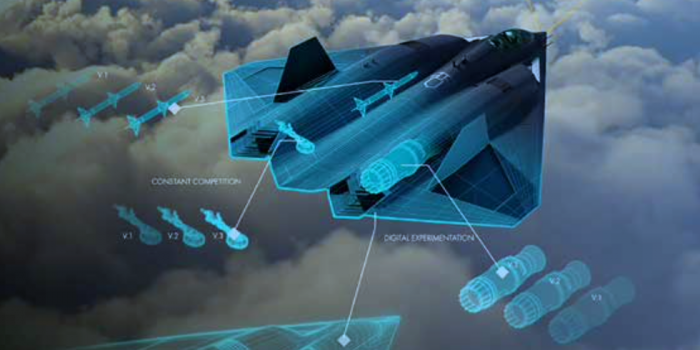
Circling back to the digital century series discussion for a sec…

I’ve been under the impression that the argument for it operates in two parts, and I’m wondering if others agree in their interpretation or not.

As I hear it, the main argument is that if you look at the life cycle costs of your generic fighter aircraft program, MRO and upgrades are more expensive than R&D and acquisition. And, this goes double (or some other financially painful multiplier) for stealth, as well as for aircraft late in their fatigue lifetimes.

Therefore, according to this argument, we are irrational in our tendency to try to buy future-proofed, long-fatigue-life airplanes that push the state of the art rather than embody it. Instead, we should cut back on sustainment costs by building mechanically less robust airframes with off-the-shelf avionic systems (though we should evolve what off-the-shelf means in a steady, independent way). A new generation of cheaper, shorter lifetime systems can provide equal capability for less cost, or greater fleet size for equal cost, and then when it ages quickly out of service, it can be replaced by new tails that do the same. And so we just buy more tails per decade, while retiring more tails per decade. 10 year airplanes rather than 30 year, say.

And then the second part of the argument comes in as an independent premise: that digital engineering tech has more or less advanced to the point where projects can go from RFP to squadron service in approximately the fatigue lifetime stated above.

Since cleansheet designs can appear so rapidly, tail churn can be equivalent to type replacement, resulting in a new jet type each decade, or mutatis mutandis for fleets with multiple types at any given time. If you had a future fighter force of two types at any time, for example, you could have a new type entering every five years if you staggered things.

So, again according to the argument, if we just have the courage to make the up-front investment in new airplanes, we can address the problems of the current thirty fatigue year model in general, and the sustainment costs of the F-35 in particular, all basically for free, while also getting to refresh our fleet decadally and therefore to tune its parameters against specific threats on something like a decadal basis.

Does that sound like a fair rendering of the argument? I seem to be hearing it as much less whiz-bang than others, who seem to hear “glittering edge faster!” and “cool new stylez!” much more. To me it all seems worrisome…with platform characteristics taking center stage and practicalities of testing, validation, maintenance, pilot familiarization, tactics development, and the like being potentially shortchanged. IMO, the fighter fleet needs range and maybe a second crewmember for battle management, but after that I don’t think platform design will win wars, unless maybe laser needs dictate constantly evolving platforms, which I doubt. Would love to hear other opinions though.

Would also appreciate it if anyone could comment on (my names for them) NGAD-C and NGAD-R being examples of this. My impression is that modern digital tools have been in use, but the digital century series hasn’t been implemented for crewed fighters, and is increasingly seen as more expensive and perhaps less practical than advertised…fighters not being smartphones after all…
 
Circling back to the digital century series discussion for a sec…

I’ve been under the impression that the argument for it operates in two parts, and I’m wondering if others agree in their interpretation or not.

As I hear it, the main argument is that if you look at the life cycle costs of your generic fighter aircraft program, MRO and upgrades are more expensive than R&D and acquisition. And, this goes double (or some other financially painful multiplier) for stealth, as well as for aircraft late in their fatigue lifetimes.
Why, w/near term advanced materials, should fatigue be an issue at all? IMO
Therefore, according to this argument, we are irrational in our tendency to try to buy future-proofed, long-fatigue-life airplanes that push the state of the art rather than embody it. Instead, we should cut back on sustainment costs by building mechanically less robust airframes with off-the-shelf avionic systems (though we should evolve what off-the-shelf means in a steady, independent way).
Mechanically less robust!?
A new generation of cheaper, shorter lifetime systems can provide equal capability for less cost, or greater fleet size for equal cost, and then when it ages quickly out of service, it can be replaced by new tails that do the same.
An F-16 replacement as a little cheaper, but, "ages out of svc" no.
And so we just buy more tails per decade, while retiring more tails per decade. 10 year airplanes rather than 30 year, say.

And then the second part of the argument comes in as an independent premise: that digital engineering tech has more or less advanced to the point where projects can go from RFP to squadron service in approximately the fatigue lifetime stated above.

Since cleansheet designs can appear so rapidly, tail churn can be equivalent to type replacement, resulting in a new jet type each decade, or mutatis mutandis for fleets with multiple types at any given time. If you had a future fighter force of two types at any time, for example, you could have a new type entering every five years if you staggered things.
This 'every 5 yrs a new plane' was never a good idea, but as you disagree w/ DEW tech will drive an upgradeable concept.
To me it all seems worrisome…with platform characteristics taking center stage and practicalities of testing, validation, maintenance, pilot familiarization, tactics development, and the like being potentially shortchanged. IMO, the fighter fleet needs range and maybe a second crewmember for battle management, but after that I don’t think platform design will win wars, unless maybe laser needs dictate constantly evolving platforms, which I doubt. Would love to hear other opinions though.
See above DEW will drive.
 
The digital century series was merely a marketing exercise in trying to drive towards DE adoption across AF systems (well intentioned but not very serious). It wasn't a very serious and organized effort to drive the entire R&D, acquisition, operations, and sustainment enterprise to that new type every five year model. The USAF and ANG are taking about five years or more to put the first squadron of F-15EX in service so suffice to say that the enterprise will collapse under the burden of introducing a new type every five years, assuming of course that a new type can be developed and tested every five years. Where the idea will live though is in the attritable and unmanned side of the house. Here we could see multiple variants, with varying attributes and characteristics, from multiple vendors come to life every few years. Between the 3-5 vendors who seem to be involved in these efforts we could see numerous types of attritables fielded in the next decade that could each be one or two mission specific. But that's far different from the sale pitch which meant that we could replace entire wings of manned platforms one for one through this model.
 
Status
Not open for further replies.

Similar threads

Back
Top Bottom