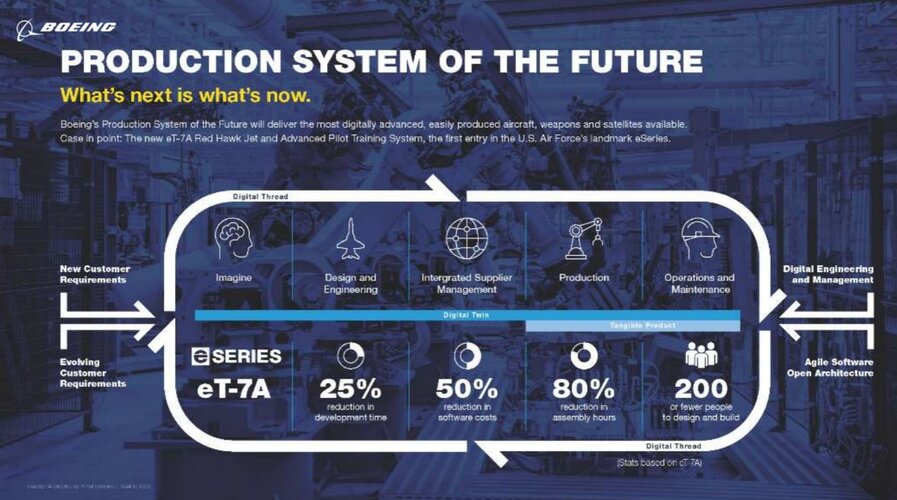
Testing and development of various subsystems is what takes most of the time, until IOC is declared..
So is the period from first prototype flight to IOC equal to the shortened development period, meaning 25%? Or is it more? Or is it less?
.
Digital engineering is one of several design, production, development and acquisition reforms/enhancements/upgrades that are aimed at reducing the time it takes to field weapons. The DE tools processes and supply chain integration goes after the problem of rapidly iterating designs (allowing you to field more mature designs faster in the design and build process), design maturity, and being able to reduce the amount of time it takes to build these systems (which traditionally has taken a long learning curve to master). Time is money so if they can sustainably shrink the assembly time then that will directly lead to cost savings and push the learning curve efficiencies to the left allowing bulk, if not all of the production program to benefit from the lower assembly time and cost. Or so is the hope which the capstone "e-series" programs will have to demonstrate. A point worth nothing here is that Boeing took on a fixed price contract as their first major DE application on a large defense program, and that the Air Force rolled it into one of its most costly modernization programs (GBSD) to start off so what they may have seen in smaller or classified applications of these tools must have been really promising.
What you are getting at in terms of qualifying, testing, and de-bugging mission systems, overcoming integration challenges and software development is only partly solved via this. The main things that are going to attempt to go after that are going to be the requirements process, being judicious with how many high payoff / high-risk sub-systems you go with and other modern design and acquisition elements that specifically target these things. That's where adoption of known OMS standards (not just open architectures but full OMS), and agile software development comes in as does the tech stack ownership and other tools like PlatformOne etc.
Also, the traditional goal posts from an acquisition perspective may not be relevant. If it still takes you 10 years to field a system but what you field in year 10 is dramatically more mature, more capable and more refined than what you would have done with a traditional approach then that is a major win and excellent progress. I think that's what Will Roper kind of hinted at during his last interview before he left the DOD. The milestone gates are defined by the acquisition process and law, and the requirements themselves (how lengthy and precise they are) impact how long a contractor spends designing to them, and how long the tester takes to ensure that each and every delivered attribute meets the specified requirements. Those requirements and what's needed to get past the validation and test phase may also be a limiting factor. Even the mature F-15EX is going to take 5-6 years to make its way to an operational unit from when the program was given a green light.
Roper specifically pointed to the maturity of the first (or first few) B-21's relative to early production or pre-production examples from past programs. And the B-21 is using a digital engineering approach but not the full digital acquisition suite that would give it an "e-series" designation. We'll see soon enough how close they actually come to delivering on that.


Cheers.