USAF/USN 6th Gen Fighters - F/A-XX, F-X, NGAD, PCA, ASFS News & Analysis [2008- 2025]

Status
Not open for further replies.
The tax law from the first Trump admin sunsets after ten years (this year? Next?).
Assuming law was passed in the first year in office, 2017, a 10 year sunset would be 2027.

But the proposition would never pass Congress or the current administration.
Probably not without the sponsor(s) knowing where ALL the bodies were buried.
 
Saddly behind paywall, the futur combat capacity seem to go in Space. May be the B-21 folow on will be an orbital hypersonic glider, able to saty in orbit and glide to earth for attacks high value targets on demand.
 
F-15s say hi, and have a really disgusting kill ratio versus 3rd gen aircraft. Especially once AMRAAMs are in use instead of Sparrows.
The F-15 has a great record as does the F-16 although in the F-15 case very few kills are with the AIM-120, the vast majority are AIM-7 or AIM-9. F-16 certainly benefited from AIM-120 in later years. Problem I have with the F-15 is all US kills are operating within the structure of AWACS and against pilots who have no where near the training of the US aircrew. Same with all the Israeli kills in the late 70s and early 80s, the Israelis were supremely well trained and operating in a manner that suited the platform.

In that context it is hard to judge the technical capability of the platform aside from the operator aspects of the platform.
Agreed. While I'm not sure how vulnerable the US supply computers are to someone deliberately screwing around, there's plenty of reports of typos and two-digit transpositions causing havoc. Like a complete Bradley turret being delivered to an aircraft carrier, because a system valve is NSN XXXXXXXXXXX29 and the turret is NSN XXXXXXXXXXX92 (not gonna use the actual numbers because they don't really matter).

Captain was not happy, and Master Chief Bosun was not happy either, because Captain didn't let him keep the turret.
Yeah a perfect example. Cyber doesn't even have to result in non-use, if it destroys your confidence that the system will function as it has previous then it has achieved its goal.
 
Problem I have with the F-15 is all US kills are operating within the structure of AWACS and against pilots who have no where near the training of the US aircrew.
Please remind me, what was the ratio of forces between NATO and the enemy - 20 to 1 or 30 to 1? Using the Bf.109
or Focke-Wulf Fw 190 on the NATO side with this ratio probably would not have greatly changed the effectiveness.
 
Please remind me, what was the ratio of forces between NATO and the enemy - 20 to 1 or 30 to 1? Using the Bf.109
or Focke-Wulf Fw 190 on the NATO side with this ratio probably would not have greatly changed the effectiveness.
“I don’t know why they gave me a German plane,” said colonel Chuck Henderson, USAF. “I mean, if we had to do it this way, wouldn’t it have made more sense to give me a P-51, or a p-47? Anyway, Operation Obstinate Falcon is proceeding smoothly…”
 
Its a hard question to answer as we still haven't had a valid definition of how a 6th gen aircraft differs from a 5th gen. It could be argued a 6th gen has
- All aspect and all frequency stealth (hence most potential examples/concepts remove the vertical stabilizers)
- Greater electrical power generation
- AI integration across likely EW, sensors, CCA control, ??
- Adaptive engine technology (likely only defines western 6th gen)
- Something else not defined yet?

A 5th gen gains decision superiority over a 4th gen due to its ability to detect, target, maneuver and engage a 4th gen aircraft before that 4th gen likely knows it has even been detected primarily from advantages of stealth, sensor and sensor integration.

Will a 6th gen platform gain a significant improvement over the 5th gen to gain that decision superiority? I'm not convinced of that yet. 5th gen will have radar and sensor upgrades that may keep it in pace with 6th gen and allow it to compete, perhaps similar to how a 4th gen wasn't markedly more improved than the 3rd gen, ie we didn't see so completely lop sided kill figures as we do in 4th to 5th gen engagements.

I think we can elaborate on some of these to somewhat get to the areas of advantage that a future 6G platform would enjoy over a baseline or upgraded 5G aircraft.

- All aspect and all frequency stealth (hence most potential examples/concepts remove the vertical stabilizers)

Let's assume better stealth (RF & IR) is included as part of a 6G aircraft. What does it enable such a platform to do that a 5G would struggle to do? Does it enable it to apply sensors, or effects differently? Does it allow it to employ new sensors and effects? If yes, then those will be part of the system and likely a defining feature setting it apart from previous generation designs.

- Greater electrical power generation
It could be that a dramatic power and cooling advantage over 5G aircraft enables new systems to be employed that are not feasible on these 4+ - 5+ generation platforms without serious mods or compromises.

- Adaptive engine technology (likely only defines western 6th gen)
Adaptive engine is a defining feature for USAF NGAD. Not sure if that's the case for other western or non-western 6G fighters. But for USAF, it is one of the public ones.

- AI integration across likely EW, sensors, CCA control, ??
Given the CCA effort split off from NGAD, its pretty safe to assume that some sort of autonomy core was considered for future 6G aircraft. This is more organic capability and not like what LM is trying to do with F-35 via a tablet.

- Something else not defined yet?

From a capability perspective, probably something about kinetic and non-kinetic weapon employment etc..The "E-Series" approach also highlights how the 6G fighter / NGAD is to be designed and built so that it can evolve a lot quicker than 5G platforms before it. While not a defining feature like say a sensor, shaping RCS etc, it is an important component of the program and thus consuming resources.

 
I think we can elaborate on some of these to somewhat get to the areas of advantage that a future 6G platform would enjoy over a baseline or upgraded 5G aircraft.


- Adaptive engine technology (likely only defines western 6th gen)
Adaptive engine is a defining feature for USAF NGAD. Not sure if that's the case for other western or non-western 6G fighters. But for USAF, it is one of the public ones.
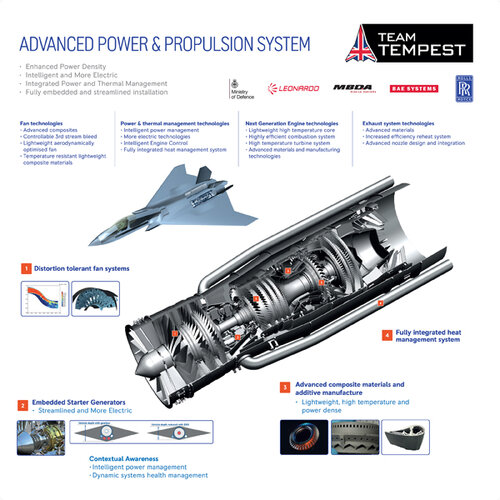
Tempest appears to have a 3-stream analog.

pr-09-01-2020-image.jpg
 

LM said:
Lockheed Martin has demonstrated its piloted-drone teaming interface, which can control multiple drones from the cockpit of an F-35 or F-22. This technology allows a pilot to direct multiple drones to engage enemies using a touchscreen tablet in the cockpit of their 5th Gen aircraft.
...
The world’s most advanced stealth fighter jet has the capability to control drones, including the U.S. Air Force’s future fleet of Collaborative Combat Aircraft. Recently, Lockheed Martin and industry partners demonstrated end-to-end connectivity including the seamless integration of AI technologies to control a drone in flight
 
Have they finish the Block 4 ? before playing with drones ? Since the first flight of J-36 Lockheed communicate with air dominance publicity only with the F-35 , most beautiful, most dominant , bla-bla- bla they worried about the new administration on the futur of the F-35 ? it will be cool to have something else than the F-35 to dominate the decades to come when we see the hurry of Chinese Air Force.
 
Last edited:
I think we can elaborate on some of these to somewhat get to the areas of advantage that a future 6G platform would enjoy over a baseline or upgraded 5G aircraft.

- All aspect and all frequency stealth (hence most potential examples/concepts remove the vertical stabilizers)

Let's assume better stealth (RF & IR) is included as part of a 6G aircraft. What does it enable such a platform to do that a 5G would struggle to do? Does it enable it to apply sensors, or effects differently? Does it allow it to employ new sensors and effects? If yes, then those will be part of the system and likely a defining feature setting it apart from previous generation designs.

- Greater electrical power generation
It could be that a dramatic power and cooling advantage over 5G aircraft enables new systems to be employed that are not feasible on these 4+ - 5+ generation platforms without serious mods or compromises.

- Adaptive engine technology (likely only defines western 6th gen)
Adaptive engine is a defining feature for USAF NGAD. Not sure if that's the case for other western or non-western 6G fighters. But for USAF, it is one of the public ones.

- AI integration across likely EW, sensors, CCA control, ??
Given the CCA effort split off from NGAD, its pretty safe to assume that some sort of autonomy core was considered for future 6G aircraft. This is more organic capability and not like what LM is trying to do with F-35 via a tablet.

- Something else not defined yet?

From a capability perspective, probably something about kinetic and non-kinetic weapon employment etc..The "E-Series" approach also highlights how the 6G fighter / NGAD is to be designed and built so that it can evolve a lot quicker than 5G platforms before it. While not a defining feature like say a sensor, shaping RCS etc, it is an important component of the program and thus consuming resources.
I certainly have no issues with any of that above. Perhaps 20 years from now we will class what arrives as 5.5 gen compared to the platforms afterwards, if there are even platforms afterwards...
 
Have they finish the Block 4 ? before playing with drones ? Since the first flight of J-36 Lockheed communicate with air dominance publicity only with the F-35 , most beautiful, most dominant , bla-bla- bla they worried about the new administration on the futur of the F-35 ? it will be cool to have something else than the F-35 to dominate the decades to come when we see the hurry of Chinese Air Force.
LM is playing in both the Manned NGAD and the F/A-XX programs. I'm not sure what else they can do given both, before pause of NGAD, are meant to be close to contract award.
 
LM is playing in both the Manned NGAD and the F/A-XX programs. I'm not sure what else they can do given both, before pause of NGAD, are meant to be close to contract award.
Why don't taking the FA/XX for USAF ? they do that with the F-4 Phantom, One air dominant fighter could do the same job for both service ?
 
Why don't taking the FA/XX for USAF ? they do that with the F-4 Phantom, One air dominant fighter could do the same job for both service ?
Never say never but I personally see zero interest from the USAF in the F/A-XX. F/A-XX is most certainly not a viable replacement for manned NGAD.
 
I am not really sure how the USAF can look at what China is doing with their manned fighters and conclude a manned next-generation fighter is not necessary? Like, what are they even talking about?

Outside of that, just look at the state of the Air Force in general. The average airframe age for the fighter / attack aircraft is 26 years old. The whole Air Force needs to be replaced with a mix of new build F-15, F-16 and F-35. The A-10 should dropped immediately. On top of paying for a manned air superiority NGAD and massively increasing B-21 production output and fleet size. Oh, and that core fleet of manned aircraft should be replaced in less than a decade.

If you are claiming you are in a great power competition with China, yet are saying you cannot afford to develop a next generation manned aircraft and maintain a non-geriatric fleet of aircraft I think you might need to rethink your foreign policy stance and goals.
 
Why don't taking the FA/XX for USAF ? they do that with the F-4 Phantom, One air dominant fighter could do the same job for both service ?

FA-XX is a strike fighter. NGAD Platform was designed as an F-22 replacement. You are probably looking at a different design goal and mission. If the USAF is asked to or decides to re-evaluate NGAD platform and look at alternates because they can't field a direct F-22 replacement, It may be worth looking at what the Navy. From what we know, the USAF assembled a blue ribbon committee to decide the future and that recommended pursuing the NGAD platform. There are still other considerations but scrapping a particular mission focus in favor of another can't just be done without a serious consideration.
 
Last edited:
Sounds awesome. How many millions did that kludge cost?

Realistically I suspect that’s the best the U.S. can do without a new fighter, given the state of the F-35 program. I kinda question if ground control shunted through UAVs or satellites would not be more practical given the timeframes we are looking at for integrated fighter control.
 
Why don't taking the FA/XX for USAF ? they do that with the F-4 Phantom, One air dominant fighter could do the same job for both service ?
USN has size and weight limits for aircraft that the USAF doesn't. Assuming that NGAD is still supposed to be a 3000+nmi range monster, that's looking to be a 105+klb airframe.

The Nimitz class carriers cannot handle an aircraft weighing more than 90klbs on the catapults, and max recovery weight is on the order of 55klbs. And the Nimitz class limits matter because they're still going to be in service till at least 2050.
 
USN has size and weight limits for aircraft that the USAF doesn't. Assuming that NGAD is still supposed to be a 3000+nmi range monster, that's looking to be a 105+klb airframe.

The Nimitz class carriers cannot handle an aircraft weighing more than 90klbs on the catapults, and max recovery weight is on the order of 55klbs. And the Nimitz class limits matter because they're still going to be in service till at least 2050.
fiscally then an increased AF investment in B-21 (max munitions, including AAMs, DEW) and a combined USN Strike/Air Sup. NGAD/FA-XX would be realistic. Space & Munitions are going to make significant fiscal demands.
 
On the F/A-XX we know what the USN wants out of the airframe,

We expect that sixth-generation platform to be able to have advanced sensors, advanced lethality, advanced range, and being able to integrate with manned and unmanned capabilities together,” said Chief of Naval Operations Adm. Lisa Franchetti. “That’s one of the things, as we learn from the Air Force and the work they’re doing, to integrate that with what we know that we need to be able to do.”

But they also want to do it on what is appearing to be a shoestring budget. It also appears the USN is looking for an in service engine to power the aircraft and not a AETP derived engine.

According to Rear Adm. Donnelly, the new carrier-based fighter will be affordable, versatile and independent of Air Force-funded technologies such as an adaptive-cycle turbofan engine.

...

“We’re looking at more of a derivative-type engine solution,” said Donnelly. “That’s just one example where we probably are different in many ways from the Air Force. In totality, they are two unique programs from an acquisition point of view and also going forward, so we’re relatively independent of each other at this point.”

That engine is potentially then a derivative F135 or a F414/110. I cannot see the USAF interested in an aircraft that does not use an adaptive engine for a start before you add the host of other things the USN wants that the USAF likely sees as either not necessary or not good enough.
 
May be it is not a so bad idea to use a derivative of an actual engine, F-135 is soon enhanced with the ECU program it is the most powerfull engine for a fighter , a fighter with 2 F-135 engines will have realy a plenty of power.
 
Last edited by a moderator:
As much as people talk ad nauseum about SeNsOr FuSiOn, with the addition of yet another capability/responsibility, at what point does this become information overload for the pilots, (if we're not already there, of course)?
The whole point of sensor fusion is to not overload the pilot.
 
The whole point of sensor fusion is to not overload the pilot.
And the feedback from F-35 pilots is that they are not being saturated but able to focus on larger aspects of the battle space and not just the immediate environment, essentially allowing them to plan a couple of moves ahead instead of just the next.
 
May be it is not a so bad idea to use a derivative of an actual engine, F-135 is soon enhanced with the ECU program it is the most powerfull engine for a fighter , a fighter with 2 F-135 engines will have realy a plenty of power.

Two F-135's on a naval FA-XX would lead to a very interesting design especially if the point is to get significantly longer strike ranges than F/A-18E/F...that's probably too big of an aircraft the Navy can afford to field in enough quantity to replace the Super Hornet which is an objective for the program.

Something build around the F414 EPE or perhaps a clean sheet engine in that class seems more feasible.
 
Last edited:
Last edited:
I know, but all of that combined with having to direct drones from a tablet sounds rather problematic, does it not?
I don't believe the tablet is the long term solution for obvious reasons, it is just a bridge to allow the associated components to be tested. In the same press release LM also said they had tested control via the current F-35 testbed which to me indicates the plan is to integrate into the mission systems directly. This paragraph;
  • F-35 CCA Connectivity Demo – The world’s most advanced stealth fighter jet has the capability to control drones, including the U.S. Air Force’s future fleet of Collaborative Combat Aircraft. Recently, Lockheed Martin and industry partners demonstrated end-to-end connectivity including the seamless integration of AI technologies to control a drone in flight utilizing the same hardware and software architectures built for future F-35 flight testing. These AI-enabled architectures allow Lockheed Martin to not only prove out piloted-drone teaming capabilities, but also incrementally improve them, bringing the U.S. Air Force’s family of systems vision to life.
https://www.lockheedmartin.com/en-u...-the-skies-with-integrated-air-dominance.html

The way I read above is that the functionality will come with a later software blk, would assume 5.
 
I don't believe the tablet is the long term solution for obvious reasons, it is just a bridge to allow the associated components to be tested. In the same press release LM also said they had tested control via the current F-35 testbed which to me indicates the plan is to integrate into the mission systems directly. This paragraph;

https://www.lockheedmartin.com/en-u...-the-skies-with-integrated-air-dominance.html

The way I read above is that the functionality will come with a later software blk, would assume 5.

And even more bugs & glitches.
 
And even more bugs & glitches.
Every aircraft has bugs and glitches and globally military aircraft are flying daily with exemptions. F-35 probably has more code than any other military airframe but the consolation is subsequent aircraft that use common mission systems will benefit from the work done.

Would the US DoD do the same again if they had the chance? Almost certainly not but the current and especially the end result is likely worth the wait.
 
F-35 CCA Connectivity Demo – The world’s most advanced stealth fighter jet has the capability to control drones, including the U.S. Air Force’s future fleet of Collaborative Combat Aircraft. Recently, Lockheed Martin and industry partners demonstrated end-to-end connectivity including the seamless integration of AI technologies to control a drone in flight utilizing the same hardware and software architectures built for future F-35 flight testing. These AI-enabled architectures allow Lockheed Martin to not only prove out piloted-drone teaming capabilities, but also incrementally improve them, bringing the U.S. Air Force’s family of systems vision to life.

This statement from Lockheed is a little misleading. The demo they are talking about was done on the ground, in a laboratory, using *some* F-35 hardware and software. It was a demonstration that the faux-F-35 test setup could send commands to a completely virtualized / simulated CCA using the Autonomy Government Reference Architecture. The A-GRA is an interface specification or contract. The virtual F-35 was talking to the virtual CCA. The method of communication - the data link - was unspecified. It did not exist in any form. In reality this would be the F-35 connecting to a support aircraft that acts as a router such as a KC-46, which in turn communicates with the CCA through ABMS or directly.
 
Clean sheet engine is the opposite of "as cheap as possible". Maybe a modified engine? NGAP without the 3rd stream?
Yes, NGAP is an adaptive engine sized for USAF's NGAD propulsion requirements. With clean sheet, I meant something leveraging existing,more mature, technology which may be cheaper than an adaptive engine for Navy thrust and performance requirements.
 
Yes, NGAP is an adaptive engine sized for USAF's NGAD propulsion requirements. With clean sheet, I meant something leveraging existing,more mature, technology which may be cheaper than an adaptive engine for Navy thrust and performance requirements.
Oh, I understood what you're aiming for. Just thinking an NGAD engine, without the 3rd-stream would be smaller and cheaper (than the full NGAD engine). And less of a redesign than making a smaller F135. Wouldn't want to go all the way down to an F414 EPE because you'd just be duplicating a Super Hornet/ J-31, roughly, and they need more than that.
 
Yes, NGAP is an adaptive engine sized for USAF's NGAD propulsion requirements. With clean sheet, I meant something leveraging existing,more mature, technology which may be cheaper than an adaptive engine for Navy thrust and performance requirements.
I don't think clean sheet is the best term to use though. USN has specifically said not NGAP related propulsion and used the term derivative.. Derivative to me speaks to a growth pathway from a current in service engine and not NGAP and I cannot see the USN funding a new engine design even if it was based on NGAP.

So given it has to be a US engine then options are likely:
- enhanced F135 but two of these likely might be too big. Two engines would be almost 6000kg in weight.
- increased thrust F110. Does the USN really want to go back to an engine they already operated on ship with the F-14? Two engines would be just below 4000kg in weight
- F414 EPE as suggested by sferrin above? Likely not enough thrust still. Two engine would be 2300kg or maybe a bit more with enhancements but maybe not enough thrust.

Could an F/A-XX using a large delta wing get by with a single F135 that is enhanced? P&W had previously spoken about operating the F135 on the test bench comfortably up to 50k.

Any other engine alternatives people could suggest?
 
Very interesting links and certainly looks like right around both thrust and weight areas that the USN would be seeking.
 
Last edited by a moderator:
With clean sheet, I meant something leveraging existing,more mature, technology which may be cheaper than an adaptive engine for Navy thrust and performance requirements.
I was thinking something like one of the newer CFM HPTs and the F136 fan section, maybe?
 
I don't think clean sheet is the best term to use though. USN has specifically said not NGAP related propulsion and used the term derivative.. Derivative to me speaks to a growth pathway from a current in service engine and not NGAP and I cannot see the USN funding a new engine design even if it was based on NGAP.

So given it has to be a US engine then options are likely:
- enhanced F135 but two of these likely might be too big. Two engines would be almost 6000kg in weight.
- increased thrust F110. Does the USN really want to go back to an engine they already operated on ship with the F-14? Two engines would be just below 4000kg in weight
- F414 EPE as suggested by sferrin above? Likely not enough thrust still. Two engine would be 2300kg or maybe a bit more with enhancements but maybe not enough thrust.

Could an F/A-XX using a large delta wing get by with a single F135 that is enhanced? P&W had previously spoken about operating the F135 on the test bench comfortably up to 50k.

Any other engine alternatives people could suggest?

A couple F414 would be underpowered for any potent F/A-XX. Unless you have three of them! But nobody would do that, right?

A couple F135, unless downsized, downrated and with a significant SFC reduction, would be too much of everything, unless the Navy wants an aircraft at the very limits of the catapults and arresting gear. Remember that every operationnal modern aircraft (bar maybe a couple exceptions) are heavier than originally conceived, and tends to gain weight during their service life.
A single uprated F135 and a surprising naval "F-16XL style Crusader 4"? Wild option but why not!

F110 family evolution sounds promising. Used and known on the carriers from early 90's (F-14 Bravo and Delta) to mid 2000's, with good records.

My personal feeling (for what it worth) is toward a F-14 sized aircraft, slightly heavier (internal weapons bay, large fuel tanks) with evolved F110 engines. Maybe conservative in some ways, but more practical, economical and "down to earth" (or sea) than some concepts floating around.
 
"Our XA-101 #Adaptive engine completed a 4th round of testing and we are nearing completion of the detailed design for the U. S. Air Force's NGAP program" ~ GE Aerospace https://t.co/O74E8hCVru
An slight change needed which confused me for a few moments. The GE is the XA-100, not the 101 which is the P&W engine. Interesting statement though given we have been lead to believe that the XA-102 is what GE would be offering for NGAP. Unless the statement from Larry Culp is more generic, he used the term "Our XA-one hundred engine" unless the detailed design is the XA-102?
 
Status
Not open for further replies.

Similar threads

Back
Top Bottom