Manuducati
ACCESS: Secret
- Joined
- 25 November 2020
- Messages
- 420
- Reaction score
- 1,420
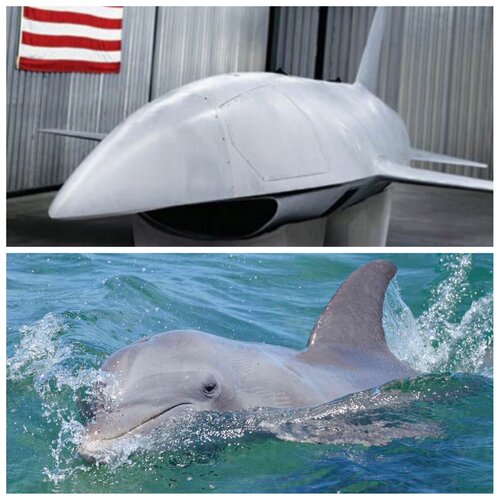
Aww, it gets its duct from the F-16!
But who's the mama in this case?

Aww, it gets its duct from the F-16!
But who's the mama in this case?
The issue is at this point no CCA we have seen matches the performance, sensor capability and magazine depth of manned aircraft other than in range and that range comes from subsonic optimised airframes. It seems likely that to match that mix would require a platform that costs similar to a manned platform, until such point that volume production may bring that comparatively down.
Thw whole point of low observability is to avoid getting locked on; to make it harder for the enemy to get a missile lock; and avoid getting detected (if possible) in the first place but the former always has the priority.
If you reduce manned NGAD capabilities then you have to compensate with improved CCA capabilities. No good having a manned NGAD that is massively outranged by the CCA and the CCA sensors are not capable enough to complete the FFTT portion of the targeting cycle on its own.I am sure it would cost about the same, but why should it have all those capabilities? The two CCAs we know about are 10,000 lb MTOW subsonic AAM carriers which likely have far less sensor capacity (at least in terms of radar). If you gave one an augmented turbofan, you would lose range but gain speed. No need for any other expensive changes. Perhaps something like Hermes’ design could even make a pseudo ramjet workable.

Sorry for the ignorant question, but has there been an NGAD flyoff? Do we know which company got the contract? Or if there hasn't been one, is there an expected date?

You criticized the CCAs as being subsonic and I merely pointed out that is only Incr 1. We do not know what performance future UAVs will have. As for capability: quantity has a certain capability all its own and not every single CCA needs to have identical sensor fits if everything is networked.If you reduce manned NGAD capabilities then you have to compensate with improved CCA capabilities. No good having a manned NGAD that is massively outranged by the CCA and the CCA sensors are not capable enough to complete the FFTT portion of the targeting cycle on its own.
I think supersonic speed involves more than just slapping on an afterburner but CCAs matching manned fighter capabilities remains a lot more than just speed.
While true, the more sensors above the basic needed to fly you add to a CCA the higher the cost of that CCA.You criticized the CCAs as being subsonic and I merely pointed out that is only Incr 1. We do not know what performance future UAVs will have. As for capability: quantity has a certain capability all its own and not every single CCA needs to have identical sensor fits if everything is networked.

the future prospects of NGAD and whether it will survive or not
Interested in seeing more of their products and concepts portrayed like how they might actually look in production... the "liveries" (if you could even call it that) are kind of ridiculous.
Depends on whether the B-21s are detectable from above.Distributed Space Radar creates the possibility of, not Ground Controlled Intercept, but Space Controlled Intercept - which puts every mission at risk of fighter interception. In such a case, subsonic penetrating bombers are borderline obsolete.
IIRC the assumption is that those will be hit by hypersonics and ballistics, if not nukes.As for range, either build a very large airplane or go STOL (and maybe swing-wing!) and operate out of Japanese airbases.
I think criticize isn't an accurate portrayal. I agree that we don't know what future platform capabilities will be but we also know what it costs to get the capability required when you add sensors, magazine depth and speed to the mix. Networking everything is fine if you assume that the platforms will have the ability to communicate. I would suggest there is enough experience with communications issues/jamming etc over Ukraine that expecting consistent communications is not good planning.You criticized the CCAs as being subsonic and I merely pointed out that is only Incr 1. We do not know what performance future UAVs will have. As for capability: quantity has a certain capability all its own and not every single CCA needs to have identical sensor fits if everything is networked.
Something is happening with the NGAD and the 6th generation fighters. Let's see.

I would assume it's same/similar sized as NG Model 437?

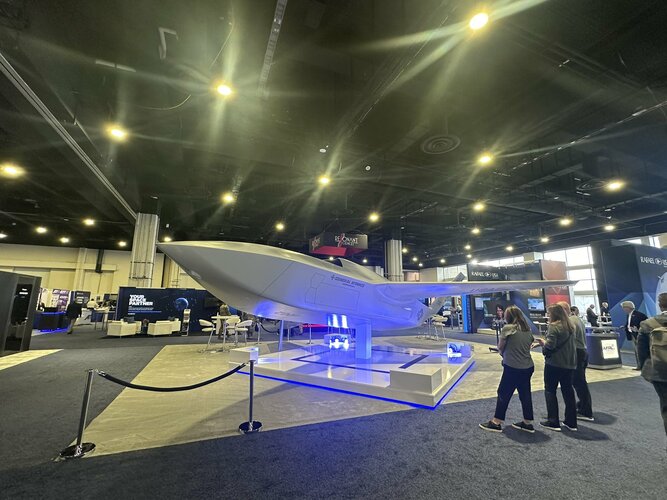
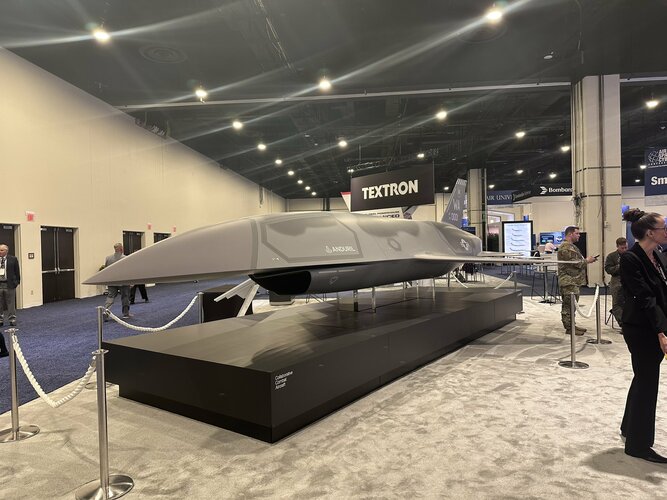
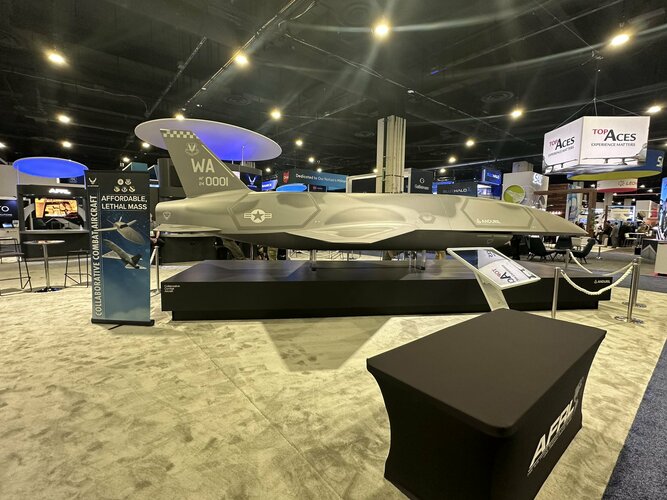
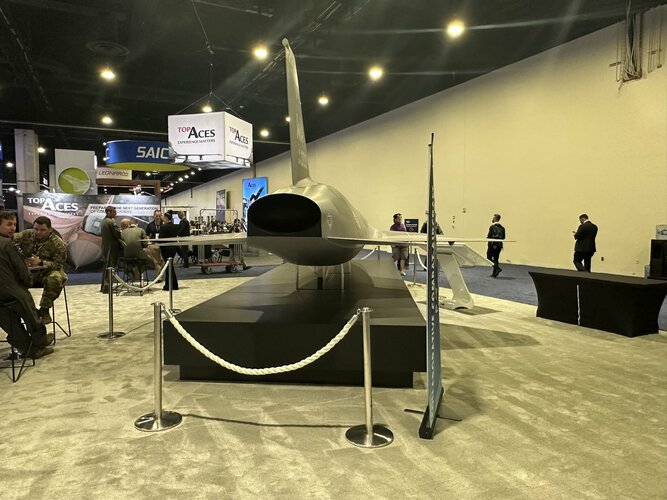
Anduril is the size of a big missile ? the capacity is what 2 amraam ?So GA-ASI CCA is bigger but apparently more steal

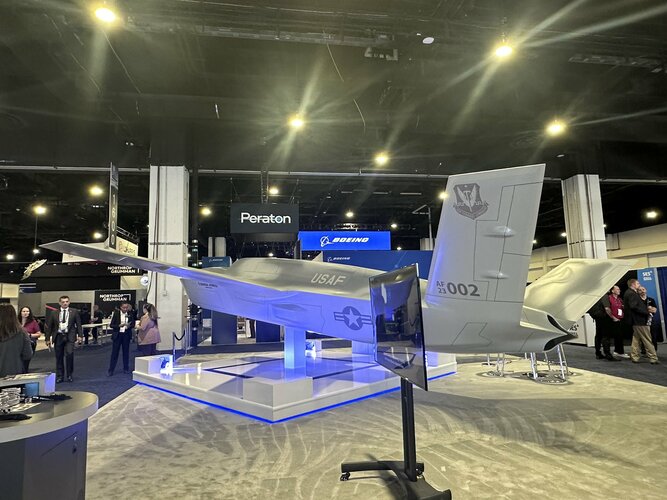
I think that an enlarged version of General Atomics Aeronautical Systems UCAV in the photo could quite possibly fill the CCA requirement quite easily raptor82

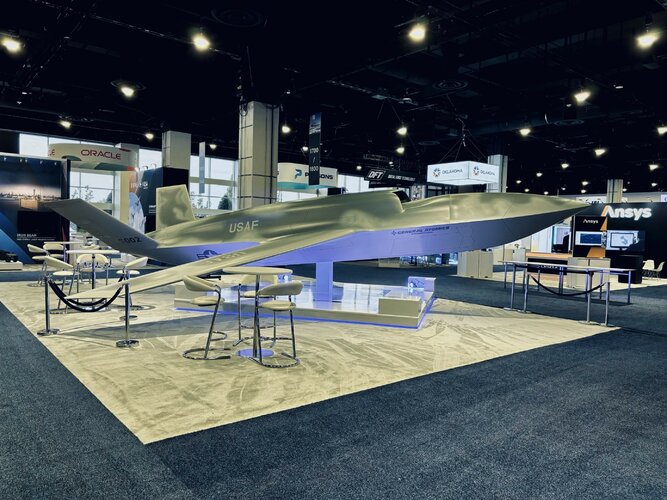
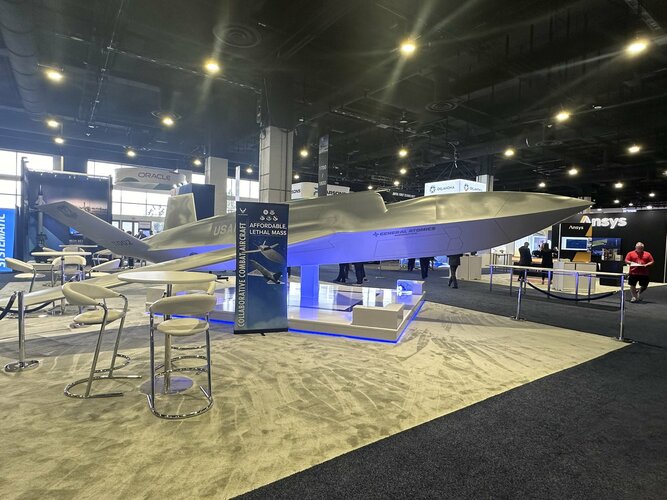
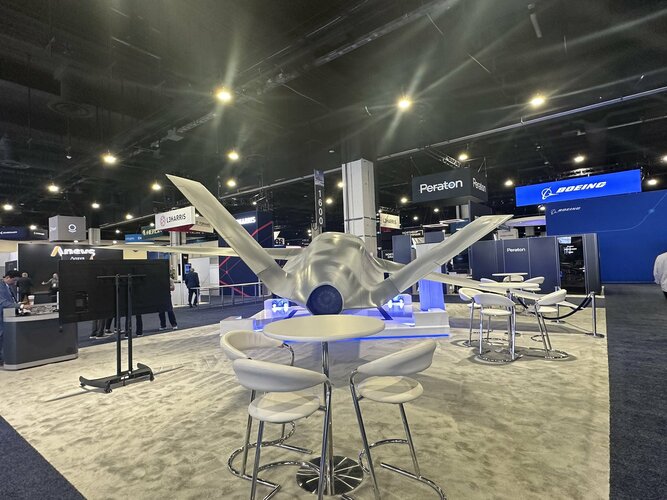
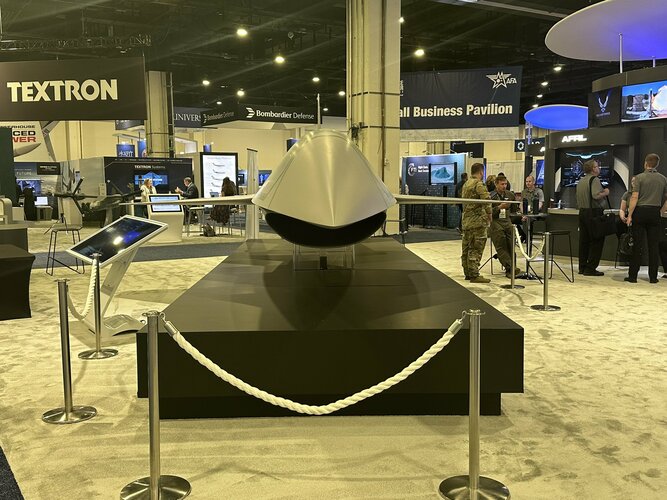
I'm still trying to work out where the AMRAAMs go on Fury. Really seems like external on the wings rather than there being an internal bay sandwiched into the lower fuselage.Anduril's CCA (BFT Fury) full-scale model :
I'm still trying to work out where the AMRAAMs go on Fury. Really seems like external on the wings rather than there being an internal bay sandwiched into the lower fuselage.


I think criticize isn't an accurate portrayal. I agree that we don't know what future platform capabilities will be but we also know what it costs to get the capability required when you add sensors, magazine depth and speed to the mix. Networking everything is fine if you assume that the platforms will have the ability to communicate. I would suggest there is enough experience with communications issues/jamming etc over Ukraine that expecting consistent communications is not good planning.
https://www.secretprojects.co.uk/th...lue-force-technologies-fury.38269/post-621160I'm still trying to work out where the AMRAAMs go on Fury. Really seems like external on the wings rather than there being an internal bay sandwiched into the lower fuselage.
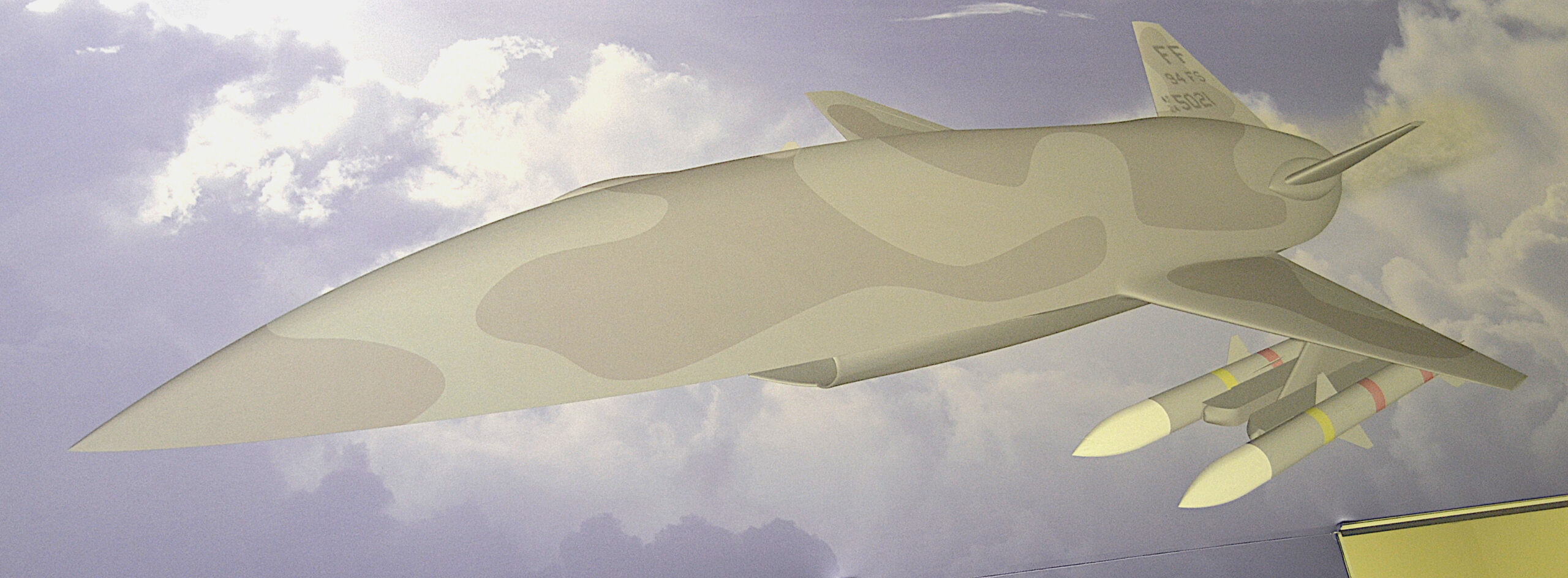

Absolutely Not. Hardest of Passes.
“So what should Increment 2 be? Do not assume and it may not be just an evolution of Increment 1. It could be an entirely different set of missions. Could be [an] entirely different kind of an aircraft,” Andrew Hunter, Assistant Secretary of the Air Force for Acquisition, Technology & Logistics, said at the 2024 Defense News Conference earlier this month. “And so part of that initial work is, again, starting with a large vendor pool, what are the good ideas out there? We’ll have some ideas [about] what we think Increment 2 needs to do as part of a broader force, and that’s part of this broader look at air dominance and how we’re going to deliver that.”
The Air Force is still voicing a clear commitment to the broader NGAS and NGAD initiatives no matter how they might evolve going forward. Questions about how aerial refueling support will be provided in high-end conflicts are also now clearly emerging as a central factor in the service’s planning for the future.
“We have a strong sense of urgency here. Our analysis must be adequate to support major decisions and to help us align our requirements, our acquisition strategies, and funding for these three programs,” Kendall said in his keynote, referring to NGAS, the NGAD combat jet, and CCA. “Stand by for answers in the next few months.”
Absolutely Not. Hardest of Passes.

Good for them for learning from past mistakes.There is a good quote at the bottom of that report:
Seems they are trading the bulky internal tanks of the transcontinental NGAD for something lighter that would refuel on a secure enough manner and have the mass weapons carried by lighter CCAs. In other words: a disaggregated design that brings similar capacity out of a variety of platforms (not a flying puzzle but an agnostic one that can pair with whatever is there available).
The lighter, less complex components also fits the desire to evolve rapidly, module after module.
What's the point of a flying weapons magazine that isn't stealthy?
I strongly disagree with that idea, unless Northrop has the capacity to make some KB21s as stealth tankers.There is a good quote at the bottom of that report:
Seems they are trading the bulky internal fuel tanks of the transcontinental NGAD for something lighter that would refuel on a secured enough manner and have the mass of a large magazine of weapons carried by lighter CCAs. In other words: a disaggregated design that brings similar capacity out of a variety of platforms (not a flying puzzle but an agnostic one that can pair with whatever is there available).
The lighter, less complex components also fit the desire to evolve rapidly, module after module.
I think more tankers with smaller targets on their backs simply offers (way) more flexibility that can at the same time cover for the disadvantages of a smaller and less complex NGAD.Half the point of the long range was to keep the tankers out of the A2AD bubble.
What's the point of a flying weapons magazine that isn't stealthy?
I strongly disagree with that idea, unless Northrop has the capacity to make some KB21s as stealth tankers.
Half the point of the long range was to keep the tankers out of the A2AD bubble.
As you note, it's 1/3 the cost of an F-35, and if you can do some tricks with construction like making the entire skin in one piece you can probably get the cost lower with a decently large production run.Re: CCAs. You would think that they should carry their weapons internally and be at least as observable as their manned collaborators? If they are not then they will not only telegraph that a manned fighter is in the area but will become attritable whether they like it or not. I thought GA's XQ-67 could carry two AMRAAM sized weapons internally. But I might be wrong about that. TBH - that's a light load for $30 million combat aircraft. Is this really affordable mass?
Remember that the CCAs are supposed to be stealthy, which means all the RAM and RAS are baked into the cost.Cost: $30 is a little pricey for something that can only carry two AMRAAMs internally. Yes, I realize that the sustainment cost will be less than a manned fighter. But the AF also only wants to have them in the front line for only 10 years before they are iterated and replaced by more advanced versions. At $30 million, I don't know if that math works out.
I honestly assume that any airfield within 1000nmi of China would be hit with ballistic missiles and/or hypersonics.Re: Range, NGAS, and NGAD. A more efficient, cost effective, and operationally effective solution is design a planform that has long range and requires minimal tanking. What's the minimal range requirement for NGAD? Is it critical for the AF to operate NGAD from extremely long distances unrefueled - Guam, Australia, Wake, etc? If this is the case then the situation with regard to China is dire. The tyranny of distance will impose a huge cost on sortie rate if NGAD cannot operate closer to China.
I am not sure what the trade off are, but an unrefueled combat radius of 1,000 to 1,200 nm would open a number of bases and civilian airfields in Japan and Philippines. Those two island chains would also be much easier for the US to logistically support with fuel and munitions than small islands close to Taiwan.
Given that the bigger MQ25 is only longer wings for 40% more fuel, I'm not expecting it to be more than about $175mil, and hopefully less due to economies of scale. 40% more fuel puts it to a fuel load of about 22,000lbs to transfer, roughly 1/4 that of a KC46.AAR is still an option, but it will be challenging to support close to Taiwan, even with NGAS. The cost of Boeing's MQ-25 is around $150 million. It is proposing a larger land based tanker. How much more will that cost? Isn't it likely that NGAS will be a Silver Bullet fleet? It is likely that it's capacity will not be as large as a KC-46 so it will likely require AAR itself? And how close will it refuel assets to IADS? The greater range that can be built into NGAD further out from the A2/AD bubble the USAF can safely refuel its fighters.