USAAF 0.60-caliber Machine Gun????

I don't know what US experiments occurred with .50 caliber HEI ammunition but late in the war a .50 caliber "super incendiary" cartridge was introduced that carried a lot more compound than the common API cartridge. It didn't get to see too much use during the war, but I think it left a positive impression. The 13.2mm FN Brownings could fire what is supposed to have been a rather effective HEI cartridge too.

There are two things I think would have really benefitted USAAF (and USN aviation) armament during the war.

#1 would be if FN had gotten plans and guns for the 13.2mm Browning over to the UK before the Germans took Belgium. I believe the UK and France had already agreed to adopt the weapon, but events had made that irrelevant. If the UK did get examples however it's possible the USA could have put into production an improved .50 caliber machine gun with a higher rate of fire, closer to that of the AN-M3 which historically was only introduced in the final days of the war. The US certainly wouldn't switch from .50 caliber (12.7mm) BMG to the 13.2mm cartridge, but that difference is pretty minimal. Perhaps examples of that 13.2mm HEI would aid in the US developing similar projectiles in .50 BMG.

#2 would be fixing the production issues which cause such difficulties with US-built 20mm Hispanos. That would probably also greatly aid in making the .60 caliber T18 variant of the Hispano function somewhat reliably. Whether or not that .60 caliber option would have any worthwhile applications is its own question, however. In most cases 20mm is the better option considering the weight of the guns and ammo would be about the same.
 
Hi Scott,

Yeah, they didn't face enough heavy aircraft that they had to try to stop with .30cal or .50cal.

Which is why the Russians went to 23mm or 37mm, the Germans to 20mm and then 30mm, and the UK to 20mm.

My impression is that historically, it was a bit more complicated, largely due to institutional inertia. If I understand it correctly, the USAAF did actually expect to use fighters in a defensive role, specifying interceptors in the shape of the P-38 and the P-39 (and a bomber destroyer in the shape of the Airacuda), which were to be armed with cannon. That the P-38 got a 20 mm cannon was sort of a downgrade with regard to the original design intentions, which seem to have envisioned the use of cannon between 23 mm T1 up to the 37 mm M4 also used by the P-39.

That the USAAF ended up with largely 0.50" heavy machine gun-equipped fighters was at least partially by accident, probably because the P-40 as a development of the P-36 sort of outshone the P-39, which generated an order for North American to produce an improved P-40, which (I'd speculate) received with the same armament as the P-40 due to the USAAF being a burnt child with regard to the Hispano 20 mm cannon.

I wouldn't consider 12.7 mm HMGs a weapon optimized for anti-fighter combat either. The German assessment of combat against modern aircraft with a load-bearing metal skin was that destroying said skin was the quickest way to cause an immediate failure, while purely kinetic projectiles of any calibre could only be effective against the relatively small critically vulnerable parts of the aircraft, leading to much lower chances for an immediate kill.

Thus, their use of 20 mm cannon was not in any way motivated by a desire to shoot down bombers specifically. The Bf 110, which was envisioned as a long-range fighter that cleared the sky around the Luftwaffe bombers from enemy fighter, was armed with cannon, because these were seen as the best air-to-air weapons.

(The 30 mm MK108 on the other hand really seems to have been developed as an anti-bomber weapon, though it really looks like the design brief was, "make it just like the MG FF/M, only bigger!" ;-)

Regards,

Henning (HoHun)
 
Hi Scott,


My impression is that historically, it was a bit more complicated, largely due to institutional inertia. If I understand it correctly, the USAAF did actually expect to use fighters in a defensive role, specifying interceptors in the shape of the P-38 and the P-39 (and a bomber destroyer in the shape of the Airacuda), which were to be armed with cannon. That the P-38 got a 20 mm cannon was sort of a downgrade with regard to the original design intentions, which seem to have envisioned the use of cannon between 23 mm T1 up to the 37 mm M4 also used by the P-39.

That the USAAF ended up with largely 0.50" heavy machine gun-equipped fighters was at least partially by accident, probably because the P-40 as a development of the P-36 sort of outshone the P-39, which generated an order for North American to produce an improved P-40, which (I'd speculate) received with the same armament as the P-40 due to the USAAF being a burnt child with regard to the Hispano 20 mm cannon.

I wouldn't consider 12.7 mm HMGs a weapon optimized for anti-fighter combat either. The German assessment of combat against modern aircraft with a load-bearing metal skin was that destroying said skin was the quickest way to cause an immediate failure, while purely kinetic projectiles of any calibre could only be effective against the relatively small critically vulnerable parts of the aircraft, leading to much lower chances for an immediate kill.

Thus, their use of 20 mm cannon was not in any way motivated by a desire to shoot down bombers specifically. The Bf 110, which was envisioned as a long-range fighter that cleared the sky around the Luftwaffe bombers from enemy fighter, was armed with cannon, because these were seen as the best air-to-air weapons.

(The 30 mm MK108 on the other hand really seems to have been developed as an anti-bomber weapon, though it really looks like the design brief was, "make it just like the MG FF/M, only bigger!" ;-)

Regards,

Henning (HoHun)
With one exception I feel you are dead on.

NAA proposed installation of 4x20mm in March 1940 during the P-509 Specification refinement - at BPC request, but NAA was halted by Materiel Division because the Hispano license had not produced enough to 'divert to a British project'. When the P-509 Specs morphed into NA-73X, then NA-73 the 20mm was dropped altogether. At that time the Tomahawk II and IIB were pre- six gun wing. I suspect BPC was a factor in up-gunning the P-40, along with SS tanks.

The original armament proposed by NAA for the A-36 in November 1941 was also 4x20mm, along with various combinations of 20mm and 37mm cannon. The Army forced the 6x50 final decision. What was curious to me is that Brewster was able to recommend and then build and test fly the 20mm battery XA-32. There clearly were two factions within Materiel Division and then Materiel Command.
 
They could have been better, but I think the common armament of 6x0.50" MGs was good against most fighters of WWII. Many Japanese fighters were lacking armor or even self-sealing fuel tanks, so they had little trouble dispatching those. Even their two engine bombers often lacked such survivability measures because of the extreme emphasis placed on range and performance. On many fighters even 4x0.50" caliber MGs was often adequate for the job.

Large Axis aircraft with four or more engines were pretty rare. The toughest targets that might be somewhat common would probably be bombers like the He-111 or Ju-88. There are more rare types like the He-177 too, but I think harsh language was enough to convince the engines on those to burst into flames. It would probably be frustrating trying to shoot down an Hs-129, but I don't know how much use those saw outside of the Eastern Front.

Generally speaking, American F4U Corsair pilots during WWII preferred the 6x0.50" MG armament because of the larger ammo load and the ability to send more bullets downrange in a few seconds of firing. But some appreciated the greater destructive power of the 4x20mm cannon option. By the time of the Korean War, I believe the Corsair pilots then openly preferred 4x20mm cannons. That probably reflects improvements to reliability that had been made and the difference in targets being engaged.
 
Hi,

They could have been better, but I think the common armament of 6x0.50" MGs was good against most fighters of WWII. Many Japanese fighters were lacking armor or even self-sealing fuel tanks, so they had little trouble dispatching those.

Good point - P-38 ace MF Kirby told me once, if he his burst of fire hit an A6M squarely, the 20 mm cannon shells were "just the icing on the cake". But of course, the P-38 had the additional advantage of the 0.50" MGs were that they were concentrated on the centreline, which in my opinion makes the P-38's guns a lot more effective under most circumstances than the same number of guns in the wings. Roger Freeman's "Combat Record: Mustang" has some pilot quotes from the China/Burma/India theatre that show that the USAAF pilots there found the Japanese Army fighter tough at times, even pointing out that the armour they found on a downed Ki-43 was thicker than that on their own fighters, much to their surprise.

However, to get back on topic, it might well be that the USAAF considered the 0.60" HMG the "optimal fighter weapon". I haven't really read much about the motivation for going to an only slightly larger cartridge with a much more powerful propellant charge. Of course, if you have a weapon that has a very flat trajectory, you can in theory engage at very long ranges, so one could argue it would have been a good anti-bomber weapon too. However, the USAAF gunnery training material emphasized that the main range-limiting factor was dispersion, and as far as I can tell, dispersion in light-weight (aircraft use) tends to increase with muzzle velocity as well as with barrel length (though the two factors are obviously connected). So realistically, the high muzzle velocity would serve mainly to minimize the amount of lead required, which would be more important in combat against fighters, thus my initial suggestion that's what the 0.60" HMG was meant for.

Generally speaking, American F4U Corsair pilots during WWII preferred the 6x0.50" MG armament because of the larger ammo load and the ability to send more bullets downrange in a few seconds of firing.

Hm, if you have any material on that, I'd be interested. During the Joint Fighter Conference (covered by a book of the same name), the Navy representative pointed out that the advantage of the Hispano 20 mm cannon was that it was capable of longer sustained fire and thus was better for strafing. The 0.50" M2 could only fire short bursts before the barrel overheated, dispersion increased wildly, and finally the barrel "burnt out". Here's a link to a video that shows gun camera footage of such an instance and provides a brief explanation:

View: https://youtu.be/sdDShOjpWm4?t=784


[Edit: Added video time stamp, 784 s resp. 13:04 min]

As this effect probably scales with something like the ratio of propellant energy to barrel inner surface area, I wonder if this issue might have been even more pronounced for the very powerful, but not much larger 0.60" machine gun.

Regards,

Henning (HoHun)
 
Hi,


Good point - P-38 ace MF Kirby told me once, if he his burst of fire hit an A6M squarely, the 20 mm cannon shells were "just the icing on the cake". But of course, the P-38 had the additional advantage of the 0.50" MGs were that they were concentrated on the centreline, which in my opinion makes the P-38's guns a lot more effective under most circumstances than the same number of guns in the wings. Roger Freeman's "Combat Record: Mustang" has some pilot quotes from the China/Burma/India theatre that show that the USAAF pilots there found the Japanese Army fighter tough at times, even pointing out that the armour they found on a downed Ki-43 was thicker than that on their own fighters, much to their surprise.

However, to get back on topic, it might well be that the USAAF considered the 0.60" HMG the "optimal fighter weapon". I haven't really read much about the motivation for going to an only slightly larger cartridge with a much more powerful propellant charge. Of course, if you have a weapon that has a very flat trajectory, you can in theory engage at very long ranges, so one could argue it would have been a good anti-bomber weapon too. However, the USAAF gunnery training material emphasized that the main range-limiting factor was dispersion, and as far as I can tell, dispersion in light-weight (aircraft use) tends to increase with muzzle velocity as well as with barrel length (though the two factors are obviously connected). So realistically, the high muzzle velocity would serve mainly to minimize the amount of lead required, which would be more important in combat against fighters, thus my initial suggestion that's what the 0.60" HMG was meant for.


Hm, if you have any material on that, I'd be interested. During the Joint Fighter Conference (covered by a book of the same name), the Navy representative pointed out that the advantage of the Hispano 20 mm cannon was that it was capable of longer sustained fire and thus was better for strafing. The 0.50" M2 could only fire short bursts before the barrel overheated, dispersion increased wildly, and finally the barrel "burnt out". Here's a link to a video that shows gun camera footage of such an instance and provides a brief explanation:

View: https://youtu.be/sdDShOjpWm4?t=784


[Edit: Added video time stamp, 784 s resp. 13:04 min]

As this effect probably scales with something like the ratio of propellant energy to barrel inner surface area, I wonder if this issue might have been even more pronounced for the very powerful, but not much larger 0.60" machine gun.

Regards,

Henning (HoHun)
My father was not particularly fond of flak trains - from your YouTube reminder. The first image is a belly landing at Steeple Morden, cockpit retracted, with all hydraulics shot out, two 20mm hits in the aft fuse tank, several others knocking out O2 and intermittently flaming up on the return, tail wheel destroyed.

The second was a 37mm hit causing a snap roll near the deck.

Nov 29 excitement was his last mission, first tour, before returning to US for 30 day leave. He levelled 65th Wing planning for the assigned strafing attack when the weather forecast accurately predicted 2-3000 overcast (accurate) which enabled the German gunners to easily set fuses.
 

Attachments

  • 355fg WRBbar_Jane IV_belly landing 29nov1944 [marshall].jpg
    355fg WRBbar_Jane IV_belly landing 29nov1944 [marshall].jpg
    302.1 KB · Views: 55
  • 355fg WRBbar_Jane VI_Marshall_22mar1945 [marshall].jpg
    355fg WRBbar_Jane VI_Marshall_22mar1945 [marshall].jpg
    252.3 KB · Views: 52
Hi Bill,

The first image is a belly landing at Steeple Morden, cockpit retracted, with all hydraulics shot out, two 20mm hits in the aft fuse tank, several others knocking out O2 and intermittently flaming up on the return, tail wheel destroyed.

Thanks a lot for sharing the pictures! Looks like your father has the approach perfectly lined up despite all the damage done to his aircraft. If Clostermann's description of what it feels like to come in for a belly landing is any indication, that shot has captured a very intense moment!

The second was a 37mm hit causing a snap roll near the deck.

Wow, I wouldn't have thought a Mustang could fly on with that kind of damage, much less land in one piece to be be photographed!

Regards,

Henning (HoHun)
 
There's another quote Tony provided which I am unfortunately unable to find, that stated that an X% increase in muzzle velocity will result in a Y% increase in probability of hit. With Y% being unreasonably high, in my opinion.
Bit of necromancy, but I might have stumbled across the values for X and Y that you recalled. In post 67 in this thread over at WW2aircraft.net a user known as Jabberwocky says (albeit without sources), “Someone had worked out that for deflection shooting that if you cut the flight time by 1/3rd then the chance of a hit went up by 400% for the average pilot,” which I would say conforms with your characterization of an unreasonably high increase in hit probability.
 
Hi MrTopaz,

Bit of necromancy, but I might have stumbled across the values for X and Y that you recalled. In post 67 in this thread over at WW2aircraft.net a user known as Jabberwocky says (albeit without sources), “Someone had worked out that for deflection shooting that if you cut the flight time by 1/3rd then the chance of a hit went up by 400% for the average pilot,” which I would say conforms with your characterization of an unreasonably high increase in hit probability.

Thanks a lot! :)

That led me to this post, which looks like verbatim quote, albeit the source is only given as "One of Anthony Williams' books":

https://ww2aircraft.net/forum/threads/usaaf-0-60-cannon.49954/?post=1436283#post-1436283
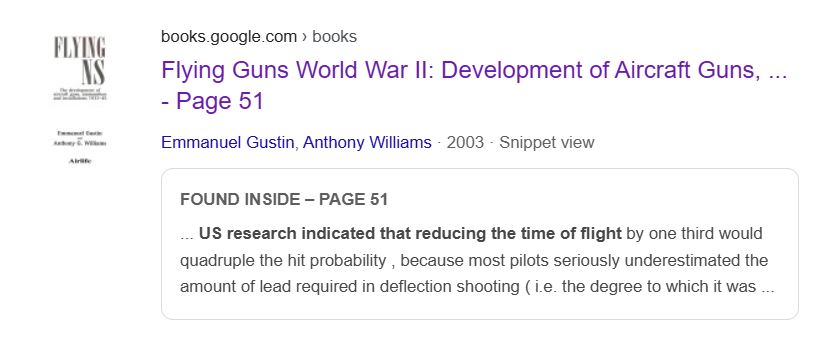
"US research indicated that reducing the time of flight by one third would quadruple the hit probability, because most pilots seriously underestimated the amount of lead required in deflection shooting."

I checked "Rapid Fire" and "Flying Guns - World War II", which are the two books I have, and it doesn't seem to be in there (or mentioned in an unexpected place, though the indexes of both books appear to be quite thorough).

Tony technically seems to be a member of this forum, but he hasn't logged in for a year now. I don't seem to be able to @-add him here, so I guess that might be a planned absence ... I think he retired from his own forum as well a while back.

Regards,

Henning (HoHun)
 
Hi TomS,

Google Books says it's on page 51 on Flying Guns - Worlds War II

Thanks a lot - now I feel like a Neanderthal for having wasted my time fruitlessly browsing through an antediluvian paper book! ;-)

Too bad that Tony's book, while having a very extensive bibliography, doesn't use footnotes ... I'd really have loved to learn more about the background of this statement.

Regards,

Henning (HoHun)
 
Hi TomS,


Thanks a lot - now I feel like a Neanderthal for having wasted my time fruitlessly browsing through an antediluvian paper book! ;-)

Too bad that Tony's book, while having a very extensive bibliography, doesn't use footnotes ... I'd really have loved to learn more about the background of this statement.

Regards,

Henning (HoHun)

I only checked Google Books after having looked fruitlessly thought my copy of Flying Guns -- The Modern Era on the off chance it might have shown up there. ;)
 
Hi again,

I'd really have loved to learn more about the background of this statement.

["US research indicated that reducing the time of flight by one third would quadruple the hit probability, because most pilots seriously underestimated the amount of lead required in deflection shooting." ]

Thinking about this for a bit, I'd say it obviously can't be universally applicable, since in a no-deflection attack, neither the reasoning nor the numerical factor would make any sense.

As the numerical factor is quite substantial, I'd say the statement probably applies to a case in which deflection shooting is required, and at a range where this results in very low hit probabilities with the original low muzzle velocities.

Why not just fly closer to the target to increase hit probabilities? That can be explained for example by a reason to stay at the original long range, for example because the target is actually shooting back, like a bomber with flexible defensive armament would.

And here it might be useful to look at a US Army concept from the infantry context (based on my probably imperfect understanding - infantry is not my specialty): "Overmatch" describes the situation where the US force can use its firearms effectively to fight the enemy, while the shorter ranged firearms of the enemy can't yet be used to engage the US forces. Of course, that's the Army's preferred combat range.

So my guess for what the USAAF (still a branch of the Army back then) was trying to achieve with the 0.60" heavy machine gun, based on Tony's brief mention of the research they did, was to provide fighters with a firearm that allowed them to engage enemy bombers from an "overmatch" situation, in which the fighters would be able to destroy the enemy bombers without being exposed to effective return fire.

From USAAF gunnery training material, it's clear that the Army Air Forces thought any effective attack on a bomber would involve a pursuit curve (as the fighter would avoid approaching straight from the six o'clock, as that would give the bomber gunners a really easy shot), so the attacking fighter would inevitably have to engage in deflection shooting - which at long range was quite difficult indeed, and probably could in fact be materially improved by an increase in projectile velocity.

Interestingly, there was also some German research on the same topic, when the Luftwaffe considered the possbility that they would have to intercept fast jet bombers in the future, and their conclusion was that while increased projectile velocity was a clear advantage at longer ranges and larger deflection angles, this disadvantage of low-velocity weapons could be compensated for by the use of lead-computing optical gunsights. Ironically, sights of this type were first fielded by the RAF and USAAF, so if the German conclusions were in fact correct, the USAAF by the introduction of the K-14 computing sight had bascially made their motivation for requiring the 0.60" HMG obsolete.

Does that sound reasonable to you? It's a bit of a leap, supported only by very indirect and thin evidence, but after using the term "unreasonable" earlier, I felt sort of obliged to come up with an explanation that actually credits the USAAF with a rational approach, for a change ;-)

Regards,

Henning (HoHun)
 
2 points.

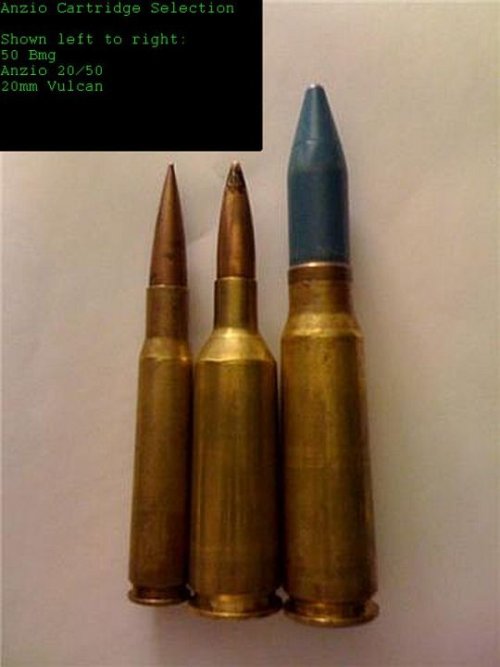
1) the development notes of the US 20x102mm says that it was based on the .60cal gun cases. Which does give us suggestions for performance if we look at the Anzio Ironworks 20/50 (a 20x102mm case necked down to .50cal).

Anzio-big-bore-selection1.jpg
900grain .50cal projectiles at roughly 3600fps. Supersonic range of 2500 yards.


2) deflection shooting is greatly dependent on the shooter's ability to lead the target correctly. The higher the projectile speeds, the less critical the range estimation is. And 3600fps will happily do that.
 
2 points.

1) the development notes of the US 20x102mm says that it was based on the .60cal gun cases. Which does give us suggestions for performance if we look at the Anzio Ironworks 20/50 (a 20x102mm case necked down to .50cal).

View attachment 804655
900grain .50cal projectiles at roughly 3600fps. Supersonic range of 2500 yards.


2) deflection shooting is greatly dependent on the shooter's ability to lead the target correctly. The higher the projectile speeds, the less critical the range estimation is. And 3600fps will happily do that.
70 year recollections are not reliable, but my recollection of the can of '60 Cal.' with inert rounds that my father gave me is that the ammunition was necked up M2 50 Cal. and compatible with M2/M3 receivers. Before we moved from Eglin AFB, dad commanded the Maintenance and Test wing where that version was being tested as alternative to 20mm.

That makes sense to me as the feed mechanisms, inventory of M2/M3 receivers and brass mfg would seem to favor neck up as 20mm was not standard until after GUNVAL in Korea in 1953.

As to lead correctly with higher velocity - I would tend to disagree. Lead with higher velocity ammo (both forward and vertical allowance) would be less but poor lead with High velocity is still 'poor'. I base that judgement on 65 years of competition in skeet, trap, flyers, Helice, sporting clays. One can discount 'lead' discussions for Helice and Bunker Trap and Flyers because those are too fast to shoot sustained lead but I have shot and shot well Skeet and Trap with loads ranging from 1150 to 1250 fps loads and never consciously adjusted lead. For high angle deflection I would agree that I would rather have a faster load for Flyers or Helice for the extreme hard right or left shot, but generally I shoot the 3 1/4 (1300fps) to 3 3/4 dram loads (1350fps) because I want the energy. For me there is no value in 1400fps thumpers.
 
Bit of necromancy, but I might have stumbled across the values for X and Y that you recalled. In post 67 in this thread over at WW2aircraft.net a user known as Jabberwocky says (albeit without sources), “Someone had worked out that for deflection shooting that if you cut the flight time by 1/3rd then the chance of a hit went up by 400% for the average pilot,” which I would say conforms with your characterization of an unreasonably high increase in hit probability.
I tend to agree Henning. Deflection shooting at 90degrees with insufficent lead is 100% miss behind the target.The same lead with higher velocity could result in hits, but if insufficient the rounds are still behind the target - just closer. It is only the case where the lead with slower velocity are getting strikes in the empennage where the higher velocity rounds could deliver hits in cockpit or engine areas.

I would submit that it makes little difference for a 30 to 40 degree deflection shot.
 
I forgot to note that (my understanding) the Eglin variety was experimental to find a minimum diameter to mate with reliable and powerful explosive projectiles while minimizing retrofit considerations across USAF maintenance and logistics channels.
 
Hi Scott,

2) deflection shooting is greatly dependent on the shooter's ability to lead the target correctly. The higher the projectile speeds, the less critical the range estimation is. And 3600fps will happily do that.

While that's undoubtedly correct, the gains from this are limited. Let's say you use a high-velocity 3600 fps muzzle velocity cannon to reduce to projectile flight times to 2/3 of that achieved with a conventional 2400 fps weapon: Your effective range against manoeuvring targets will not increase to 3/2 of the conventional weapon, as at that range, the apparent target size will be only (2/3)^2 of the apparent target size at the original range, or 44%.

In addition to this, to achieve the much increased muzzle velocity, compromises will have to be made, which probably includes a much increased dispersion, which is a range-limiting factor in itself. Historically, the 0.60" machine gun in the form that was flight tested was known for excessive muzzle blast and violent vibrations when firing, and that would be difficult to avoid in any design that increased the propellant energy enough to provide the desired muzzle velocity increase - unless one decreased projectile mass or increased the mass of the cannon, which both are trade-offs that immediately make the new design less competitive.

It's worth noting that the Luftwaffe had a high-velocity fighter gun at its disposal, the 15 mm MG 151, which as soon as a 20 mm barrel for firing highly destructive mine shells at a much lower muzzle velocity became available was dropped from service as a fighter gun entirely. To the best of my knowledge, not even a single Luftwaffe fighter ace disagreed with that, which given the diva status Luftwaffe aces enjoyed is quite telling ;-)

In operational service, I presume that many encounters didn't require great amount of deflections. From combat reports, it's hard to tell, but given that often, bursts of several seconds duration are mentioned, I'd guess that's an indication of a target that was mostly static, and any trade-off made in gun design to facilitate deflection shooting would lead to the weapon being inferior to the standard weapon in a situation that didn't require lots of deflection.

Regards,

Henning (HoHun)
 
Hi Bill,

As to lead correctly with higher velocity - I would tend to disagree. Lead with higher velocity ammo (both forward and vertical allowance) would be less but poor lead with High velocity is still 'poor'. I base that judgement on 65 years of competition in skeet, trap, flyers, Helice, sporting clays.

The Luftwaffe's comic-book-style manual "Des Jägers Schießfibel" confirms that sentiment ... https://www.lexikon-der-wehrmacht.de/Vorschriften/Schiessfibel.pdf

On the numbered p. 14, emphasis is placed on knowing the proper lead exactly, pointing out that weapon dispersion is not going to compensate for poor lead.

(And on p. 12, it's actually suggested that lead-estimation practice should actually be incorporated into fighter pilot drinking games! :-D )

On a slight tangent, what's your take on reflector sights on sporting shotguns? Historically, the first practical use of such sights outside fighter cockpits seems to have been on such shotguns (with the ambient-illuminated Nylar sight, I believe), but apparently, they were not as useful on shotguns as they were in fighter aircraft: https://www.forgottenweapons.com/nydar-reflex-sight/

Regards,

Henning (HoHun)
 
Hi Bill,


The Luftwaffe's comic-book-style manual "Des Jägers Schießfibel" confirms that sentiment ... https://www.lexikon-der-wehrmacht.de/Vorschriften/Schiessfibel.pdf

On the numbered p. 14, emphasis is placed on knowing the proper lead exactly, pointing out that weapon dispersion is not going to compensate for poor lead.

(And on p. 12, it's actually suggested that lead-estimation practice should actually be incorporated into fighter pilot drinking games! :-D )

On a slight tangent, what's your take on reflector sights on sporting shotguns? Historically, the first practical use of such sights outside fighter cockpits seems to have been on such shotguns (with the ambient-illuminated Nylar sight, I believe), but apparently, they were not as useful on shotguns as they were in fighter aircraft: https://www.forgottenweapons.com/nydar-reflex-sight/

Regards,

Henning (HoHun)
Hi Henning - my experience points to low value for reflector sights.

Once my face is on the stock I make sure that both eyes are either focused beyond the traps (if Multiple traps like Bunker or Helice) or in the case of skeet, approximately in the region in which the target appears matching my reaction speed. The barrel is not in my mind consciously. I'm aware of the periphery on either side of my gun hold position. The reflector sight has a tendency to draw my vision to the sight or barrel - which for me is very bad form. A one eyed shooter has no choice but for me in the field or Internat'l skeet my head and eyes are moving with the target as I bring the gun to face/cheek - always focused on the front of the target.

For flyers or upland birds I instinctively seek the head as the beak points toward where they want to fly

The only time I 'calculate' lead is a long crossing or high inbound overhead. Pheasant, ducks/geese and wood pigeons and sporting clays often present the shot and the time to make the calculation.
 
Hi Scott,


While that's undoubtedly correct, the gains from this are limited. Let's say you use a high-velocity 3600 fps muzzle velocity cannon to reduce to projectile flight times to 2/3 of that achieved with a conventional 2400 fps weapon: Your effective range against manoeuvring targets will not increase to 3/2 of the conventional weapon, as at that range, the apparent target size will be only (2/3)^2 of the apparent target size at the original range, or 44%.

In addition to this, to achieve the much increased muzzle velocity, compromises will have to be made, which probably includes a much increased dispersion, which is a range-limiting factor in itself. Historically, the 0.60" machine gun in the form that was flight tested was known for excessive muzzle blast and violent vibrations when firing, and that would be difficult to avoid in any design that increased the propellant energy enough to provide the desired muzzle velocity increase - unless one decreased projectile mass or increased the mass of the cannon, which both are trade-offs that immediately make the new design less competitive.

It's worth noting that the Luftwaffe had a high-velocity fighter gun at its disposal, the 15 mm MG 151, which as soon as a 20 mm barrel for firing highly destructive mine shells at a much lower muzzle velocity became available was dropped from service as a fighter gun entirely. To the best of my knowledge, not even a single Luftwaffe fighter ace disagreed with that, which given the diva status Luftwaffe aces enjoyed is quite telling ;-)

In operational service, I presume that many encounters didn't require great amount of deflections. From combat reports, it's hard to tell, but given that often, bursts of several seconds duration are mentioned, I'd guess that's an indication of a target that was mostly static, and any trade-off made in gun design to facilitate deflection shooting would lead to the weapon being inferior to the standard weapon in a situation that didn't require lots of deflection.

Regards,

Henning (HoHun)
I would add that tracers enable the shooter to 'walk' the stream forward or aft to strike the target.
 
70 year recollections are not reliable, but my recollection of the can of '60 Cal.' with inert rounds that my father gave me is that the ammunition was necked up M2 50 Cal. and compatible with M2/M3 receivers. Before we moved from Eglin AFB, dad commanded the Maintenance and Test wing where that version was being tested as alternative to 20mm.

That makes sense to me as the feed mechanisms, inventory of M2/M3 receivers and brass mfg would seem to favor neck up as 20mm was not standard until after GUNVAL in Korea in 1953.
Huh. Interesting.

Yes, being able to reuse M2/M3 stuff would be a huge improvement, but 15mm projectiles are heavy so I think MV would have been awfully low. IIRC 900gr .50cal flies at around 2500fps instead of the 2800fps of the 650gr standard slugs.


As to lead correctly with higher velocity - I would tend to disagree. Lead with higher velocity ammo (both forward and vertical allowance) would be less but poor lead with High velocity is still 'poor'. I base that judgement on 65 years of competition in skeet, trap, flyers, Helice, sporting clays.
100% agreed here. If you cannot lead properly you're not going to hit. But a faster ammo makes for less lead required at the same engagement ranges so the pilots are less likely to mess it up.
 
Huh. Interesting.

Yes, being able to reuse M2/M3 stuff would be a huge improvement, but 15mm projectiles are heavy so I think MV would have been awfully low. IIRC 900gr .50cal flies at around 2500fps instead of the 2800fps of the 650gr standard slugs.


100% agreed here. If you cannot lead properly you're not going to hit. But a faster ammo makes for less lead required at the same engagement ranges so the pilots are less likely to mess it up.
The 1950-1953 timeframe was replete with testimony that the F-86, while hammering MiGs above 35K, they were not getting flames/explosions or structural failures with heavy API concentrations. I suspect the issue was recognized as solvable with explosive rounds leading to destruction of key structural components.

FWIIW I have never seen MV more important than primary and secondary destruction due to the projectile. MV is certainly important to tissue damage in hunting, and important to 'lead', but even in that consideration I have been a 'big bullet' proponent for Elk or Bear or Kudu, for example and feel that an explosive round offers better range of applications than ball or API in same caliber comparisons.

Strictly opinion, but shared among many
 
Hi Bill,

I would add that tracers enable the shooter to 'walk' the stream forward or aft to strike the target.

That might be an explanation for the long bursts, but the WW2 training manuals are generally critical of this. The Schießfibel says, "A woman's love can be treacherous, tracers are a lot worse."

The "tracer illusion", as it was sometimes called, was based on the lack of distance cues for the tracer stream, so it might look like the tracers were hitting the target when they were in fact arching over it and burning out behind it.

I believe the "de Wilde" round used by the RAF was so popular because it indicated a hit more clearly with a flash, and the Germans had "observation rounds" for the same purpose.

Ingeniously, the Japanese tried to provide some distance cues with colour-changing tracers, so you'd be able to tell near and far trajectory apart.

Generally, manuals stressed the use of the sight as the most important technique, though in my opinion, the "calculation" of lead as outlined for example in the RAF's "Bag the Hun" wasn't really suited for heat-of-combat moments.

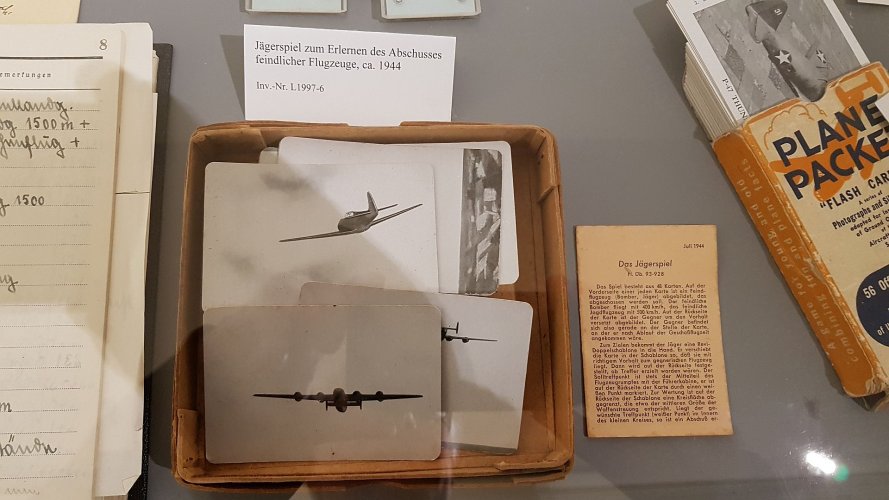
I'd love to learn more about the German instruction/practice methods mentioned in the Schießfibel. I saw an example of the card game in the Deutsches Museum at Oberschleißheim, but of course it was safeguarded against my curiosity by a glas cabinet ;-)

Regards,

Henning (HoHun)
 
Hi Scott,

If you cannot lead properly you're not going to hit. But a faster ammo makes for less lead required at the same engagement ranges so the pilots are less likely to mess it up.

The question is, is it worth it to increase the muzzle velocity while providing a weapon that fits the same restrictions with regard to weight and bulk, especially considering that in many situations, like a rear attack, increased muzzle velocity doesn't provide much of an advantage?

Comparing the 15 mm MG 151 to the 20 mm MG 151/20, the combined kinetic and chemical energy of the 15 mm high eplosive shell was only about 60% of its 20 mm counterpart, at 85% of the weight per belted round - so it was just roughly 70% as effective for rear attacks (using total energy as a yard stick for effectiveness) for equal weight of rounds. If one introduces the much more effective 20 mm mine shells to the comparison, relative effectiveness is even down to 35%.

To overcome this disadvantage and draw equal outside of the parameter range where deflection doesn't really matter, the 15 mm rounds would need to be 42% more likely to hit even with the 20 mm high-explosive shells, or almost 3 times as likely to hit as the 20 mm mine shells.

However, to make a better weapon overall, the high-velocity weapon actually needs to be clearly superior where deflection matters. How large the margin of superiority needs to be to draw even with the more destructive low-velocity weapon would require knowledge of the distrubution of attack directions. I have no data on that, so for the sake of the example, I'm assuming an even distribution of 50% rear attacks where deflection hardly matters, and 50% serious deflection attacks where the high-velocity weapon can utilize its advantage.

This leads to the requirement that the high-velocity weapon needs to score 82% more hits than the low-velocity weapon on the basis of a comparison to the high-explosive shell, and 6 times as many hits as the mine shells.

The mine shells could be seen as an "unfair" technology advance to make the larger calibre look better, but based on Tony Williams' "Flying Guns", I'd say it's more a case mine shells not being worthwhile in smaller calibres, so their availability is directily tied to the calibre increase that goes along with the muzzle velocity decrease that's at the heart of this comparison.

In conclusion, I get the impression that in a WW2 context, as long as slower projectiles can be made more destructive than faster ones), the lowest muzzle velocity one can still "get away with" is probably near the overall optimum. How low exactly the muzzle velocity can drop is probably determined by how large the share of the attacks is in which deflection doesn't play a significant role - this share will shrink as muzzle velocity is reduced.

Regards,

Henning (HoHun)
 
Hi Scott,


The question is, is it worth it to increase the muzzle velocity while providing a weapon that fits the same restrictions with regard to weight and bulk, especially considering that in many situations, like a rear attack, increased muzzle velocity doesn't provide much of an advantage?

Comparing the 15 mm MG 151 to the 20 mm MG 151/20, the combined kinetic and chemical energy of the 15 mm high eplosive shell was only about 60% of its 20 mm counterpart, at 85% of the weight per belted round - so it was just roughly 70% as effective for rear attacks (using total energy as a yard stick for effectiveness) for equal weight of rounds. If one introduces the much more effective 20 mm mine shells to the comparison, relative effectiveness is even down to 35%.

To overcome this disadvantage and draw equal outside of the parameter range where deflection doesn't really matter, the 15 mm rounds would need to be 42% more likely to hit even with the 20 mm high-explosive shells, or almost 3 times as likely to hit as the 20 mm mine shells.

However, to make a better weapon overall, the high-velocity weapon actually needs to be clearly superior where deflection matters. How large the margin of superiority needs to be to draw even with the more destructive low-velocity weapon would require knowledge of the distrubution of attack directions. I have no data on that, so for the sake of the example, I'm assuming an even distribution of 50% rear attacks where deflection hardly matters, and 50% serious deflection attacks where the high-velocity weapon can utilize its advantage.

This leads to the requirement that the high-velocity weapon needs to score 82% more hits than the low-velocity weapon on the basis of a comparison to the high-explosive shell, and 6 times as many hits as the mine shells.

The mine shells could be seen as an "unfair" technology advance to make the larger calibre look better, but based on Tony Williams' "Flying Guns", I'd say it's more a case mine shells not being worthwhile in smaller calibres, so their availability is directily tied to the calibre increase that goes along with the muzzle velocity decrease that's at the heart of this comparison.

In conclusion, I get the impression that in a WW2 context, as long as slower projectiles can be made more destructive than faster ones), the lowest muzzle velocity one can still "get away with" is probably near the overall optimum. How low exactly the muzzle velocity can drop is probably determined by how large the share of the attacks is in which deflection doesn't play a significant role - this share will shrink as muzzle velocity is reduced.

Regards,

Henning (HoHun)
With velocity, higher is better to a point. There's clearly a range limitation on using guns in aerial combat. As aircraft speed increases, velocity better too because not only do you need it for firing time, but you need the rounds to outrun the plane.

Slow 'slug throwers' are fine against non-maneuvering bombers through the say, early 1950's. A massive cannon with destructive shells that fires slowly at lower velocity is just fine for that. But it doesn't work with fast jets fighting maneuvering opponents.

Then, by the late 50's you need a cannon with higher velocity not just to engage targets because of speed, but because aircraft are getting harder to destroy. When modern aircraft have lots of major components made out of machined solid billets, like this:

helicopter-airframe-structure-projects-milling-aluminum_(6)-.jpg


Throwing a mine shell at that does little or nothing. Blast won't cut it. You need destructive kinetic energy to smash parts like that.

Velocity and rate of fire become the important factors. Explosive power takes a back seat to sheer destruction by penetration.
 
The question is, is it worth it to increase the muzzle velocity while providing a weapon that fits the same restrictions with regard to weight and bulk, especially considering that in many situations, like a rear attack, increased muzzle velocity doesn't provide much of an advantage?
Arguably? No.

But USAAF/USAF thought it did.

Now, an M2 where the .50 was necked up to 20mm (see also MG151/20) likely would be the better option.
 
Hi Scott,

Arguably? No.

But USAAF/USAF thought it did.

Hehe, excellent point! :)

Now, an M2 where the .50 was necked up to 20mm (see also MG151/20) likely would be the better option.

Instead of a 46g 12.7mm bullet at 860m/s, such a weapon would fire a 90g 20mm mine shell at 615m/s, assuming the same kinetic energy in both cases.

Regards,

Henning (HoHun)
 
assuming the same kinetic energy in both cases
Internal ballistics is weird, but for a back of the envelope idea check it's good enough.

Instead of a 46g 12.7mm bullet at 860m/s, such a weapon would fire a 90g 20mm mine shell at 615m/s,
Exactly. I don't really like 615m/s, but ~20grams of boom inside would make a great equalizer. And with all the guns having the same MV it doesn't really matter. 6 of those will ruin someone's day, badly!

As is, the USAF went with the 20x102 which gave a velocity 150-200m/s in excess of that of the .50cal with only ~5grams of boom.
 
Hi again,

I'd love to learn more about the German instruction/practice methods mentioned in the Schießfibel. I saw an example of the card game in the Deutsches Museum at Oberschleißheim, but of course it was safeguarded against my curiosity by a glas cabinet ;-)

Jägerspiel.jpg

Translation of the visible instruction page:

"The game consists of 48 cards. On the front of each card, a to-be-shot-down enemy aircraft (bomber, fighter) is pictured. The enemy bomber flies at 400 km/h, the enemy fighter at 500 km/h. On the backside of the card the opponent is pictured offset by the proper lead. Thus, the opponent is positioned exactly in the position of the card at which it would have arrived after the passing of the projectile flight time.

For aiming, the fighter pilot uses a hand-held reflector sight twin template. He slides the card within the template in such a manner, that it is positioned with the proper lead. Then the backside is checked to see if hits would have been achieved. The objective is to always hit the central fuselage with the cockpit, it's marked on the backside of the card by a white dot. For scoring, the backside of the template delimits a disk area that roughly corresponds to the average size of weapon dispersion. If the desired point of impact (white dot) within the small disk, a kill has been [achieved]."

So for the glassbox display, it would have been interesting to show the sight template and the backside of a card, since the front is only a normal aircraft picture (probably of a model) that doesn't illuminate the methodology very well.

Regards,

Henning (HoHun)
 
Hi again,

Generally, manuals stressed the use of the sight as the most important technique, though in my opinion, the "calculation" of lead as outlined for example in the RAF's "Bag the Hun" wasn't really suited for heat-of-combat moments.

For reference, here's "Bag the Hun". The original seems to have had the reflector sight printed in red and thus looked a bit nicer than the black/white scan, as can be seen on this example page:

https://images.nationalarchives.gov.uk/asset/26981/
Regards,

Henning (HoHun)
 

Attachments

  • Bag the Hun (RAF Gunnery Manual).pdf
    3.3 MB · Views: 6
Now, an M2 where the .50 was necked up to 20mm (see also MG151/20) likely would be the better option.
The .50 BMG case tapers somewhat so you couldn't neck it out all the way to 20mm if you keep that characteristic. The general idea isn't unfeasible though. There was the 16mm Vega which which used a necked up .50 case. It was intended for a new machine gun/cannon and the designers thought the 16mm projectile was the minimum necessary to carry a worthwhile explosive charge. Supposedly Lockheed was interested in it as an armament for the P-38 but the USAAF couldn't be sold on the idea. I haven't been able to find more information on this unfortunately.

I think high velocity is a bit more useful than some are giving it credit for, but the .60 caliber took it to an extreme that ultimately wasn't worthwhile. Too low a velocity and it gets harder to hit, especially on maneuvering fighters.
 
Last edited:
The .50 BMG case tapers somewhat so you couldn't neck it out all the way to 20mm if you keep that characteristic. The general idea isn't unfeasible though. There was the 16mm Vega which which used a necked up .50 case. It was intended for a new machine gun/cannon and the designers thought the 16mm projectile was the minimum necessary to carry a worthwhile explosive charge. Supposedly Lockheed was interested in it as an armament for the P-38 but the USAAF couldn't be sold on the idea. I haven't been able to find more information on this unfortunately.
Huh, had not heard about that one!

And yes, .50bmg would basically be a straight-walled case with a 20mm projectile in it. That could cause issues with extracting the cases. Maybe a wax coating on the cases like .276 Pedersen or 5.7x28?


I think high velocity is a bit more useful than some are giving it credit for, but the .60 caliber took it to an extreme that ultimately wasn't worthwhile. Too low a velocity and it gets harder to hit, especially on maneuvering fighters.
Agreed. You do need enough velocity to get there, but anything 700-1000m/s is adequate for the task. If you have mixed-caliber armament, you want it all to drop at the same rate. The various MiGs had issues with this, 23mm guns missing high and the 37mm missing low.
 
The .50 BMG case tapers somewhat so you couldn't neck it out all the way to 20mm if you keep that characteristic. The general idea isn't unfeasible though. There was the 16mm Vega which which used a necked up .50 case. It was intended for a new machine gun/cannon and the designers thought the 16mm projectile was the minimum necessary to carry a worthwhile explosive charge. Supposedly Lockheed was interested in it as an armament for the P-38 but the USAAF couldn't be sold on the idea. I haven't been able to find more information on this unfortunately.

I think high velocity is a bit more useful than some are giving it credit for, but the .60 caliber took it to an extreme that ultimately wasn't worthwhile. Too low a velocity and it gets harder to hit, especially on maneuvering fighters.
An AN/M3 firing the 16mm Vega would have been a helluva thing.
 
Hi Scott,

And yes, .50bmg would basically be a straight-walled case with a 20mm projectile in it. That could cause issues with extracting the cases. Maybe a wax coating on the cases like .276 Pedersen or 5.7x28?

From Tony Williams' "Rapid Fire" and "Flying Guns", I got the impression that the US Army was very unhappy with cases that required wax coating, though it's been a while that I read these books.

If you have mixed-caliber armament, you want it all to drop at the same rate. The various MiGs had issues with this, 23mm guns missing high and the 37mm missing low.

This actually doesn't matter much as in mixed-calibre guns, the guns are adjusted to different elevation values so the drop at realistic shooting ranges is the same. If a MiG missed high and low at the same time, it's a sign that the pilot was firing from outside effective range - probably far outside, as such a clear picture would result only if not only the average trajectory, but also the dispersion cones were cleanly separated. (The USAF clearly recognized the MiG's armament as highly effective, see https://www.secretprojects.co.uk/th...-meteor-viii-mig-15-f86a-f86e-in-korea.42098/ )

For the US 12.7 mm heavy machine guns, "Air Forces Manual No. 64 - Fighter Gunnery" quote dispersion as the range-limiting factor, stating that above 1000 ft range, the hit density is too low, stating 1200 feet as the maximum effective range:

https://archive.org/details/air-for...bing-1-may-1945/page/67/mode/2up?view=theater
That's a bit of a Catch 22 for gun designers ... high muzzle velocity tends to increase dispersion, so attempts to increase the range by increasing muzzle velocity only works to a certain degree. The MG FF/M was actually superior to the higher-velocity MG 151/20 with regard to dispersion. Here a few numbers - they should be viewed as coarse indications only, as the dispersion also depends on the rigidity of the mounting and the airframe itself:

75% dispersion circles:

MG FF: 1.0 mil
MK 108: 1.5 mil
MG 151/20: 1.9 mil
MK 103: 2.0 mil
Hispano M2: 3 mil
12.7 mm M2: 4 mil

(German guns according to a memorandum of the Kommission "Schlechtwetter- u. Nachtjagd" vom 16.2.1945, US guns according to "Air Forces Manual No. 64", based on an installation in the P-38 ... nose-mounted guns usually have lower dispersion than wing-mounted guns.)

Regards,

Henning (HoHun)
 
In the Joint Fighter Conference, which has been mentioned a few times, the following is stated on pg 166;
Lieutenant Colonel TOUBMAN:
“You spoke of the .60-caliber gun. Can you give us a little
more dope on that gun?”
Commander MONROE: “Yes; I can give you a brief outline of it. It was a development that
was started in May 1941 by the Army, which, of course, develops all guns. After 3 1/2 years
we have about a dozen firing models. The gun has not gone too far along. From my experi-
ence with guns, the short time I have been in the Bureau, it is at least 1 year away. Even if
we had a gun now that was satisfactory that would give us 1,000 rounds with no breakages,
which is a sort of thumb rule used, I believe it would be practically a year before we could
get them in production. The .60-caliber gun is so attractive a weapon, and so lethal, that we
are trying to change our contracts to put a hole in the plane that a .60-caliber will go in, and
to make provision for it. Of course, we cannot guarantee what the final shape of the gun is
going to be. I cannot guarantee anything except that we can show now what a wooden
model looks like. I believe new production models are coming out at the moment. But it is
too far away.
“I don’t know whether the Army has any objections to my discussing the gun or not. If
not, I can give you figures on what the gun will do. We’re dishing the guns out to contrac-
tors. I suppose everybody here has been cleared. Well, it is a 3,600-foot-second gun, weighs
140 pounds, and has a rather large bullet, that is, the powder chamber is large and a conical
shape, which means it is going to be hard to stack them. That has been reduced recently, so
it’s not quite as conical as it was. Rate of fire is variously reported, anywhere from 500 to
700, depending on who is using it. This chart has 725 revolutions per minute. I think that is
high. It is probably in the neighborhood of 600. The armor penetration is very spectacular.
It will go through 1 1/4 inches of armor at 600 yards at a 20 degree obliquity, which means
that you can’t arm against it, you can’t carry that much armor. Its time of flying to 500 yards
is .045 seconds, against 0.62 for the conventional .50-caliber gun. It has a very satisfactory
effect on leak-proof tanks. When the leak-proof tank is full the hydraulic shock wave set up
is so severe, the exit side of the tank is ruptured with every shot. You can guarantee that if
you hit a full or semifull leak-proof tank, you will have a fire in every case. The German
leak-proof tank with this projectile did not have a fire. In addition to not being able to armor
your airplane, you cannot use the conventional leak-proof tanks. One hit, one fire.
It is a
very handy weapon to spring on your enemy at any time. I believe if you can get that gun in
the air you could knock out any air force in the world immediately. There is absolutely
nothing that can take it and these are not fanciful theories. They can be proved on the
ground and have been proved on the ground. So when the gun gets here we will really have
something. Of course, by that time, the other fellow may have something too. The weight of
the projectile is about the same as a 20-mm., that is double .50-caliber, or 60 pounds per 100
rounds. That is a pretty good picture of it. I would like the contractors to keep in mind until
it does come out, put in a hole for it and it will lead the field. I want to impress that on all the
Navy contractors, and due to the fact that it will almost fit into the 20-mm. hole, you should
not have too much trouble; it will be a good thing if the fighter contractor could bear that in
mind. Reserve a space for it.”
Sounds like there was a bit more than just the reduced lead that they found appealing.
 
There's some serious typos in that quote (I assume you copied a pdf?)

140lbs means it's the same weight or more as the Hispano-Suiza 20mm guns. It's got about the same cyclic rate as an AN-M2 aircraft gun, and only holds the same number of rounds as a 20mm withdrawn, the HS404 has about the same rate of fire.

Also, I'm not sure how often planes would leave various tanks full, as opposed to drawing them all down more or less equally (there's operational arguments for both)
 
Hi,

I think high velocity is a bit more useful than some are giving it credit for, but the .60 caliber took it to an extreme that ultimately wasn't worthwhile. Too low a velocity and it gets harder to hit, especially on maneuvering fighters.

Please allow me to clarify that I don't deny the usefulness of high muzzle velocities, it's just that I think that when it comes to trading off different desirable characteristics of weapons, muzzle velocity is the one that can be traded off with the least negative impact as long as you don't go into extremes.

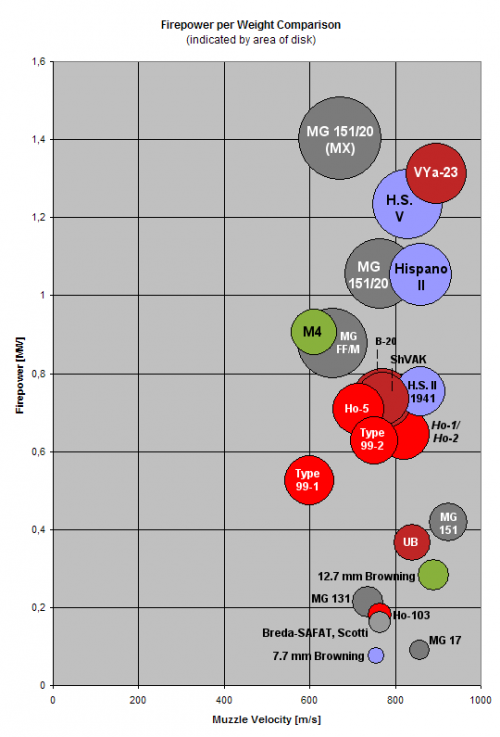
Here's a diagram a prepared quite a while back which shows the where most of the common fighter weapons were located in the "trade-off space", with the horizontal axis showing muzzle velocity, the vertical axis firepower per barrel, and the size of the disk the weight efficiency in terms of firepower per weight of a gun battery, including a certain (realistic) amount of ammunition.

Gun Comparison Plus 3.png

Depending on the exact assumptions and which of the varying and sometimes contradictory data sources one follows, this diagram could look a bit different in various ways and any implied ranking certainly isn't set in stone, but it shows some groupings, such as the light machine guns being quite weak by any measure, the heavy machine guns having a bit of variation in their parameters but being about equally weight-efficient, and the 20 mm cannon grouping nicely, with the Hispano having the best muzzle velocity and the German cannon living a bit outside of the main group due to the use of mine shells. It's also interesting to see the Hispano V dropping a bit of muzzle velocity in favour of a higher rate of fire, and the Luftwaffe projected use of the more powerful MX shells also lowering muzzle velocity in favour of effectiveness. (The MX shells never made it into operational use, as far as I know.)

Regards,

Henning (HoHun)
 
Hi Sienar,

In the Joint Fighter Conference, which has been mentioned a few times, the following is stated on pg 166;

Sounds like there was a bit more than just the reduced lead that they found appealing.

Well, the described good characteristics all are a direct result of the high muzzle velocity. The bad characteristics are low rate of fire, high weapon weight and high ammunition weight, showing that the good characteristics are the result of a trade-off (as is inevitable).

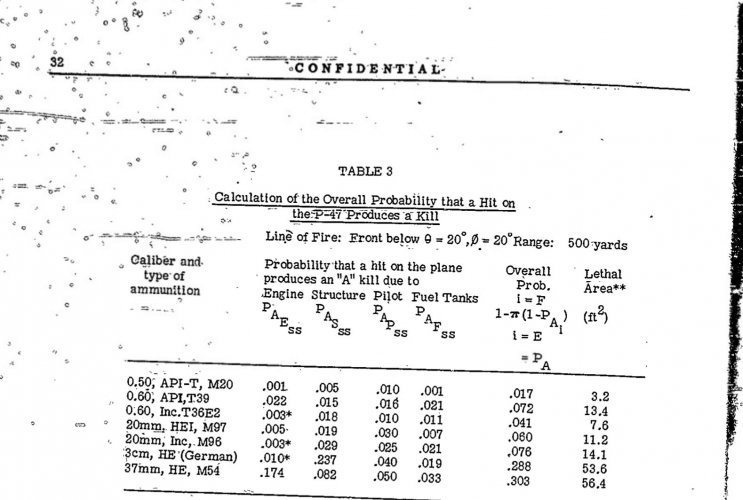
Here's Memorandum Report No. 462, Airplane Vulnerability and Overall Armament Effectiveness, by Herbert K. Weiss/Arthur Stein, based on extensive firing trials with various weapons, including the 0.60" machine gun: https://apps.dtic.mil/sti/pdfs/ADA800394.pdf

Excerpt:

ADA300394 Memorandum Report No. 462 Herbert Weiss.jpg

An "A" kill is a hit that takes the aircraft out of action within 5 minutes. Note that the 60 caliber rounds are much better (round per round) than the 50 caliber rounds, but about the same as the 20 mm rounds also used during testing.

Considering the increased weight, the 60 caliber gun doesn't look like a quantum jump to me.

Regards,

Henning (HoHun)
 
Back
Top Bottom