- Joined
- 27 December 2005
- Messages
- 19,230
- Reaction score
- 35,694
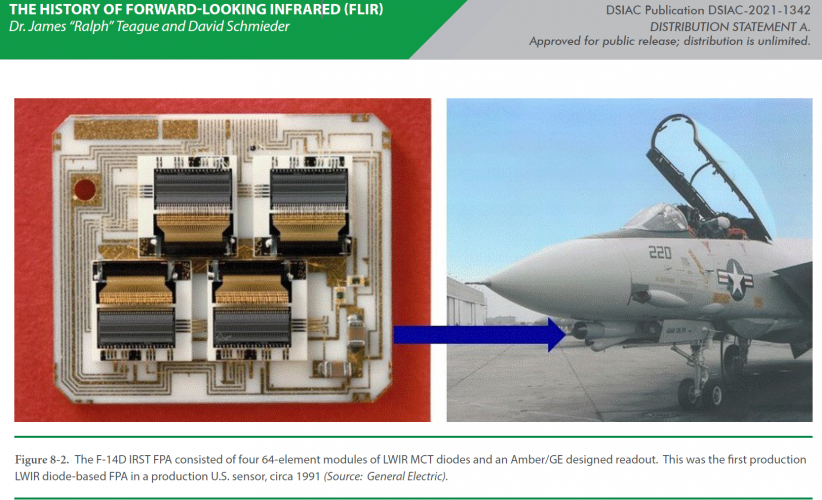
GE did the F-14D IRST.Infra-red search and track system
General Electric is developing an airborne infra-red search and track system (IRSTS) under what is described as 'multi-million dollar funding' from the US Air Force's Wright Aeronautical Laboratories at Wright-Patterson Air Force Base, Ohio. Under this programme, General Electric is to build and conduct-flight evaluation of an IRSTS which employs modern focal-plane array technology and sophisticated LSI-circuitry signal/clutter processing techniques. The system is intended to permit the multiple tracking of thermal energy emitting targets at extremely long ranges to augment information supplied by conventional tactical radars.
The General Electric programme entered the Phase 2B final design, fabrication and flight demonstration stage during the latter half of 1982 following a 16-month Phase 1 and 2A early design effort.
STATUS: under development.
Infra-red search and track systems
Northrop is currently involved in the development of infra-red search and track systems, designed for passive long-range target acquisition at night and in adverse weather. This equipment is known to have a multi-target capability. Other roles envisaged for these systems include weapon delivery, surveillance and fire control. One such system is called the focal plane array. It is an infra-red sensor that can direct optical target acquisitions at night or in poor visibility, and was tested on a US Army helicopter in 1984. The unit comprises 16 384
individual sensors, each of only 0.001 inch in diameter, feeding signals into a microprocessor. The resulting information is displayed on
the television monitor of the host optical system.
STATUS: under development.
Jane's Avonics, 1987-88
Last edited: