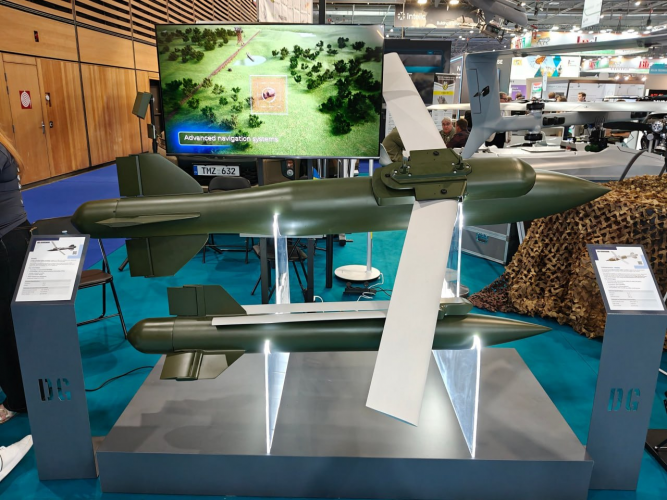
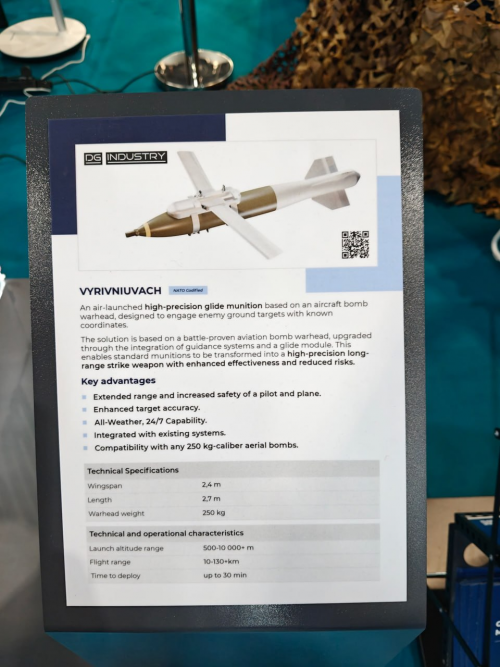
Ukraine missile/rocket/PGM projects

https://euromaidanpress.com/2026/04...er-month-in-winter-which-russia-hits-hardest/

Earlier, journalists identified a new surface-to-air missile known as "Koral" for the first time at the defense exhibition. Its development has been underway for several years as part of Ukraine’s ground-based air defense systems, with potential additional capabilities that may also support counterintelligence-related missions.

The reported specifications include a mass of around 300 kg, a 25 kg warhead, and a speed of up to 3,600 km/h. The missile is said to be capable of engaging some ballistic targets.
 
Last edited:
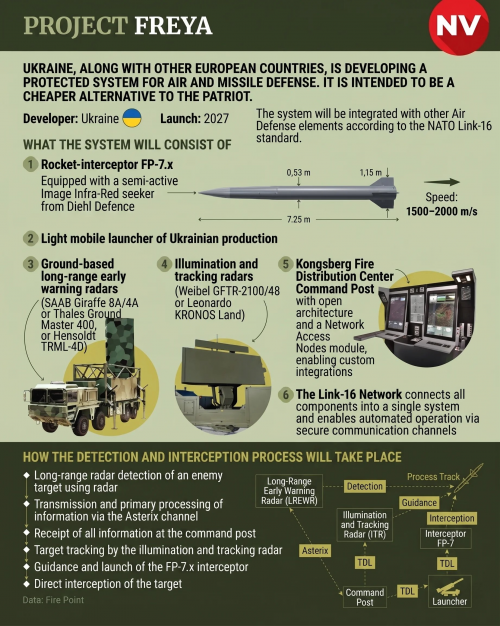
That looks very strange for IIR seeker... Something inbetween of pseudoimaging and very crude uncooled linear array.
It is cross type seeker. So you have 4 seeker elements in thin stripe shape rotating thousands of times per second and tracking every hot spot and possible flare their trajectory and amplitude changes and effect of gravity.
 

Ukraine’s top strike-drone maker moves into ballistic missile defense​

https://www.defensenews.com/unmanne...e-maker-moves-into-ballistic-missile-defense/
Its new FP-2 drone struck an oil refinery in Russia’s Tyumen region on June 20 — a target 1,286 miles from the Ukrainian border, Zelenskyy said — and the company says its rebuilt FP-1 now flies 1,677 miles up from 1,025 miles, while the FP-2 can carry a 440-pound warhead up to 230 miles away.

“The new modernized FP drones have been tested. Now they can reach targets at a distance of 3,000 kilometers. I am grateful to the Fire Point engineers,” Zelenskyy said in his June 20 evening address.
Zelenskyy said the next Fire Point drones will reach 1,864 miles, far enough to put refineries and arms plants in the Urals and western Siberia within range.
The FP-7.X is designed to hit a ballistic missile at 15 miles altitude for about $700,000 a shot — $300,000 under the original target — against roughly $3.8 million for a Patriot PAC-3. Fire Point aims to mass produce it at three a day starting in August.
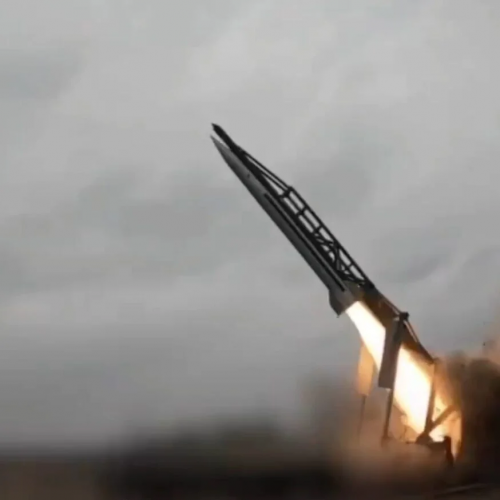
Fire Point flight-tested the FP-7.X in early June, a “fully controlled maneuvering flight,” co-founder Iryna Terekh wrote on X alongside a video of the launch.

Ukraine’s newest strike weapon drifts into Russia on the wind​

https://www.defensenews.com/global/...strike-weapon-drifts-into-russia-on-the-wind/
The balloon-born missile, DART, drops from a balloon at about 7 to 11 miles and runs on satellite guidance until it falls to about 4 miles, where its navigation cuts out and a solid-fuel engine carries it along a fixed course, according to its creators at the Ukrainian company Center of Innovative Technologies Program.

Its roughly 22-pound warhead scatters conductive graphite filaments designed to short out Russian power grids, according to Militarnyi, though it has not yet cleared Ukrainian military codification.
 
Last edited:
Some more on the FP-7.X ABM buried at the end of this.

https://defence-blog.com/ukraines-ballistic-missile-to-hit-moscow-is-almost-ready/
Fire Point’s ambitions extend beyond the FP-9 into an entirely separate program Shtilerman calls Project Freya, a Ukrainian anti-ballistic missile system designed as a lower-cost alternative to the Patriot. On June 3, 2026, Fire Point published footage of the FP-7x, described as a maneuvering interceptor missile, conducting a controlled flight test. Shtilerman told Pressing that the Freya system uses the FP-7 interceptor as its kill vehicle, integrates with existing Western radars including the Saab Giraffe, Thales Ground Master 400, and Hensoldt TRML-4D, and is built around an open software architecture specifically designed to prevent the kind of remote shutdown that rendered Qatar’s Patriot batteries inoperable when the United States suspended access during an Israeli operation targeting Hamas leadership. He characterized the entire Freya architecture as a deliberate response to the strategic vulnerability of depending on weapons that foreign governments can switch off unilaterally.
 
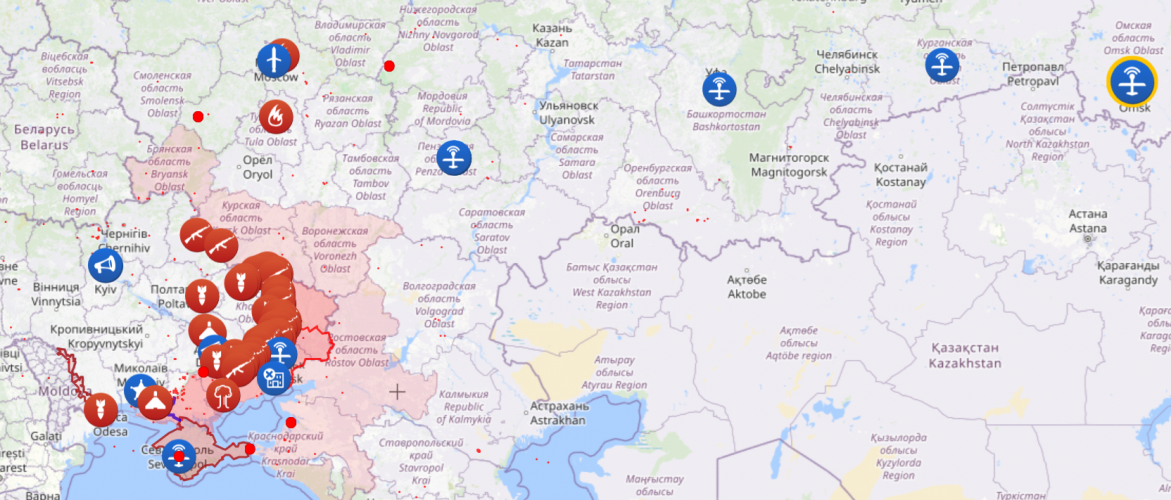
I spent two weeks in Sochi and witnessed two attacks by Ukrainian drones. The first drone was destroyed in front of my eyes from the window of a hotel room, and the second was destroyed from the window of a railway station building. The attack was carried out using the Pantsir anti-aircraft missile system, which fired a single missile at a single target and then fired a short burst of 6-8 cannon shells. Both drones were destroyed approximately 5-2 kilometers from the coastline. There were no other attacks.

https://maps.app.goo.gl/5dG2KrpNyDAQ1QcY8
 
I spent two weeks in Sochi and witnessed two attacks by Ukrainian drones. The first drone was destroyed in front of my eyes from the window of a hotel room, and the second was destroyed from the window of a railway station building. The attack was carried out using the Pantsir anti-aircraft missile system, which fired a single missile at a single target and then fired a short burst of 6-8 cannon shells. Both drones were destroyed approximately 5-2 kilometers from the coastline. There were no other attacks.

https://maps.app.goo.gl/5dG2KrpNyDAQ1QcY8

Wow.
 
Ukraine’s biggest missile runs on free drone software, CEO defends it
https://defence-blog.com/ukraines-biggest-missile-runs-on-free-drone-software-ceo-defends-it/
Key Points
  • Futura reported that Ukraine's FP-5 Flamingo cruise missile uses the open-source ArduPilot autopilot system, examined at Eurosatory in June 2026.

The routes followed are anything but straight.
View: https://x.com/NOELreports/status/2073411948398477369?s=20
 
Last edited:
Ukraine Calls For License Production Of Patriot Missiles

Ukrainian President Volodymyr Zelenskyy is calling for the country to be allowed to license-produce Patriot interceptors to try to stem the tide of Russian ballistic missile attacks.

Russia has been taking advantage of a shortfall in Ukrainian stocks of the missiles—as well as a slow-down in deliveries of the weapons—by increasing ballistic missile attacks against Ukraine’s cities and energy infrastructure.

Patriot deliveries to Ukraine have slowed to a trickle after hundreds of the missiles were used by the U.S. and Middle Eastern countries to defend against Iranian attacks. Washington is redirecting new-build weapons to Middle Eastern allies and the U.S. military.

Approximately 50 civilians have died in Russian missile strikes in the past week. During strikes on July 6, Russia launched nearly 30 ballistic missiles, but Ukraine was unable to down even one of them, according to figures released by the Ukrainian Air Force.

Now, Zelenskyy is calling on Washington to give the green light to enable license production of the missile in Ukraine and has urged his European neighbors to get behind such an initiative.

“We all value the Patriot system, but today’s wars have shown that current Patriot production is not enough to meet the growing demand for protection against ballistic missiles,” Zelenskyy told the NATO Summit in Ankara, Turkey.

“We have discussed Patriot production licenses with our American partners, and I ask you to support our efforts to make this happen,” he added.
 
If Zelensky wants to get US approval for licence production then he just needs to highlight all of the royalty fees Ukraine would be paying Raytheon.
 

Safran supplies the guidance system for the Ukrainian FP-5 Flamingo long-range cruise missile


Last month, industrial sites belonging to the Russian companies VNIIR-Progress and Titan-Barrikady [a Roscosmos subsidiary] were hit by Ukrainian strikes carried out in Cheboksary [on June 10] and Volgograd [on June 27], respectively. Both sites shared the common feature of being targeted by FP-5 Flamingo long-range missiles.

With a profile similar to the Soviet Tu-141 drone [though others might see a resemblance to the V-1], this vehicle was unveiled in August 2025 by the Ukrainian company FirePoint—which developed it with the support of the Anglo-Emirati group Milanion—just days before its first operational use against an FSB [Russian domestic intelligence agency] base in Crimea.

Powered by an Ivchenko AI-25 turbofan engine, the FP-5 Flamingo carries a 1,150-kilogram warhead over a maximum range of 3,000 km, flying at a cruising speed of 850 km/h [950 km/h top speed] and an altitude of 16,000 feet. Approximately thirty units are reportedly produced each month.

To navigate to its target, the FP-5 Flamingo uses a GPS and inertial guidance system—details of which FirePoint had previously disclosed almost nothing about. However, as reported by the daily newspaper *Le Monde* during the Eurosatory land-air defense trade show, the Ukrainian company revealed that the component in question was supplied by Safran. It further added that the French group was also participating in the "development of other products," without providing further details.

For its part, Safran confirmed that, through its subsidiary Safran.AI (formerly Preligens), it was supplying other "Ukrainian operators" with various types of equipment, including navigation systems, electro-optical systems, anti-drone countermeasures, and intelligence analysis support solutions.

In any case, the specific guidance system supplied to FirePoint by Safran was not disclosed. The manufacturer markets several solutions, such as the ICONYX inertial navigation unit, which is inherently resilient to the jamming of satellite-based positioning (GNSS) signals.

It is also possible that the FP-5 Flamingo’s guidance system is derived from the one developed by Safran for the A2SM (*Armement Air-Sol Modulaire*, or "Hammer") weapon system—much like the Thundart rocket, developed by MBDA under the FLP/T (*Frappe Longue Portée / Terrestre* or Long-Range Ground Strike) program led by the French Defense Procurement Agency (DGA) on behalf of the Army.

Ultimately, this cooperation between FirePoint and Safran could benefit the Chorus project, which the Ministry of the Armed Forces has entrusted to Turgis Gaillard and the automaker Renault.

As a reminder, during a Senate hearing in February, the Head of the Defense Procurement Agency (DGA), Patrick Pailloux, explained that the aim of the Chorus project was to develop "the equivalent of the Ukrainian Flamingo," albeit with lower performance specifications (a 500 kg warhead and a cruising speed of 400 km/h)

 

Perfect time to start developing a european IBCS or make all capable of similiar plug and play.....​

Perfect time to start developing a european IBCS or make all capable of similiar plug and play.....
It's really not a bad idea for Europe to co-develop this and have it as a stop-gap prior to HYDIS, as well as a cheaper alternative for volume, which seems to be what they're doing:

9 nations back Ukraine’s Patriot alternative, Freyja — and want it flying in a year​

https://www.defensenews.com/global/...ernative-freyja-and-want-it-flying-in-a-year/
NATO Secretary General Mark Rutte, European Commission President Ursula von der Leyen and European Council President António Costa also attended Monday’s meeting in Paris, in addition to representatives from several European defense companies, including: Destinus, Diehl Defence, Eurosam, Fire Point, HENSOLDT, Kongsberg Defence & Aerospace, Leonardo, MBDA, Saab, Safran, Thales and Weibel Scientific.
“Europe needs more protection against ballistic threats. Together, we can create such a system,” he said. “It is important to politically confirm that FREYJA is our joint project, serving the interests of all of Europe.”

View: https://x.com/angelshalagina/status/2076662270440976404?s=20
 
Last edited:

It's really not a bad idea for Europe to co-develop this and have it as a stop-gap prior to HYDIS, as well as a cheaper alternative for volume, which seems to be what they're doing:

More like Patriot then HYDIS/HYDEF but lets make it a common standard across europe for the current and next generation.

Make C2, sensors and effectors independent of each other and allow everyone to build what they need...
 
Last edited:
View: https://x.com/NOELreports/status/2084614201830420643?s=20

Ukraine’s Fire Point starts to integrate European tech into missile defense system​

https://www.defensenews.com/global/...te-european-tech-into-missile-defense-system/
Ukrainian drone and missile maker Fire Point has secured agreements from over a dozen European defense companies to provide radar, guidance and other systems for the Freyja missile defense project, and is starting to integrate the various systems, its CEO has said.
Fire Point aims to produce a ballistic interceptor for less than €1 million ($1.2 million) per missile, Terekh said — a quarter to a sixth of the cost of a Patriot.
A missile gets through only if all the interceptors in a launcher miss. Keeping the probability of six misses in a row below 5% — an industry standard — requires each interceptor to hit roughly 40% of the time, according to Fabian Hoffmann, missile expert at the Norwegian Institute for Defence Studies.
 
Last edited:

Similar threads

Back
Top Bottom