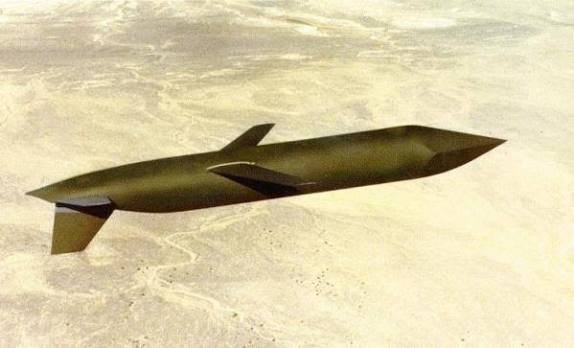
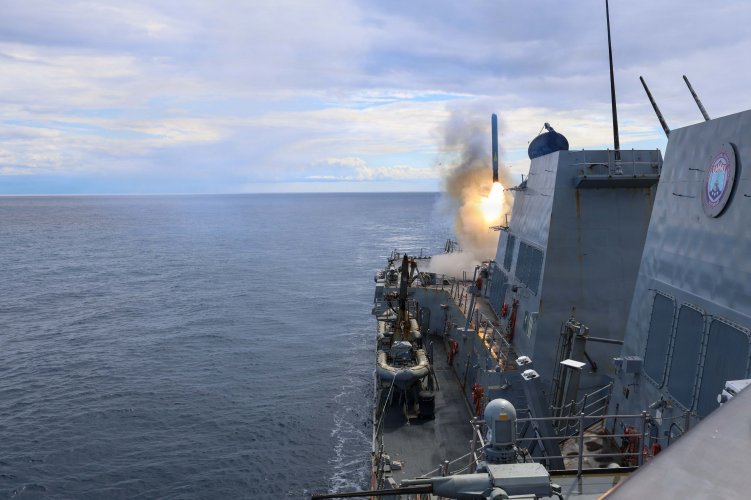
Your not seeing tomahawk from 50 to 100 km out, its going to be more like 20 to 30 (that's gust what turane hugging dose) and your not going to be able to afford to put sams sites on every available path, and an enemy airforce is going to have bigger thing to worry about then tomahawks in a war against the us.
SAM sites can't see a terrain-hugging object very far out, but a surface radar is not the only sensor operated by a peer enemy. Networked airborne radar systems, which these days includes fighters, can pick out a low-altitude object from a much greater distance. Once a track is established, ground or air fires can be vectored--it might be shot down by radar-guided SAMs, or a training jet firing heatseekers. It isn't a particularly difficult target.
If the enemy is afraid to radiate because of active sensor denial, they will still be flying, floating, or mounting networks of passive sensors, depending on the terrain. The Ukrainians frequently get a track on Russian missiles while they're still in Russia, but they certainly pick them up once they cross the border and start flagging the tower-mounted acoustics. A peer enemy will certainly be doing the same.
Also the b1 was almost canceled because stealth was just around the corner. the tomahawk was created during the same time period if turane hugging wasn't considered viable In the 80s then why would we have procured tomahawk in the first place?
Because they are completely different technologies in different niches? Obviously?
That's like asking why we kept putting guns on tanks even though we retired the battleships. Terrain hugging wasn't viable for bombers in the 80s, because bombers are big and expensive enough to be a rare occurrence. Tomahawk missiles are small (harder to detect for older airborne radar systems) and are cheap enough to be launched in the dozens for every bomber. If half the Tomahawks get caught, it doesn't matter, we were going to expend them anyway. Or, so goes the likely thinking in the 1980s. Flying low did a much better job, relatively speaking, since there were fewer other sensors around to pick up the slack.
An acoustic network may actually help dectet a turane hugging missile better then radar but that doesn't mean in enemy has the assests to intercept anyway. And do we have any data that supersonic terminal actually lowed defense effectiveness?
A peer enemy, by definition, should be expected to have the assets to intercept a subsonic cruise missile. I'm not arguing that Tomahawk isn't a useful weapon, it works fine for bombing technicals. I'm arguing that it is too expensive for plinking technicals, and it isn't high enough quality to fly through defended airspace.
Admittedly, I don't have a source on hand claiming that flying faster makes intercept harder. The vague proof is that ballistic missiles, which are fast, seem to have a lower shootdown rate than cruise missiles, which are slow. The other vague proof is that everyone is betting hard on stealth or hypersonic weapons, and if hypersonics were no more difficult to shoot down, that would be a foolish bet.
Low altitude flight is still an effective method of evasion. If nothing else, it at least postpones engagement by long range systems, and it forces those systems to be very close to the target.
Nothing with supersonic speed approaches tomahawk range, outside of far more expensive intermediate ranged ballistic missiles.
It definitely has a niche to fill, though a cheaper and easier to produce weapon is needed as well.
Emphasis mine. Yes, it does postpone detection to fly low. Fifty years ago, it postponed detection until you came over the horizon (pretty much, not in all cases or sensors). But now, it reduces detection until you get picked up by airborne sensors, active or passive, or a cheap network of passive acoustic sensors. Flying high might get you detected at 200 km, flying low with all of these other sensor options might get you detected at 150km. (Numbers are purely illustrative.) Strictly speaking, you made it 50 kilometers further. But if we're debating how effective this missile will be on the target, it got detected FAR away from impact and the enemy has plenty of time to vector interceptors. "Better" wasn't good enough.
What niche do you see it filling? It seems to me, we should rely on JDAM dropped by stealth or non-stealth platforms if the enemy doesn't have an IADS capable of shooting down TLAM, and we need a more blingy, expensive missile if they CAN shoot down TLAM. Perhaps this is a thread derailment, however.