- Joined
- 21 January 2015
- Messages
- 15,032
- Reaction score
- 24,272

[...] Atomic-6 claims to have created an improvement on the Whipple Shield with its Space Armor product. Developed over an 18-month period, Space Armor consists of tiles of a proprietary polymer made of an undisclosed ratio of fibers to resins that are formed under an equally hush hush process. These tiles are self-adhesive, measuring one foot by one foot (30 cm by 30 cm) and one inch (2.5 cm) thick, or can be made to order in sizes up to 3.3 ft by 3.3 ft (1m by 1 m).
According to the company, Space Armor can handle impacts of over 4.35 miles per second (7 km/s) with far less debris being produced. Variants include a lighter, thinner armor that can handle 90% of probable space debris up to 3 mm in diameter or a heavy version for debris up to 12.5 mm wide

Wouldn't ions be deflected by Earth's magnetic field?
Italy's 2025 Space Law introduces mandatory insurance requirements for space operators, allows victims to bring direct claims against insurers, and crucially grants Italian nationals the right to claim compensation from their own state even when no international claim is pursued. This creates a safety net that the international framework alone cannot provide.
Kinetica 1 is a 100-foot-tall (30 meters) solid-fuel rocket operated by CAS Space. The company, which is based in Guangzhou, responded to Nicolls' post, saying that it did its due diligence as the launch services provider (LSP) but is looking into the incident nonetheless.
"Our team is currently in contact for more details. All CAS Space launches select their launch windows using the ground-based space awareness system to avoid collisions with known satellites/debris. This is a mandatory procedure. We will work on identifying the exact details and provide assistance as the LSP," CAS Space said via X on Friday night.
"If confirmed, this incident occurred nearly 48 hours after payload separation, by which time the launch mission had long concluded. CAS Space will coordinate with satellite operators to proceed. This calls for re-establishing collaborations between the two New Space ecosystems," the company added in another X post a few hours later.
](...) Here we propose a new metric, the CRASH Clock, that measures such stress in terms of the time it takes for a catastrophic collision to occur if there are no collision avoidance manoeuvres or there is a severe loss in situational awareness. Our calculations show the CRASH Clock is currently 2.8 days, which suggests there is now little time to recover from a wide-spread disruptive event, such as a solar storm. This is in stark contrast to the pre-megaconstellation era: in 2018, the CRASH Clock was 121 days.
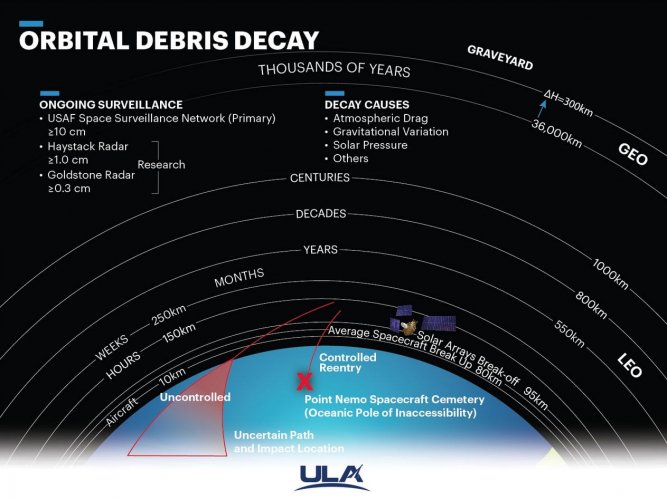
Arstechnica article with details on the breakup of Starlink 34343. Worrying bit is that this occurred in a higher orbit (560 km) than the December 17, 2025 breakup of Starlink 35956 (418 km orbit). Thus the resulting debris of the recent breakup should be around longer. Starlink 35956 re-entered on Jan 16.
https://arstechnica.com/tech-policy...into-tens-of-objects-spacex-confirms-anomaly/
The following months are going to show if this is an accelerating trend...