The Next US Army Tanker System (N.U.T.S?)

TomcatViP

Hellcat
Joined
12 February 2017
Messages
11,019
Reaction score
16,928
View: https://youtu.be/X-hQiibTHYg


As the US Army has confirmed its need for a refueling aircraft to support the new MV-75 Cheyenne II in long range assault mission and autonomous deployment (in the sense that MV-75 would deploy by themself instead of requiring Cargo shipment), this thread to track and comment US Army endeavor in this new domain (only US SOC and a very few Special Operation commands across the world have ever used long range air assault with rotorcraft supported by Aerial tankers before ).

@Mods : perhaps we could relocate here some of the post made in the MV-75 thread if your available time allows for this.

 
Last edited:
Detailing here the specificities of the mission according to our early discussions:

- Being able to refuel at high cruise altitude a group of Cheyenne on trans-oceanic deployment (Pilots only onboard refueled aircraft)
- Being able to refuel a group of Cheyenne at low alt (<10kft) on long range assault mission (troops in the cabin)
- Being able to fly at low level for long duration mission
- Able to cruise at low alt at 250kt for long duration mission
- Ideally capable of NoE flight at full or reduced Max takeoff weight while full mission capable at a similar speed
- Being able to operate according to ACE deployability conundrums
- Must be able to do STOL, at least with a reduced Takeoff Weight while remaining mission capable
- Must offer undisturbed slipstream for safe and rapid refueling and good drogue stability
- A dedicated crew member must be in charge to monitor and direct refueling operations
- All refueling equipment must be integrated to the airframe or rapidly mounted in a safe manner. That includes safe COM, night vison in rear sector, defensive equipment etc... (the tanker is not a pod but a fully built airframe)
- A nice to have capability is to be able to transition from high cruise altitude to low level in a rapid manner at mission weight (dive brake, thrust reverser, reversed prop pitch...)
- Being able to climb back to holding pattern at higher cruise altitude in a a quick and economic manner at mission weight
- The selected aircraft MUST NOT shadow, duplicate or burden USAF parallel effort to recapitalize their tanker fleet

Leaving to be completed: offloading fuel mass, airframe footprint etc...
 
Last edited:
The MV-75 boast un unrefueled range of 2100 NM for self deployment. I assume that means that the cargo compartment is filled with a removable fuel systems (like SOAR helicopters). While fuel carried is not listed, the platform claims to carry 10,000 lbs internally. That said even if the MV-75 can jump across the Pacific on self contained fuel, this does not solve the operational problem of extending the distance that the MV-75 can conduct air assault. Given that the information available says that the aircraft is to be able to do 200 NM radius of action (there and back) I would propose a couple more parameters:

If the MV-75 is conducting a long range air assault of an infantry battalion that would be a maximum effort for the MV-75 unit. Currently U.S. Army assault helicopter battalions have 24 helicopters. I would propose to stay with this number of MV-75 since they do not carry more troops than the UH-60. Given a realistic readiness rate the unit would have 19-20 aircraft available for the mission. Since the unit will likely have to make more than one round trip during the entirety of the air assault I think the limit should be no more than the aircraft range of 400 NM. If we use these parameter we need an inflight refueling of

~20 x MV-75 at mission gross weight.
distance of 350-400 NM
refuel should be done at efficient cruise speed (220-250 knots)
 
You perfectly identified the duality of the mission: supporting long range deployments at altitude and assault missions at low level where Cheyenne would takeoff at MGTOW, refuel and fly to their drop zone. A tanker must be able to loiter in that narrow space (considering IADS modern range), low, while MV-75 shuttle back and forth, and still be able to dash forward to support a crippled aircraft.
 
~20 x MV-75 at mission gross weight.
distance of 350-400 NM
refuel should be done at efficient cruise speed (220-250 knots)
By this eaxmple that's 100kllb plus some for each infill and exfill. With each MQ25 providing 15klb at least 7 would be needed on station or 14 to keep it flowing. Or a 3:2 ratio. Not ideal cost wise but then again not so different for jets either.
 
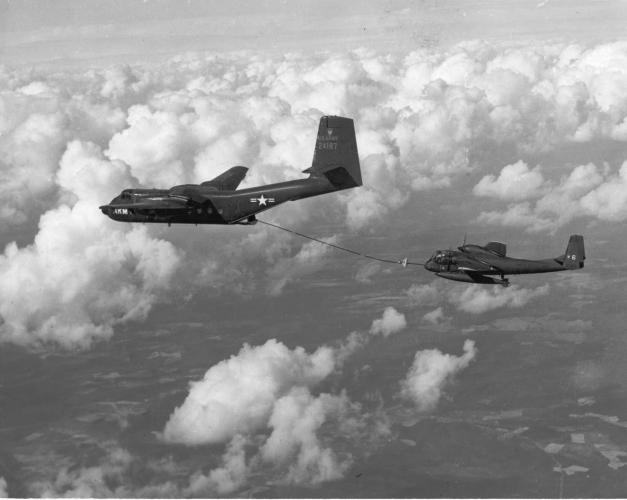
The Army has had an on-and-off interest in organic aerial refueling since at least the 60s, where an OV-1B Mohawk was fitted with a probe for refueling from a CV-2 Caribou and KC-130 to extend the Mohawk's ferry distance. The AH-56 Cheyenne in its initial form before budget cuts was also planned to self-deploy from CONUS to Europe on external tanks alone. I'd be very curious who ends up "owning" this tanker drone at the Division Aviation Brigade, or a higher Corps/Theater asset?

1777151090903.png

 
I’d like to see a refined multi-role amphibious STOL transport aircraft to take on this tanker role. This would give you lots more options than current types regarding basing. It could also cover USMC island basing support and Rapid Dragon like arsenal aircraft duties too.

Maybe revisit the towed glider fuel tank for the Cheyenne II if doing STO?
 
If we use these parameter we need an inflight refueling of

~20 x MV-75 at mission gross weight.
distance of 350-400 NM
refuel should be done at efficient cruise speed (220-250 knots)
Twice, actually. once on infil and again on the way out.


By this eaxmple that's 100kllb plus some for each infill and exfill.
That's about twice what one KC-130 with fuselage tanks can offload.


With each MQ25 providing 15klb at least 7 would be needed on station or 14 to keep it flowing. Or a 3:2 ratio. Not ideal cost wise but then again not so different for jets either.
Are you assuming the current small MQ-25s or the proposed enlarged ones? With longer wings/more fuel.

With larger airframes for the tanker, I'd want roughly 1 tanker for every 2-4 MV-75s.


I'd be very curious who ends up "owning" this tanker drone at the Division Aviation Brigade, or a higher Corps/Theater asset?
I'd assume Division Aviation Brigade.

Though it's possible that they'd be higher, since any operation needing IFR would need some serious SEAD/DEAD and that means integrating with USAF ops.


I’d like to see a refined multi-role amphibious STOL transport aircraft to take on this tanker role. This would give you lots more options than current types regarding basing. It could also cover USMC island basing support and Rapid Dragon like arsenal aircraft duties too.
Hard to do large STOL and amphibious at the same time.

The two are kinda counteracting. Either you have a tall narrow fuselage (see Shinmaywa US1/US2) or you have bigass draggy floats. Just to point it out, the takeoff distance of a float-equipped plane is about 25% more.
 
I’d like to see a refined multi-role amphibious STOL transport aircraft to take on this tanker role. This would give you lots more options than current types regarding basing.
Why amphibious? There's no tanker storage for them to refill. And using ships takes them away from the (more demanding) fleet which also requires far longer delay/transit time than an aircraft doing island hopping.

Are you assuming the current small MQ-25s or the proposed enlarged ones? With longer wings/more fuel.

With larger airframes for the tanker, I'd want roughly 1 tanker for every 2-4 MV-75s.
Current ones.
Ideally, a tanker should service only 4 in one session to keep mission delay time low and not wasting fuel for the whole group waiting for the last one to finish. Then loiter for the next group or for the exfill return part of the mission before returning. Assuming cruise speed on both sides are roughly similar. This would give a ratio of 1 tanker to 4 needy aircraft and no extra ones needed other than the spares.
Imho all future tankers should all be blended wing designs.
 
Back
Top Bottom