The Meredith, or Leduc-Effect

PhR

ACCESS: Top Secret
Top Contributor
Senior Member
Joined
15 February 2024
Messages
684
Reaction score
1,849
I guess you mean mega Meredith effect....
The so-called "Meredith" effect was known in France as "Leduc effect". René Leduc patented this effect in June 1933 (FR-770.326). He participated to implement it in the Breguet 482 engine cowling.
It is not required to have variable cross section nozzle to take benefit of this effect, it only requires a cross surface of the exhaust greater that the cross section of the inlet. But of course, having variable nozzle helps a lot to adapt to flight evolutions.
 
1776928289680.png
The so-called "Meredith" effect was known in France as "Leduc effect". René Leduc patented this effect in June 1933 (FR-770.326). He participated to implement it in the Breguet 482 engine cowling.
It is not required to have variable cross section nozzle to take benefit of this effect, it only requires a cross surface of the exhaust greater that the cross section of the inlet. But of course, having variable nozzle helps a lot to adapt to flight evolutions.
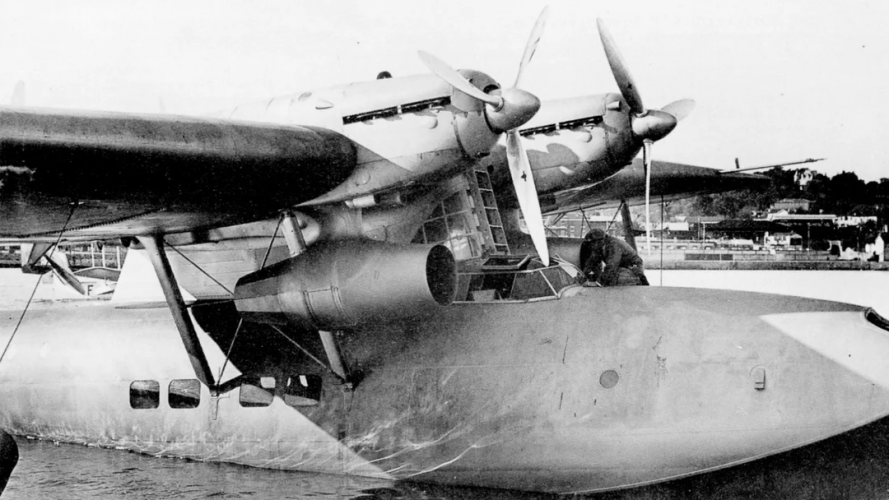
The Lioré and Olivier H-47 seaplane had ring coolers designed to minimize their aerodynamic drag. The prototype flew in 1936, but it was only after the first flight that this type of cooler was apparently installed ... Meredith’s work on the additional thrust of coolers designed according to his principle was published in 1936 ... The most famous example of the application of the Meredith effect is obviously the famous NA P-51 Mustang... But it is good to remember that this was in the air in the mid 1930s and 1940s, and it still is today in formula 1 racing cars !..
 
The so-called "Meredith" effect was known in France as "Leduc effect". René Leduc patented this effect in June 1933 (FR-770.326). He participated to implement it in the Breguet 482 engine cowling.
It is not required to have variable cross section nozzle to take benefit of this effect, it only requires a cross surface of the exhaust greater that the cross section of the inlet. But of course, having variable nozzle helps a lot to adapt to flight evolutions.
This geometry was allready invented by Hugo Junkers (''Duesenkuehler'') and used in the J1 (first all metal plane from 1914).

Meredith puplished a paper about the posibility of creating thrust, it might have been the first one. This can only be archieved, when the outlet speed is greater than the entry speed, therefor the exhaust cross section must be very small. A small exhaust cross section would cause the engine to overheat, therefor it must be variable.

 
the exhaust cross section must be very small
I do not understand this statement. It is exactly the opposite: the cross section of the exhaust must be greater than the inlet. If it is not the case, the thermodynamic effect cannot provide thust.
 
I do not understand this statement. It is exactly the opposite: the cross section of the exhaust must be greater than the inlet. If it is not the case, the thermodynamic effect cannot provide thust.
Not true, just look at the graphs of this post, you can see exhaust flaps but no inlet flaps. Same is true for the P51, the very first variants had iinlet and exhaust flaps, while the later ones only used exhaust flaps
 
I guess you mean mega Meredith effect....

I think that too, but I don't fully understand the birdcage like structure on the end. To really gain thrust out of the cooling air, the exhaust opening must be variable so that it can be minimized at high speeds. That strange thing at the rear is shurly a variable cross section nozzle, but I have no idea how it worked
Yes, that's what I meant lol sorry. I would imagine it was variable. Perhaps, and this is just me theorizing, it was like the I-16 air intakes that had "sliding doors" that could be opened and closed?
1776957872799.png
 
Not true, just look at the graphs of this post, you can see exhaust flaps but no inlet flaps. Same is true for the P51, the very first variants had iinlet and exhaust flaps, while the later ones only used exhaust flaps
The flaps are on the exhaust, as always. This is also the case for all jet engines: the exhaust is variable.
But you are wrong at least on one point: for having thrust from thermodynamic effect (effect called Leduc, Meredith, athodid, etc.), the exhaust is ALWAYS greater than the inlet. When this is not the case, the radiator only generates drag.
 
That's simply wrong, the inlet size influencees drag, but not the Meredith effect. All that matters is, the air must flow out with an higher velocity than at the entrance. This can only be archieved, if the exhaust cross section is small enough. Only than, the back pressure is mainly created by the exhaust flap and not by cooling drag. In an ideal cooling syst, the amount of air flow would only depend on the exhaust cross section.
 
Last edited:
Yes, that's what I meant lol sorry. I would imagine it was variable. Perhaps, and this is just me theorizing, it was like the I-16 air intakes that had "sliding doors" that could be opened and closed?
View attachment 810068
I'm quite shure they could be opened and closed by a plate rotating around the prop axis. A clever system became which became obsolete with the cowl flaps.

I love the look of the I-26
 

Similar threads

Back
Top Bottom