Surface Ships Need More Offensive Punch, Outlook

And yet the US continues to have a Defense budget greater than the next 10 countries combined. :rolleyes:
I think both the article and the following comment highlights two different problems both of which poses the same choice to the American taxpayer - are you willing to sacrifice or not?

Americans want to have it all - the guns, the bragging rights, the freedom, the low taxes all while marinating ourselves in a pool of welfare. That's not how this works. That's not how any of that works. You either increase defense spending by making cuts elsewhere, or you increase it by increasing taxes - at least that's my layman's impression. Make the sacrifice and you'll have solved a bit of this puzzle. The right balance of this is probably a big part of the solution.

The other side of this problem is that even upping 8% doesn't match Chinese production 1 to 1 because every goddamned thing from antacids to aircraft costs twice as much as it does in China. Instead, maybe we slash the blanket welfare programs, reinvest in building infrastructure, manufacturing, and factory worker's rights. Those jobs aren't easy at all, but they are the most important jobs. The rest of the bean counters, MBAs we need only as much as necessary. The surplus of those can follow the influencers and shitty middle-men startups right ahead into starvation until they transition to a more aligned profession. Essentially - government policy should reward those that align with the goals determined by the government while leaving the rest to evolution. But who am I kidding? I live in a democracy elected by lazy and out of touch people.

So yeah, realistically fixing the national strategy and broadly future defense initiatives involves mainly what the article author said - have a set of unyielding goals that supersede all other budgetary concerns. If your goal is to build the world's greatest safety net for people, then just leave the center stage to China. If your goal is to build the world's greatest military, then you either pay your debt off or you gouge it out of the taxpayer. You can't have your cake and eat it too.
 
Honestly, don’t you think the U.S. should be building arsenal ships like the Aegis-equipped vessels Japan is planning, rather than stealth-focused ships like the Zumwalt-class?Well, that’s assuming the U.S. still has the shipbuilding capacity to actually make them.
 
Honestly, don’t you think the U.S. should be building arsenal ships like the Aegis-equipped vessels Japan is planning, rather than stealth-focused ships like the Zumwalt-class?Well, that’s assuming the U.S. still has the shipbuilding capacity to actually make them.
No.
 
The U.S. is never going to meet PRC rates. It’s response will have to be asymmetrical.
If your focus is on the near to medium term, asymmetry is sustainable. If you want to compete long term - as in for the next century, making an asymmetric approach work requires sufficient technological advantage, which we probably dont have enough of. So we had better do something to close that gap. Resigning to just asymmetrical advantage is just resigning to a slow defeat. We arent just competing in the west pacific- thats narrow-minded. This is a power we will need to contend against on a worldwide scale or not contend against at all.

We dont need to meet things 1 for 1, but we at least need to meet something like 1 to 1.2 or 1 to 1.5 to even remain credible. Dismissing that as an option is a terrible idea especially since relatively speaking, we are still sorting out the problems of re-arming and modernization. Theres a lot of dust to be settled still.
 
The U.S. is never going to meet PRC rates. It’s response will have to be asymmetrical.
Plus we have to insure every pacific military is working jointly with us. The US/Japanese/SKorean/Australian/Taiwan and the maybes like Philippines/Singapore/Vietnam/Indonesia etc. a coalition with overwhelming military power.
 
Most nations in the world can not and have citizens that do not want to intervene in the affairs of far away nations. It is not like the US is actually dependent on those far away places for much.

If the American way is actually superior, it can be self evidently observed and no military force is necessary to cause it to spread.
 
And yet the US continues to have a Defense budget greater than the next 10 countries combined. :rolleyes:
It's also got one of the largest economies in the world. So you need to start comparing defense budget to economy size.

As a % of GDP is the usual method.


Honestly, don’t you think the U.S. should be building arsenal ships like the Aegis-equipped vessels Japan is planning, rather than stealth-focused ships like the Zumwalt-class?Well, that’s assuming the U.S. still has the shipbuilding capacity to actually make them.
The ASEVs are not "arsenal" ships any more than Ticos are. Arsenal ships were supposed to be more or less cargo ships packed full of VLS cells and their crews would abandon them in combat.

The Navy is currently talking about 3x32 Mk41s on the DDGX, same loadout as a Burke. With the option to swap a set of Mk41s for the bigger CPS tubes like those that replaced the guns on the Zumwalts.

Personally, I'd want to line the port and starboard edges of the helo deck with Mk57 PVLS cells to pick up a few more cells available if they're going to swap 32x Mk41 cells for some lesser number of CPS. Assuming a helo deck roughly the size of a Burke (~50x50ft), you could put 4 or 5 Mk57 units on each side. That's 32-40 additional cells. This does require 26ft vertically in the stern where the helo deck is, however.


Most nations in the world can not and have citizens that do not want to intervene in the affairs of far away nations. It is not like the US is actually dependent on those far away places for much.

If the American way is actually superior, it can be self evidently observed and no military force is necessary to cause it to spread.
The US tried to play isolationist, you do your thing we do our thing and we ignore each other. We got dragged into not 1, but 2 global wars anyways.
 
The ASEVs are not "arsenal" ships any more than Ticos are. Arsenal ships were supposed to be more or less cargo ships packed full of VLS cells and their crews would abandon them in combat.
Not exactly. The general idea of arsenal ship is, it's only a mobile launch platform. It got many launchers, but no fire control system of its own, only very rudimental sensors and self-defense armament. It rely completely on other warships fire control systems for missile guidance.
 
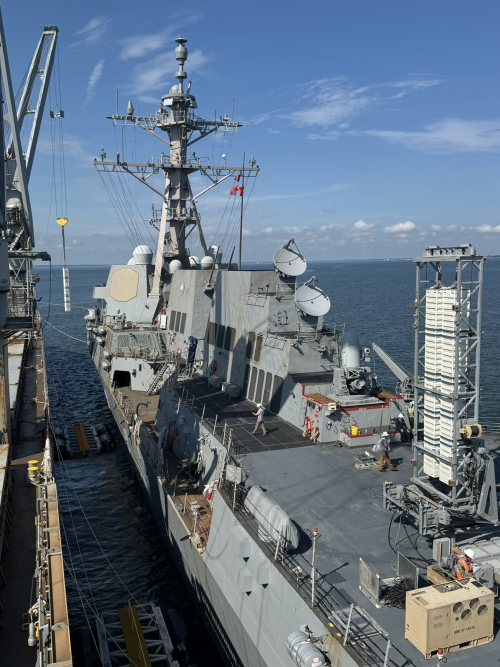
The U.S. Navy is moving closer to rearming warships in the open ocean following the successful reloading of missile canisters into a vertical launch system while off the coast of Virginia last week.

While anchored at sea July 17, USNS Gopher State (TACS-4) utilized its heavy-lift cranes to transfer and load 25-foot missile canisters into a vertical launch system on destroyer USS Farragut (DDG-99) as part of Large Scale Exercise 2025, the third iteration of the Navy’s global maritime exercise.

1753346968217.png
ORIGINAL CAPTION: Destroyer USS Farragut (DDG 99) during a vertical launch system (VLS) rearmament evolution as part of Large Scale Global Exercise 2025. US Navy photo
 
"while anchored at sea"

They need to do that while making 15+ knots.
Issue is well.

You a bubble head, I assuming you help with Sub reloading at least once.

Imagine doing that, out at sea in 15 knots.

It basically the same process and issues.

A 15 to 20 foot steel pipe full of boom makes everyone brown star pucker up when it starts swinging
 
Issue is well.

You a bubble head, I assuming you help with Sub reloading at least once.

Imagine doing that, out at sea in 15 knots.

It basically the same process and issues.

A 15 to 20 foot steel pipe full of boom makes everyone brown star pucker up when it starts swinging

Which is why the 1980s system they resurrected last year keeps the canister under positive control once it comes off the highline from the supply ship.
 
It's also got one of the largest economies in the world. So you need to start comparing defense budget to economy size.

As a % of GDP is the usual method.
The US also has massive global commitment to allies/alliances. The argument of “the next ten countries combined” is absolutely irrelevant.

Plus spending 3.5% of GDP is incredibly affordable for a nation. The Cold War average was near double.
 
By “underway” I mean the ship actively moving in open water.

That one was underway. Up to Sea State 4, which admittedly is pretty calm for the open ocean, but baby steps here. I think TRAM is designed for up to Sea State 6 (but don't quote me on that).

The tests were done during a typical, connected underway resupply between Chosin and Washington Chambers, using TRAM hardware modified and modernized “with additional sensors and technology,” Small said. Crews used TRAM to remove an empty canister from Chosin’s forward vertical launching cell and then transferred it to Washington Chambers, he said, and then they took a new canister from Washington Chambers and loaded it into an empty VLS cell aboard Chosin.
 
Last edited:
Perhaps I am just misusing “underway”.

“While *anchored* at sea July 17, USNS Gopher State (TACS-4) utilized its heavy-lift cranes to transfer and load 25-foot missile canisters into a vertical launch system on destroyer USS Farragut (DDG-99) as part of Large Scale Exercise 2025, the third iteration of the Navy’s global maritime exercise.”


These are two separate events. The one I referenced was Chosin and Washington Chambers, not Farragut and Gopher State. The Chosin test occurred as part of a connected underway replenishment with both ships, not an anchored evolution.
 
Last edited:
These are two separate events. The one I references was Chosin and Washington Chambers, not Farragut and Gopher State. The Chosin test occurred as part of a connected underway replenishment with both ships, not an anchored evolution.

My mistake.
 
The US also has massive global commitment to allies/alliances. The argument of “the next ten countries combined” is absolutely irrelevant.

Plus spending 3.5% of GDP is incredibly affordable for a nation. The Cold War average was near double.
Average of 7% of gdp during the cold war? What nations are u talking about? 3-4 % were more like the average with 4 beeing on the high side..
 
Average of 7% of gdp during the cold war? What nations are u talking about? 3-4 % were more like the average with 4 beeing on the high side..
No... no it wasnt.

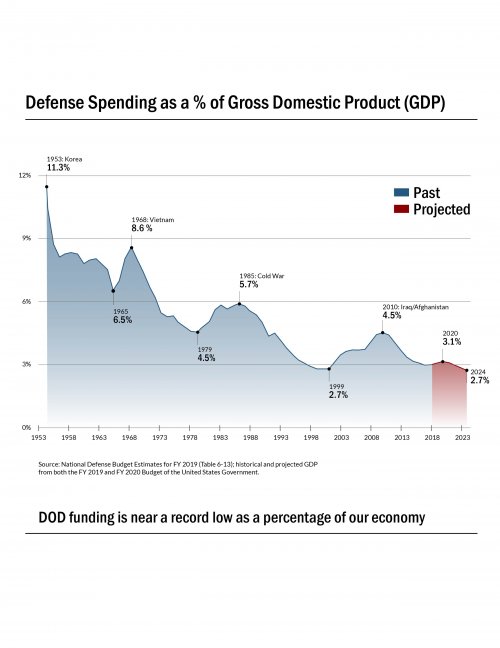
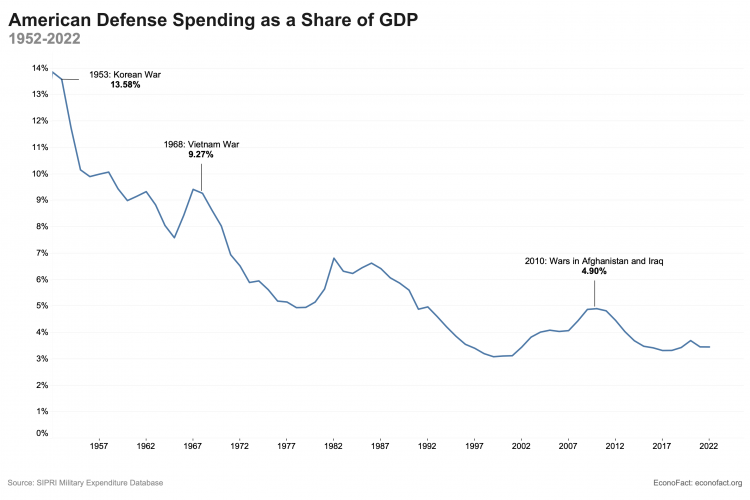
Below are excerpts from this article. It was only under clinton that we started flat-lining at 3 - 4 percent GDP. For most of the cold war, spending never fell below 5%.

through the Vietnam era, defense spending was typically 8 to 10% of GDP

After the Vietnam drawdown, defense spending dropped to around 4.5% of GDP which is almost 50 percent bigger than the current share of national income spent on defense.

Defense spending increased to about 6% of GDP during the Reagan Administration

1753459138276.png
 
No... no it wasnt.

Below are excerpts from this article. It was only under clinton that we started flat-lining at 3 - 4 percent GDP. For most of the cold war, spending never fell below 5%.
Yeah the US and Soviet did.. no others could afford that.. in the end the soviets didnt..


Scroll down to :

Figure 1
Defence spending, 1960-2023​

in % of GDP.
 
Last edited:
Yeah the US and Soviet did.. no others could afford that.. in the end the soviets didnt..


Scroll down to :

Figure 1​

Defence spending, 1960-2023​

in % of GDP.
Except many estimated spending by the Soviets to be as high as 20% of GDP, arguably unaffordable, and they still maintained it for 45 years.
 
Except many estimated spending by the Soviets to be as high as 20% of GDP, arguably unaffordable, and they still maintained it for 45 years.
Sure i get that..

I was just replying to this claim:
"Plus spending 3.5% of GDP is incredibly affordable for a nation. The Cold War average was near double"

Cold war average was not 7% average for most nations.. atleats not in NATO.. and today even 3,5% is not "affordable" since most countries incl the US have to run huge defecits to spend that kind of money on defence.
 
Sure i get that..

I was just replying to this claim:
"Plus spending 3.5% of GDP is incredibly affordable for a nation. The Cold War average was near double"

Cold war average was not 7% average for most nations.. atleats not in NATO.. and today even 3,5% is not "affordable" since most countries incl the US have to run huge defecits to spend that kind of money on defence.
I was talking about the US only as my first paragraph eludes however I acknowledge the second paragraph does introduce some ambiguity/confusion to my meaning.

Should have read 3.5% is affordable for a nation the US spent nearly double that…..
 
The US also has massive global commitment to allies/alliances. The argument of “the next ten countries combined” is absolutely irrelevant.

Plus spending 3.5% of GDP is incredibly affordable for a nation. The Cold War average was near double.
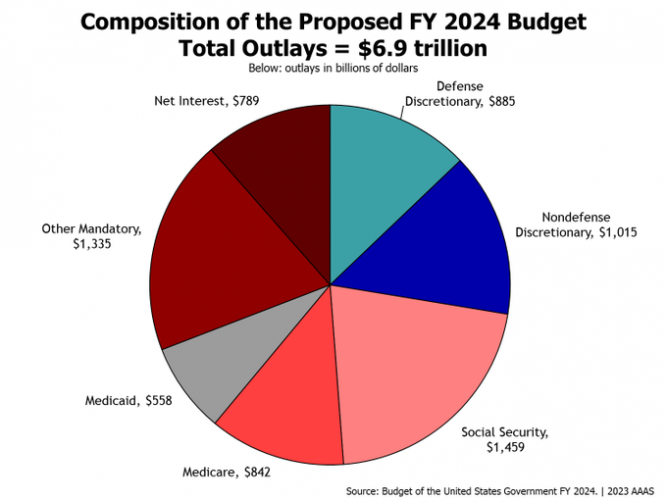
And to your point - I did a cursory search of this earlier to get a very rough understanding:

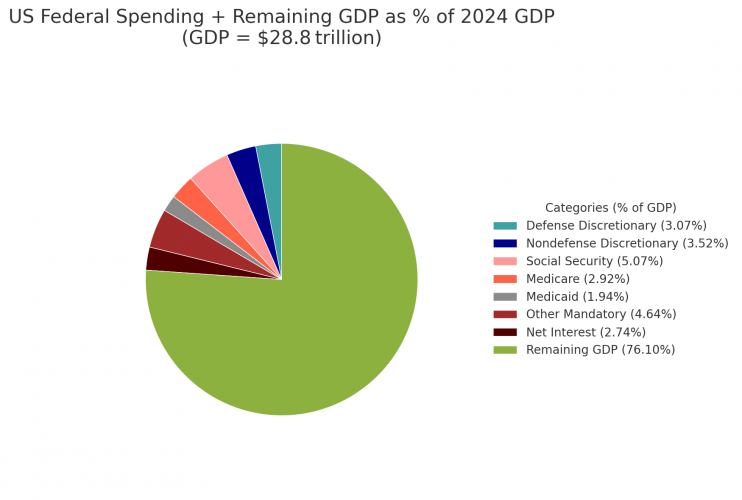
The US spending in 2024 looked like
1753460045338.png

Now I'm just going to assume for a moment this guy on twitter has accurate numbers. In 2024, the US gov's treasury website listed the GDP as 28.8 trillion. So if we were to look all expenditures as a proportion of GDP, you get this (defense spending in orange). I had chart gpt extract data from the top chart and present it with the 28.8 trillion total GDP. I didn't want to sink a ton of time into this so that's why it looks terrible:
1753461773348.png
So really when people say "we can't pay for shit" that's not really true, but your options are limited and not palatable to most Tiktok scrolling mouth breathers in this country:

1. Cut chunks out of social security, medicare, medicaid, other mandatory (like CDC, NIH, VA retirement)
2. Raise taxes
3. You could also pay off interest, but that requires cutting or raising taxes again.

So really in the end it's less "government MIC collusion" and more "mouthbreathers want a high social net and low taxes".

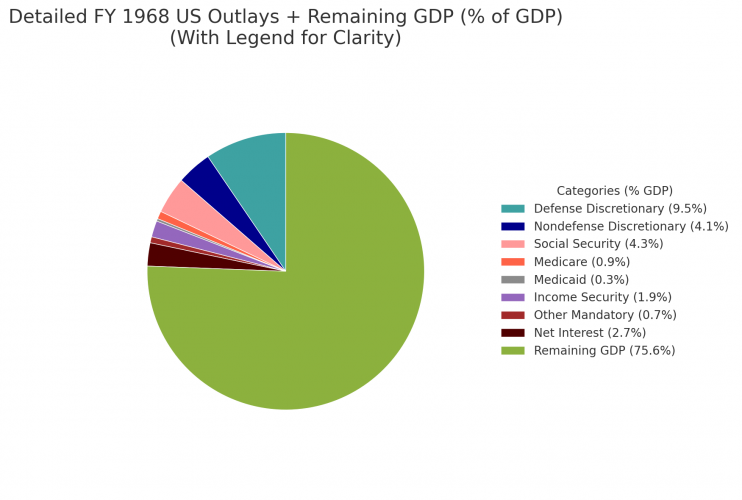
For reference, here is the an quick estimate for government spending in 1968 (defense spending in teal):
1753461733367.png
Total spending percentage relative to GDP shrunk, as the tax revenue relative to GDP has stayed fairly constant since after WWII.
Not terribly hard to tell what spending actually shrunk and what spending actually increased.
 
Last edited:
I was talking about the US only as my first paragraph eludes however I acknowledge the second paragraph does introduce some ambiguity/confusion to my meaning.

Should have read 3.5% is affordable for a nation the US spent nearly double that…..
Ok i understand what u mean..

But really is 3,5% really affordable for the US today?

US run huge defecits to finance everything.

I see the need to do it, even for the European nations but to call it affordable to blow a trillion $ every year on weapons dont seem "affordable" to me when its done by taking on debt.
 
On some level some of the posts reminds of Z telegram nationalists on how the Russian government fails so hard at properly fighting the war. (while other people roll their eyes at the starting and continuing of the war)

I'd think unless China pulls a pearl or 911, the bulk of the population won't be more interested in getting involved than Ukraine. From a certain perspective it can be viewed as a Budapest, I mean the island in question isn't even recognized as a state and there is a lot of escape clauses if one doesn't want to get involved.
 
I'd think unless China pulls a pearl or 911, the bulk of the population won't be more interested in getting involved than Ukraine.

From a certain perspective it can be viewed as a Budapest, I mean the island in question isn't even recognized as a state and there is a lot of escape clauses if one doesn't want to get involved
I don't think the national strategy right now is focused (just) on Taiwan at all nor do I think the U.S will easily jump into that conflict. Quite frankly, I still don't understand why people believe containing China within the first island chain is useful especially when there's zero chance the US and China go to direct war over anything.

Taiwan is, however, a good and realistic "scenario" that both represents the worst case location the U.S will have to fight China in and a concrete fear that helps give the population a more tangible reason to recognize China as the pacing threat.

The goal is to rile people up to 10 with 10 being "we will absolutely join the fight" while the need is to get the public to be concerned enough to start increasing military spending and compete with China in the long term. If you don't have a Taiwan to use as a very real example, then all anyone ever feels about China is that it's a distant competitor that makes cheap toys.

Realistically, the future of U.S China competition will be first and foremost in economy, technology, and diplomacy. Those are the areas where military supremacy is won or lost. Rarely - if ever - will it actually be won in the field save for US and Chinese tech in the hands of countries that fight their generational forever wars.
 
Taiwan is economically indispensable to the global economy, so it is far, far more significant that Ukraine or Budapest. As for U.S. involvement - that will totally be up to the administration in power at the time of any conflict. Popular support would not matter until the election cycle after such a conflict began, and while it would be consideration, it probably would not be the central one.
 

Similar threads

Back
Top Bottom