those are really good numbers on the right, if the service life sacrifice is like 6k to 4k it might be worthOfficial data on Izd. 177 engine, 16,000 kgf.
View: https://x.com/MuxelAero/status/1990040663052992794
View attachment 791755

You are using an out of date browser. It may not display this or other websites correctly.
You should upgrade or use an alternative browser.
You should upgrade or use an alternative browser.
Sukhoi T-75 LTS (CheckMate)
- Thread starter sublight_
- Start date
16000kgf in 905mm diameter. So your Su-27 can transform into P-42. Su-30Sm and Su-34 would benefit significantly from it. And Su-35 too.
BTW, it means that if they could squeeze 11t dry and 16t wet in 905mm, 17-18 ton for izd.30 is not that hard to believe.
BTW, it means that if they could squeeze 11t dry and 16t wet in 905mm, 17-18 ton for izd.30 is not that hard to believe.
More importantly, do we know if 177 is already flight tested, debugged and ready for production, or is it just an offer at the moment with testing/production to happen in the future if there are customers?

donnage99
ACCESS: Top Secret
- Joined
- 16 June 2008
- Messages
- 1,545
- Reaction score
- 1,546
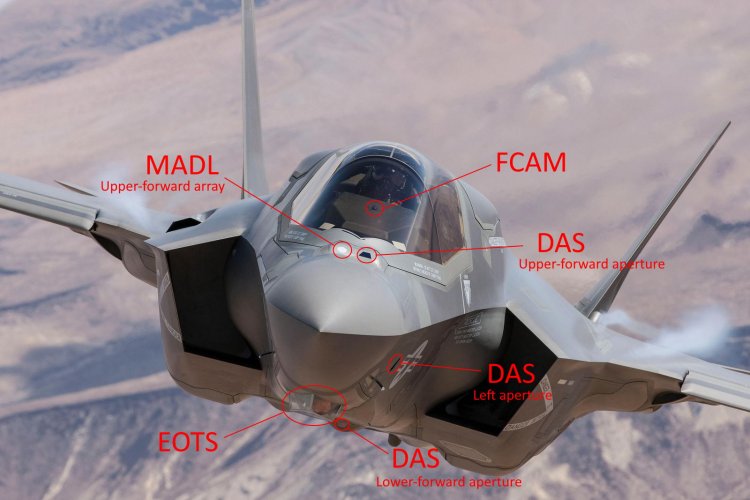
EOTS is basically an IRST and FLIR, laser range finder combined in 1. EOTS has zoom in function equivalent of the tracking function on traditional IRST. IRST often and ideally operates in LWIR. EOTS, because it also has ground mode, operates in MWIR. Each has its own advantages, but if your sensor is advanced enough, MWIR is the most versatile. Not to mention, block 4 introduces SWIR and visual light spectrum and IR marking function. Its housing utilizes an advanced material that provide great transparency over different frequencies and independent of rare earth metal in its manufacturing (supply chain vulnerability).Has there been a stealthy IRST ever been deployed by any nation? For example, the F-35s EOTS is not an IRST, but an IR camera - which operates on a different physical principle.
Interestingly, older literature stated that the DAS system operates in both MWIR and LWIR. I'm guessing the forward facing and possibly upward facing apertures have LWIR mode. However, such wording disappeared in recent time, either due to reclassification or more likely, dropped.
Anyway back to topic.
Attachments

LMFS
ACCESS: Top Secret
- Joined
- 19 March 2019
- Messages
- 563
- Reaction score
- 975
It is an offer for the export, means it used izd. 30 technology but is less advanced. Operational life should be better than 177S' 4k hour, it has been stated many times by UEC that this is one of the cardinal aspects of 5th gen engines.
The most critical parameter revealed, IMHO is the dry thrust. It has several key implications, at least in theory:
- 11k is the supposed dry thrust of F119. Though exhaust velocity matters a lot, high dry thrust is already one precondition of a supercruising engine
- Such value for the monkey version implies an even higher value should be expected for izd. 30
Just remembered that according to Marchukov, izd. 30's specific thrust should be best in class. So the overall supersonic performance of the engine, with those two preconditions met, should be excellent.
The most critical parameter revealed, IMHO is the dry thrust. It has several key implications, at least in theory:
- 11k is the supposed dry thrust of F119. Though exhaust velocity matters a lot, high dry thrust is already one precondition of a supercruising engine
- Such value for the monkey version implies an even higher value should be expected for izd. 30
Just remembered that according to Marchukov, izd. 30's specific thrust should be best in class. So the overall supersonic performance of the engine, with those two preconditions met, should be excellent.
Last edited:
Scott Kenny
ACCESS: USAP
- Joined
- 15 May 2023
- Messages
- 16,974
- Reaction score
- 24,080
With the right airframe, a J52 is capable of supercruising.The most critical parameter revealed, IMHO is the dry thrust. It has several key implications, at least in theory:
- 11k is the supposed dry thrust of F119. Though exhaust velocity matters a lot, high dry thrust is already one precondition of a supercruising engine
- Such value for the monkey version of izd implies an even higher value should be expected for izd. 30
donnage99
ACCESS: Top Secret
- Joined
- 16 June 2008
- Messages
- 1,545
- Reaction score
- 1,546
Thorough faceting of all panels and gaps itself is not some technological achievement in itself (it's not that hard to weld basic shapes), it is rather an indicator that the material science side of stealth has caught up (or projected to catch up by the time of its mass production), namely the ability to convert specular waves into surface waves and guide them towards the aligned leading edges, gaps, panels that dumb uniformly the return in a controlled manner and narrow spikes.If the model corresponds to the real design, then we see a significantly greater emphasis on stealth than in the case of the Su-57 (cut from a photo by Michael Jerdev).
I wouldn't doubt su-75, if designers truly able to achieve these breakthroughs by the time of its production, yield significant lower RCS while utilizes less RAM than the su-57 (yes modern true stealth fighters like f-22 and onward minimizes RAM usage in comparison to earlier stealth F-117)
Ainen
I really should change my personal text
- Joined
- 25 August 2011
- Messages
- 2,113
- Reaction score
- 3,599
All modern targeting systems can operate as IRSTs, they are just not very good at it. Ultimately IRST is a detection or tracking device, while bombsight tries to produce best picture possible, and to my understanding it's a trade off choice of how you arrange your mirror setup.EOTS is basically an IRST and FLIR, laser range finder combined in 1. EOTS has zoom in function equivalent of the tracking function on traditional IRST. IRST often and ideally operates in LWIR. EOTS, because it also has ground mode, operates in MWIR. Each has its own advantages, but if your sensor is advanced enough, MWIR is the most versatile. Not to mention, block 4 introduces SWIR and visual light spectrum and IR marking function. Its housing utilizes an advanced material that provide great transparency over different frequencies and independent of rare earth metal in its manufacturing (supply chain vulnerability).
LWIR - it depends on what you want (in fact majority of IRSTs are in MWIR, aimed more at supporting WVR engagement rather than competing with radar in detection); Long wave infrared is very specifically longer range detection, less targeting and identification.
It's also hard to tell which is most desirable - LWIRs benefit massively from better processing...
Speaking of T-75 specifically - since the idea of this plane was to keep bs away, i honestly think they should've kept only "EOTS". Yes, it somewhat sucks to be lower hemisphere only, but not like F-35 EOTS has incredible angles ahead upwards either.

EmoBirb
E.S.T
- Joined
- 18 January 2025
- Messages
- 2,209
- Reaction score
- 5,622
I wouldn't doubt su-75, if designers truly able to achieve these breakthroughs by the time of its production, yield significant lower RCS while utilizes less RAM than the su-57
Speaking of T-75 specifically - since the idea of this plane was to keep bs away, i honestly think they should've kept only "EOTS".
To attempt at a combined answer, one may argue that the (probably) inherently better low observability of the T-75 design made it worth while to have the EOTS and the IRST as well. Having the advantage of these two properly integrated systems, although the IRST in its current form brings some compromises to the signature reducing measures, it may be that the airframe is such an improvement compared to the previous stealth fighter developed by Sukhoi, that the disadvantages of the IRST are outweighed by the superior geometry and thus the technical upsides of retaining a proper dedicated IRST system become tangible again.
donnage99
ACCESS: Top Secret
- Joined
- 16 June 2008
- Messages
- 1,545
- Reaction score
- 1,546
RCS reduction is not so much seen through an add/substract lens ( we -5 overall rcs therefore we can afford +5 rcs else where) because the relationship between rcs to detection range is exponential. A additional x amount of rcs increase for a 0.01 m2 object vs 0.0001 m2 object result in exponential gain in detection range difference which makes me quite reserved on the achieved rcs of the su-75 vs american or chinese equivalences (not directly due to the RCS of the IRST but the class of RCS it sits in that make retaining still makes sense).To attempt at a combined answer, one may argue that the (probably) inherently better low observability of the T-75 design made it worth while to have the EOTS and the IRST as well. Having the advantage of these two properly integrated systems, although the IRST in its current form brings some compromises to the signature reducing measures, it may be that the airframe is such an improvement compared to the previous stealth fighter developed by Sukhoi, that the disadvantages of the IRST are outweighed by the superior geometry and thus the technical upsides of retaining a proper dedicated IRST system become tangible again.
If it is but still retain the IRST in the end - the most likely case is that achieving constant 360 degree coverage of detection and tracking in MWIR (lots of cooling in this band) like the f-35 is outside of the su-75's technological or financial feasibility and having a traditional gimbal for close range dogfight without turning is essential.
Last edited:
Slaanesh
I really should change my personal text
- Joined
- 26 January 2019
- Messages
- 3
- Reaction score
- 1
inlet size is the same. there are other differences between, but there is an idea of making them maximum compatible with all airframes that are powered by AL-31FSo what planes is 177 intended for and what planes is 177s intended for?
I would think that inlet size and design may be a limiting factor, as it limits air volume...
Obviously not both 177 variants are compatible with all airfames. Otherwise there would be no need for two separate variants. So which russian af planes, present and future ones will get 177 and which ones will get 177S?
Ainen
I really should change my personal text
- Joined
- 25 August 2011
- Messages
- 2,113
- Reaction score
- 3,599
177s - every flanker around, especially since most of them nowadays are underpowered to a varying degree.So what planes is 177 intended for and what planes is 177s intended for?
I would think that inlet size and design may be a limiting factor, as it limits air volume...
177 - LTS. Maybe also first 2-3 dozens of J-20, if China for some reason decides to keep them.
May be mind bug that secondary passive channel with full targeting data set(w: range) with FoV matching pilot's main engangement envelope is quintessential.If it is but still retain the IRST in the end - the most likely case is that achieving constant 360 degree coverage of detection and tracking in MWIR (lots of cooling in this band) like the f-35 is outside of the su-75's technological or financial feasibility and having a traditional gimbal for close range dogfight without turning is essential.
donnage99
ACCESS: Top Secret
- Joined
- 16 June 2008
- Messages
- 1,545
- Reaction score
- 1,546
Can you reword. I dont understand. mind bug?May be mind bug that secondary passive channel with full targeting data set(w: range) with FoV matching pilot's main engangement envelope is quintessential.
Slaanesh
I really should change my personal text
- Joined
- 26 January 2019
- Messages
- 3
- Reaction score
- 1
well, they are not, indeed)Obviously not both 177 variants are compatible with all airfames. Otherwise there would be no need for two separate variants. So which russian af planes, present and future ones will get 177 and which ones will get 177S?
In my interpretation you can get both engines and both nozzles for any flanker or any 5th gen, as the engine is virtually the same with added stress, for some platforms the extra thrust might be unnecessary, so the customer would naturally go for the extra service life, for others the extra thrust might be favored, same situation for the nozzleObviously not both 177 variants are compatible with all airfames. Otherwise there would be no need for two separate variants. So which russian af planes, present and future ones will get 177 and which ones will get 177S?
Ainen
I really should change my personal text
- Joined
- 25 August 2011
- Messages
- 2,113
- Reaction score
- 3,599
Like, they placed it there without thoroughly thinking through how truly necessary it is for a more affordable aircraft.Can you reword. I dont understand. mind bug?
It is nice capability to have, sure, but by default fighter IRST is a backup option. In my mind, backups are for more extravagant aircraft like Su-57E.
Scott Kenny
ACCESS: USAP
- Joined
- 15 May 2023
- Messages
- 16,974
- Reaction score
- 24,080
I'm not sure an IRST is a backup device anymore.Like, they placed it there without thoroughly thinking through how truly necessary it is for a more affordable aircraft.
It is nice capability to have, sure, but by default fighter IRST is a backup option. In my mind, backups are for more extravagant aircraft like Su-57E.
Ignoring the Tomcats doing their thing to avoid radiating at all, I suspect that 5th and 6th gen aircraft are at the point where IRST is the longer ranged sensor.
donnage99
ACCESS: Top Secret
- Joined
- 16 June 2008
- Messages
- 1,545
- Reaction score
- 1,546
Well it's not like stealthy solutions for an upper hemisphere IRST don't exist. If you can't go multi apertures embedded throughout the aircraft like f-35 or j-20, you can go for something similar to KAAN. We're talking about penalty of stealth not just cost. Most perplexed is that the "EOTS" hub is faceted but not the IRST. This leads me to think it could be a placeholder to emphasize to wary foreign customer afraid of shouldering entire development cost that "hey look at this identical irst found on su-57, we piggybacking from the su-57 program guys, it's not gonna cost that much"
Scott Kenny
ACCESS: USAP
- Joined
- 15 May 2023
- Messages
- 16,974
- Reaction score
- 24,080
That is logical. I suspect it's correct.Most perplexed is that the "EOTS" hub is faceted but not the IRST. This leads me to think it could be a placeholder to emphasize to wary foreign customer afraid of shouldering entire development cost that "hey look at this identical irst found on su-57, we piggybacking from the su-57 program guys, it's not gonna cost that much"
Ainen
I really should change my personal text
- Joined
- 25 August 2011
- Messages
- 2,113
- Reaction score
- 3,599
But they can - Su-35 has it for over a decade. They were too small to produce good enough picture (old airframe without sufficient volume for apertures, old gen optics), but on the model they are here already(and we saw these on OKB T-50 several years ago).Well it's not like stealthy solutions for an upper hemisphere IRST don't exist. If you can't go multi apertures embedded throughout the aircraft like f-35 or j-20, you can go for something similar to KAAN.
As such, this is specifically desire to keep a moving scanning mirror with optical zoom and LRF, just for upper hemisphere and WVR combat.
Which is half retro, half super extravagant for an affordable aircraft aimed to keep costs. Especially if this aircraft really wants to be fighter bomber, i.e. offensive role is high up.
Kaan is a bit of a different beast here - it's bigger and heavier.
I think it's ok to have the optics world on Su-57, which by default is an extravagant sensory node.I'm not sure an IRST is a backup device anymore.
Ignoring the Tomcats doing their thing to avoid radiating at all, I suspect that 5th and 6th gen aircraft are at the point where IRST is the longer ranged sensor.
If you really need to IRST scan front hemisphere better than EODAS (or produce idenitifiable picture further out) - IMHO you can afford to pitch up and let EOTS do its job. This IRST ball is 3rd system of generally same type on a same aircraft.
Last edited:
EOTS afaik are regular cameras, with a focusing lens, and an imaging sensors that form a full picture just like a regular camera would.How is an IRST different from an IR camera in terms of physical principles? The fact that it not all IRST are imagining infrared search and track doesn't make the physics different. If it can search and track in IR wavelengths then it is an IRST regardless of whether it is imaging or not!?
IRSTs in contrast contain a flat mirror that rapidly flips around - essentially taking in a single pixel of the sky at the time. Here's a pic of a sensor I could find:
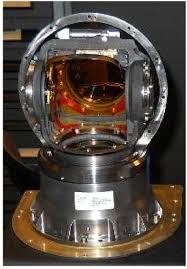
The advantages of IRSTs are twofold - first due to the fact that your single pixel aperture is the size of the palm of your hand instead of being miniscule, like in a camera sensor, you get much more signal (however you're looking at a single point in the sky, while EOTS looks everywhere in its FoV at the same time). That's why there's a 'track' mode where the sensor is focusing on the target after it acquired it.
The other has to do with the particle-wave duality. Remember the double-slit experiment? Once your pixel pitch in the sensor gets small enough, neighboring pixels start interfering, due to photons diffracting into neigboring sensors with your detection, which means adding extra resolution becomes useless. The IR band stretches from about 1 um to 1mm (~1400x of visible light), so I'm sure imaging sensors only operate in upper IR wavelength, while IRST can cover a wider band.
This double-slit issues (and physical sensor size) is why high-end digital cameras have giant sensors with comparatively modest Megapixel numbers, with your smartphone manufacturer happily selling you an 50 Megapixel phones with sensors the size of a pinhead. The former is driven by picture quality considerations, the latter driven by marketing BS.
I suspect that if you can reduce the problem of IR detection to detecting a single value in a short amount of time, the number of physical principles you can use expands compared to your typical semiconductor based IR sensor.
Also IRSTs are not outdated, the US just started outfitting their Hornets with IRST pods, and some nations use such pods on their F15s as well:
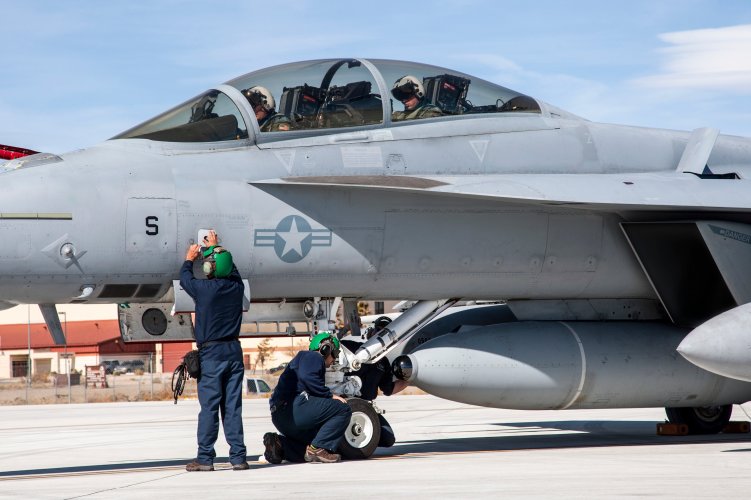 The KF-21 also comes with an IRST, and that plane is still in development. Eurofighters also have one.
While I'm sure EOTS and other imaging systems are also highly sophisticated, there are some physical principles at play which gives IRSTs some inherent advantages when it comes to signal-to-noise (thus range).
Afaik many IR pods (used in other places than fighter jets) feature both an IRST and a IR camera.
There are advantages and disadvantages to both approaches, I don't wanna go into more detail (in part due to the effort required, and the fact that I'm not super knowledgeable about the topic)

Avimimus
ACCESS: Top Secret
- Joined
- 15 December 2007
- Messages
- 2,600
- Reaction score
- 1,259
Isn't the Eurofighter's sensor an IIRST (i.e. imaging infra-red search and track i.e. infra-red camera)? I thought EOTS was distinguished through using non-IR wavelengths as well.
Also, I feel like I needed to clarify that - but isn't this getting a bit off topic?
Shouldn't we wait until someone finds information on what these sensors actually are (instead of assuming MAWS only, IRST only, IIRST etc?) I just wanted to point out that the assertion that these sensors are MAWS only might underestimate that value of EO/IR spectrum for a CCA... and thus we shouldn't immediately dismiss the possibility of some capacity.
Also, I feel like I needed to clarify that - but isn't this getting a bit off topic?
Shouldn't we wait until someone finds information on what these sensors actually are (instead of assuming MAWS only, IRST only, IIRST etc?) I just wanted to point out that the assertion that these sensors are MAWS only might underestimate that value of EO/IR spectrum for a CCA... and thus we shouldn't immediately dismiss the possibility of some capacity.
You can stitch together the output of the IRST's 'pencil beam' into an image - similarly to how imaging radar works. An imaging sensor (like a camera sensor) on the other hand produces an image by itself. I'm pretty sure all IRSTs designed in this century have powerful computers, and have an imaging mode, just like most radars do (even mechanically scanned ones), but their imaging abilities are likely much worse . This feature is not unique to the Eurofighter.
I mentioned that with imaging sensors, you trade wavelength for resolution, so it's likely that the EOTS has visible-light cameras and IR cameras as well, and they fuse the image with some signal processing. (This is also how commercial IR cameras work)
. Also these sensors (IRST, IR camera, visible-light camera) have different strengths and weaknesses, so it makes sense to use them together.
IRSTs are pretty much specialized to anti-air roles, as in a ground attack role an imaging sensor is much better.
They are uniquely suited for anti-stealth missions, as they can go pretty deep into the infrared and pick things up like aircraft skin heating against the cold backdrop of the sky. EOTS absolutely
That's why I think there's renewed interest in them as well, and started popping up on Western designs as their adversaries started fielding stealthy aircraft in numbers.
We don't know what that particular aperture is on the Su-75 other than it being some camera. But I think it makes sense that it'd get an IRST, as anti-stealth detection capabilities are going to be important going forward.
Also it's safe to assume that most of these modern sensors/antennas perform multiple duties so the EOTS doubles as MAWS etc..
I mentioned that with imaging sensors, you trade wavelength for resolution, so it's likely that the EOTS has visible-light cameras and IR cameras as well, and they fuse the image with some signal processing. (This is also how commercial IR cameras work)
. Also these sensors (IRST, IR camera, visible-light camera) have different strengths and weaknesses, so it makes sense to use them together.
IRSTs are pretty much specialized to anti-air roles, as in a ground attack role an imaging sensor is much better.
They are uniquely suited for anti-stealth missions, as they can go pretty deep into the infrared and pick things up like aircraft skin heating against the cold backdrop of the sky. EOTS absolutely
That's why I think there's renewed interest in them as well, and started popping up on Western designs as their adversaries started fielding stealthy aircraft in numbers.
We don't know what that particular aperture is on the Su-75 other than it being some camera. But I think it makes sense that it'd get an IRST, as anti-stealth detection capabilities are going to be important going forward.
Also it's safe to assume that most of these modern sensors/antennas perform multiple duties so the EOTS doubles as MAWS etc..
donnage99
ACCESS: Top Secret
- Joined
- 16 June 2008
- Messages
- 1,545
- Reaction score
- 1,546
But they can - Su-35 has it for over a decade. They were too small to produce good enough picture (old airframe without sufficient volume for apertures, old gen optics), but on the model they are here already(and we saw these on OKB T-50 several years ago).
As such, this is specifically desire to keep a moving scanning mirror with optical zoom and LRF, just for upper hemisphere and WVR combat.
Which is half retro, half super extravagant for an affordable aircraft aimed to keep costs. Especially if this aircraft really wants to be fighter bomber, i.e. offensive role is high up.
Kaan is a bit of a different beast here - it's bigger and heavier.
I think it's ok to have the optics world on Su-57, which by default is an extravagant sensory node.
If you really need to IRST scan front hemisphere better than EODAS (or produce idenitifiable picture further out) - IMHO you can afford to pitch up and let EOTS do its job. This IRST ball is 3rd system of generally same type on a same aircraft.
Su-35's system 360 coverage is ultraviolet based, strictly MAWS function with 6 apertures. To provide 360 situation awareness of both aircraft and missiles, IFF with the range of DAS,
Though I agree that the IRST is used in very specific scenario, perhaps to guide high off boresight missiles in WVR given the fact that most the time the system is inactive in rear facing mode, exposing its RAM covered backside forward. I don't see it as extravagant feature, but rather operational relevant and nessacary one given the lack of DAS like system (you don't want to have to orient the nose for the lower hemisphere aperture to get a good look in WVR) even though it's quite an awkward evolution of 4th gen fighter sensors not able to get get the hump for something like DAS.
Last edited:
Scott Kenny
ACCESS: USAP
- Joined
- 15 May 2023
- Messages
- 16,974
- Reaction score
- 24,080
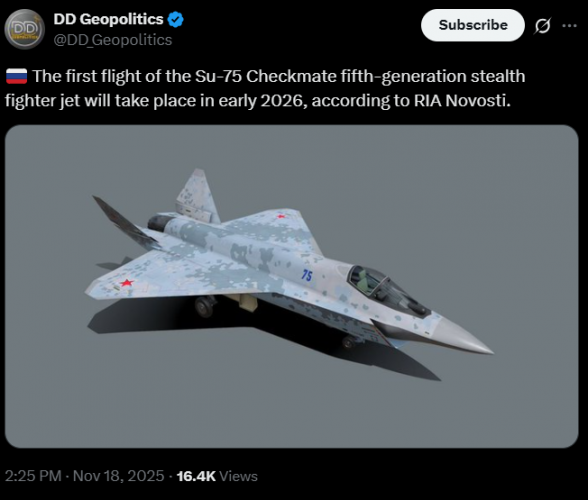
You don't think first flight would be possible next month, or that first flight won't happen in 2026 (meaning not till 2027)?This is utterrly BS.

- Joined
- 1 April 2006
- Messages
- 12,024
- Reaction score
- 13,946
Your backbone state TV channel sends you to sunny Dubai from murky Moscow and you make Bogdan, Chemezov, Sukhoi, UAC and Rostec sound like idiots because you cropping Bogdan direct speech, mixing up aircraft models and don't care of checking contents before going on air...
Attachments

Attachments

snne
ACCESS: Top Secret
- Joined
- 3 July 2022
- Messages
- 2,047
- Reaction score
- 7,557
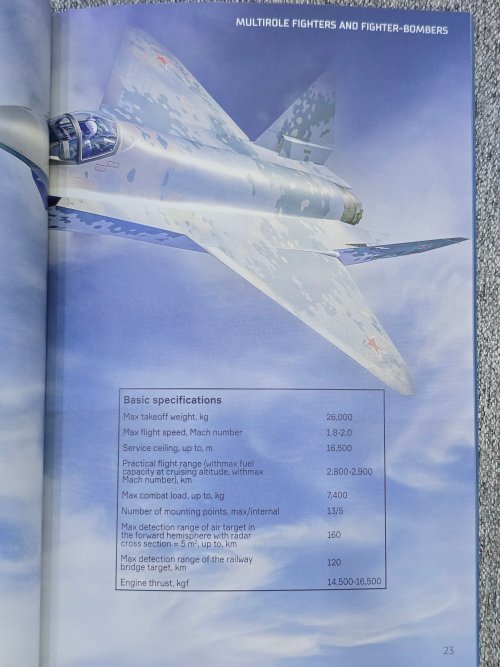
They must mean tracking by "max detection distance", right (if not outright weapons-grade)? If not, 160 km max detection range against a 5 sqm target is terrible for a modern radar intended for this fighter class.
Last edited by a moderator:
they are certainly not expecting to sell any unit if it's only detection, if it's (Pd ≥ 0.9) weapon-grade tracking at this distance it's actually a good one for someone on the export market, and it must be, the early zhuk radars they offered for export had greater detection only range in the early 2000'sThey must mean tracking by "max detection distance", right (if not outright weapons-grade)? If not, 160 km max detection range against a 5 sqm target is terrible for a modern radar intended for this fighter class.
Last edited:
EmoBirb
E.S.T
- Joined
- 18 January 2025
- Messages
- 2,209
- Reaction score
- 5,622
Certainly not, it will be derived from the Radar used by the Su-57, be it S or M (also depending if there's a difference).Is su-75 really going to come with a radar that’s essentially Zhuk-ae? It’s so dead
I also wouldn't take brochures that are publicly available at face value, given that certain specs, especially the ones important to potential customers, will most likely only be disclosed during talks behind closed doors between representatives of both parties.

kizvy
Local su-30mkm enjoyer
- Joined
- 14 October 2025
- Messages
- 93
- Reaction score
- 88
True, if it’s for pd90 then it’s fine, however if it’s just standard pd50 then we got a problemCertainly not, it will be derived from the Radar used by the Su-57, be it S or M (also depending if there's a difference).
I also wouldn't take brochures that are publicly available at face value, given that certain specs, especially the ones important to potential customers, will most likely only be disclosed during talks behind closed doors between representatives of both parties.

- Joined
- 18 October 2006
- Messages
- 4,623
- Reaction score
- 6,383
Russia’s Checkmate Fighter Nearing First Flight, Rostec CEO Says | Aviation Week Network
The first prototype of the Su-75 combat aircraft is closing in on its first flight, according to the CEO of Sukhoi’s parent company Rostec.
 aviationweek.com

Null
ACCESS: Secret
- Joined
- 16 December 2024
- Messages
- 221
- Reaction score
- 393
Su-75 Checkmate fighter to begin bench tests soon â Rostec CEO
Sergey Chemezov also added that Rostec continues work on the aircraft
 tass.com
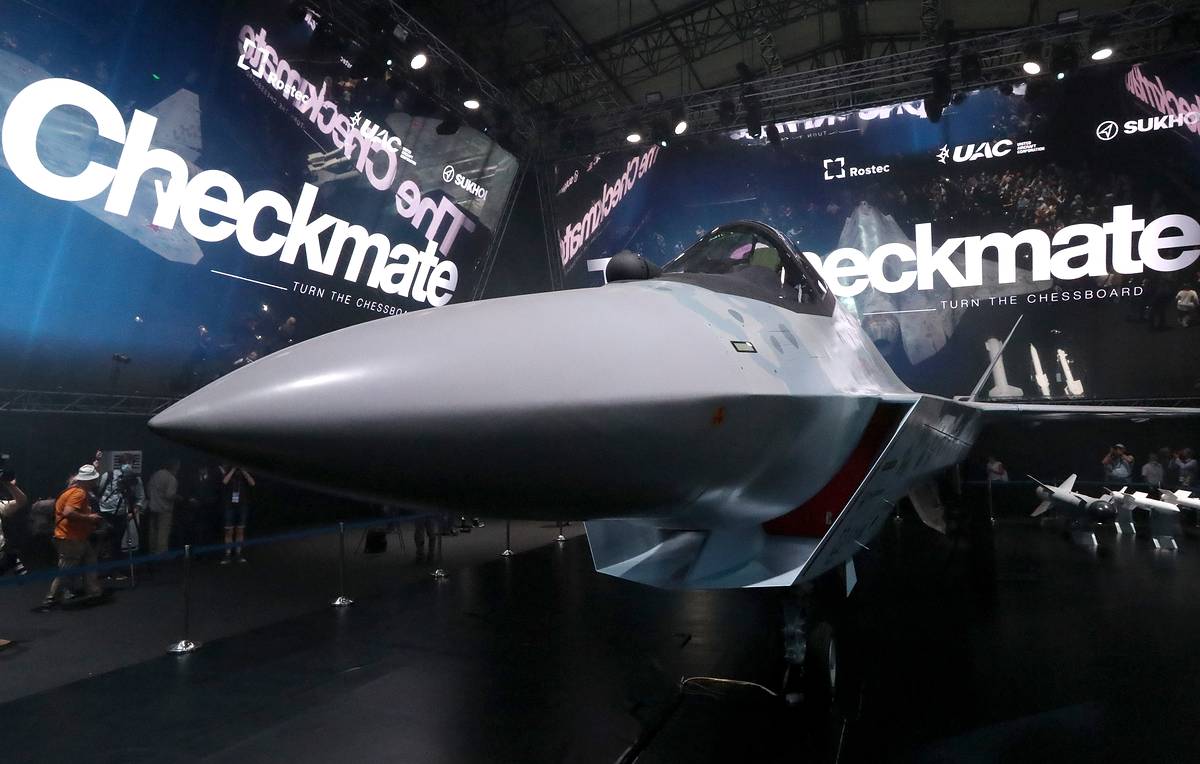
DUBAI, November 19. /TASS/. The Su-75 Checkmate fighter will soon begin bench tests, Rostec state corporation CEO Sergey Chemezov stated on the sidelines of the Dubai Airshow 2025.
"Developing a new aircraft requires a considerable amount of time, on average, 10 to 15 years. Very little time has passed so far. Aircraft are not born that quickly, children can be born in nine months. Ours is already practically at the flight stage," he said, clarifying it will soon transition to bench testing.
Chemezov added that Rostec continues work on the aircraft, believing "it will be in demand. It is cheaper, with a single engine, and I think its weaponry will be sufficient to handle everything necessary, both for destroying aerial and ground targets. In terms of efficiency, price, and quality, I think it will be quite good."
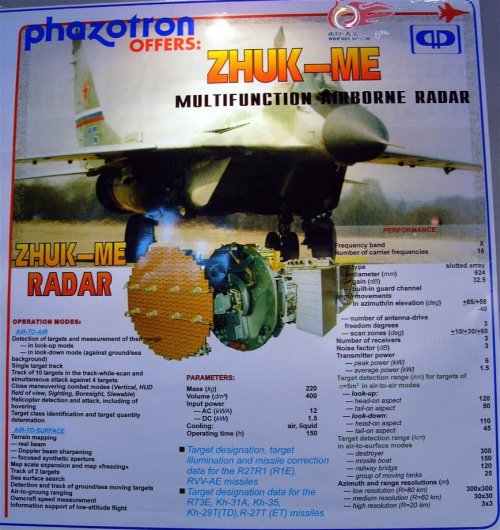
nevertheless, it is stupid that they advertise something like this, I am sure zhuk radars in the 1980's had the same radar tracking performance parameters as the estimate they are showing in Dubai.160 km max detection range against a 5 sqm target is terrible for a modern radar intended for this fighter class.
Zhuk me promo

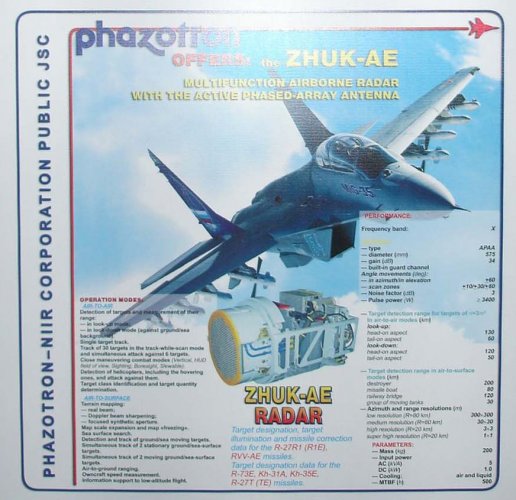
zhuk ae promo

So from 120 km for 5 m2 fighter and 120 km railway bridge in the 1990s, to 148 km for 5 m2 fighter (equivalent of stated 130 km for 3 m2) and 120 km railway bridge in 2000s on paper - to today's 160 km for 5 m2 fighter and 120 km railway bridge. Perhaps that's mature, not paper numbers for 2010s and simply due to the war and change in funding priorities, development of small radars was not worked on further since 2010s and since MiG-35 project proved to be a stillborn project.
zhuk ae promo
So from 120 km for 5 m2 fighter and 120 km railway bridge in the 1990s, to 148 km for 5 m2 fighter (equivalent of stated 130 km for 3 m2) and 120 km railway bridge in 2000s on paper - to today's 160 km for 5 m2 fighter and 120 km railway bridge. Perhaps that's mature, not paper numbers for 2010s and simply due to the war and change in funding priorities, development of small radars was not worked on further since 2010s and since MiG-35 project proved to be a stillborn project.
kizvy
Local su-30mkm enjoyer
- Joined
- 14 October 2025
- Messages
- 93
- Reaction score
- 88
Low k you can’t just compare numbers like this, who knows if it’s pd50 (enough to get a detection) or something like pd90 (where you can actually track the darn thing).
Either way it’s not amazing, but it doesn’t exactly tell us much. A good example is n011m, that things range has been all over the place mostly likely because different measuring criteria are used
Either way it’s not amazing, but it doesn’t exactly tell us much. A good example is n011m, that things range has been all over the place mostly likely because different measuring criteria are used
Last edited:
Similar threads
-
 Sierra Nevada P-9A "Pale Ale" (Bombardier Q200) drug interdiction aircraft
- Started by Stargazer
- Replies: 9
-
