
You are using an out of date browser. It may not display this or other websites correctly.
You should upgrade or use an alternative browser.
You should upgrade or use an alternative browser.
Submarine Aircraft Carrier
- Thread starter hesham
- Start date


avion ancien
The accidental peasant!
- Joined
- 6 March 2013
- Messages
- 392
- Reaction score
- 304
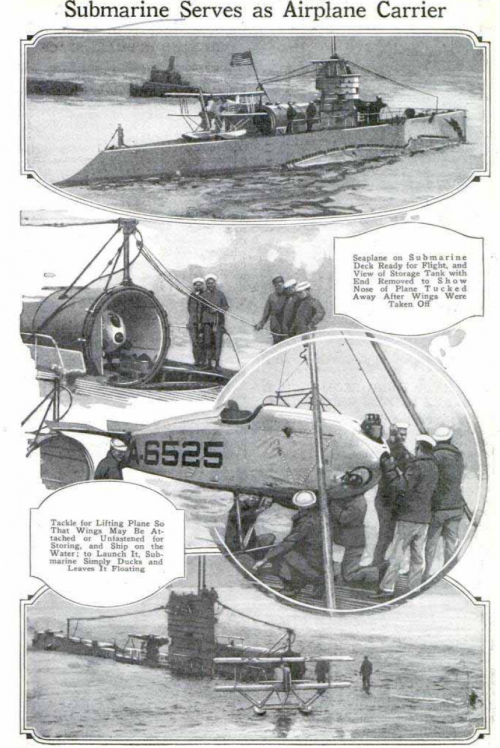
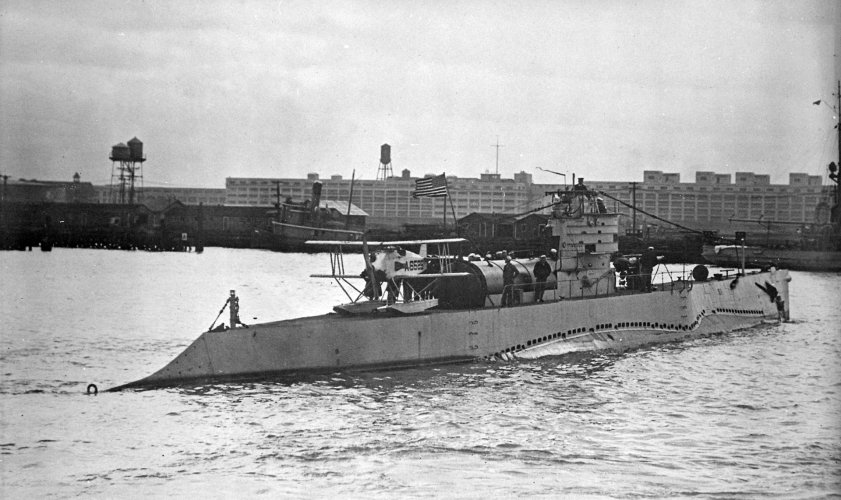
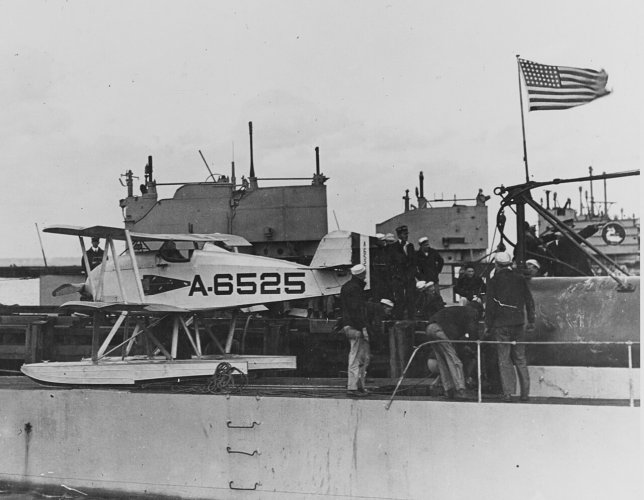
Martin MS-1 (aircraft) and USS S-1 (submarine)?

- Joined
- 6 November 2010
- Messages
- 6,351
- Reaction score
- 8,226
Right on both counts. Images from wiki:
https://en.wikipedia.org/wiki/USS_S-1
https://en.wikipedia.org/wiki/Martin_MS
https://en.wikipedia.org/wiki/USS_S-1
https://en.wikipedia.org/wiki/Martin_MS
Attachments

Dilandu
I'm dissatisfied, which means, I exist.
Always wondered, how they managed to solve stability problem with something as small as S-class submarine...Right on both counts. Images from wiki:

Vepr157
I like submarines
- Joined
- 20 December 2015
- Messages
- 171
- Reaction score
- 463
(Apologies for the very late response.) The hangar itself was not particularly heavy: it was 5'9" in diameter and 22'9" long with 3/4" plating, which equates to about 7 tons. What was more concerning was flooding of the hangar while submerged. Apparently the early Electric Boat S-class submarines could survive the hangar flooding, but the later Electric Boat units (the S-42 through S-47) could not (from Friedman's U.S. Submarines through 1945). The S-1 was provided with the necessary piping to drain and blow the hangar if it did flood, which it fortunately never did. The S-1 was a little slower and less maneuverable with the addition of the hangar, but otherwise was little affected by her role as a seaplane carrier.Always wondered, how they managed to solve stability problem with something as small as S-class submarine...
The danger of the hangar flooding, either as a result of surface gunfire or a depth charge springing the door, was one of the primary reasons that the General Board cited in recommending against the installation of a (much larger) hangar on the V-4 (Argonaut) and V-5 (Narwhal) classes.
I cover the U.S. submarine aircraft program in some detail in my recent book:
https://www.secretprojects.co.uk/th...s-by-jacob-gunnarson-and-norman-polmar.48592/
Dilandu
I'm dissatisfied, which means, I exist.
Thank you for the answer!(Apologies for the very late response.)
Dilandu
I'm dissatisfied, which means, I exist.
A question, if I may; where there specific cases with Japanese aircraft-carrying submarines, when their hangar flooding became direct cause of their loss? Or Japanese submarines were big enough for hangar flooding not to be considered a fatal problem by itself?The danger of the hangar flooding, either as a result of surface gunfire or a depth charge springing the door, was one of the primary reasons that the General Board cited in recommending against the installation of a (much larger) hangar on the V-4 (Argonaut) and V-5 (Narwhal) classes.
Vepr157
I like submarines
- Joined
- 20 December 2015
- Messages
- 171
- Reaction score
- 463
I don't know of any, and if it did occur, there would not be a record of it since the submarine sank. But the Japanese aircraft-carrying submarines (e.g., the Type B) were so big (~4,000 tons submerged displacement) that I doubt it would have sunk the submarine. The hangar was about the size of the conning tower, and typically submarines of that era were designed such that blowing the safety tank could compensate for flooding of the conning tower and save the ship. I'd assume that the same was the case for the hangar.A question, if I may; where there specific cases with Japanese aircraft-carrying submarines, when their hangar flooding became direct cause of their loss? Or Japanese submarines were big enough for hangar flooding not to be considered a fatal problem by itself?
I am not sure if the Sentoku Type (I-400 class) and Type A Mod. 2 submarines could have survived flooding of the hangar though because it was so much larger in comparison to their hulls. The only technical information I have seen on these boats that could answer this question is this manual for the I-14, but the quality is quite poor and my Japanese is basically non-existent.
Dilandu
I'm dissatisfied, which means, I exist.
Thank you for explanation!I don't know of any, and if it did occur, there would not be a record of it since the submarine sank. But the Japanese aircraft-carrying submarines (e.g., the Type B) were so big (~4,000 tons submerged displacement) that I doubt it would have sunk the submarine. The hangar was about the size of the conning tower, and typically submarines of that era were designed such that blowing the safety tank could compensate for flooding of the conning tower and save the ship. I'd assume that the same was the case for the hangar.
I am not sure if the Sentoku Type (I-400 class) and Type A Mod. 2 submarines could have survived flooding of the hangar though because it was so much larger in comparison to their hulls. The only technical information I have seen on these boats that could answer this question is this manual for the I-14, but the quality is quite poor and my Japanese is basically non-existent.
Vepr157
I like submarines
- Joined
- 20 December 2015
- Messages
- 171
- Reaction score
- 463
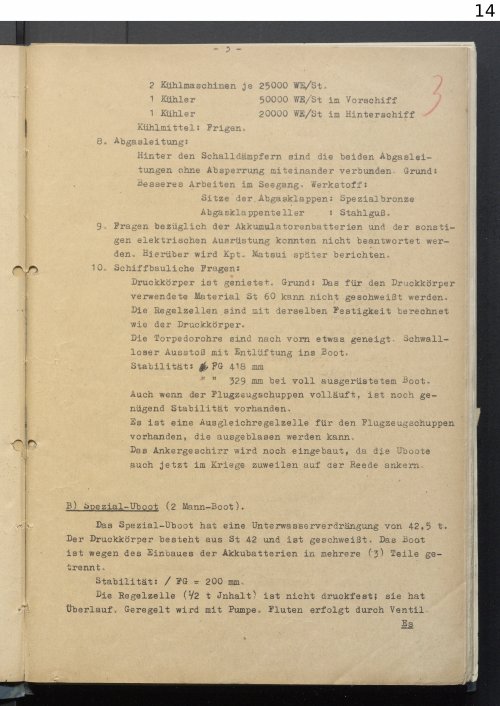
@Dilandu By total coincidence this morning I was looking through a file I downloaded from the Bundesarchiv (RM 7/1257), which has a report on the visit of the I-29 (a Type B submarine) to German-occupied France.
On page 14 it says:
Even if the aircraft hangar floods, sufficient stability remains. There is a compensating tank for the hangar, which can be blown.
Presumably this compensating tank, like a safety tank, was normally flooded and would be blown to compensate for flooding of the hangar.
On page 14 it says:
Even if the aircraft hangar floods, sufficient stability remains. There is a compensating tank for the hangar, which can be blown.
Presumably this compensating tank, like a safety tank, was normally flooded and would be blown to compensate for flooding of the hangar.
Attachments
Dilandu
I'm dissatisfied, which means, I exist.
Quite interesting data! Apparently Japanese were quite throughout with their concept!Even if the aircraft hangar floods, sufficient stability remains. There is a compensating tank for the hangar, which can be blown.
Presumably this compensating tank, like a safety tank, was normally flooded and would be blown to compensate for flooding of the hangar.
avion ancien
The accidental peasant!
- Joined
- 6 March 2013
- Messages
- 392
- Reaction score
- 304
I'm surprised that no mention has yet been made of the UK submarine M2 and its Parnall Peto N255, both of which were lost off the West Dorset coast, on 26 January 1932, due to the submarine's hangar being flooded.
Vepr157
I like submarines
- Joined
- 20 December 2015
- Messages
- 171
- Reaction score
- 463
The thread started with a drawing of the S-1, so there has not (yet) been discussion of the ~70 other aircraft carrying submarines built.I'm surprised that no mention has yet been made of the UK submarine M2 and its Parnall Peto N255, both of which were lost off the West Dorset coast, on 26 January 1932, due to the submarine's hangar being flooded.
She is certainly covered in my book. I was able to obtain some excellent archival information, which to my knowledge has not been published before.

- Joined
- 22 January 2006
- Messages
- 4,434
- Reaction score
- 2,796
Anyone interested, not only on "submarine aircraft carrier" concepts but also "submarine aircraft tenders" will be surprised with the contents of the book.I'm surprised that no mention has yet been made of the UK submarine M2 and its Parnall Peto N255, both of which were lost off the West Dorset coast, on 26 January 1932, due to the submarine's hangar being flooded.
The book gives an extensive description on expectations, operations, failures and alternatives along decades. The narrative is addictive and the reader is precisely guided along the timeline of technological development in every chapter.
For instance, I had no idea about the role of submarines in early Cold War concepts involving strategic bombing.
Similar threads
-

-
PThe project of the Arctic atomic cargo submarine Moby Dick. 1962-1969.
- Started by pavel
- Replies: 2
-
 Japanese Unknown Flying Boat Seaplane of 1926
- Started by hesham
- Replies: 1
-
Transatlantic Airplane of 1926 with new idea
- Started by hesham
- Replies: 0
-