Sikorsky MH-60 Upgrade (MH-60X)

Training_Dummy

Meet me at the green spot
Senior Member
Joined
30 May 2023
Messages
560
Reaction score
1,202
What is concurrency on steroids?

Concurrenconcurrency?


I guess this plan is one way of redirecting attention from LMTs newly announced longer ranged MH-6x proposal for navy helos!

From AWST….

“The Advanced Single Main Rotor (A-SMR) concept proposes adding a hybrid-electric drivetrain to increase the range to 500 nm from the Seahawk’s current maximum of 220 nm.”
 
What is concurrency on steroids?

Concurrenconcurrency?


I guess this plan is one way of redirecting attention from LMTs newly announced longer ranged MH-6x proposal for navy helos!

From AWST….

“The Advanced Single Main Rotor (A-SMR) concept proposes adding a hybrid-electric drivetrain to increase the range to 500 nm from the Seahawk’s current maximum of 220 nm.”

Well, that's certainly a useful bump. Fits with the idea of an MH-60X rather than a tilt-rotor for Navy missions.
 
“The Advanced Single Main Rotor (A-SMR) concept proposes adding a hybrid-electric drivetrain to increase the range to 500 nm from the Seahawk’s current maximum of 220 nm.”
It sounds very good but is the number correct? Airbus did something similar but they only got a 30% bump on a two engine model where there's more room to play around. With given 232 nm (430 km) * 1.3 = 301.6 nm (559 km) ... looks like the a mix up of units.
 

I don't think it can be a units mixup, given the figure for the E-SMR design of 280 nm. (In all cases, we must be talking about radius, not range, since the USN usually quotes 245 nm as the combat radius for the Seahawk).
 
It sounds very good but is the number correct? Airbus did something similar but they only got a 30% bump on a two engine model where there's more room to play around. With given 232 nm (430 km) * 1.3 = 301.6 nm (559 km) ... looks like the a mix up of units.
Well... If the Chief of Staff of the U.S. Army can make a math mistake, surely we can't be too mad at Sikorsky...
 
Last edited:

I don't think it can be a units mixup, given the figure for the E-SMR design of 280 nm. (In all cases, we must be talking about radius, not range, since the USN usually quotes 245 nm as the combat radius for the Seahawk).
Any non-paywalled access to the article or description of the upgrade?
 
Any non-paywalled access to the article or description of the upgrade?

I think this is the full text. No more details, really.

 
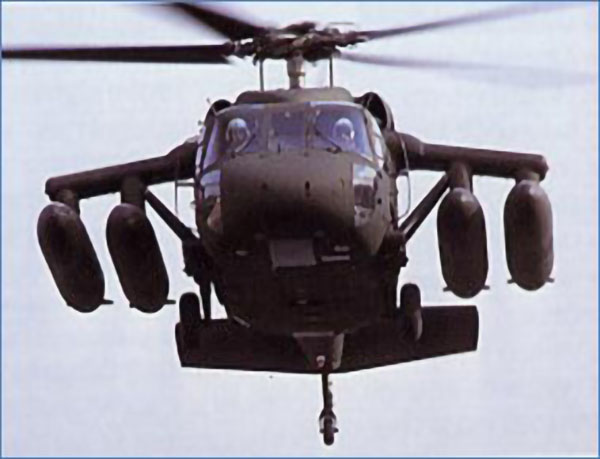
Even with the 4-pylon External Stores Support System (ESSS) for carrying fuel tanks and weapons systems, Blackhawk ferry range is only 1150 miles. 500 mile radius sounds like new engine and a lighter frame.
clip_image010_0002.jpg
 
Even with the 4-pylon External Stores Support System (ESSS) for carrying fuel tanks and weapons systems, Blackhawk ferry range is only 1150 miles. 500 mile radius sounds like new engine and a lighter frame.
clip_image010_0002.jpg

ESSS are pretty draggy. I expect a lot of fuel is spent just to carry the tanks.

The range cited for A-SMR does seem like a lot. Until we get some more details it's hard to guess what ll it entails. My guess is that at least part of it is the ability to shut down one turboshaft in cruise.
 
They did say an electrical motor boost. Probably turns gas power into electrical for storage which sounds improbable at first, but because we are talking about turbines it would allow you to run as close of an ideal power factor as possible while in use. One downside of helicopters have always been powering up and down using up a lot of fuel disproportionate to fuel use while doing actual work. Instead of losing all the energy at startup and slow down you can boost the rpm's before spoiling the fuel to get to full and consistent speed, and charge while spooling down, two ranges where the turbine operates least best. This is kind of the premise of the next generation of electric boost turbofans. You don't run the turbine fully off the electric, just nudge it through its weakest points. Storage needs are smaller for significant boosts in fuel economy. In fixed wing assets the boost in economy is fairly low, but the complexity and cost to implement are expected to be even more low. The strategy is probably going to be really key in other vehicles where starts and stops are more common, like helicopters and tanks.
 
Another options could be to "electrify" the tail rotor. It "should" reduce the power requirement, especially in hover. I don't recall how much the tail rotor uses in a hover, but it is substantial (8%-10%?). A substantial savings I think for a helicopter that spends a lot of time hovering.
 

Similar threads

Back
Top Bottom