Shirane/Haruna-like class in the RN?

Croatian Sailor

ACCESS: Restricted
Joined
9 March 2025
Messages
35
Reaction score
19
So, why wasn't the RN interested into something like Shirane/Haruna class helicopter destroyers ( with 3-4 Sea Kings ). Okay, I know that they converthed Tiger-class cruisers, but why wouldn't they build a few helicopter destroyers like Shirane/Haruna?
 
So, why wasn't the RN interested into something like Shirane/Haruna class helicopter destroyers ( with 3-4 Sea Kings ). Okay, I know that they converthed Tiger-class cruisers, but why wouldn't they build a few helicopter destroyers like Shirane/Haruna?
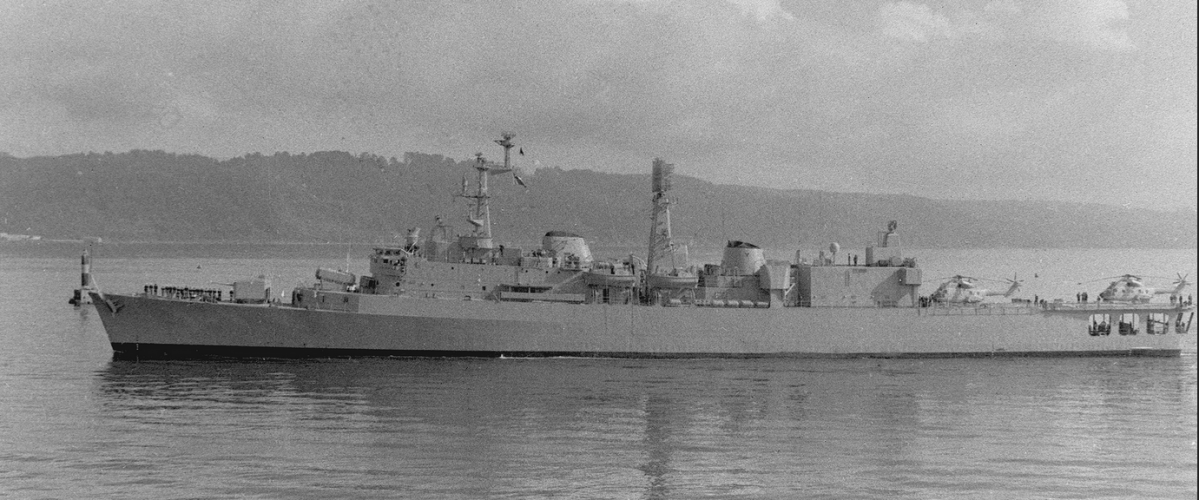
Well, actually they were at least partially interested - there were a proposal of DDH destroyer, based on Country-class ships. The Seaslug SAM would be removed, and a larger helipad & hangar for two helicopters would be installed. The project was not proceeded with, since it was determined that County-class hulls are too narrow to operate highly-capable Sea King helicopters (and Wessex was deemed too obsolete).

P.S. Chilean Navy basically done this with some of the County-class they brought in 1980s:

1764428395840.png
The Seaslug SAM was completely removed (it was obsolete anyway) and a large helipad and two-helicopter hangar was installed. The Seacat short-range SAM (also obsolete) was replaced with Israel-delivered Barak-1 short range SAM.
 
So, why wasn't the RN interested into something like Shirane/Haruna class helicopter destroyers ( with 3-4 Sea Kings ). Okay, I know that they converthed Tiger-class cruisers, but why wouldn't they build a few helicopter destroyers like Shirane/Haruna?
They followed the concept to its logical conclusion: the Invincible-class helicopter cruisers. Just as the JMSDF followed the concept to the same conclusion with the Hyūga-class.
 
They followed the concept to its logical conclusion: the Invincible-class helicopter cruisers. Just as the JMSDF followed the concept to the same conclusion with the Hyūga-class.
Arguably even more than Japanese, since Invincible-class were also area defense units, with their Sea Dart SAM (Hyuga have only self-defense capabilities)
 
They followed the concept to its logical conclusion: the Invincible-class helicopter cruisers. Just as the JMSDF followed the concept to the same conclusion with the Hyūga-class.

Okay, but considering the costs of Invincibles and that 3 Invincibles can be only in 2 places at the same time, why not go for larger number of smaller ships?
 
Okay, but considering the costs of Invincibles and that 3 Invincibles can be only in 2 places at the same time, why not go for larger number of smaller ships?
Because Royal Navy was already rather well-equipped in terms of helicopters - all of its destroyers and frigates could carry at least one. Japanese Navy needed helicopter-carrying destroyer, because a significant part of their destroyers and escort ships weren't helicopter-capable then.
 
Okay, but considering the costs of Invincibles and that 3 Invincibles can be only in 2 places at the same time, why not go for larger number of smaller ships?
Because nine helicopters can only be in two places at the same time. Yes, the maths works out. And if you're operating nine helicopters, it's more cost efficient and more operationally effective to put them on one big ship than three small ones.
 
Okay, I get it, 9 or more helicopters can do far better job when they are there than 3-4. But, in a scenario where the RN needs to protect convoys over the Atlantic again, could it be argued that having a 5-6 smaller ships with lesser number of helicopters can have some advantages over 2-3 larger?
 
A better question is why the UK did not put Seakings instead of Lynx on its Type 22s. They could have carried them and the Type 23 was designed to operate EH101 Merlins.
The answer in all cases was cost. It was cheaper to use Wasp and then Lynx.
 
A better question is why the UK did not put Seakings instead of Lynx on its Type 22s. They could have carried them and the Type 23 was designed to operate EH101 Merlins.
The answer in all cases was cost. It was cheaper to use Wasp and then Lynx.
Different tactics.
Lynx HAS.2 and HAS.3 were essentially a continuation of the Westland Wasp MATCH concept - the helicopter is guided by the parent frigate and told when to drop its Sting Rays onto the target, the Type 2016 sonar on the ship does all the heavy work.

Sea King/Merlin is an ASW barrier, firstly using dipping sonar and then from the HAS.5 onwards adding sonobuoy capability to maintain that sensor barrier and to classify contacts made by towed array equipped ships. They can self-designate their targets.

But, in a scenario where the RN needs to protect convoys over the Atlantic again, could it be argued that having a 5-6 smaller ships with lesser number of helicopters can have some advantages over 2-3 larger?
Convoy escort was not the RN's doctrine. ASW efforts were focused on the GIUK Gap - stopping the Soviet subs from transiting south into the Atlantic in the first place. A larger ship with 9 or more helicopters was far more useful in that role.

 
A better question is why the UK did not put Seakings instead of Lynx on its Type 22s. They could have carried them and the Type 23 was designed to operate EH101 Merlins.
The answer in all cases was cost. It was cheaper to use Wasp and then Lynx.
The last 4 Batch 2 Type 22 and the 4 Batch 3 ships were given enlarged flight decks and hangars to allow them to operate the Sea King and all bar Sheffield did so at different times from around late 1987 until late 2003. In the period the deployed one aircraft flights came from 824/819/810 squadrons depending on which had responsibility at the time in question.

But it is true to say that these ships operated the Lynx in its various forms for most of their lives.
 
And lets not forget that in the earliest Type 22 concepts the RN was looking at using the Fort class AORs as the maintenance base for helicopters dispersed across a hunting group of austere frigates.
 
Different tactics.
Lynx HAS.2 and HAS.3 were essentially a continuation of the Westland Wasp MATCH concept - the helicopter is guided by the parent frigate and told when to drop its Sting Rays onto the target, the Type 2016 sonar on the ship does all the heavy work.

Sea King/Merlin is an ASW barrier, firstly using dipping sonar and then from the HAS.5 onwards adding sonobuoy capability to maintain that sensor barrier and to classify contacts made by towed array equipped ships. They can self-designate their targets.
Interestingly Canada's Tribal class ASW destroyers operated 2x Sea Kings from 1973 onwards. So they must have thought that a Sea King with dipping sonar was a useful way to expand the ship's detection range.
 
Interestingly Canada's Tribal class ASW destroyers operated 2x Sea Kings from 1973 onwards. So they must have thought that a Sea King with dipping sonar was a useful way to expand the ship's detection range.
The difference is the RN was able to have both options, the RCN had to select one.
 
Different tactics.
Lynx HAS.2 and HAS.3 were essentially a continuation of the Westland Wasp MATCH concept - the helicopter is guided by the parent frigate and told when to drop its Sting Rays onto the target, the Type 2016 sonar on the ship does all the heavy work.

Sea King/Merlin is an ASW barrier, firstly using dipping sonar and then from the HAS.5 onwards adding sonobuoy capability to maintain that sensor barrier and to classify contacts made by towed array equipped ships. They can self-designate their targets.


Convoy escort was not the RN's doctrine. ASW efforts were focused on the GIUK Gap - stopping the Soviet subs from transiting south into the Atlantic in the first place. A larger ship with 9 or more helicopters was far more useful in that role.
I am puzzled still.
This implies that Seakings were just searchers and did not carry torpedoes.
Why did Type 22 and 23 ships only carry Seakings now and again instead of Lynx?
 
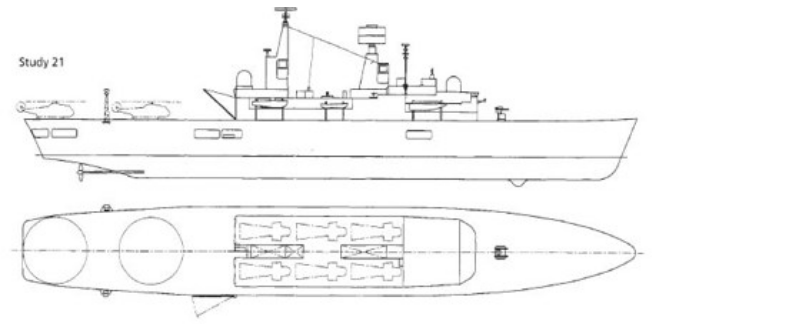
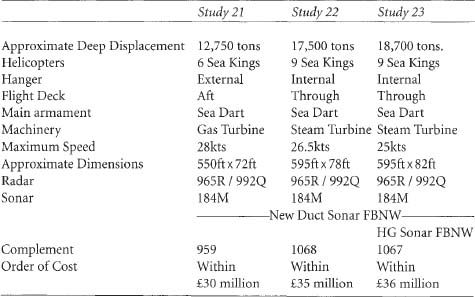
The Invincible class arose from two different events. The original design was selected in 1962 as an Escort Cruiser for Carrier Task groups with heavy long range ASW helicopters (Chinook was considered and then Seaking selected). For various reasons the Tiger class conversions were built instead with the Escort Cruisers postponed.
After the Carriers were cancelled the 1966 Fleet Working Party resurrected the 1962 design as the basis for a Command Cruiser. Three rather than six of these were built.
Between 1970 and 1981 only the two Commando carriers, Blake and later Tiger could operate 4 or more Seakings.
Canada on the other hand had operated them from escorts aince the 60s.
 
Can't help thinking that a small DDGH was a better solution, as 2-3 DDGHs could provide much more flexible ASW and AAW coverage than a single helicopter cruiser.

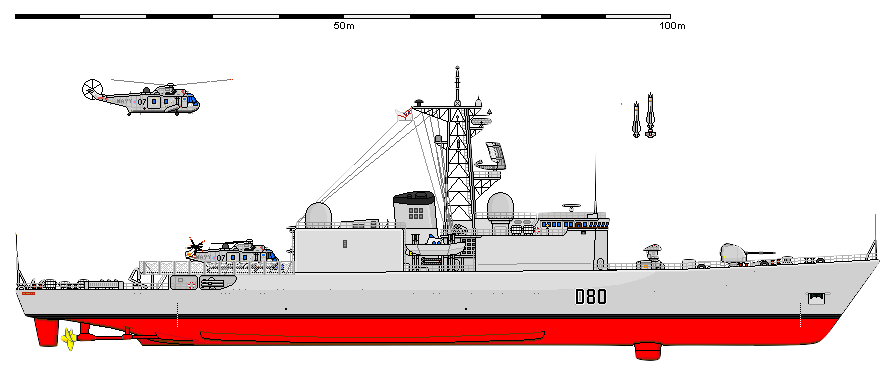
Just pump out a bunch of Canadian Tribals with 2x Sea Kings, bear trap and towed sonar. Fit Sea Dart and 114mm gun forward instead of Sea Sparrow + 5" gun (lengthen the hull by 5-10ft as needed). Replace the Canadian COGOG set-up with UK CODOG (Type 21) or CODOG (Niteroi class)... but if money needs to be saved, go with a simplified propulsion (FFG-7 style) with 2x gas turbines on 1x shaft.

Something like this... Tribal DDGH with Sea Dart, 114mm gun and 2x Type 909 fire control radars:

RN DDGH what if 2px=1ft v2.png
 
Back
Top Bottom