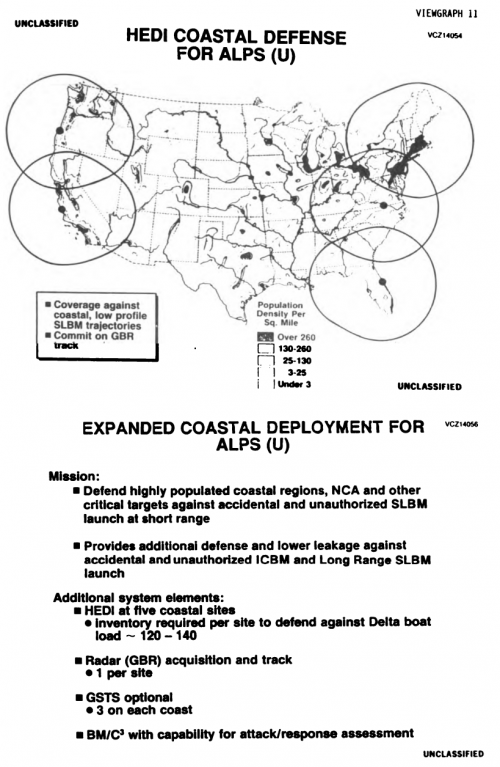
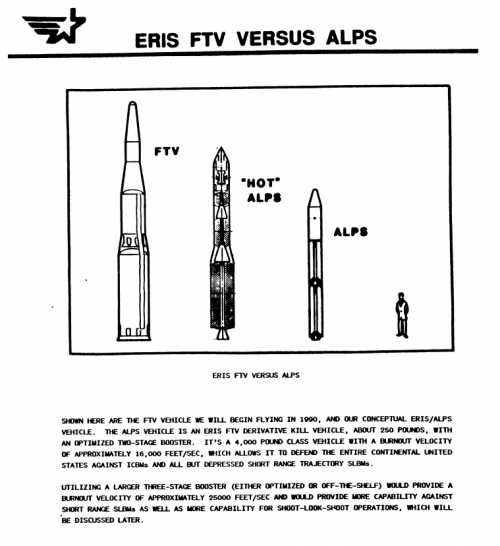
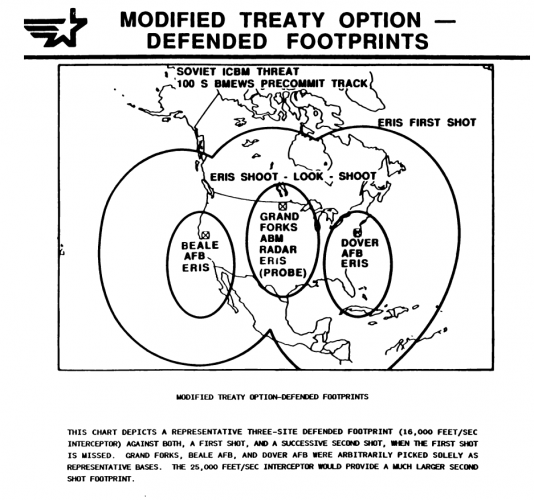
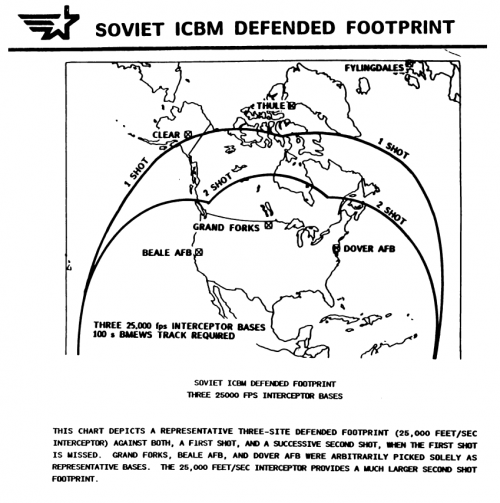
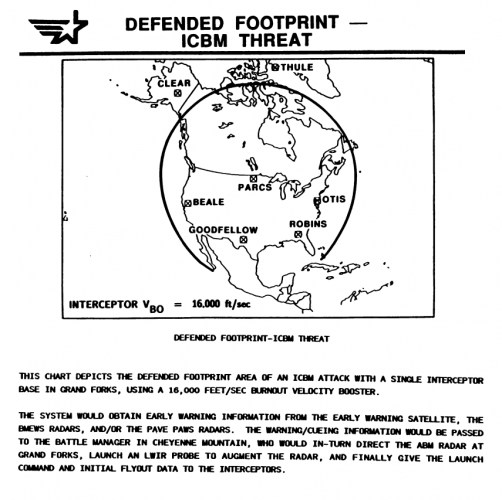
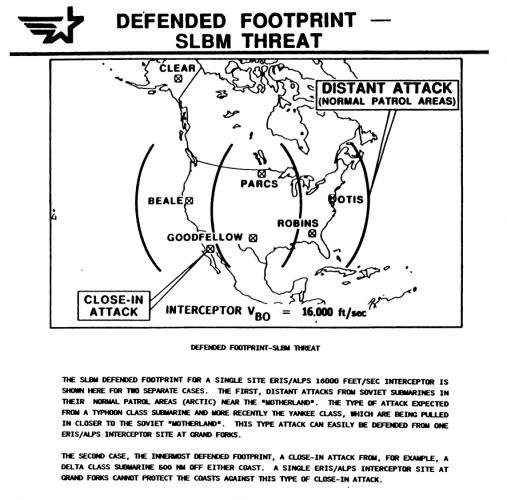
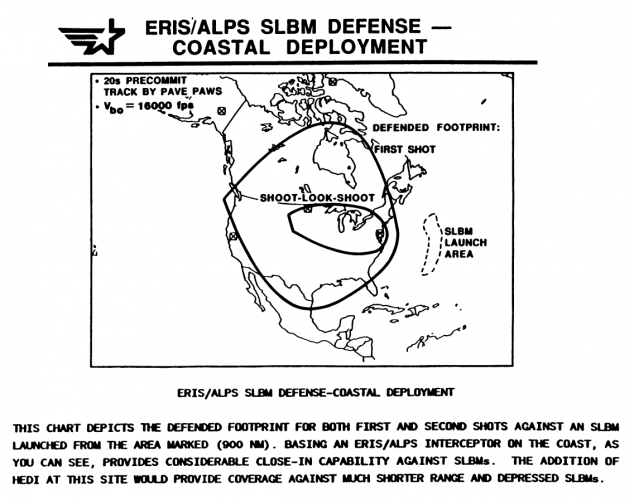
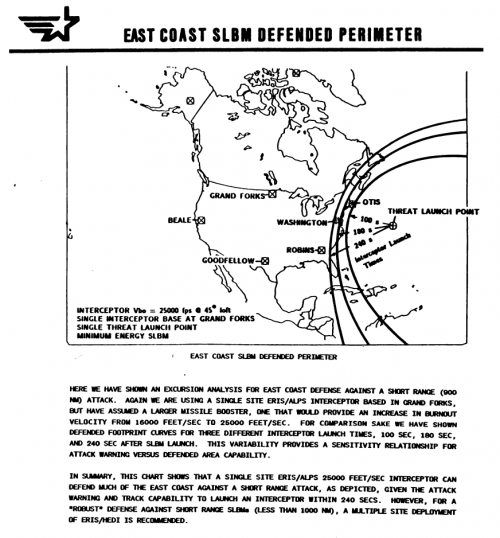
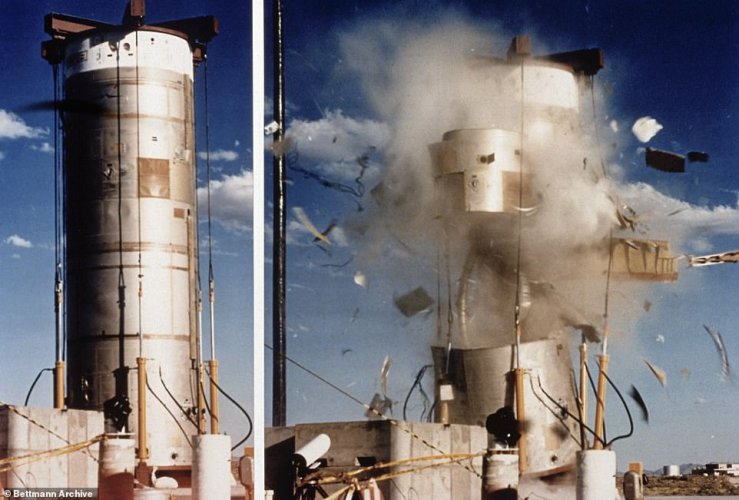
These slides all come from briefings given to Congress on the ALPS (Accidental Launch Protection System) and show the performance expected of SDIO GMD if it had been pushed to deployment.
First up is North American Rockwell's AERIE concept.
per the transcript:
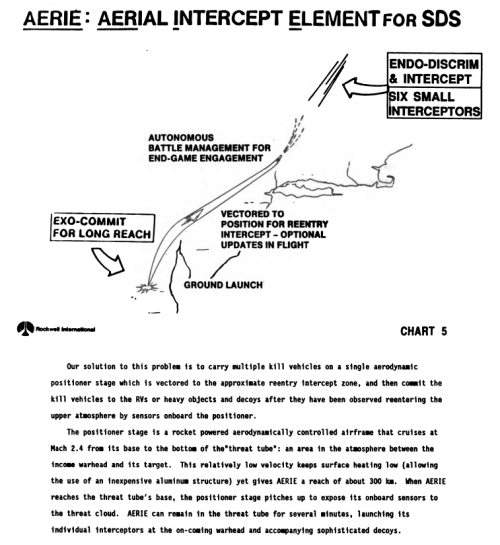
Mr. WRIGHT. The next chart shows an AERIE concept that I am going to be discussing, where it fits in with respect to intercept timeline. As you can see here, it is a relatively small interceptor.
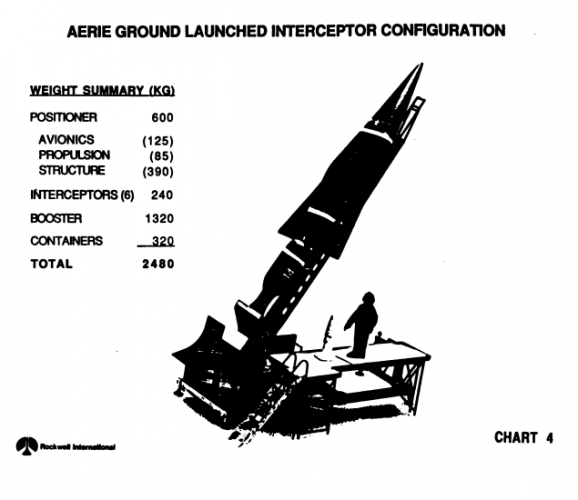
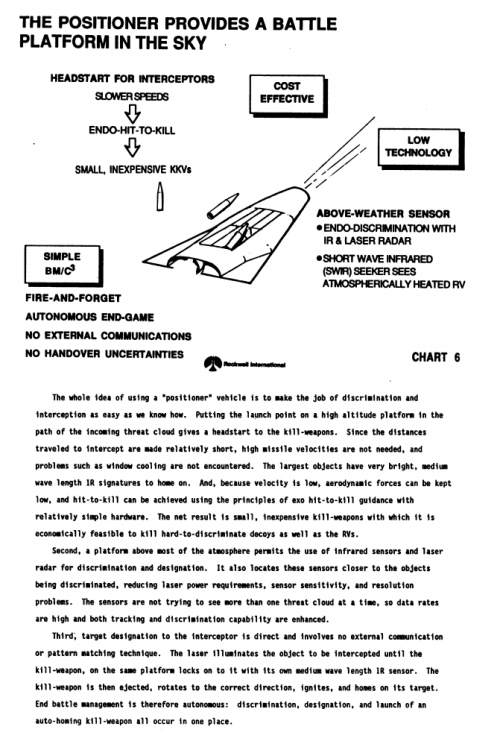
What you see on top is called a positioner stage. It is a rocket-powered atmospheric-controlled cruise vehicle, like a remote piloted vehicle (RPV) but rocket powered. Inside the positioner stage are small hit-to-kill weapons.
[...]
Mr. WRIGHT. The idea or the operational concept here is that we would commit this positioner stage on exoatmospheric information.
That is to say, when we had a rough idea of where the cluster of objects-not just an RV or a decoy -- but a cluster of objects, (what we call a threat tube) is going. That is pictured in the upper right here. We can vector this positioner stage to approximately the large area of interest-that which we call the intercept zone or the battle zone-and then on board the positioner stage we have at the front end an infrared detector and a laser radar. These operate after the system is on station is now very close to the threat where it can see it at close range. They examine the threat as it enters the upper atmosphere. They can look at objects as they heat up, as they burn up in the atmosphere, as they slow down in the atmos- phere, et cetera. Based on this information now, which includes both metric, velocity, and radiometric data, such as temperature and the like, we have an excellent idea now of what are the decoys and what are the RVs and heavy objects.
To do perfect discrimination against a heavy decoy is difficult. To solve that problem, we carry on the positioner six of those small interceptor kill vehicles that you saw. The six interceptors give us the flexibility to commit against an RV and any other objects that we cannot discriminate. However, because we are using atmospher- ic discrimination, these would have to be fairly credible heavy decoys of which an ICBM booster could only have a few per RV, as opposed to light decoys exoatmospherically where it is possible to have hundreds per RV.
The key then is the early commit and at the same time the late commit of the interceptor itself which allows us to do an effective job. Essentially, now we have a battle platform in the sky.
Mr. WRIGHT. By putting the positioner on station up high in the atmosphere, about 100,000 feet up, and near where the RVs will be coming in, we have gotten through the heavy atmosphere and all the problems of high acceleration. We have a system which has very simple battle management. It is a fire-and-forget system. It has an autonomous end game. It requires no external communica- tions after it has been launched. It can be vectored to the site, open its sensors, look at the threat, and commit its interceptors.
Furthermore, it is an above-the-weather sensor, and by using its sensors to look at the threat it can commit and lock its interceptors onto the threat before releasing them, so we have an assured com- mitment. Once we have chosen a target using this system which locked on an interceptor, it can be released and fired and then engage the target. We have enough of these interceptors on board to provide us a very high assurance of getting one or more interceptors at the RV or each heavy object, which gives us a high probability of kill.
Because we are up in the atmosphere, the interceptors can be small and inexpensive. They are closer. They don't have to go as fast. They don't have to face problems of burning through the atmosphere at high speeds trying to look through an infrared window, et cetera. So the technology now becomes simpler as does the battle management.
[...]
Mr. WARD. Let me go back to the point about the technology that is involved. We really don't see any long poles in the tent. Let me begin. The positioner itself flies at about the same speed as the Concorde. It uses the same kind of structure that goes into things we have been building for 30 years in aircraft. The only two things in the system that are really departures are not departures in technology, they are departures in the way the system is mechanized.
The first one is the interceptors themselves. These are very slow.
These are about 5,000 feet per second Delta V, three times slower than the ones that we typically compare them to. They don't involve any components that are new and different from those that are built today to go in tactical missiles and things of similar nature.
The other item, which is a new one in a sense -- it is new in its application here is the laser radar that is carried in the nose of the positioner. We have a breadboard of that operating now at our Autonetics Facility. It is a CO2 laser that operates at two frequencies, and we have got it operating at almost the power levels that you would put in this. So we really don't see any big technical things. Therefore, the rapidity with which one could bring it on stream is a function really of what is the funding level and how fast the decision is made to bring it on. I think we are talking about something that could be done, if one pushed it, in the early 1990s, without any question about it.
Mr. SPRATT. Well, are you saying, then, that the carrier vehicle is a straight take-off or a derivative of the Tomahawk?
Mr. WARD. No, it is not a derivative. It is about the same size and it represents the same class of technology. It is shaped differently because it flies supersonically. It flies at Concorde speeds. But it is a simple, straightforward airframe.
First up is North American Rockwell's AERIE concept.
per the transcript:
Mr. WRIGHT. The next chart shows an AERIE concept that I am going to be discussing, where it fits in with respect to intercept timeline. As you can see here, it is a relatively small interceptor.
What you see on top is called a positioner stage. It is a rocket-powered atmospheric-controlled cruise vehicle, like a remote piloted vehicle (RPV) but rocket powered. Inside the positioner stage are small hit-to-kill weapons.
[...]
Mr. WRIGHT. The idea or the operational concept here is that we would commit this positioner stage on exoatmospheric information.
That is to say, when we had a rough idea of where the cluster of objects-not just an RV or a decoy -- but a cluster of objects, (what we call a threat tube) is going. That is pictured in the upper right here. We can vector this positioner stage to approximately the large area of interest-that which we call the intercept zone or the battle zone-and then on board the positioner stage we have at the front end an infrared detector and a laser radar. These operate after the system is on station is now very close to the threat where it can see it at close range. They examine the threat as it enters the upper atmosphere. They can look at objects as they heat up, as they burn up in the atmosphere, as they slow down in the atmos- phere, et cetera. Based on this information now, which includes both metric, velocity, and radiometric data, such as temperature and the like, we have an excellent idea now of what are the decoys and what are the RVs and heavy objects.
To do perfect discrimination against a heavy decoy is difficult. To solve that problem, we carry on the positioner six of those small interceptor kill vehicles that you saw. The six interceptors give us the flexibility to commit against an RV and any other objects that we cannot discriminate. However, because we are using atmospher- ic discrimination, these would have to be fairly credible heavy decoys of which an ICBM booster could only have a few per RV, as opposed to light decoys exoatmospherically where it is possible to have hundreds per RV.
The key then is the early commit and at the same time the late commit of the interceptor itself which allows us to do an effective job. Essentially, now we have a battle platform in the sky.
Mr. WRIGHT. By putting the positioner on station up high in the atmosphere, about 100,000 feet up, and near where the RVs will be coming in, we have gotten through the heavy atmosphere and all the problems of high acceleration. We have a system which has very simple battle management. It is a fire-and-forget system. It has an autonomous end game. It requires no external communica- tions after it has been launched. It can be vectored to the site, open its sensors, look at the threat, and commit its interceptors.
Furthermore, it is an above-the-weather sensor, and by using its sensors to look at the threat it can commit and lock its interceptors onto the threat before releasing them, so we have an assured com- mitment. Once we have chosen a target using this system which locked on an interceptor, it can be released and fired and then engage the target. We have enough of these interceptors on board to provide us a very high assurance of getting one or more interceptors at the RV or each heavy object, which gives us a high probability of kill.
Because we are up in the atmosphere, the interceptors can be small and inexpensive. They are closer. They don't have to go as fast. They don't have to face problems of burning through the atmosphere at high speeds trying to look through an infrared window, et cetera. So the technology now becomes simpler as does the battle management.
[...]
Mr. WARD. Let me go back to the point about the technology that is involved. We really don't see any long poles in the tent. Let me begin. The positioner itself flies at about the same speed as the Concorde. It uses the same kind of structure that goes into things we have been building for 30 years in aircraft. The only two things in the system that are really departures are not departures in technology, they are departures in the way the system is mechanized.
The first one is the interceptors themselves. These are very slow.
These are about 5,000 feet per second Delta V, three times slower than the ones that we typically compare them to. They don't involve any components that are new and different from those that are built today to go in tactical missiles and things of similar nature.
The other item, which is a new one in a sense -- it is new in its application here is the laser radar that is carried in the nose of the positioner. We have a breadboard of that operating now at our Autonetics Facility. It is a CO2 laser that operates at two frequencies, and we have got it operating at almost the power levels that you would put in this. So we really don't see any big technical things. Therefore, the rapidity with which one could bring it on stream is a function really of what is the funding level and how fast the decision is made to bring it on. I think we are talking about something that could be done, if one pushed it, in the early 1990s, without any question about it.
Mr. SPRATT. Well, are you saying, then, that the carrier vehicle is a straight take-off or a derivative of the Tomahawk?
Mr. WARD. No, it is not a derivative. It is about the same size and it represents the same class of technology. It is shaped differently because it flies supersonically. It flies at Concorde speeds. But it is a simple, straightforward airframe.
Attachments
Last edited: