S300 & S400 and Ukraine's New Cruise Missiles; How did Taganrog happen?

PleaseSaveUsDonald

ACCESS: Restricted
Joined
7 September 2025
Messages
7
Reaction score
8
Hello,

I am not very well versed within missile defenses, but I guess in a sense, this is as much of a question related to Ukraine's new cruise missiles/drones.

As I can understand a S300 or S400 missile defence system has a large multiple in the 100's of rockets to defend itself with against missiles. It has a radar that can detect the missiles 100's of KMs away and can in fact engage them at these distances. This has me wondering how exactly Ukraine has been able to not just circumvent but actually destroy exactly such a missile defence system in Taganrog? Can the S300/S400 not see the cruise missiles way in advance? Or is it because the new drones - essentially missiles - like palianytsia don't trigger the missile defence?

Br.

Hopefully you will bear over my limited knowledge within the field.
 
PleaseSave Us,
Keep in mind that Western, in particularly American, air forces have been hunting and destroying Russian or Soviet air defense systems since the nineteen sixties. Russian air defense systems have gotten better and better over the years.But it's always easier for them to shoot down an enemy aircraft or missile than it is to defend themselves from a concentrated attack using deception , electronic warfare and missiles custom developed to attack radars. I suspect the United States has helped the Ukrainians to develop a wild weasel program.
Keep in mind that the Russians are also destroying Ukrainian air defenses systems.
 
Can the S300/S400 not see the cruise missiles way in advance?
It's kinda a matter of simple geometry. Radar could not see beneath the horizon and/or terrain obtackles (like mountains or hills), and any radar have at least some problems with ground clutter. So low-flying cruise missiles could sneak on radar by staying very low and approaching from behind hills, or through ravines & similar depressions. In that case the radar would detect them only relatively close. It's common problem for all SAM's - the PATRIOT isn't immune either.
 
 
PleaseSave Us,
Keep in mind that Western, in particularly American, air forces have been hunting and destroying Russian or Soviet air defense systems since the nineteen sixties. Russian air defense systems have gotten better and better over the years.But it's always easier for them to shoot down an enemy aircraft or missile than it is to defend themselves from a concentrated attack using deception , electronic warfare and missiles custom developed to attack radars. I suspect the United States has helped the Ukrainians to develop a wild weasel program.
Keep in mind that the Russians are also destroying Ukrainian air defenses systems.
Is there any record of Russia destroying Patriot systems? (I don't mean minor stuff that has it back in operation in a matter of a couple hours.)
 
Is there any record of Russia destroying Patriot systems? (I don't mean minor stuff that has it back in operation in a matter of a couple hours.)
I found a video from late 2024 showing an Iskander disabling a Patriot system with a direct hit
 
there's also the patriot battery commander who died "in duty" in a day where a bombardment happened, anyways, Ukraine has PAC-3 MSE and iskander interception rates are in the single digits, so even without BDA you can assume some attrition happened
 
It's kinda a matter of simple geometry. Radar could not see beneath the horizon and/or terrain obtackles (like mountains or hills), and any radar have at least some problems with ground clutter. So low-flying cruise missiles could sneak on radar by staying very low and approaching from behind hills, or through ravines & similar depressions. In that case the radar would detect them only relatively close. It's common problem for all SAM's - the PATRIOT isn't immune either.

The S-300P/400 has the 40V6 series masts to improve low-altitude radar coverage...but these are rarely used at sites near the front lines because those batteries relocate relatively often. Using the masts means an extra 45-90 minutes of set-up or tear-down time. No masts? A battery can be on the move in 5 minutes, but your radar horizon does suffer.
 
The S-300P/400 has the 40V6 series masts to improve low-altitude radar coverage...but these are rarely used at sites near the front lines because those batteries relocate relatively often. Using the masts means an extra 45-90 minutes of set-up or tear-down time. No masts? A battery can be on the move in 5 minutes, but your radar horizon does suffer.
At the frontline I am sure a lot of things can happen; But with the recent S300/S400 at Taganrog, it was hundreds of kilometers away.
 
There is more to the challenge than the mechanical/technical. There is a human aspect as well. Russia has always preferred a very centralized command and control network with their air defenses. There soldiers are not well trained for independent operations. Because of this and and a lack of training for independent operations, there have been a number of incidents with both friendly civil and military aircraft. This solidifies centralized control. Centralized control can be slow to react. With high speed cruise missiles flying at very low altitudes, time can be of the essence. It is not the soldiers in the command vans fault, they are trained to a specific way of operating and this can be exploited.

To be fair Russia is not the only country who has challenges with air defenses. NATO also has a very tight control program that can be restrictive. Let us not forget that the U.S. Army has managed to shoot down at least two friendly aircraft (I believe) in combat with the Patriot.
 
Hello,

I am not very well versed within missile defenses, but I guess in a sense, this is as much of a question related to Ukraine's new cruise missiles/drones.

As I can understand a S300 or S400 missile defence system has a large multiple in the 100's of rockets to defend itself with against missiles. It has a radar that can detect the missiles 100's of KMs away and can in fact engage them at these distances. This has me wondering how exactly Ukraine has been able to not just circumvent but actually destroy exactly such a missile defence system in Taganrog? Can the S300/S400 not see the cruise missiles way in advance? Or is it because the new drones - essentially missiles - like palianytsia don't trigger the missile defence?

Br.

Hopefully you will bear over my limited knowledge within the field.
1. Radar waves cannot penetrate hundreds of kilometers through Earth, so radar coverage is limited by radar horizon. As a result, low altitude targets can only be detected at much shorter ranges.
2. Theoretical detection ranges assume ideal conditions, which rarely exist in practice. In the real world, factors such as jamming, ground clutter, and atmospheric effects significantly reduce actual detection performance.
 
At the frontline I am sure a lot of things can happen; But with the recent S300/S400 at Taganrog, it was hundreds of kilometers away.

These are still near the front lines given the range at which Ukrainian weapons are engaging Russian targets and vice versa. But regardless of how you want to define front lines, Taganrog, Belgorod, Kursk, Millerovo, Kamensk-Shakhtinsk, Dzhankoi, Sevastopol, Yevpatoriya, Simferopol, Kerch - these are some of the locations where S-300PM/400 batteries have been constantly relocating and therefore not using the 40V6 mast assemblies.
 
Keep in mind these radar have been operating for years. There may have been spare parts to keep them running for weeks. It's astonishing that the Russians still have many air defence radars that function at all.

The simplest way to destroy an air defence battery's radar with some flying object is to attack when the battery is not operational for whatever (bribery, technical issue, lack fo readiness, not operating to reduce consumption of spares...) reasons.
 
Depending on the level of intelligence assistance the U.S. is providing, exact positions of SAM sites located anywhere in Russia might be available within a day or so of set up. Potentially less. While the weapons being used in these attacks may be limited, they often are in large numbers. So a well planned attack with dozens, or even low hundreds of munitions of different types deliberately attempting to bypass most defenses and concentrate and overwhelm others is still a challenging problem for anyone.
 
The biggest problem is radar horizon.

At sea, your radars are ~75ft/25m up and can see wave-hugging missiles at 30km.

On land, your radars are maybe 5m up and can see ground-skimming missiles at ~10km if the ground is perfectly flat. Now add hills and valleys to things and you're down to about 6km. In central Europe, it's even worse, the top of the first hill/ridge is about 1.5km away!

Good attack route planning will make it so that the first time your radar sees the attack it's only a couple km away from the radar. maybe 10 seconds of warning before boom.
 
On land, your radars are maybe 5m up and can see ground-skimming missiles at ~10km if the ground is perfectly flat. Now add hills and valleys to things and you're down to about 6km. In central Europe, it's even worse, the top of the first hill/ridge is about 1.5km away!
That's why in modern conditions, long-range SAM's must be protected by short-range, fast-reaction systems, like Pantsir.
 
Some cities further west might receive more radar horizon being further away from the frontlines while also being further away from common artillery and drone strikes. Some cities further east from the frontline are easier targets for common drone and artillery strikes which can also saturate air defenses.
1764656063731.png

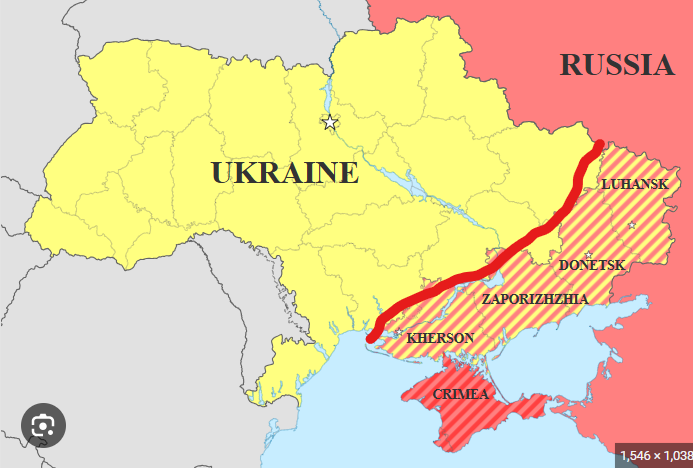
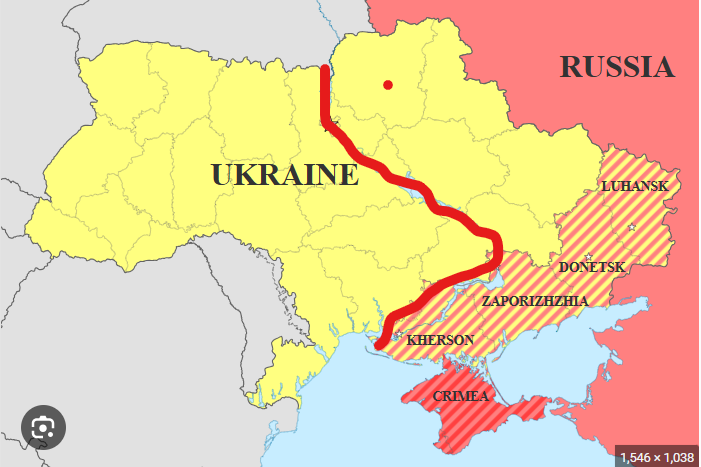
Let's say the frontline changed and it looked like this.
1764656278975.png
Radar horizon increases which so does tracking time for air defense radars because long range missiles like ATACMs and air to ground launch missiles have to be launched at higher flight ceilings offering radars more time to respond because longer distances have to be covered more than before. Also the frontline that got moved further west would make the original cities in the east less prone to artillery and drone strikes.

In general, you do not want to be the one with less land either because instead of more places you are giving the adversaries less to places to look for if they are to find and hit strategic targets a lot more often than they did before.
 
As others pointed, the Radar horizon for Taganrog case is not so good for low flying target detection.

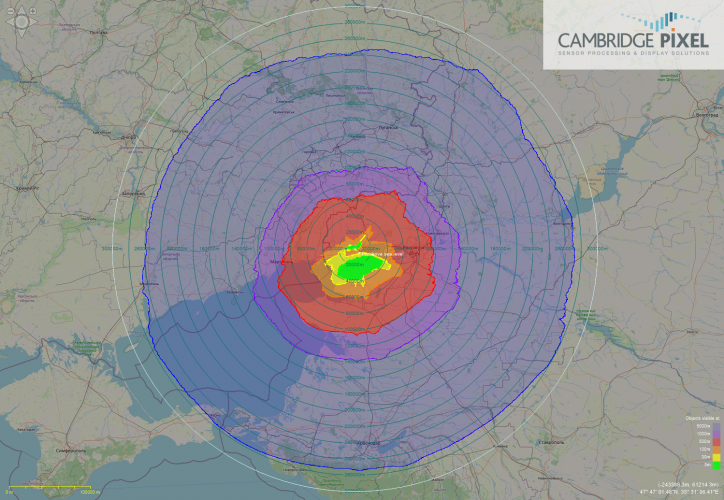
RadarCoverage-20251202-150503.png

This is shadowcountour plot for Taganrog, say one put S-400 with 40V6M mast, notice target flying very low up to 100 m can only be detected or possibly be detected at range of about 20-30 km and not in all direction. Target flying 500 m can be detected properly but not at the full envelope of the system.

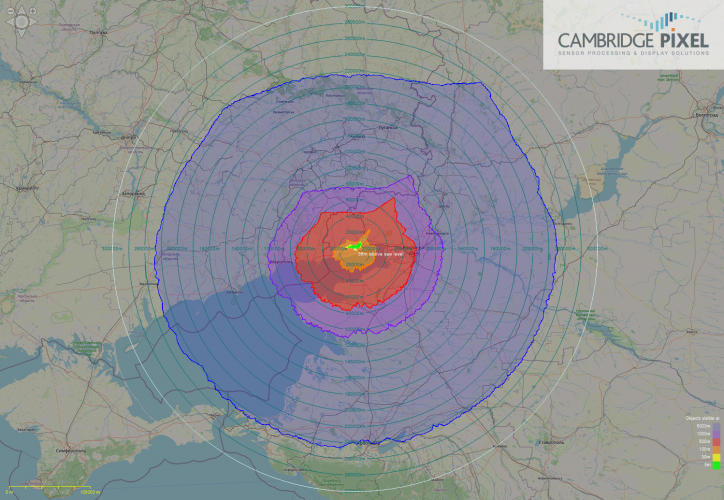
Without 40V6M mast, things get bit iffy

RadarCoverage-20251202-151515.png

Notice how much smaller the envelope for the target flying at 5 and 25 m. This essentially left considerable portion of the city and thus the aviation plant unprotected against target flying at such altitude.

The other thing is whether the battery is active or not. As air defense battery might not active at all times to save hours, instead they active or deployed in randomly selected "schedule" time and pre-planned site. The job of Recce is to identify when and where the battery will deploy and whether they goes active or not at that time. Then plan to strike, post to telegram after.

Again i highly Recommend Cambridge Pixel's Radar coverage tool which have free edition


Can only provide single plot but it is enlightening and realistic.
 

Similar threads

Back
Top Bottom