

You are using an out of date browser. It may not display this or other websites correctly.
You should upgrade or use an alternative browser.
You should upgrade or use an alternative browser.
Rutan's first design for Beechcraft: Models 78/79 "Commuter"
- Thread starter Orionblamblam
- Start date

- Joined
- 26 May 2006
- Messages
- 38,288
- Reaction score
- 20,425
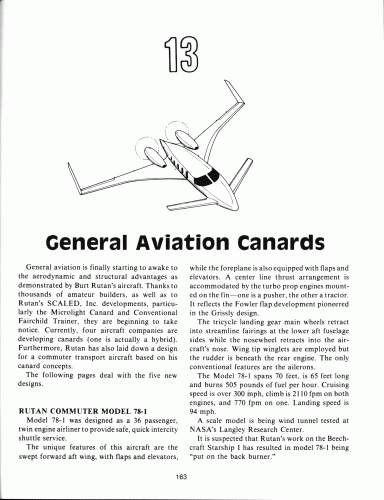
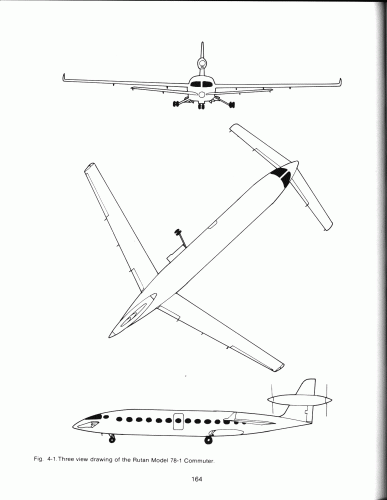
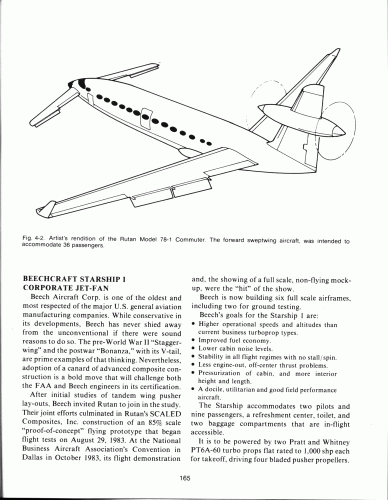
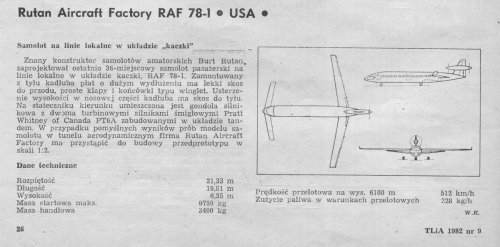
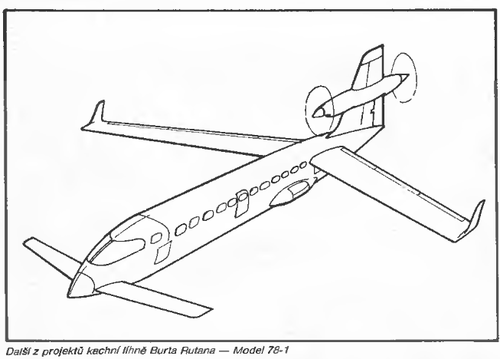
Orionblamblam said:From "Canard, A Revolution In Flight." I've only ever seen the book once, and that was when I bought it.
The Model 78-1;
http://books.google.com.eg/books?id=0dQDAAAAMBAJ&pg=PA203&dq=rutan+78-1&hl=ar&ei=5XmXTLXzHeWhOL2d0YgJ&sa=X&oi=book_result&ct=result&resnum=1&ved=0CCMQ6AEwAA#v=onepage&q&f=true
Attachments

- Joined
- 26 May 2006
- Messages
- 38,288
- Reaction score
- 20,425
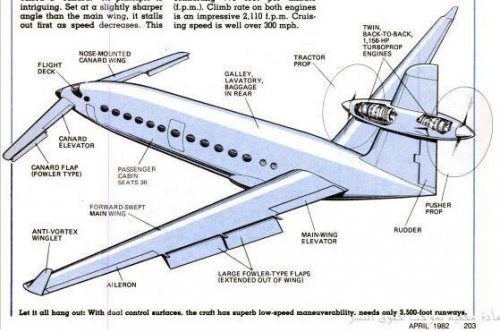
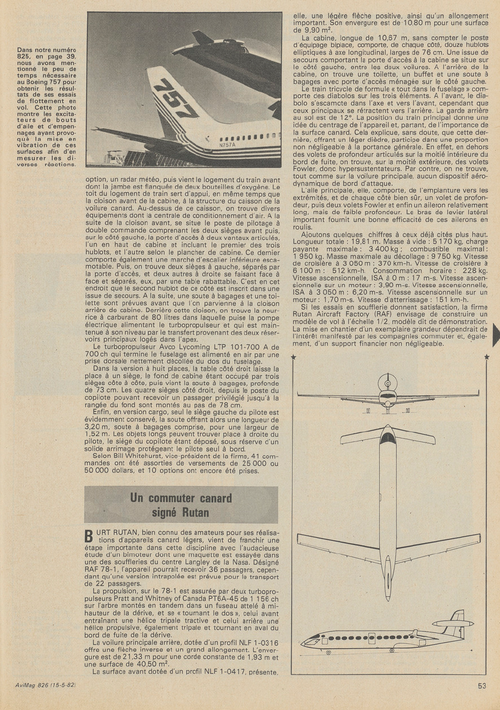
From "Canard, A Revolution In Flight." I've only ever seen the book once, and that was when I bought it.
From Aviation magazine 1982.
Attachments

- Joined
- 25 June 2009
- Messages
- 15,515
- Reaction score
- 9,447
 Now that Scaled Composites has become part of the Northrop Grumman group, after years of working prominently (though not exclusively) for that same group as a consultant, it is almost forgotten that for a little while, Burt Rutan's company was affiliated to Beechcraft.
During that period, four prototypes were developed by Scaled for Beechcraft: the Model 81 "Catbird" (a small sports prototype), the Model 115 SCAT (undersized Starship demonstrator), the Model 133 (ATTT tandem-wing transport) and the Model 143 "Triumph" (twin business jet). Out of those, only the Model 115 led to a full-scale development with the production of 53 examples of the larger Beechcraft 2000 "Starship".
But before Burt Rutan thought of the radical pusher bizjet, and even before working on the "Catbird", he had envisioned a large, equally radical, push-pull piston-powered 36-passenger transport design for Beechcraft, which he named the "Commuter". Two separate configurations, designated Models 78-1 and 79 were wind-tunnel tested at NASA, but only the former's design and data were ever released. No information pertaining to the Model 79 configuration has emerged yet, and to my knowledge, NASA has never made public any photos of the wind-tunnel tests. (NOTE: all the model numbers given above are from Scaled, not Beechcraft, although the Catbird might also have been the Beechcraft Model 81 if produced).
Does any forum member have any idea what the Model 79 might have looked like? Could it have been a more conventional, more conservative take on the concept? And has anyone ever seen a photo of either types in wind-tunnel model form?

Last edited:
Silencer1
That now I am the Ruler of the Queen's Navee!
- Joined
- 3 August 2009
- Messages
- 943
- Reaction score
- 703
I noted, that there is no mention of lifting surface on the drawings and in the articles, at least, at the first glance. IMHO, sizes of both surfaces have been extremely small for the overall size of the aircraft. And push-pull engine layout relatively high above wings could be another factor, that designers should compensate.Now that Scaled Composites has become part of the Northrop Grumman group, after years of working prominently (though not exclusively) for that same group as a consultant, it is almost forgotten that for a little while, Burt Rutan's company was affiliated to Beechcraft.
With all my respect to Rutan and his colleagues, this project remind me some post-WW2 airliners projects and sole prototypes: they have unusual configuration, very advanced layouts - and, even build, couldn't compete with DC-3 and "classic" propliners.
Thanks for mentioning the number of produced Beech Starship! Never figure out, that more the 50 have been built!
I was (erroneously) sure, that only a prototype has been produced.
- Joined
- 25 June 2009
- Messages
- 15,515
- Reaction score
- 9,447
Sadly, they were all purchased back by Beechcraft for destruction (except for three I think), because the company estimated it was less costly than continuing to provide parts and maintenance, given the very limited number of those very costly aircraft.Thanks for mentioning the number of produced Beech Starship! Never figure out, that more the 50 have been built!
I was (erroneously) sure, that only a prototype has been produced.
The canard as drawn wouldn't have been a very adaptable design for smaller or bigger offshoots of a base model. Too bad it wasn't more like his tri-wing designs with the longest wing mounted in the middle high on the fuselage, and sturdier stub wings front and back.
The high-mounted twin-engine tail would have been a nightmare to maintain and inspect at regular intervals. Good maybe for an amphibian, not real practical for an airliner.
The high-mounted twin-engine tail would have been a nightmare to maintain and inspect at regular intervals. Good maybe for an amphibian, not real practical for an airliner.

- Joined
- 1 May 2007
- Messages
- 2,816
- Reaction score
- 2,659
The Britten-Norman Trislander would like a word . . .The high-mounted twin-engine tail would have been a nightmare to maintain and inspect at regular intervals. Good maybe for an amphibian, not real practical for an airliner.

cheers,
Robin.
Piaggio P180 Avanti got the idea of the wings and made the engines serviceable without specialized equipment.
https://en.wikipedia.org/wiki/Avantair#/media/File:Piaggio_P180.jpg![1024px-Piaggio_P180[1].jpg](data:image/svg+xml;charset=utf-8,%3Csvg xmlns%3D'http%3A%2F%2Fwww.w3.org%2F2000%2Fsvg' width='1024' height='768' viewBox%3D'0 0 1024 768'%2F%3E "1024px-Piaggio_P180[1].jpg")
https://en.wikipedia.org/wiki/Avantair#/media/File:Piaggio_P180.jpg
![1024px-Piaggio_P180[1].jpg](https://www.secretprojects.co.uk/data/attachments/323/323486-e4afee599e39c12ce49da949c5ddf9dd.jpg "1024px-Piaggio_P180[1].jpg")
- Joined
- 25 June 2009
- Messages
- 15,515
- Reaction score
- 9,447
In my opinion one of the best aircraft designs... ever.Piaggio P180 Avanti got the idea of the wings and made the engines serviceable without specialized equipment.
Silencer1
That now I am the Ruler of the Queen's Navee!
- Joined
- 3 August 2009
- Messages
- 943
- Reaction score
- 703
Good point! And I would like to mention, that TrIsladner is a smaller aircraft, so (perhaps) ladder, needed to access engine isn't too high and thus stable and suitable enough for work.The Britten-Norman Trislander would like a word . . .
P.S. Islander and TrISlander are the nice examples, how very simple aircraft could be successful, if the designers clearly understand their market's niche
- Joined
- 25 June 2009
- Messages
- 15,515
- Reaction score
- 9,447
The high-mounted twin-engine tail would have been a nightmare to maintain and inspect at regular intervals. Good maybe for an amphibian, not real practical for an airliner.
The Dornier SeaStar also has something to say...The Britten-Norman Trislander would like a word . . .

(and I promise the registration here is genuine!)

Maveric
Fight for yor Right!
- Joined
- 14 January 2007
- Messages
- 2,291
- Reaction score
- 1,024
Is there also a drawing of the Model 79?View attachment 787532Now that Scaled Composites has become part of the Northrop Grumman group, after years of working prominently (though not exclusively) for that same group as a consultant, it is almost forgotten that for a little while, Burt Rutan's company was affiliated to Beechcraft.
During that period, four prototypes were developed by Scaled for Beechcraft: the Model 81 "Catbird" (a small sports prototype), the Model 115 SCAT (undersized Starship demonstrator), the Model 133 (ATTT tandem-wing transport) and the Model 143 "Triumph" (twin business jet). Out of those, only the Model 115 led to a full-scale development with the production of 53 examples of the larger Beechcraft 2000 "Starship".
But before Burt Rutan thought of the radical pusher bizjet, and even before working on the "Catbird", he had envisioned a large, equally radical, push-pull piston-powered 36-passenger transport design for Beechcraft, which he named the "Commuter". Two separate configurations, designated Models 78-1 and 79 were wind-tunnel tested at NASA, but only the former's design and data were ever released. No information pertaining to the Model 79 configuration has emerged yet, and to my knowledge, NASA has never made public any photos of the wind-tunnel tests. (NOTE: all the model numbers given above are from Scaled, not Beechcraft, although the Catbird might also have been the Beechcraft Model 81 if produced).
Does any forum member have any idea what the Model 79 might have looked like? Could it have been a more conventional, more conservative take on the concept? And has anyone ever seen a photo of either types in wind-tunnel model form?
View attachment 787530
- Joined
- 25 June 2009
- Messages
- 15,515
- Reaction score
- 9,447
Ahem...Is there also a drawing of the Model 79?

Two separate configurations, designated Models 78-1 and 79 were wind-tunnel tested at NASA, but only the former's design and data were ever released.
Does any forum member have any idea what the Model 79 might have looked like?
Similar threads
-
 Rutan 58 and 59 Predator joined-wing agricultural aircraft project
- Started by Stargazer
- Replies: 3
-
Grumman / Shin Meiwa PX-2 Flying boat.
- Started by Pioneer
- Replies: 5
-
Kentron variable-sweep wings commuter aircraft
- Started by Stargazer
- Replies: 0
-
-
