Status
Not open for further replies.
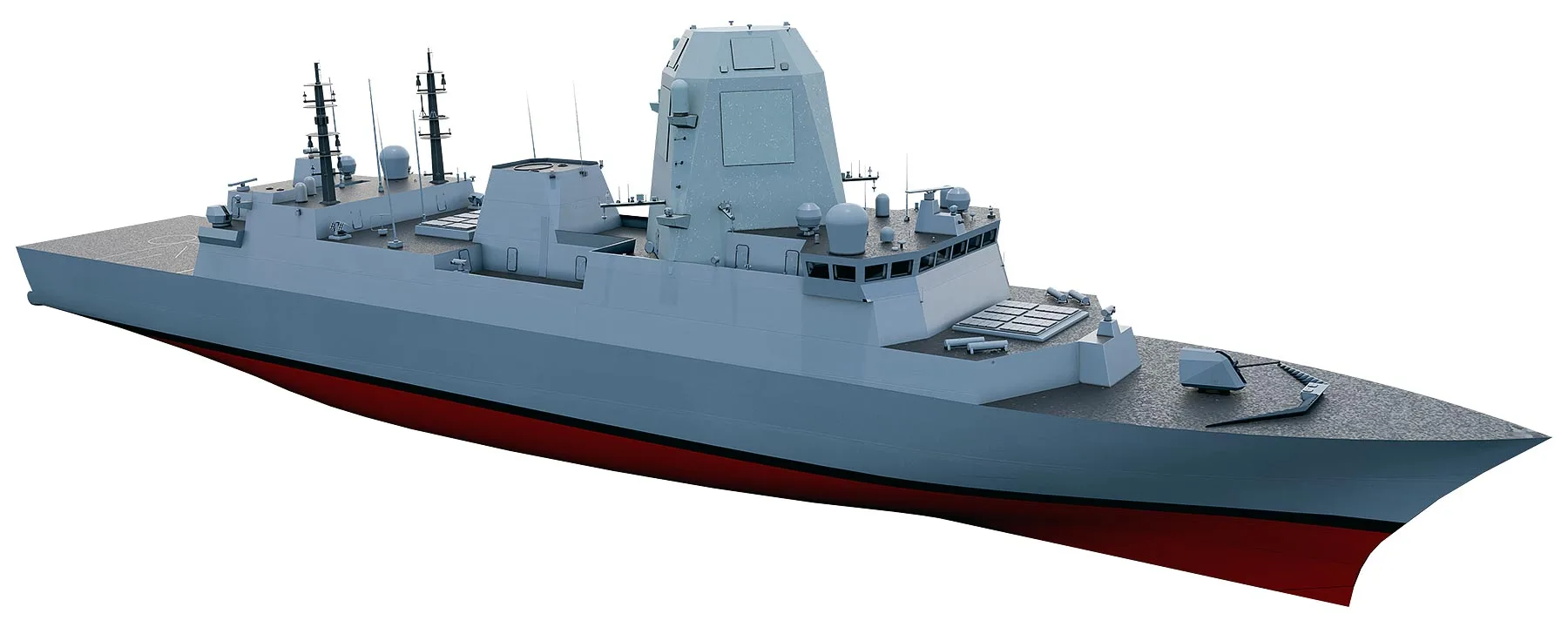
That's not quite the most recent concept, that one's a little older than the many-faced array being shown off above. This one cuts down on some of the smaller panels, but the eight main ones looks the same.
BAE-Systems-Future-Air-Warfare-Destroyer-3.webp
Jeez that is not attractive.


Always seems strange to see the radar antennas tower over the ESM kit.

Logically shouldn’t the ESM antenna(s) be positioned at the top of the radar mast to allow for maximum passive surveillance? While the rest of the ship and the actively emitting radars are still hull down under the radar horizon. (Eg. Italian DDX, Australian Hunter, French FDI antenna arrangements etc)
Yes, ESM should be as high as possible. It's why US subs have the ESM antennas built into the periscopes.
 
Its the Type-83 so will never have US radar. But any S-band arrays will need to be mounted lower. BAE is developing a next gen Sampson for the Type-83.
"OR EQUIVALENT"

I suspect that the UK radars are quite similar in weight, volume, and power required.
 
The pagoda design is slightly better, but BAE raised the flight deck from T26 for some reason (I notice no boat bays?) in order to give the same flush deck as T45. It's also very fat in order to carry the big radar on a 160m hull:
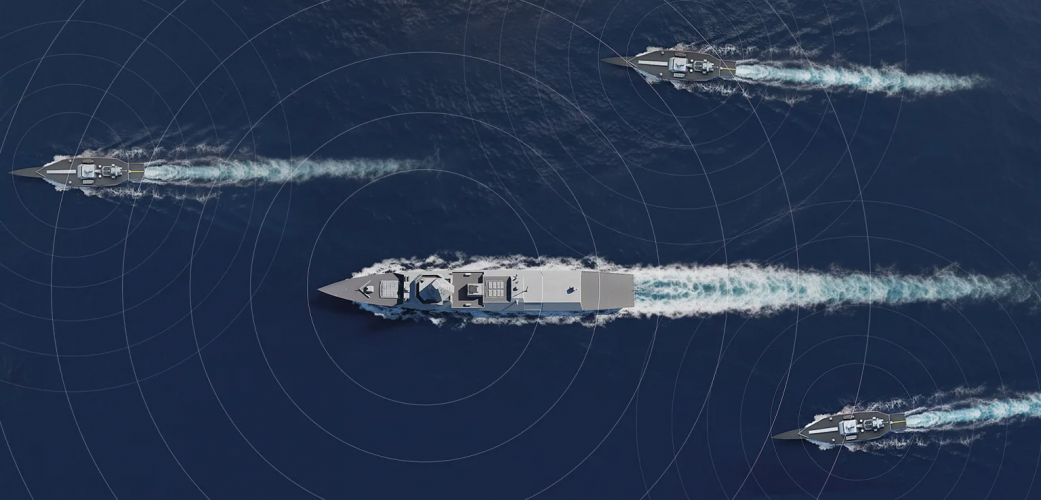
Huh, those smaller ships are trimarans. Interesting.

As to the fat hull, looks like the same proportions as a Burke, L:B of about 7.6:1. That's less efficient than it could be, but IIRC the UK suffers from a lack of long drydocks and no space to build them.

IIRC the best L:B is about 8.6:1
 
Huh, those smaller ships are trimarans. Interesting.
BAE Sensor Effector Platform design for the T91 USV. They based it on the Triton trimaran hull, which was a subscale demonstrator early in what became the T26 programme.
As to the fat hull, looks like the same proportions as a Burke, L:B of about 7.6:1. That's less efficient than it could be, but IIRC the UK suffers from a lack of long drydocks and no space to build them.

IIRC the best L:B is about 8.6:1
Ah OK then, not too bad. There's also a 150m design which is probably slightly worse, but Burke shaped isn't terrible. I have always liked the long, elegant Japanese escorts however.
 
Ah OK then, not too bad. There's also a 150m design which is probably slightly worse, but Burke shaped isn't terrible.
It's still short, fat and with low forecastle :)

DSEI in September last year.
There were rumors that the program since came under heavy review and the ship may be either redesigned or cancelled. What's going on with that?
 
More likely Type 91 will be built first and operate with Type 45. Schedule is measured in a few years.

Relative to Type 83 which is more likely a decade away.
 
I would just say that the central warship in that render is a concept from neither BAE nor Babcock, but a placeholder for the RN for various PR and other such events.
That's the BAE Future Air Warfare Command Ship concept, isn't it?
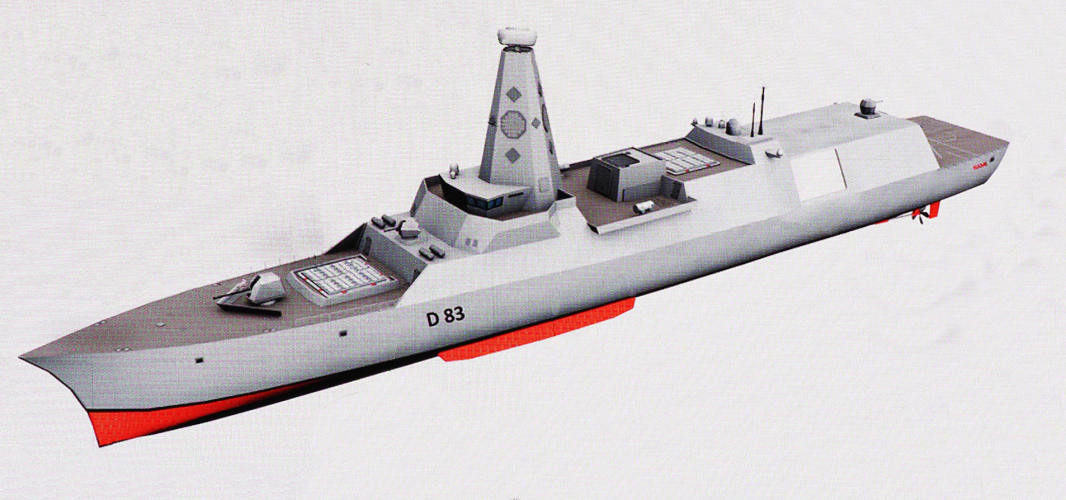
The RN's own placeholder from the NDP is this one:
1779963627707.png
I'm suspicious of that image on the whole as well. I can't really find it anywhere else, and I have feeling it might be a Navy Lookout AI-special rather than an official release.
This is a good article for explaining the concept.
NL are pretty good at getting information out of companies and their photoshops (AI enhanced rather than AI made, I suspect) are usually easier to spot than that. It might be worth looking at Naval News video from the BAE stand at DSEI to see if that image comes up in the background.
 
1779964313647.png Sorry, I was talking about the concept in this image here. My mistake.
 
The thing that I think is interesting is that all available detailed concepts seem to lack a hull-mounted sonar.
 
The thing that I think is interesting is that all available detailed concepts seem to lack a hull-mounted sonar.
do they have 2 towed arrays? one shallow and one VDS? If so you don't absolutely NEED a hull-mounted sonar. Especially if the planned mission area is deep water.

IMO the correct sonar rig is shallow towed array and VDS at the stern for deep water, and a hull sonar at the bow that is optimized for water too shallow to run the towed arrays. But that does cost. If you do the fitted for but not with game *spits*, the place where the bow sonar would be still gives you that nice big bulbous bow for improved wake control.
 
Sorry, I was talking about the concept in this image here. My mistake.
No no you're right, that's the RN concept not the BAE one. It has the same 40mm arrangement. It's missing the rotating masthead array which was enough to make me think it had the chonky BAE mast.
 
do they have 2 towed arrays? one shallow and one VDS? If so you don't absolutely NEED a hull-mounted sonar. Especially if the planned mission area is deep water.

IMO the correct sonar rig is shallow towed array and VDS at the stern for deep water, and a hull sonar at the bow that is optimized for water too shallow to run the towed arrays. But that does cost. If you do the fitted for but not with game *spits*, the place where the bow sonar would be still gives you that nice big bulbous bow for improved wake control.
I doubt it'll have anything in the way of towed array sonar, given that the Type 45 doesn't have one, and the Type 31 doesn't have anything in the way of sonar at all.
 
  • Like
Reactions: DJK
I doubt it'll have anything in the way of towed array sonar, given that the Type 45 doesn't have one, and the Type 31 doesn't have anything in the way of sonar at all.
That weird no bow dome hullform is on both the RN and BAE concepts. Hopefully it just indicates a space for an unspecified dome, very weird otherwise.
 
There have been suggestions that under the Hybrid Navy programme large destroyers are a thing of the past and everything can be distributed across multiple large USVs instead to increase numbers.
It's poppycock because a big radar needs a big ship, and at that point you might as well carry most of the VLS as well.
Yes, exactly.

Power cooling and the often missed elevation above sea level.
 
BAE talked about stripping away all non-AAW related missions in order to improve affordability for their concept. Who knows? A HMS might not be deemed essential if the LUSVs can be equipped for that role.
 
BAE talked about stripping away all non-AAW related missions in order to improve affordability for their concept.
So back to Type 40 series.
I doubt it'll have anything in the way of towed array sonar, given that the Type 45 doesn't have one, and the Type 31 doesn't have anything in the way of sonar at all.
If it's Type 80 series, it should be multirole and TAS of some sort delivers that in the platform.
 
IMO the correct sonar rig is shallow towed array and VDS at the stern for deep water, and a hull sonar at the bow that is optimized for water too shallow to run the towed arrays. But that does cost. If you do the fitted for but not with game *spits*, the place where the bow sonar would be still gives you that nice big bulbous bow for improved wake control.
If no sonar at all, then at least a bulbous bow for efficiency and reduced bow slamming. I would say there should be mine avoidance sonar at the very least. But RN seems to treat ASW as something done by an escort.
BAE talked about stripping away all non-AAW related missions in order to improve affordability for their concept. Who knows? A HMS might not be deemed essential if the LUSVs can be equipped for that role.
I saw a writeup about a side mounted hull sonar, maybe Thales. It was modular and flexible, could be used on small vessels too.
 
We're standardising on mk41 at the moment, though I wouldn't rule out some bigger silos for Nightfall-derived ballistic missiles or whatever hypersonics come out of AUKUS. I don't think it's worth keeping the smaller missiles on the USVs because they are needed on every ship for self defence anyway and to have a spread out task group longer missiles are needed anyway. In addition CAMM is extremely compact and so T83 is most likely to run out of long range missiles first. Rotating T91s with the larger weapons can allow the T83 to retain enough CAMM for its own self defence on station, though of course it would carry a decent number of Stratus-RS and Aster just in case.
I was mostly meaning in terms of length of tube, not diameter.

Like how Mk41 has Self-Defense, Tactical, and Strike length cells. If the ASROC-equivalent fits into SD cells, all you fit to the USV is those short cells.
 
BAES is working with several partners on the Hyperion Core Demonstrator. Based on the THEIA array technology, originally developed in the UK by BAES. The demonstrator, funded through the Missile Defence Centre (MDC), is built around advanced Ga-N TRMs, ultra-wideband and fully software-defined beamforming.

Hyperion is a generation-after-next radar that unites roles normally performed by multiple, separate sensor systems into a common, ultra-wideband aperture. Hyperion exploits Highly Coupled Dipole Array technology to operate in multiple radar bands and in all polarisations. It is currently focused on demonstrating its benefits against emerging threats, but it could be expanded to combine active and passive radar, electronic surveillance and communications functions. This inherent flexibility and software-driven digital architecture will be vital for meeting the demands of future integrated air and missile defence missions
Is this related to the radar system on the Type 83?

 
BAES is working with several partners on the Hyperion Core Demonstrator. Based on the THEIA array technology, originally developed in the UK by BAES. The demonstrator, funded through the Missile Defence Centre (MDC), is built around advanced Ga-N TRMs, ultra-wideband and fully software-defined beamforming.

Hyperion is a generation-after-next radar that unites roles normally performed by multiple, separate sensor systems into a common, ultra-wideband aperture. Hyperion exploits Highly Coupled Dipole Array technology to operate in multiple radar bands and in all polarisations. It is currently focused on demonstrating its benefits against emerging threats, but it could be expanded to combine active and passive radar, electronic surveillance and communications functions. This inherent flexibility and software-driven digital architecture will be vital for meeting the demands of future integrated air and missile defence missions
Is this related to the radar system on the Type 83?
Probably not directly. I think the general impression now is that SAMPSON will be replaced by a system derived from the Next Generation Transmit/Receive Module, which is also being incorporated into the new Artisan-NG system.

Hyperion appears to be gunning for the future frigates (as in, post T26/31, if such a ship will ever exist). It probably won't be Hyperion directly either; a developed version will be very different.
 
Probably not directly. I think the general impression now is that SAMPSON will be replaced by a system derived from the Next Generation Transmit/Receive Module, which is also being incorporated into the new Artisan-NG system.

Hyperion appears to be gunning for the future frigates (as in, post T26/31, if such a ship will ever exist). It probably won't be Hyperion directly either; a developed version will be very different.
Yes, the 'generation after next' tag means it probably isn't intended for the current crop of programmes, which will rely on NGTRM.
It sounds like an incredibly useful concept though and if BAE can make the multi-static radar thing from NGTRM work alongside a single panel for active radar, ESM and Comms that would be huge.
 
The FADS concept as a whole may be progressing, with clear proposals for the Type 91 appearing from BAE, Navantia and BMT, but the type 83 itself appears to be still a ghost ship.

https://ukdefencejournal.org.uk/new-british-destroyer-underdeveloped-concept/

Only around GBP 1 million has been spent on platform-specific design work for the Royal Navy’s planned Type 83 destroyer over the past three financial years, with the Ministry of Defence admitting it inherited the programme as an underdeveloped concept on entering office, the department stated in a written answer to a parliamentary question [...] The figures show a programme still very much in its earliest stages, despite the Type 83 having been publicly identified as the future replacement for the Royal Navy’s Type 45 air defence destroyer fleet for several years [...] The strategic defence review published in June 2025 retained the requirement for a successor to Type 45 within the Royal Navy’s force structure but did not provide a detailed timeline for the Type 83.

 
Probably because someone in the MoD realised the things won't start construction for at least a decade.
 
Okay, so the Times are reporting that the T83 will be dropped in the DIP, in favour on drones.

However:

'While it is understood that some form of new crewed vessel will be commissioned in the near future, autonomous vehicles will be prioritised in a shift towards modernising the armed forces in the face of the rising threat from Russia and other hostile states.'

So, unless this refers to the 13 new frigates, we might be seeing a shift back to the T4X.

https://www.thetimes.com/uk/defence...nce-investment-plan-warships-drones-m08mjg5w2
 
Same from UKDJ:

https://ukdefencejournal.org.uk/uk-to-buy-drone-command-warships-instead-of-new-destroyers/

They link to this 2025 article that in retrospect was pointing in this direction:

https://ukdefencejournal.org.uk/the-future-air-warfare-command-ship-and-its-drone-escorts/

Maybe this is more evolution than revolution and the combination of sea and air control in one platform makes sense as the Type 90 series drones are to cover different domains.

So, is the vaguely-defined Type 32 going to evolve into the Common Combat Vessel? The CCV is going to need a big, powerful radar, so it likely won't be frigate sized.

Babcock has pitched a variant of its Type 31 as a drone command ship:

https://www.navylookout.com/babcock...ate-as-command-platform-for-uncrewed-systems/

ROMULUS is designed to operate in concert with other uncrewed assets, including unmanned aerial vehicles (UAVs) and HII’s own REMUS unmanned underwater vehicles (UUVs). This capability for dual-domain operations expands reach across surface, subsurface and air domains, a critical attribute for future anti-submarine warfare, force protection and distributed maritime tasks. 
 
Last edited:
Thoughts.....on cancelling Type 83.

Within the regional defence of the North Atlantic, the chief concern is just finding stuff and tracking it accurately.

With the advent of rapid strike systems of great range, the need to place assets near the target has retreated.
This is simply the continuation of increasing stand-off ranges of weapon systems. Which long since flew beyond the horizon to engage the enemy.

Thus a ballistic missile with a with anti-ship capability is increasingly affordable. Whether that is dispensing subminitions or casting a hypersonic glide vehicle to slam through the ship.

This can be launched from land, obviating the need for a ship to be sustained for this purpose.

Equally the ability to swarm drones and low cost cruise missiles open up potential to swamp a warships defences.

If need be, an aircraft can tote Anti-ship missiles and within a few hours bring them to bear on the targets. GCAP delivers this gor the future, but right now Typhoon and Lightning II.

And Sea based Drones have proven capable of ranging hundreds of nautical miles to strike at Russian naval assets.

This implies not just drone surveillance systems, but an increasing reliance of satellites to provide real time updates on assets at sea.
Istari is the UK satellite constellation, finally being funded, that will achieve this if expanded sufficiently.

But further to that, the use of OTHR systems similar to JORN is more pressing now. Something the UK is exploring.
These giving good real time tracking of air and sea assets out to prodigious ranges.
Enough to more than cover the Northern Quadrant of the Earth the UK sits in....if not far further.

So where in all this does Type 83 come.....?

An expensive vessel that draws funds away from the core mission set. Drawing funds away from Istari, away from OTHR, away from the Anti-ship missile systems., away from GCAP and all to inadequately deliver AAW in a package all too vulnerable to saturation attack.

Just so we swan over to the Pacific and go "my Destroyer is better than your Destroyer"?

I think we're looking at a another Sandys Moment, here.
 
Let's not get into political arguments.

Since Type 83 is dead, in a few days I'll relocate this thread to the Naval Projects section.
 
Status
Not open for further replies.

Similar threads

Back
Top Bottom