Status
Not open for further replies.
Not really sure if this is the right place, but there's no dedicated thread for the Type 45, or for the Mk8, so I though I'd put it here.

View: https://www.youtube.com/watch?v=ZenAkC74n_U


At 13:54 (Edit: 7:02, thanks SB), the crew member tells the presenter that Dauntless downed a drone using her main gun - I was under the impression that the current variant of the Mk8 lacked the software needed to engage air targets. Just thought it was interesting.
 
Last edited:
Not really sure if this is the right place, but there's no dedicated thread for the Type 45, or for the Mk8, so I though I'd put it here.


At 13:54, the crew member tells the presenter that Dauntless downed a drone using her main gun - I was under the impression that the current variant of the Mk8 lacked the software needed to engage air targets. Just thought it was interesting.
I have it as between 07:00 and 07:15?
They specify that the gun is designed for surface to surface and that shooting down air targets is 'unheard of', so I wonder whether some of the gunners went old-fashioned and did the aiming themselves?
Incredibly skilled if so.
 
but the latest wording signals that the programme is no longer proceeding in isolation and is now being assessed as part of a broader restructuring of future naval capability.
Knowing the british, this doesn't sound good and will most likely result in many delays, cost overruns, cut corners and lacking capability when something eventually hits the water.

In general all the talk and especially uncertainty about fleet composition, numbers and the general future of the RN paints the picture of a force that has no clear idea of what their role and capabilities in the future should be.

If it wasn't for the (admittedly lackluster) nuclear component, the RN would have been relegated to being the third or even fourth most powerful Navy in Europe, rather than being the second most capable currently.
 
Here we go again!
Into the weeds of meeting after meeting, study after study and always No.11 going "can you reduce capability/numbers a bit more", and the perennial "Do you really need it like that".

the general future of the RN paints the picture of a force that has no clear idea of what their role and capabilities in the future should be.

The UK lacks a strategic view of what it should be and do. Because we're into a once-in-a-hundred years reorganisation of the political landscape. Where the old post-45 order is collapsing.

UK is an Atlantic Power and a dominating influence on the North Sea.
Or it is nothing of worth.

Until reality reasserts itself, the decline will continue.

Clarity, would require FADS goes forward in numbers familiar to the Cold War.
 
Well it probably makes sense to check that the T83 fits into the Hybrid Navy - although most of the unmanned components seem to be more oriented towards ASW than ADS so far. Better than starting to build them and someone says its not compatible anymore and getting cancelled - we don't want another T82 scenario.
 
So in the 2030s only Italy and Germany will have modern AAW ships in Europe?
In this sense that they will be the first to replace their ships, yes. The Brits may introduce their FADS during the late 2030s, but it's unlikely. The Type 45s will be heavily modernised, though, and still hanging around into the 2040s. We've heard nothing from the French.
 
So in the 2030s only Italy and Germany will have modern AAW ships in Europe?
The Dutch are working on a replacement for their Zeven Provincien class, but that won't show up till the end of the 30s.
 
So in the 2030s only Italy and Germany will have modern AAW ships in Europe?
If by modern you mean gigantic behemoth, yes.
Although, i would consider the 4 modernized Horizon class, FDI and FREMM EVO modern AAW ships.

The Dutch have their own program, but considering the delays with ASWF, I wouldn’t expect the future air-defense ships to be delivered on schedule either ... likely slipping into the late 2030s.
The LCF frigates were recently modernized and are currently being equipped with Tomahawk missiles.


We've heard nothing from the French.
According to the Chief of the French Navy, they have no interest in the large cruiser concept.
Even the replacement for the Horizon class is expected to be roughly the same size on the French side.
However, the Marine Nationale will also need heavier frigates... But this issue will only be addressed when replacing the Air Defense Frigates [FDA] of the Horizon class, probably with boats of the same class, i.e. 7,000 tons
 
According to the Chief of the French Navy, they have no interest in the large cruiser concept.
Even the replacement for the Horizon class is expected to be roughly the same size on the French side.
Any concrete news on this, a known timeline?
 
If by modern you mean gigantic behemoth, yes.
Although, i would consider the 4 modernized Horizon class, FDI and FREMM EVO modern AAW ships.
I wouldnt, none of them have the firepower to defend other ships in any conzentrated attack.
The Dutch have their own program, but considering the delays with ASWF, I wouldn’t expect the future air-defense ships to be delivered on schedule either ... likely slipping into the late 2030s.
The LCF frigates were recently modernized and are currently being equipped with Tomahawk missiles.
I forgot about the Dutch
According to the Chief of the French Navy, they have no interest in the large cruiser concept.
Even the replacement for the Horizon class is expected to be roughly the same size on the French side.
 
Any concrete news on this, a known timeline?
The two Horizon-class FDA are expected to retire in 2038 and 2040 ... so I’d anticipate the next-generation "FDA NG" to enter service slightly before then ?

I believe the idea is to field 18 true first-rank frigates when both Charles de Gaulle is operational and the PANG is at sea on trials, around 2036–2038 (and maybe beyond).

The final mix is undecided ... either 8 FREMM / 8 FDI / 2 FDA NG or 8 FREMM / 6 FDI / 4 FDA NG ... I personally lean toward the second option.

I wouldnt, none of them have the firepower to defend other ships in any conzentrated attack.
Well in that case, to you France will never field modern AAW ships ...
How would you classify a 48 VLS ship, escorted by 2 16 VLS USVs ?
 
Well in that case, to you France will never field modern AAW ships ...
Yes France will not field modern AAW ships in the 2030s, France clearly doesnt build their navy to fight mayor sea and airbattles.
How would you classify a 48 VLS ship, escorted by 2 16 VLS USVs ?
I mean that higly depends on the sensors of the 48 VLS ship but still 48 VLS in the Sylver family disnt that much
 
I wouldnt, none of them have the firepower to defend other ships in any conzentrated attack.
The Marine Nationale, like the USN until very recently (Trump BBG(X)), appears to believe more in Distributed Maritime Operations (DMO) than putting all its eggs in one basket. So any task force facing the risk of concentrated attack would be escorted by at least 3-4 frigates with significant AAW capability and 100+ VLS, plus carrier based fighters with air-to-air missiles. With every ship also equipped with short-range defenses against a wide range of threats (jammers, decoys, point-defense missiles and guns etc).

Currently (and far into the forseeable future) only the Chinese have the kind of large arsenal of sophisticated anti-ship missiles that could overwhelm this kind of defensive screen.
 
Last edited:
France clearly doesnt build their navy to fight mayor sea and airbattles.
Compared to whom? China or the US? Maybe. But France has a very capable Navy and has ships that cover the whole spectrum of anti-submarine warfare, anti-air warfare as well as anti-ship, strike and aerial warfare covered by Charles De Gaulle and it's airwing. Btw a carrier that is equipped with VLS, another layer in the defense of a French battlegroup. Not something you'd see if they only intended to play in a sandbox or do anti-piracy. The french Navy is the most powerful Navy in Europe and operates routinely in the Atlantic, Mediterranean Sea and around Africa and the near East. Yes, 2 Horizon DDGs seem lackluster at first glance, but it's enough to ensure that their CVN always has a dedicated AAW destroyer in it's battlegroup and the rest is covered by frigates or allied warships (like for example Italian Horizons). They posess a degree of naval autonomy that few others enjoy.
 
The two Horizon-class FDA are expected to retire in 2038 and 2040 ... so I’d anticipate the next-generation "FDA NG" to enter service slightly before then ?

I believe the idea is to field 18 true first-rank frigates when both Charles de Gaulle is operational and the PANG is at sea on trials, around 2036–2038 (and maybe beyond).

The final mix is undecided ... either 8 FREMM / 8 FDI / 2 FDA NG or 8 FREMM / 6 FDI / 4 FDA NG ... I personally lean toward the second option.
Maybe worth it's own thread or is there not enough info yet (perhaps an overarching "Future of the Marine Nationale" thread would be adequate though, with the associated posts here moved there)?
 
Last edited:
48 VLS in the Sylver family disnt that much
So what, everyone should have Burkes with 96 VLS cells for Area Air Defence?

But what goes into those VLS Cells? Take out 20 for Tomahawk, we're down to 76.

Then another 8 for VL Asroc, we're down to 68.

Then another 8 for SM3 for BMD, we're down to 60. (And versus Chinese ATBMs is 8 really sufficient?)

Let's say 16 SM6, because Harpoon's not the threat it used to be, and 16 seems to be the new default SSM fit. SM6 does cover AAW, but can you afford to flush your ASuW battery just now? So we're down to 44 cells.

Type 45 (post MLU) offers 48 Aster 30 Blk 2, plus 24 CAMM. If you want an equal number of ESSM vs CAMM, then that's another 6 cells, and you're down to 38 cells for area air defence. And suddenly 48 Aster 30 Blk 2 isn't looking at all bad.
 
Maybe worth it's own thread or is there not enough info yet (perhaps an overarching "Future of the Marine Nationale" thread would be adequate though, with the associated posts here moved there)?

There is probably not enough information yet.

All we really have about the future FDA is the comments from CEMM Admiral Vanjour is that he is not in favor of a large >10,000-ton projects (which comes up occasionally as there have been questions about a cooperative program regarding the Italian DDX by some MP's - but the French MoD has never expressed any interest), and that the Horizon-class will probably be replaced by ships of similar tonnage;

Toutefois, la Marine nationale aura aussi besoin de « frégates plus lourdes »… Mais cette question ne sera abordée qu’au moment de remplacer les frégates de défense aérienne [FDA] de la classe Horizon, « probablement par des bateaux de la même gamme, soit 7 000 tonnes », a-t-il conclu.

Machine translation for convivence:
However, the French Navy will also need "heavier frigates"... But this issue will only be addressed when replacing the Horizon-class air defense frigates [FDA], "probably with ships of the same class, i.e. 7,000 tonnes," he concluded.
 
Type 45 (post MLU) offers 48 Aster 30 Blk 2, plus 24 CAMM. If you want an equal number of ESSM vs CAMM, then that's another 6 cells, and you're down to 38 cells for area air defence. And suddenly 48 Aster 30 Blk 2 isn't looking at all bad.
By your counting, a Burke would have 80 cells for SM-2 and ESSM if it carried as many cruise missiles, anti-submarine missiles, and exoatmospheric BMD missiles as a Type 45.
 
Last edited:
By your counting, a Burke would have 64 cells for SM-2 and ESSM if it carried as many cruise missiles, anti-submarine missiles, and exoatmospheric BMD missiles as a Type 45.
Your equation doesn't hold together, Type 45s aren't trying to be the RN's primary land-attack or ASW combatants, because that's not a role we need them to adopt. Burkes, on the other hand, are expected to cover those roles.
 
Type 45 (post MLU) offers 48 Aster 30 Blk 2, plus 24 CAMM. If you want an equal number of ESSM vs CAMM, then that's another 6 cells, and you're down to 38 cells for area air defence. And suddenly 48 Aster 30 Blk 2 isn't looking at all bad.
Aster-30 Block 1 is the current plan. That's for short-range BMs.
 
Seems to be the way the RN are going as well. Smaller platforms, therefore cheaper platforms (at least, that's the plan).
I do think there’s some truth to smaller is cheaper. It’s a little counterintuitive given the push towards larger platforms (steel is cheap), but the logic is that the smaller platforms can share a greater deal of commonality, eg. a single platform with ASW, AAW and export variants, leveraging common systems, propulsion system etc. Plus you get the benefit of larger production runs.

To some extent you see that with the various T26 derivatives, though it’s not exactly small (but still far less than 10,000 tons). That’s also how you go from 4 Horizon DDGs to 24x FREMMs sharing the same propulsion system, same sonars etc. Plus with scalable modern flat panel radars and common software libraries it’s more valuable to have a larger number of platforms with a large degree of combat system commonality, since once you’ve paid the upfront R&D cost, the cost of each incremental system is quite low.

So for the RN the smart play would be a T26 AAW derivative with maximum commonality. And for the Marine Nationale it will probably involve a single platform to replace the Horizons and FREMMs from ~2040. In the meantime they can buy more FDIs to work as AAW sensor/shooter platforms collaborating with a Horizon DDG.
 
Last edited:
If we're discussing the mid-to-late '30s (and area air defence), I'm reasonably confident the loadout will have moved on.
Not to the Block 2, or its modern replacement, the Aquila - those are larger missiles and would require replacing either the forward planned CAMM silo, or the main A50 silo, to be replaced with the A70-NG. I really doubt they'd bother with that.

The Block 1NT is probably likely to arrive if they push through to the 40s.
 
There is a balance to be struck between trying to squeeze in too much or rely on too advanced a technology on a smaller hull.

And that of the temptation to pile ever more systems onto a larger hull.
In both cases costs blow out and undermine the programme.

The Seaslug Cruiser lost out to the Destroyer, because of cost/production speed limits on the Type 901 radar. Two "Jelly" per Cruiser limited production to maybe four such vessels.
Far more preferable to have 8 Destroyers....

For example if Type 42 Batch I was a bit too tight. Type 43 was too much and Type 44 would only really work if a Sea Dart VL option had been funded. But that wouldn't be backwards compatible with Type 42.

We can say based on BAE Systems claims, that Sampson didn't need the addition of the S1850 Volume Search radar. Arguably the savings might be enough to have persuaded the government to allow a 7th Type 45....

Arguably FADS may less be reliant on a single large ship, than multiple more modest ships working together.
 
Not to the Block 2, or its modern replacement, the Aquila - those are larger missiles and would require replacing either the forward planned CAMM silo, or the main A50 silo, to be replaced with the A70-NG. I really doubt they'd bother with that.

The Block 1NT is probably likely to arrive if they push through to the 40s.
Possibility exists of CAMM-MR added into the mix
 
Seems to be the way the RN are going as well. Smaller platforms, therefore cheaper platforms (at least, that's the plan).
We didn't go for the smaller ship with T31 or the QEs, IMO what we might term the 'revival' period of ship designs post-T26 disaster have all focussed on large, adaptable hulls with plenty of capability able to be added later.
So what I think for T83 is that the RN will go big on the long term limiting factors like array and hull size but perhaps not have 128 VLS or a conventional strategic strike capability at the beginning in order to maximise hull numbers, and then use the scalable production of T91 and upgrades to reach full capacity once the birds are in the hand.
So it would be the 160m, 10-11kt FAWCS option but with more modular spaces.
 
I don't think we'll see CAMM-MR on the Type 45s, for similar reasons. So far, all indications have been that CAMM-MR will designed for the Mk41, to accommodate twin-packing. From previous indications, I don't think twin-packing into the A50 is feasible, nor particularly necessary, to be frank. So again, you'd need to exchange one of the two current VLS groups for the Mk41.
 
We didn't go for the smaller ship with T31 or the QEs, IMO what we might term the 'revival' period of ship designs post-T26 disaster have all focussed on large, adaptable hulls with plenty of capability able to be added later.
So what I think for T83 is that the RN will go big on the long term limiting factors like array and hull size but perhaps not have 128 VLS or a conventional strategic strike capability at the beginning in order to maximise hull numbers, and then use the scalable production of T91 and upgrades to reach full capacity once the birds are in the hand.
So it would be the 160m, 10-11kt FAWCS option but with more modular spaces.
Yeah, that's a fair assessment. Though, as next-generation AAW ships go, 160m and 10,000t isn't all that big. The Renhai is 13,000t and 180m, whilst I've seen some varied numbers for the DDX, but 14,000t and 180m was thrown around at one point (not sure where they've settled now, likely smaller). The Indian P18 also looks to be around 13,000t and 180m. Of course, the Japanese have their very big BMD ships, but they're not really the same category, neither is the American BBG(X).

Anyone remember that mention of the option to swap out some of the Mk41 modules on the Type 83, in exchange for a couple of CPS tubes?

 
Last edited:
There is a balance to be struck between trying to squeeze in too much or rely on too advanced a technology on a smaller hull.

And that of the temptation to pile ever more systems onto a larger hull.
In both cases costs blow out and undermine the programme.

The Seaslug Cruiser lost out to the Destroyer, because of cost/production speed limits on the Type 901 radar. Two "Jelly" per Cruiser limited production to maybe four such vessels.
Far more preferable to have 8 Destroyers....

For example if Type 42 Batch I was a bit too tight. Type 43 was too much and Type 44 would only really work if a Sea Dart VL option had been funded. But that wouldn't be backwards compatible with Type 42.

We can say based on BAE Systems claims, that Sampson didn't need the addition of the S1850 Volume Search radar. Arguably the savings might be enough to have persuaded the government to allow a 7th Type 45....

Arguably FADS may less be reliant on a single large ship, than multiple more modest ships working together.
Did they ever consider transferring the S1850 to another type?
 
  • Like
Reactions: zen
Yeah, that's a fair assessment. Though, as next-generation AAW ships go, 160m and 10,000t isn't all that big. The Renhai is 13,000t and 180m, whilst I've seen some varied numbers for the DDX, but 14,000t and 180m was thrown around at one point (not sure where they've settled now, likely smaller). Of course, the Japanese have their very big BMD ships, but they're not really the same category, neither is the American BBG(X).

Anyone remember that mention of the option to swap out some of the Mk41 modules on the Type 83, in exchange for a couple of CPS tubes?
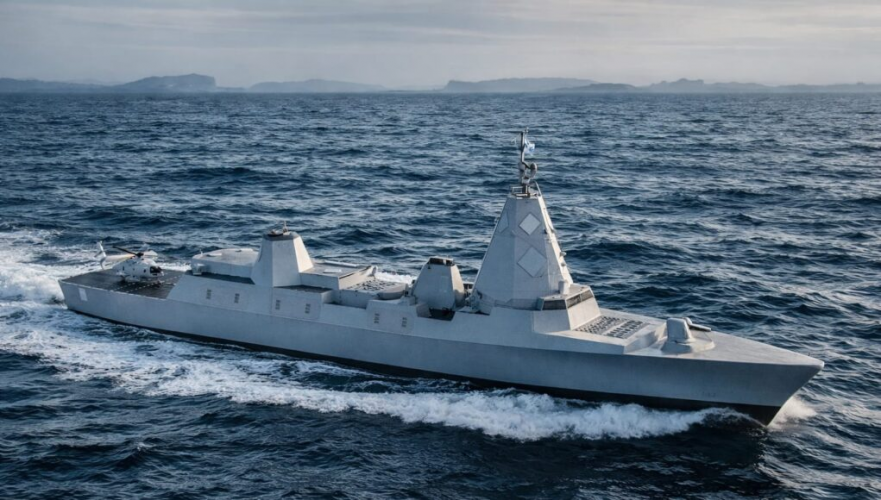
I'd like it to be bigger, but the FAWCS is the only option we've seen apart from the BAE cruiser which would have been approximately 12kt and 170m, I recall, so I chose that. Looking back now the family resemblance to FAWCS is clear, especially in the forwards VLS silo. One major change I can see is that the previous twin funnels have been combined into one, which saves some length.
1769720421553.png 1769720439366.png
IMO we should keep some space clear in the design for a future large-diameter ballistic/hypersonic weapon to follow on from Nightfall. I'm desperately hoping a strategic conventional deterrence is part of the DIP but it's all in my head at the moment.
 
Status
Not open for further replies.

Similar threads

Back
Top Bottom