
You are using an out of date browser. It may not display this or other websites correctly.
You should upgrade or use an alternative browser.
You should upgrade or use an alternative browser.
Royal Navy Type 83 Destroyer (Type 45 replacement)
- Status
- Not open for further replies.

- Joined
- 11 February 2007
- Messages
- 4,140
- Reaction score
- 8,886
OTOH they're emphasizing man-in-the-loop override of FTEWA, and you're not getting that on a fully automated vessel.On the other end it's likely a fully automated AAW ship. Eating into the justifications for a crewed FADS.
- Joined
- 15 July 2007
- Messages
- 5,732
- Reaction score
- 6,313
Yes but there's a significant difference between a crew of 250 to a crew of 80 for example and exactly how many be needed on the high end of a Type 91 is not clear.OTOH they're emphasizing man-in-the-loop override of FTEWA, and you're not getting that on a fully automated vessel.
bobthemonkey
ACCESS: Confidential
- Joined
- 9 February 2011
- Messages
- 86
- Reaction score
- 204
Looks like it’s a long hull / enlarged 140, rather than a new design.Seen nothing about an Arrowhead 160 anywhere other than that article.
What international reference design could they use?
Batch 1 Sejong the Great?
See the penultimate paragraph of https://www.navalnews.com/event-new...bitions-for-fads-programme-type-83-destroyer/

TorpedoJ
ACCESS: Secret
- Joined
- 11 October 2023
- Messages
- 434
- Reaction score
- 869
That's a pity, I just finished my Shipbucket kitbash of an Atogo with 57mm guns, Dragonfire and CAMM:Looks like it’s a long hull / enlarged 140, rather than a new design.
See the penultimate paragraph of https://www.navalnews.com/event-new...bitions-for-fads-programme-type-83-destroyer/

At some point you're setting the standards around damage control and operating the ship, not just AAW needs. I mean, it really sounds more like they're moving to something closer to Aegis or Patriot's TEWA architecture / automation, which would (to me) imply that your benefit is reduced workload and better decision-making by watch standers, not hugely reduced crewing. But I also am not terribly familiar with how Sea Viper / T45 does it. Maybe it's quite a bit more manual and you can lose a handful of CIC crew.Yes but there's a significant difference between a crew of 250 to a crew of 80 for example and exactly how many be needed on the high end of a Type 91 is not clear.
Given the issues the Danes had with Iver Huitvelt crewing, though, I'm quite skeptical about these very lean crewing concepts the RN keeps talking about. It all seems like a lot of expense and risk that could end up baked into the design, vs trying to solve the staffing issues.

Reuben James
ACCESS: Top Secret
- Joined
- 15 September 2024
- Messages
- 547
- Reaction score
- 1,113
Is Babcock's involvement pretty much a formality at this point. Given BAE are developing the radar systems for the Type 83, are Babcock likely to be picked?So
Plus Type 91 'missile barge' still not much defined.
Intriguingly, Denmark is currently looking at the option to cut the Ivar Huitfeldt-class and replace with new build.
Could they be brought into FADS?
Interesting that neither major British supplier are offering a fully new design.

Grey Havoc
ACCESS: USAP
- Joined
- 9 October 2009
- Messages
- 24,500
- Reaction score
- 18,175
Someone's (probably in the Treasury) idea of a cost efficiently, I would bet.Interesting that neither major British supplier are offering a fully new design.
- Joined
- 5 May 2007
- Messages
- 2,016
- Reaction score
- 4,277
The requirements haven't been fully defined, and the procurement hasn't been started. What Babcock and BAE Systems are trying to do right now is influence the requirement in a direction that suits them.Interesting that neither major British supplier are offering a fully new design.
Grey Havoc
ACCESS: USAP
- Joined
- 9 October 2009
- Messages
- 24,500
- Reaction score
- 18,175
Could be.
Ron5
I really should change my personal text
- Joined
- 19 January 2016
- Messages
- 164
- Reaction score
- 264
The requirements haven't been fully defined, and the procurement hasn't been started. What Babcock and BAE Systems are trying to do right now is influence the requirement in a direction that suits them.
More likely showing their capability to compete for the order..
bobthemonkey
ACCESS: Confidential
- Joined
- 9 February 2011
- Messages
- 86
- Reaction score
- 204
Would also some Treasury/RN forethought in adapting what is sometimes called tick-tock development cycles; where you split a product into two chunks and alternate which half you iterate on every subsequent release. Intel used it when they were on top of their CPU game to great effect, and you see it in automotive, where a new car may have carry over engines from a previous generation until they are replaced at the mid life facelift.
Arguably this already happened with T26 carrying over the highly effective combat systems from the T23 MLU/Lifex. T83 would therefore be a new combat system on a largely proven hull and propulsion package. How much appetite is there across government for a “new everything” build like T45?
Arguably this already happened with T26 carrying over the highly effective combat systems from the T23 MLU/Lifex. T83 would therefore be a new combat system on a largely proven hull and propulsion package. How much appetite is there across government for a “new everything” build like T45?
TorpedoJ
ACCESS: Secret
- Joined
- 11 October 2023
- Messages
- 434
- Reaction score
- 869
I think that sort of approach would be admirable in a AFV procurement (alternating new hulls and turrets) or even UCAVs (combat systems/airframes) and minehunters, but in a system where we alternate building AAW ships and ASW ships it would just cause problems for whatever comes second in the hull cycle in that the hull is always optimised for the first role.Would also some Treasury/RN forethought in adapting what is sometimes called tick-tock development cycles; where you split a product into two chunks and alternate which half you iterate on every subsequent release. Intel used it when they were on top of their CPU game to great effect, and you see it in automotive, where a new car may have carry over engines from a previous generation until they are replaced at the mid life facelift.
Arguably this already happened with T26 carrying over the highly effective combat systems from the T23 MLU/Lifex. T83 would therefore be a new combat system on a largely proven hull and propulsion package. How much appetite is there across government for a “new everything” build like T45?
By the time we build T83 the T26 hull and propulsion will indeed have been proven... in the ASW role.

Brett Davidson
ACCESS: Top Secret
- Joined
- 26 September 2006
- Messages
- 4,449
- Reaction score
- 12,848
Some material of the potential 'Type 91' arsenal ship to complement the Type 83 as part of the Future Air Dominance System (FADS). FADS itself is part of a system-of-systems-based approach to air and sea control that also includes Type 92 ASW USVs and Type 92 ASW UUVs.
https://ukdefencejournal.org.uk/britain-wants-a-missile-carrying-drone-warship-the-type-91/
Links within the article:
https://www.navalnews.com/event-new...bitions-for-fads-programme-type-83-destroyer/
https://ukdefencejournal.org.uk/uk-signals-progress-on-drone-sub-hunting-fleet-for-atlantic/
The Type 91 concept remains in a pre-concept phase, but would provide “resilience in depth” by offering additional missile capacity in support of more complex platforms like Type 83.
The vessel would be uncrewed and equipped with a deep magazine of missile launchers. It would not operate independently, but rather as part of a force-wide network linking sensors, effectors and decision-making systems across the fleet.
Recently, we reported that The Ministry of Defence (MOD) is pursuing “a deployable and persistent wide area ASW search capability” built around the new Type 92 Sloop – an uncrewed surface vessel – and the Type 93, a drone submarine, according to an industry notice. Imagery associated with the programme suggests the aim is to monitor the GIUK (Greenland-Iceland-UK) gap.

(According the the graphic, the Dreadnought-class SSBNs and other vessels will be patrolling northern Canada [Edit: Greenland!], so it's not just polar bears that you'd have to worry about.)
https://ukdefencejournal.org.uk/britain-wants-a-missile-carrying-drone-warship-the-type-91/
Links within the article:
https://www.navalnews.com/event-new...bitions-for-fads-programme-type-83-destroyer/
https://ukdefencejournal.org.uk/uk-signals-progress-on-drone-sub-hunting-fleet-for-atlantic/
The Type 91 concept remains in a pre-concept phase, but would provide “resilience in depth” by offering additional missile capacity in support of more complex platforms like Type 83.
The vessel would be uncrewed and equipped with a deep magazine of missile launchers. It would not operate independently, but rather as part of a force-wide network linking sensors, effectors and decision-making systems across the fleet.
Recently, we reported that The Ministry of Defence (MOD) is pursuing “a deployable and persistent wide area ASW search capability” built around the new Type 92 Sloop – an uncrewed surface vessel – and the Type 93, a drone submarine, according to an industry notice. Imagery associated with the programme suggests the aim is to monitor the GIUK (Greenland-Iceland-UK) gap.
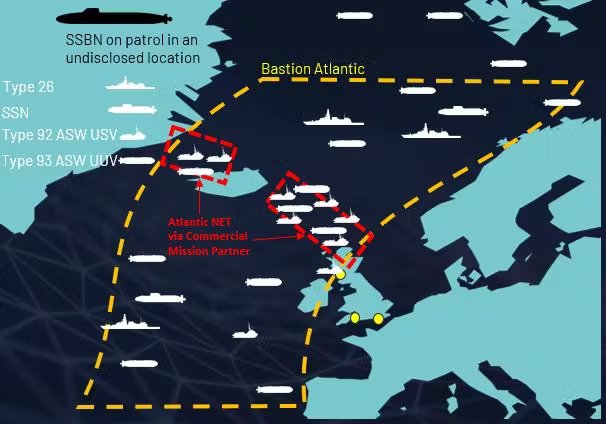
(According the the graphic, the Dreadnought-class SSBNs and other vessels will be patrolling northern Canada [Edit: Greenland!], so it's not just polar bears that you'd have to worry about.)
Last edited:
Reuben James
ACCESS: Top Secret
- Joined
- 15 September 2024
- Messages
- 547
- Reaction score
- 1,113
Appears to currently be patrolling the middle of Greenland, according to the graphic.According the the graphic, the Dreadnought-class SSBNs and other vessels will be patrolling northern Canada, so it's not just polar bears that you'd have to worry about.)
Reuben James
ACCESS: Top Secret
- Joined
- 15 September 2024
- Messages
- 547
- Reaction score
- 1,113
As others pointed out, unless they were within rapid response distance of another vessel, they'd be sitting ducks for submarines and, in littoral scenarios, for fast attack craft and helicopter assaults. If these carry large loads of missiles, they'd be a soft and expensive target.Some material of the potential 'Type 91' arsenal ship to complement the Type 83 as part of the Future Air Dominance System (FADS). FADS itself is part of a system-of-systems-based approach to air and sea control that also includes Type 92 ASW USVs and Type 92 ASW UUVs.
https://ukdefencejournal.org.uk/britain-wants-a-missile-carrying-drone-warship-the-type-91/
Links within the article:
https://www.navalnews.com/event-new...bitions-for-fads-programme-type-83-destroyer/
https://ukdefencejournal.org.uk/uk-signals-progress-on-drone-sub-hunting-fleet-for-atlantic/
The Type 91 concept remains in a pre-concept phase, but would provide “resilience in depth” by offering additional missile capacity in support of more complex platforms like Type 83.
The vessel would be uncrewed and equipped with a deep magazine of missile launchers. It would not operate independently, but rather as part of a force-wide network linking sensors, effectors and decision-making systems across the fleet.
Recently, we reported that The Ministry of Defence (MOD) is pursuing “a deployable and persistent wide area ASW search capability” built around the new Type 92 Sloop – an uncrewed surface vessel – and the Type 93, a drone submarine, according to an industry notice. Imagery associated with the programme suggests the aim is to monitor the GIUK (Greenland-Iceland-UK) gap.
View attachment 773969
(According the the graphic, the Dreadnought-class SSBNs and other vessels will be patrolling northern Canada, so it's not just polar bears that you'd have to worry about.)
They'd need some force protection capability, but at that point, you're looking at minimally crewed vessels rather than drones. Unless we go full Ukraine and just let them fend for themselves.
- Joined
- 15 July 2007
- Messages
- 5,732
- Reaction score
- 6,313
One of the things that struct me about this, is that a 'missile barge' has the capacity to return to port and reload, without removing critical sensor and network systems from the area of operations.
Nor does that degrade magazines aboard those high value Frigates and Destroyers.
They would use up the barges magazines first.
Historically we have solid evidence of SSNs running out of T-LAM and powering back to appropriate ports for reloading. During I vaguely recall Iraq or similar.
And we have evidence from the Ukrainian War, that magazine depth can never be deep enough.
Nor does that degrade magazines aboard those high value Frigates and Destroyers.
They would use up the barges magazines first.
Historically we have solid evidence of SSNs running out of T-LAM and powering back to appropriate ports for reloading. During I vaguely recall Iraq or similar.
And we have evidence from the Ukrainian War, that magazine depth can never be deep enough.
- Joined
- 23 August 2011
- Messages
- 2,564
- Reaction score
- 8,447
Some material of the potential 'Type 91' arsenal ship to complement the Type 83 as part of the Future Air Dominance System (FADS). FADS itself is part of a system-of-systems-based approach to air and sea control that also includes Type 92 ASW USVs and Type 92 ASW UUVs.
The Type 91 concept remains in a pre-concept phase, but would provide “resilience in depth” by offering additional missile capacity in support of more complex platforms like Type 83.
The vessel would be uncrewed and equipped with a deep magazine of missile launchers. It would not operate independently, but rather as part of a force-wide network linking sensors, effectors and decision-making systems across the fleet.
Recently, we reported that The Ministry of Defence (MOD) is pursuing “a deployable and persistent wide area ASW search capability” built around the new Type 92 Sloop – an uncrewed surface vessel – and the Type 93, a drone submarine, according to an industry notice. Imagery associated with the programme suggests the aim is to monitor the GIUK (Greenland-Iceland-UK) gap.
View attachment 773969
(According the the graphic, the Dreadnought-class SSBNs and other vessels will be patrolling northern Canada, so it's not just polar bears that you'd have to worry about.)
So which Greenland or Icelandic bases are they going to be using to support this fleet of USV? Keflavik? Stykissholmur (of Red Storm Rising fame)?, Akuyreyi?...or all the way to Reykjavik? Is the Icelandic Government supportive? Otherwise its a long chug back to the UK from the sector north-west of Iceland....
Keflavik would look like the best place....particularly in time of war it might have some protection.
Reuben James
ACCESS: Top Secret
- Joined
- 15 September 2024
- Messages
- 547
- Reaction score
- 1,113
I've just noticed that at the start of the NN article, Commodore Michael Wood, Senior Responsible Owner (SRO) for the programme in Navy Command says that:
That sounds like, contrary to my previous beliefs, they intend to carry Aster-30 Block 1/1NT through into FADS, alongside CAMM. Unless he's refering to simply the CMS architecture related to those effectors, in which case I could be wrong.
That would require integrating Aster into Mk41 though. I'd also mention that given German and Dutch involvement in the Aquila programme, are we likely to see Aquila be Mk41 capable from launch? I'm not sure that the RN are thinking that far in the future, but it is interesting.
Elements of FADS are already being developed or de-risked. Examples include work to open up combat management systems under Project RECODE, investments in weapons effectors through Sea Viper Evolution and the Common Anti-air Modular Missile
That sounds like, contrary to my previous beliefs, they intend to carry Aster-30 Block 1/1NT through into FADS, alongside CAMM. Unless he's refering to simply the CMS architecture related to those effectors, in which case I could be wrong.
That would require integrating Aster into Mk41 though. I'd also mention that given German and Dutch involvement in the Aquila programme, are we likely to see Aquila be Mk41 capable from launch? I'm not sure that the RN are thinking that far in the future, but it is interesting.
Reuben James
ACCESS: Top Secret
- Joined
- 15 September 2024
- Messages
- 547
- Reaction score
- 1,113
Scratch that, it's a little less clear on closer inspection. In the article (I'll link it below), it's written like this:I've just noticed that at the start of the NN article, Commodore Michael Wood, Senior Responsible Owner (SRO) for the programme in Navy Command says that:
That sounds like, contrary to my previous beliefs, they intend to carry Aster-30 Block 1/1NT through into FADS, alongside CAMM. Unless he's refering to simply the CMS architecture related to those effectors, in which case I could be wrong.
That would require integrating Aster into Mk41 though. I'd also mention that given German and Dutch involvement in the Aquila programme, are we likely to see Aquila be Mk41 capable from launch? I'm not sure that the RN are thinking that far in the future, but it is interesting.
Speaking at the Navy Leaders CNE 2025 conference in Farnborough on 21 May, Commodore Michael Wood, Senior Responsible Owner (SRO) for the programme in Navy Command, characterised FADS as the navy’s highest priority future capability, and one of the most impactful of the next decade. “I have six projects within the programme,” he told delegates, “but in reality it is a portfolio of various programmes and projects which are moving across defence inside navy, in the air domain and in UK Strategic Command, all trying to deliver sequences of effects…in combination and concert.”
Elements of FADS are already being developed or de-risked. Examples include work to open up combat management systems under Project RECODE, investments in weapons effectors through Sea Viper Evolution and the Common Anti-air Modular Missile, and development of the next-generation StrikeNet communications and data architecture. “Those are moving on apace, and they’re also unlocking and de-risking the programme so that FADS will have a greater chance of success when it comes into service in the mid-2030s,” Commodore Wood said.
So, the part about Sea Viper Evolution being carried through may not be the words of the officer himself, but rather an inference/assumption made by the article's author. So, back to square one.
I really wish they'd just ask them...These events are open to the public sometimes, maybe I'll have to go and do it myself.
https://www.navalnews.com/event-new...bitions-for-fads-programme-type-83-destroyer/
Brett Davidson
ACCESS: Top Secret
- Joined
- 26 September 2006
- Messages
- 4,449
- Reaction score
- 12,848
A bit of surprisingly recent history, showing how quickly things have changed. One article isn't worth a new thread, so here's as good a place as any. In the author's opinion, the reason why the UXV never went past a model was that it was a 'bespoke' drone carrier - neither a destroyer nor a carrier, or both - when instead, drones were added to the capacity of existing and planned platforms. For example, 'Project Ark Royal', which includes retrofitting the QE class carriers for additional drones.
https://ukdefencejournal.org.uk/the-uxv-combatant-the-drone-carrier-that-came-too-soon/
https://ukdefencejournal.org.uk/project-ark-royal-plans-for-angled-decks-and-drones/
https://ukdefencejournal.org.uk/the-uxv-combatant-the-drone-carrier-that-came-too-soon/
https://ukdefencejournal.org.uk/project-ark-royal-plans-for-angled-decks-and-drones/

- Joined
- 16 April 2008
- Messages
- 10,595
- Reaction score
- 18,148
A bit of surprisingly recent history, showing how quickly things have changed. One article isn't worth a new thread, so here's as good a place as any. In the author's opinion, the reason why the UXV never went past a model was that it was a 'bespoke' drone carrier - neither a destroyer nor a carrier, or both - when instead, drones were added to the capacity of existing and planned platforms. For example, 'Project Ark Royal', which includes retrofitting the QE class carriers for additional drones.
https://ukdefencejournal.org.uk/the-uxv-combatant-the-drone-carrier-that-came-too-soon/
https://ukdefencejournal.org.uk/project-ark-royal-plans-for-angled-decks-and-drones/
When they were still talking about a Type 32 follow-on to the Type 31, there was some talk of it being a drone control ship. But the T32 has pretty much gone silent.
Reuben James
ACCESS: Top Secret
- Joined
- 15 September 2024
- Messages
- 547
- Reaction score
- 1,113
Still technically in development, though I expect that the upcoming DWP will either cancel it entirely, combine it with the MRSS or replace it with a smaller number of extra Type 31s.But the T32 has pretty much gone silent.
Grey Havoc
ACCESS: USAP
- Joined
- 9 October 2009
- Messages
- 24,500
- Reaction score
- 18,175
Quite possible, given the current lot in power.Still technically in development, though I expect that the upcoming DWP will either cancel it entirely, combine it with the MRSS or replace it with a smaller number of extra Type 31s.
Reuben James
ACCESS: Top Secret
- Joined
- 15 September 2024
- Messages
- 547
- Reaction score
- 1,113
Little different to what the previous lot would've done. They're all incompetent. Whole system is disappointing.the current lot in power
Reuben James
ACCESS: Top Secret
- Joined
- 15 September 2024
- Messages
- 547
- Reaction score
- 1,113

https://www.janes.com/osint-insight...ulates-vision-for-future-air-dominance-system
If anyone is lucky (or loaded) enough to have a Janes subscription, this article might interest you. If it does, and if there's anything interesting in it, please share! The rest of us have to make do with this infographic.
Rather strange and curiously un-British style. More like a crossover of FREMM with a Chinese destroyer.with this infographic
Reuben James
ACCESS: Top Secret
- Joined
- 15 September 2024
- Messages
- 547
- Reaction score
- 1,113
The bridge section is pure Type 26 aesthetics, with the recessed bridge and large windows.Rather strange and curiously un-British style. More like a crossover of FREMM with a Chinese destroyer.
Only that and the mast. I refer mostly to the hull and the overall superstructure.The bridge section is pure Type 26 aesthetics, with the recessed bridge and large windows.
Reuben James
ACCESS: Top Secret
- Joined
- 15 September 2024
- Messages
- 547
- Reaction score
- 1,113
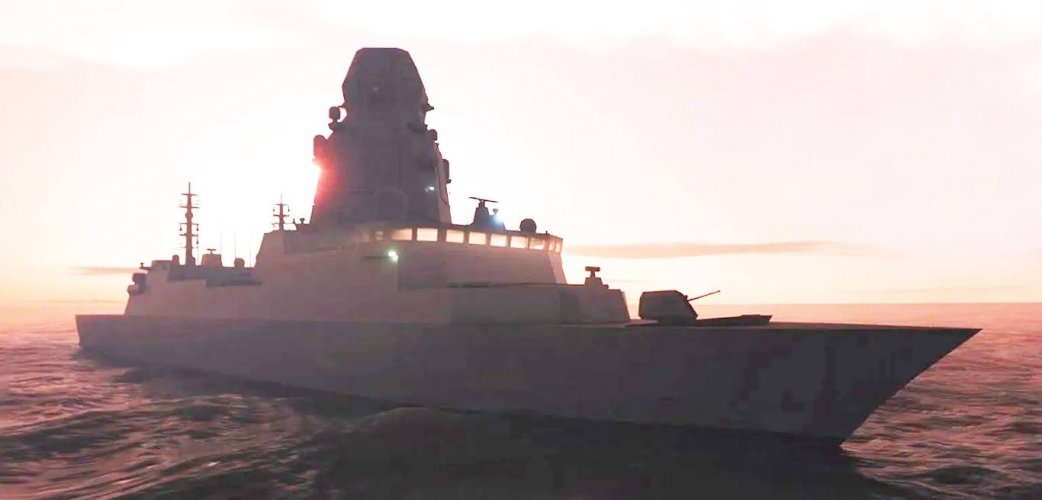
I brightened the image of BAE's Air Warfare Command Ship from this NL article to get a better look at the details.
That radar system is interesting. There appears to be four large panels (assuming the arrangement is mirrored), with an extra platform at the top of the mast with eight smaller panels, and a further set of very small panels facing directly forward. I'm not very well-educated on the topic of radars, but in my mind, this looks to be a way of getting both the powerful large panels seen on an Arleigh Burke-class destroyer or Type 055 and the smaller, high-mounted panels for extending the systems range against sea-skimming objects. The flat space on top could hold an upwards facing panel as well.
With the much smaller gun as compared to the Type 26 frigates (57mm instead of 127mm), would that allow for the forward missile banks found on the Type 26 to be extended forwards? I know the RAN has had some trouble fitting a 32-cell system in that space, so perhaps this would assist in doing that on the FAWCS?
Has the bridge been redesigned? The windows no longer seem to be offset.
There doesn't seem to be a mission bay as fitted to the Type 26 frigates - perhaps the space has been converted for additional VLS cells, as was proposed on the Hunter-class frigates.
- Joined
- 11 February 2007
- Messages
- 4,140
- Reaction score
- 8,886
Well, Chinese warships always look like they took styling advice from the RN, so....Rather strange and curiously un-British style. More like a crossover of FREMM with a Chinese destroyer.
Reuben James
ACCESS: Top Secret
- Joined
- 15 September 2024
- Messages
- 547
- Reaction score
- 1,113
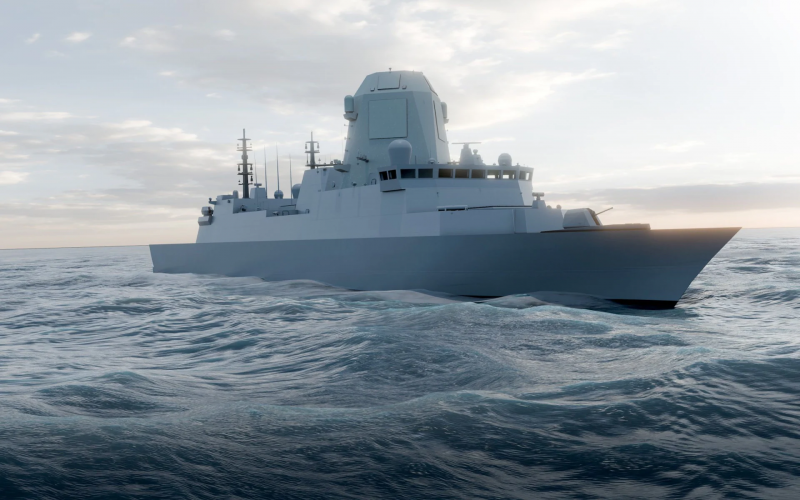
That's definitely a bank of strike-length VLS forward of the bridge - I'm assuming either a block of either 32 or 48 Mk41. There's a second bank of around the same size amidships - given we know it's at least 72, I'd guess to 48-cell complexes for a total of 96, plus a pair of 40mm guns on the rear and a pair of DEW forward and aft.Very newest BAE imagery on T83/ Future Air Warfare Command Ship, courtesy of a Telegraph article on T91:
View attachment 784025
It looks pretty much like the one above but in better light, and with a much simplified radar mast.
Decent fit, nothing crazy. Radar looks impressive though.
Edit - Telegraph article says up to 128 cells, so it could be two sets of 64 fore and aft.
Last edited:
TorpedoJ
ACCESS: Secret
- Joined
- 11 October 2023
- Messages
- 434
- Reaction score
- 869
Yup, huge panels for volume air search and BMD, and then the small ones up top for horizon search and high res targeting.Different panels for different tasks.
The small ones each side of the high medium sized panels, likely be datalinks.
It's strange how far the top ones are leaned back, that can't be good for range against sea skimmers. Maybe they want to lean more heavily on E/O sensors and AEW Proteus?
TorpedoJ
ACCESS: Secret
- Joined
- 11 October 2023
- Messages
- 434
- Reaction score
- 869
If anything the midships one looks bigger, the front looks around 32. Maybe 32+48 for 80, maybe plus some CAMM?That's definitely a bank of strike-length VLS forward of the bridge - I'm assuming either a block of either 32 or 48 Mk41. There's a second bank of around the same size amidships - given we know it's at least 72, I'd guess to 48-cell complexes for a total of 96, plus a pair of 40mm guns on the rear and a pair of DEW forward and aft.
Decent fit, nothing crazy. Radar looks impressive though.
- Joined
- 11 February 2007
- Messages
- 4,140
- Reaction score
- 8,886
I presume that's Dragonfire superfiring over the 57mm, and on the hangar roof, huge arcs for both the forward mounts, though the aft Dragonfire is likely limited by the mast/aerial farm forward of it to only a bit over 180 deg. Plus 40mm Bofors Mk 4 on the aft hangar corners, sponsoned out so they'll have close to 270 degree arcs.Very newest BAE imagery on T83/ Future Air Warfare Command Ship, courtesy of a Telegraph article on T91:
View attachment 784025
It looks pretty much like the one above but in better light, and with a much simplified radar mast.
- Joined
- 11 February 2007
- Messages
- 4,140
- Reaction score
- 8,886
That's similar to what we've seen with some of the latest CEAFAR installations. I suspect the high angle threat is growing.Yup, huge panels for volume air search and BMD, and then the small ones up top for horizon search and high res targeting.
It's strange how far the top ones are leaned back, that can't be good for range against sea skimmers.
Reuben James
ACCESS: Top Secret
- Joined
- 15 September 2024
- Messages
- 547
- Reaction score
- 1,113
Interesting that they seem to trust the 57mm for missile defence duties, though I assume it's more than adequate for that role.I presume that's Dragonfire superfiring over the 57mm, and on the hangar roof, huge arcs for both the forward mounts, though the aft Dragonfire is likely limited by the mast/aerial farm forward of it to only a bit over 180 deg. Plus 40mm Bofors Mk 4 on the aft hangar corners, sponsoned out so they'll have close to 270 degree arcs.
Reuben James
ACCESS: Top Secret
- Joined
- 15 September 2024
- Messages
- 547
- Reaction score
- 1,113
I'd be surprised if they held onto the individual CAMM launchers, but it's possible. They don't seem to be present on the image though.If anything the midships one looks bigger, the front looks around 32. Maybe 32+48 for 80, maybe plus some CAMM?
- Status
- Not open for further replies.
Similar threads
-
 Royal Navy Type 45 ("D" Class) Destroyer Daring Class concepts
- Started by Triton
- Replies: 52
-
 RN Type 42 AAW Destroyer (Study 382) 1964 question
- Started by Thorvic
- Replies: 2
-

-

-