Rafael Derby design

totoro

ACCESS: Top Secret
Joined
11 January 2011
Messages
950
Reaction score
1,158
I find that missile pretty interesting, in so much that it seems to differ in design choices from most of its contemporaries.

Most missiles of similar class seem to go for tail placed fins for manouvering and some sort of mid body wings or strakes for stabilization and lift.

Derby, however, seems to have reverted to Sparrow configuration in so much that it seems to use fixed rear body fins for stabilization while the front pair of steerable fins, wings actually, serve for lift and maneuvers.

But while Sparrow had its front wings positioned roughly mid-body, Derby has its front wings positioned visibly closer to the front tip of the missile. That would surely have to influence the moment arm, having in mind the center of mass. But while center of mass for sparrow missile (once the fuel was spent) was fairly close by just behind the mid wings. (which were, granted, pretty big) center of mass of fuel-spent derby missile seems to be almost as far from the steering fins as it is on conventional designs like amraam.

My questions are:
1) can anyone deduce some general ideas about advantages and drawbacks of the said aerodynamic configuration?
For example, is it more maneouverable? But causes more drag? Maybe its better at maintaining manouverability from the launch, while the missile is still heavy with rocket fuel?

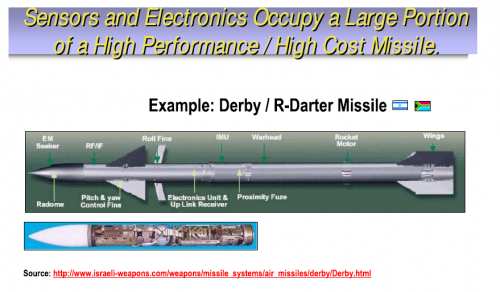
2) what do those little fins, right behind the front fins, do? they also seem to be present on python 5.

3) do we know anything about derby's rocket motor? Has it been changed compared to python 5? if so, how? Is there any promotional cutout drawing of derby, showing the rough placement and dimensions of its rocket motor?
 
So, no. The Derby is canard controlled like Sidewinder or Python 4.


If you strip the front canards from a Python 4 leaving the second set, and add a slightly longer nose for a radar seeker, you can see where Derby comes from conceptually. The paddle vanes behind are used for yaw control on Python, so the same on Derby.


Its basically a modified, enlarged Python 4. Motor is supposed to be a slight modification of the Python 4 one.
 
At highly-supersonic missile speeds much of the overall lift is generated from the nose and forbody, which is balanced by the aft fins.

For Python, Debry etc. I assume that the canards would have to trim-out the change as the motor burns-out, but I don't know if they generate much lift overall.
 
totoro said:
My questions are:
1) can anyone deduce some general ideas about advantages and drawbacks of the said aerodynamic configuration?
For example, is it more maneouverable? But causes more drag? Maybe its better at maintaining manouverability from the launch, while the missile is still heavy with rocket fuel?

2) what do those little fins, right behind the front fins, do? they also seem to be present on python 5.

3) do we know anything about derby's rocket motor? Has it been changed compared to python 5? if so, how? Is there any promotional cutout drawing of derby, showing the rough placement and dimensions of its rocket motor?

1.Hmm in my view it's to provide as much room for rocket motor as possible. By moving every actuators, batteries, cables etc to front.
So basically the main advantage of such configuration is packaging. Disadvantage however is that the canard control is suspectible to stall on high AoA unless a second pair of canard placed in front of it (Python4,5, Matra Magic, R-73..All use double canard configuration)

2.They're roll control fins

3.Hmm roughly half of the missile right behind warhead.

Here's an image from tactical missile design presentation by Fleeman. Seems pretty much you are looking for :D
 

Attachments

  • Derby.png
    Derby.png
    258.5 KB · Views: 489
Looking at these images and comparing them to python 5 it seems that derby has hardly any bigger rocket motor than python 5. Certainly if it is bigger at all it doesn't look more than 10-20% longer. Diameter seems the same, as missile diameters are the same. So what is left is fuel composition, perhaps it's optimized for different burn scheme, and the drag. Drag wise derby does seem cleaner than python 5, but it's hard to tell how much that'd influence range. Plus there's the drag from the trajectory, if derby goes up through thinner air and then coasts on a shallow dive.

The latter point not really applicable for spyder-sr i would imagine, which is why, i guess, spyder-sr is often quoted with just 20 km range. energy wise, derby just isn't in the same league as amraam or similar missiles. Rough image/drawing based comparison suggests derby has rocket motor of same length as early amraams, meaning rocket motor volume was some 25% bigger for amraam, due to fairly narrow body of derby missile. Then when the longer rocket motor came for later amraams that volume grew to a motor one third more volumenous.
 
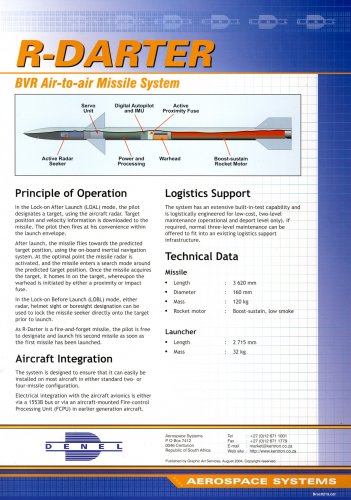
Totoro, just in case you were unaware, the R-Darter/Derby was a joint South African/Israeli design and build. I'm not sure of how the design and work-share was split, however It has been hinted at the following - South Africa did the rocket motor, proximity fuse and some of the electronics (digital autopilot and IMU?), Israel did the radar seeker and servos. If true, then I would guess that the Israelis properly made a new or improved version of the R-Darter/Derby rocket motor for the Python AAM's (licensing issues, plus evolutionary development..?) .

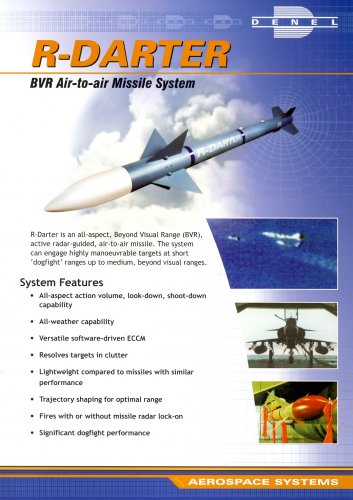
Don't hold me to the above, just snippets I have heard and read over the years. Attached is a brochure from Denel, very scant in terms of info, however the cutaway drawing and other info may be of value to you. I guess not being able to develop as miniaturised a version of the radar seeker that the major powers could, it ended up taking up a lot more space than what AMRAAM's would for example. This is properly what lead to it's slightly strange design (and obviously shorter range).

Interestingly enough on all the South African brochures and show models, they always eliminate the two roll-control fins - BTW I was not going to post this in the South African missile thread as it is certainly not a prototype, however since you asked about it...
 

Attachments

  • R-Darter-01.jpg
    R-Darter-01.jpg
    394.4 KB · Views: 399
  • R-Darter-02.jpg
    R-Darter-02.jpg
    489 KB · Views: 380
Thanks for the brochures and the info! I knew Denel had its hands in derby, but did not know they also made the rocket motor.

Also interesting to read in brochure that the rocket motor is boost sustain type. While late sparrow and early amraam motor had such profile, recent amraams reverted to a rocket motor with just boost grain, allegedly improving overall performance. That seems like another indication derby is comparable to early amraams in most regards (possibly excluding the seeker and electronics of course)
 

Rafael and Raytheon may uncoil Python for AIM-9X​

24 September 1996

RAFAEL IS IN talks with Raytheon which could lead to elements of the Israeli missile manufacturer's Python 4 agile short-range air-to-air dogfight missile being included in the US company's bid to replace US Air Force and Navy AIM-9 Sidewinder weapons.
Raytheon's bid to meet the US AIM-9X requirement is based around a 125mm-diameter airframe. It has also provided a "growth-option" design thought to be based on a 165mm-diameter weapon. Rafael could provide an "off-the shelf" motor for the bigger design. The additional propellant in a wider diameter missile would increase considerably the weapon's performance-envelope.
Rafael finally unveiled the configuration of its Python 4 at the Washington Convention. Previously, officially released images had omitted the forward ailerons and the rear-fuselage strengthening strakes.


Rafael confirms that it is in discussions with Raytheon over the Python 4 motor, which is already in service with the Israel air force.
The solid-propellant dual-thrust motor, the ND-10, has a profiled motor burn to allow the missile to be used against high off-boresight targets.
After an initial high-thrust burning of some 8kN (1,800lb) for 3-4s, the missile motor's thrust is reduced to around 0.7kN for up to a further 80s. A moderate increase in thrust to provide manoeuvring energy could also be expected.


Raytheon is competing with Hughes for the AIM-9X contract. The latter is offering an "in-house" bid based on the Box Office air frame and also a modified British Aerospace Advanced Short Range Air-to-Air Missile (ASRAAM).
The improved ASRAAM P3I differs from the baseline design by including thrust-vector control and an increased warhead size.
BAe's ASRAAM has also been evaluated separately under a foreign-comparative test (FCT) programme. An otherwise successful evaluation was marred when the final missile shot from a ground sled resulted in it breaking up around 4s into the flight.


Sources say that the sled test was intended to examine the missile's performance at a 30¡ angle of attack (AoA). The weapon was launched and flown at this AoA, successfully completing a maximum G turn before the failure occurred. The cause of the failure has yet to be determined.
The US Department of Defense will announce the winner of the AIM-9X competition around the turn of the year, with a initial production run of 5,000 missiles each for the air force and navy.
Source: Flight International
Some engine stuff
 
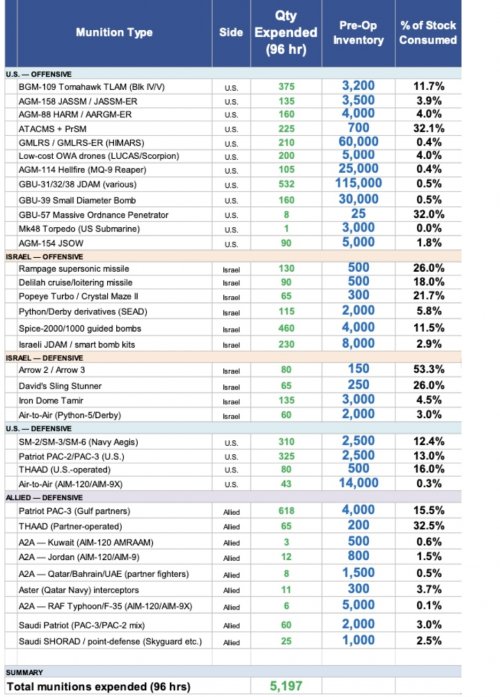
What is SEAD derivatives of Derby and Python?

View attachment 805969

Where does this chart come from?

I can see 2 errors right off the bat....

USS Charlotte fired 2 Mk.48 torpedoes at the IRIS Dena....

RAF does not use AIM-9X either...uses AIM-132, and Typhoon on QRA are loaded with Meteor as well...

I'd also be VERY surprised if the US only has 14,000 AIM-120 and AIM-9X in stock...UK does not have 5,000 AAM's in total either...total stock will be <4,000 of AIM-132, AIM-120 and Meteor...might even be closer to 3,000 with Ukraine donations of Asraam and AIM-120...

And there are many more questionable figures.....
 
What is SEAD derivatives of Derby and Python?

View attachment 805969

When they tested the Brazo (Spanish for ARM) seeker package at the dedicated 'Bratfac' test facility in the mid-1970s they were essentially teaching a digital monopulse seeker to recognize main and side/backlobes of a given radar to help it lock on quickly and efficiently to emitting threats.

In the process, they developed a catalog system of ~10 threats overall and a 'top four' from those, using the aircraft RHAWS and the missile onboard seeker memory, respectively. You basically reset the WRCS system memory to initiate the Brazo (AA-ARM) tracking mode through a separate WRA black box and once it was active, used key select from a missile control panel in the rear cockpit to set the type of (front 60 to 180 degrees) target set, before stepping through the displayed emitter list and then handing off the chosen emitter parameters into the missile seeker trajectory memory (emulating the analog autopilot) before supplying a ranging pulse from the WRCS APQ-72 radar to complete the trajectory math and firing the missile.

The purpose of this was to give the F-4B (test airframe) and later J/S squadron aircraft an initial, multi-shot, fire and forget capability against threats which came at the jet in swarms. It was a relatively surefire way to fire into conflicted squirrel cage conditions because the missile was homing on the threat radar, not a mad dog launch on whatever airframe passed in front of its radome.

What was interesting about this was that the missile could also home on certain _ground emitters_.

All by simply using a monopulse seeker instead of the period inverse conscan of the AIM-7E.

It appeared to work well but cost, in the 1974-76 period was a major driver and it was not until later 7M/MH generations that 'Home On Jam' became a thing.

As for Python, if it's like AIM-9X (128X128 IIR) it can already produce a seeker image sufficient to EOID airborne targets at beyond visual range (more than 2-3 miles).

The P5 is also dual band, adding a visual TV channel to this. If you go back to the F-4G, it's APR-47 ELS could place the LCOSS pipper in an auto-depress mode over the target to allow for auto-ranged CCRP with Mk.82 or Maverick seeker cueing as part of a site cleanup capability (and this could also be passed to companion F-4E over a proprietary datalink sufficient for HARM range-known shots) and thus, whether onboard or via relay from something like the F-16I chief suppression aircraft with its Elisra SPS-3000 you have the option to combine precision seeker IMU and airframe GPS coordinates to again, cue the seeker declination/azimuth angle.

Once someone's Emitter Location System tells you a 3DRK or three dimensional range known calculation, pointing the seeker at the target and refining the aimpoint at whatever contrast will hold the lock for a hit is going to depend mostly on how sensitive the FPA is and whether the target has advanced camouflage netting (MCS) or screens to blend with the target.

It still sounds awfully sporting in that you have to point the seeker within HOBS limits at a target which is theoretically 'moments away' if not _actually firing at you_ with a threat interceptor missile which is itself increasingly likely to be autonomous and thus undeterred by suppression tactics, even if its parent vehicle is dead (AD-08 Majdid).

Compared to say Delilah which can go either ARM or DTV or IIR to arrive in the mission area some 60-100nm downrange and pull the Tacit Rainbow 'loitering ARM' trick or go for a direct (via datalink) MITL EO lock-on attack, based on satcomms relay of the last overhead IMINT/SIGINT pass, no more than 10-15 minutes before.

Since available pictures of F-35s _do not_, in fact, show them carrying Pythons in addition to or replacing AIM-9X (an IDFAF brag) on their outboard station rails, the question becomes what aircraft are actually penetrating Iranian airspace which are carrying self defense weapons and whether they have enough onboard to be actually 'variants' of any given missile or if this capabiilty is imbedded in the bog standard weapon.

Going from imagery of jets from last year's Operation Rising Lion attacks in the June 12-24 'Twelve Day War' the jets were going out with rather a motley collection of 1-2 self defense weapons and maybe a pod, at most, to make radius with max gas.

Literally one AIM-7, one P4/5 and one EL-8222 pod on an F-15. Or a single Python, two 600 gallon tanks and a ROCS or Golden Horizon missile on an F-16I.

They are not proceeding, as they would have in 1982 or 2006, with maximal loads at all.
 

Similar threads

Back
Top Bottom