Google Willow made major step in computing


Theory suggests that consciousness is a quantum process, connecting us all to the entire universe


Related papers:


Quantum consciousness comes from Sir Roger Penrose's work in the 80s, as popularized in his 1989 book The Emperor's New Mind. It's not new, and it's still controversial. Even Penrose called it speculative, and Marvin Minsky was a lot less polite about it.
 
Quantum consciousness comes from Sir Roger Penrose's work in the 80s, as popularized in his 1989 book The Emperor's New Mind. It's not new, and it's still controversial. Even Penrose called it speculative, and Marvin Minsky was a lot less polite about it.
Seen Dark Matter on Apple+?
 
I have a small question, the buzzwords thrown about like confetti end up being just that.

Quantum, can someone define that for me when used with technology?

How long before we have quantum vacuum cleaners or even quantum cornflakes etc. Turbo, was a trope for turbocharged engines in cars etc, but, we even had vacuum cleaners with the word turbo emblazened all over them.

How about a poll on the NEXT buzzwords?
 
Relying on a process defined by quantum physics, not Newtonian physics.

Speaking of which
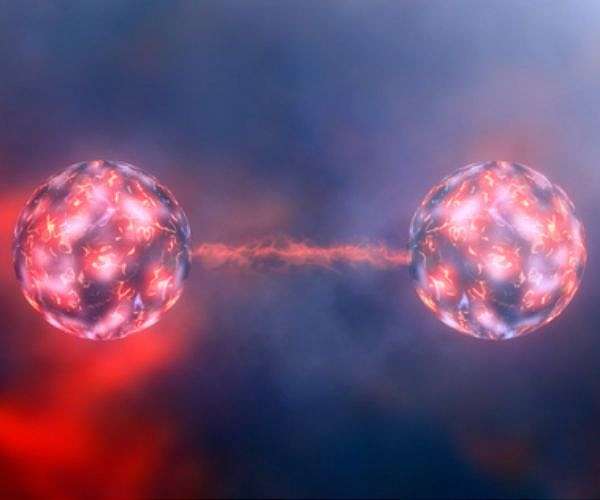
All particles of the same type—for example, photons or electrons—are entangled with one another, including those on Earth and those in the most distant galaxies. This surprising statement follows from a fundamental postulate of quantum mechanics: particles of the same type are, in their very nature, identical. Does this mean that a universal source of entanglement—underlying the peculiar, nonlocal features of the quantum world—is at our fingertips? And can we somehow outsmart quantum theory, which so carefully guards access to this extraordinary resource?

Answers to these questions have been provided by two Polish theorists from the Institute of Nuclear Physics of the Polish Academy of Sciences (IFJ PAN) in Krakow and the Institute of Theoretical and Applied Informatics of the Polish Academy of Sciences (IITiS PAN) in Gliwice. Their findings, published in npj Quantum Information, show how the very identity of particles gives rise to observable quantum nonlocality.


Better transmission
Previously, the maximum distance two quantum computers could connect through a fiber cable was a few kilometers. This means that, even if fiber cable were run between them, quantum computers in the University of Chicago's South Side campus and downtown Chicago's Willis Tower would be too far apart to communicate with each other.

Research published today in Nature Communications from University of Chicago Pritzker School of Molecular Engineering (UChicago PME) Asst. Prof. Tian Zhong would theoretically extend that maximum to 2,000 km (1,243 miles).


Potential for research

For the first time, a quantum computer has successfully measured pairing correlations (quantum signals that show electrons teaming up in pairs), which is essential to helping scientists find one of the holy grails of physics—superconductors that work at room temperature. "These results show that a quantum computer can reliably create and probe physically relevant states with superconducting pairing correlations, opening a path to the exploration of superconductivity with quantum computers," commented the researchers in a paper published on the arXiv preprint server.

Sim

It's magic

Memory
 
Last edited:
Diraq progresses to new stage in DARPA drive for practical quantum computers
 
Quantum Chip simulation

Quantum systems

The latest

Chip cooling

Cables and tech

Optical circuits

These things would look good as time rotors atop the TARDIS console:

mindful networking?

The quantum boundary pushed
 
Last edited:
Just in

University of Iowa researchers have discovered a method to "purify" photons, an advance that could make optical quantum technologies more efficient and more secure. The work is published in the journal Optica Quantum.

Meet our latest debugger...Ernest Angley:

Scientists build a quantum computer that can repair itself using recycled atoms

--be healed.....
 
Last edited:
The latest
"A triplet superconductor is high on the wish list of many physicists working in the field of solid state physics," said Professor Jacob Linder. He works at NTNU's Department of Physics, more specifically at QuSpin—a research center where physicists grapple with some of the gnarliest questions you can imagine. "Materials that are triplet superconductors are a kind of 'holy grail' in quantum technology, and more specifically quantum computing," explained Linder.

He and his colleagues are now on the trail of this triplet superconductor—much to the excitement of physicists worldwide. "We think we may have observed a triplet superconductor," said Professor Linder.


Simulations simplified
Drawing on the example of a quantum simulation, physicists Guido Burkard and Joris Kattemölle from the University of Konstanz illustrate how harnessing symmetry dramatically lowers the computational effort needed: They use recurring patterns in the quantum systems to reduce the required computational effort by a factor of a thousand or more. The method has now been published in the journal Physical Review Letters.

Many body

Tech
 
Last edited:

Infleqtion lists shares on NYSE as neutral atom quantum firm​


Similar threads

Back
Top Bottom