Forest Green
ACCESS: USAP
- Joined
- 11 June 2019
- Messages
- 14,596
- Reaction score
- 31,708


Sounds like it would be a pretty fiesty particle weapon.exhaust speeds of over 500,000 MPH.
Kzinti lesson: any rocket engine powerful enough to be interesting, makes a mean weapon.Sounds like it would be a pretty fiesty particle weapon.
So do I, they're talking about testing it in space, not on the ground.I think this is intended for space travel.

Their written description on site lines up with a nuclear fusion thermal rocket. Which, yes, requires a massive amount of energy to work in the form of that nuclear fusion reactor."Pulsar is a clean space propulsion systems and services company delivering intelligent propulsion now and creating the future through fusion applications."
Saw this as the first thing when looking up this company. Lots of buzzwords and current-year tier phraseology. At first hearing it sounds like a very novel and exotic method of propulsion and the kinds of nuclear fusion rockets I've read of are very large and would require massive amounts of energy to work.
The very first thing I would ask for is an independently validated, vetted, verified and confirmed TRL of this scheme. My personal guess would be a score of 0 on an official NASA scale of 1 through 9..."Pulsar is a clean space propulsion systems and services company delivering intelligent propulsion now and creating the future through fusion applications."
Saw this as the first thing when looking up this company. Lots of buzzwords and current-year tier phraseology. At first hearing it sounds like a very novel and exotic method of propulsion and the kinds of nuclear fusion rockets I've read of are very large and would require massive amounts of energy to work.
Nah, TRL of most fusion tech is about 5. This one is a little lower, due to the sheer size and resulting miniaturization needed before they can get it into space.The very first thing I would ask for is an independently validated, vetted, verified and confirmed TRL of this scheme. My personal guess would be a score of 0 on an official NASA scale of 1 through 9...
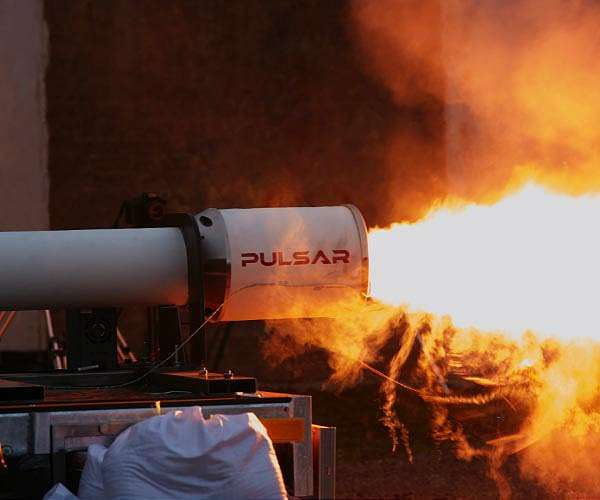
Hello Scott, first off, please provide and quote any *credible* readily accessible online sources for your claim of a fusion TRL of 5, especially for an aerospace system. Second, the assertion of "sheer size and resulting miniaturization needed" as an impediment seems weird and contradictory, since larger typically is *better* in terms of efficiency for aerospace propulsion systems. Third, their demonstrator setup looks like completely hokey/ignorant investor bait to me (notice there is only a still picture and not even a few seconds of video, hence the 0 rating, but since I'm just a simple rocket scientist {I actually published a paper [Acta Astronautica 54 (2004) 713 – 721] that showed that the so-called Tsiolkovsky rocket equation is only the simplest case of propulsive equations that define the relation of vehicle acceleration depending on the propulsion specific impulse and changes thereof, which in the particular case I examined was decreasing linearly with the speed of flight as an approximation of air-breathing propulsion systems}, so what do I know?), especially when it comes to distinguishing *actual* fusion exhausts from chemical ones with respect to turbulence and flame colour. I've personally witnessed plasma and ramjet flames *way* more energy dense/intense than the one shown for an alleged fusion one. Note also that the formulation in the article that the "UK aerospace company Pulsar Fusion has started constructing the largest practical nuclear fusion rocket engine ever built" immediately begs the question what was the first (presumably smaller?) practical nuclear fusion rocket engine ever built before that utterly brilliant newcomer outfit burst on the scene?Nah, TRL of most fusion tech is about 5. This one is a little lower, due to the sheer size and resulting miniaturization needed before they can get it into space.

The same image appears here:That "pulsar" pic sure does look like good old chemical combustion exhaust,
Wiki describes it as 'hybrid polyethylene/nitrous oxide launch rocket engine'.The ‘green’ (non-toxic) hybrid rocket engine combusts nitrous oxide (N2O) oxidiser and high-density polyethylene (HDPE) fuel and oxygen. It is a new model that enables the company to manufacture these compact rocket engines at record lead times, with an enhanced safety factor as due to the design, these engines have relatively benign failure modes in comparison with conventional liquid propulsion engines.
My bad, TRL 4 is "demonstrated in a lab", not 5.Hello Scott, first off, please provide and quote any *credible* readily accessible online sources for your claim of a fusion TRL of 5, especially for an aerospace system. Second, the assertion of "sheer size and resulting miniaturization needed" as an impediment seems weird and contradictory, since larger typically is *better* in terms of efficiency for aerospace propulsion systems. Third, their demonstrator setup looks like completely hokey/ignorant investor bait to me (notice there is only a still picture and not even a few seconds of video, hence the 0 rating, but since I'm just a simple rocket scientist {I actually published a paper [Acta Astronautica 54 (2004) 713 – 721] that showed that the so-called Tsiolkovsky rocket equation is only the simplest case of propulsive equations that define the relation of vehicle acceleration depending on the propulsion specific impulse and changes thereof, which in the particular case I examined was decreasing linearly with the speed of flight as an approximation of air-breathing propulsion systems}, so what do I know?), especially when it comes to distinguishing *actual* fusion exhausts from chemical ones with respect to turbulence and flame colour. I've personally witnessed plasma and ramjet flames *way* more energy dense/intense than the one shown for an alleged fusion one. Note also that the formulation in the article that the "UK aerospace company Pulsar Fusion has started constructing the largest practical nuclear fusion rocket engine ever built" immediately begs the question what was the first (presumably smaller?) practical nuclear fusion rocket engine ever built before that utterly brilliant newcomer outfit burst on the scene?
All I can say is that I will not trust/rely on *any* company press releases. I've seen way too many hypes like this come and implode/vanish in my 6+ decades on this planet.My bad, TRL 4 is "demonstrated in a lab", not 5.
National Ignition Facility is a large laboratory example of one Fusion setup. Polywells and tokamaks are also demonstrated but are still short of break-even by my memory, also demonstrated in lab settings (TRL4) as opposed to industrial settings (TRL5).
The reason it needs to be miniaturized is to get the rocket into space. Their test engine, reactor, and all supporting equipment needs to weigh less than 150 tonnes and take up less than 1000m^3 to fit in a SpaceX Starship. Less than 63 tonnes to fit into a Falcon Heavy.
Their rocket would be demonstrating TRL5 if/when it fires in space.
Generally agreed, but their press release is not claiming any performance above and beyond what a nuclear thermal rocket would be capable of, according to the rocket equations at Atomic Rockets.All I can say is that I will not trust/rely on *any* company press releases. I've seen way too many hypes like this come and implode/vanish in my 6+ decades on this planet.
I completely concur, but I want to see independent objective confirmation of their claims on any website link that ends in .gov.Generally agreed, but their press release is not claiming any performance above and beyond what a nuclear thermal rocket would be capable of, according to the rocket equations at Atomic Rockets.


To be fair, we'v got working thermonuclear fusion.That's amazing and completely blew my mind. Now, if only thermonuclear fusion could be made to work before the usual "twenty years in the future"...

Would have a higher ISP than atomic (fission).To be fair, we'v got working thermonuclear fusion.
I'm just not sure about the feasebility of a Orion drive with thermonuke pulse units.


Cool, where's the paper? That article is the usual super light, fluffy, and cloying like cotton candy fare mainstream journalism likes to keep for science articles.
Companies don't really publish papers but there's a product sheet:Cool, where's the paper? That article is the usual super light, fluffy, and cloying like cotton candy fare mainstream journalism likes to keep for science articles.