Attachments
Last edited:


Rightly so.warn against extrapolating
I posit Crockford has an axe to grind. I am getting tired of the climate change deniers' creed.Crockford is a signatory of the International Conference on Climate Change's 2008 Manhattan Declaration,[13] which states that "Carbon dioxide and other 'greenhouse gas' emissions from human activity...appear to have only a very small impact on global climate," and "Global cooling has presented serious problems for human society and the environment throughout history while global warming has generally been highly beneficial."
https://onlinelibrary.wiley.com/doi/full/10.1111/j.1365-2486.2012.02753.xIan Stirling and Andrew E. Derocher, 2012Denier blogs that downplay the threats of AGW to Arctic ice and polar bears rely heavily on arguments that it has been warmer in the past, that temperature and seasonal ice extent vary naturally over time, and that it is therefore difficult or even impossible to predict what will happen in the future. This framing ignores the fact that scientists agree that natural short-term fluctuations in weather and climate will persist along with secular trends of global warming and declining ice. Also, previous global-warming events were a part of natural cycles of warming and cooling driven by orbital factors. Summer sea ice did not disappear entirely during past interglacial periods (Stein et al. 2017), as it ultimately will with unabated GHG rise. And even if dramatically reduced, ice extent always recovered when warm interglacial periods were followed by waning insolation and cooling temperatures. Current global warming, in contrast, is driven by rising GHG concentrations, is occurring despite reduced insolation, and cannot be reversed without mitigating GHG rise (Brigham-Grette 2009, Tzedakis et al. 2012, Barnhart et al. 2013, Stocker et al. 2013). Moreover, sea-ice habitat reductions during past interglacial periods occurred over millennia (rather than over the decadal scales that accompany AGW), giving the bears more time to adjust their behavior and distribution. Bears today also face multiple additional threats, including chemical bioaccumulation, on-the-ground habitat manipulation, and human harvesting, factors that were absent during past warming episodes (Stirling and Derocher 2012). Because current warming cannot be reversed without human action (Stocker et al. 2013), the prognosis for polar bears and other Arctic biota without GHG mitigation is bleak (Stirling and Derocher 2012, Regehr et al. 2016). These facts are not accurately reflected in the views expressed by denier blogs.
https://royalsocietypublishing.org/...rvation-status-of-polar-bears-Ursus-maritimusEric V. Regehr et al. 2016Effects of climate warming on polar bears: a review of the evidence
Abstract
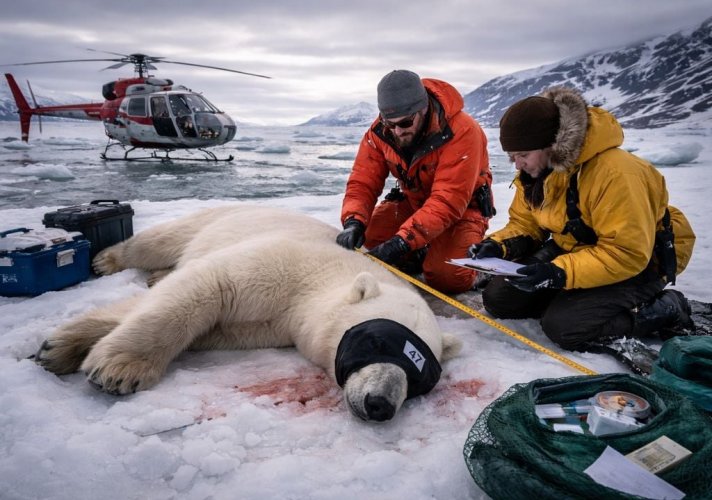
Climate warming is causing unidirectional changes to annual patterns of sea ice distribution, structure, and freeze-up. We summarize evidence that documents how loss of sea ice, the primary habitat of polar bears (Ursus maritimus), negatively affects their long-term survival. To maintain viable subpopulations, polar bears depend on sea ice as a platform from which to hunt seals for long enough each year to accumulate sufficient energy (fat) to survive periods when seals are unavailable. Less time to access to prey, because of progressively earlier breakup in spring, when newly weaned ringed seal (Pusa hispida) young are available, results in longer periods of fasting, lower body condition, decreased access to denning areas, fewer and smaller cubs, lower survival of cubs as well as bears of other age classes and, finally, subpopulation decline toward eventual extirpation. The chronology of climate-driven changes will vary between subpopulations, with quantifiable negative effects being documented first in the more southerly subpopulations, such as those in Hudson Bay or the southern Beaufort Sea. As the bears' body condition declines, more seek alternate food resources so the frequency of conflicts between bears and humans increases. In the most northerly areas, thick multiyear ice, through which little light penetrates to stimulate biological growth on the underside, will be replaced by annual ice, which facilitates greater productivity and may create habitat more favorable to polar bears over continental shelf areas in the short term. If the climate continues to warm and eliminate sea ice as predicted, polar bears will largely disappear from the southern portions of their range by mid-century. They may persist in the northern Canadian Arctic Islands and northern Greenland for the foreseeable future, but their long-term viability, with a much reduced global population size in a remnant of their former range, is uncertain.
Conservation status of polar bears (Ursus maritimus) in relation to projected sea-ice declines
Abstract
Loss of Arctic sea ice owing to climate change is the primary threat to polar bears throughout their range. We evaluated the potential response of polar bears to sea-ice declines by (i) calculating generation length (GL) for the species, which determines the timeframe for conservation assessments; (ii) developing a standardized sea-ice metric representing important habitat; and (iii) using statistical models and computer simulation to project changes in the global population under three approaches relating polar bear abundance to sea ice. Mean GL was 11.5 years. Ice-covered days declined in all subpopulation areas during 1979–2014 (median −1.26 days year−1). The estimated probabilities that reductions in the mean global population size of polar bears will be greater than 30%, 50% and 80% over three generations (35–41 years) were 0.71 (range 0.20–0.95), 0.07 (range 0–0.35) and less than 0.01 (range 0–0.02), respectively. According to IUCN Red List reduction thresholds, which provide a common measure of extinction risk across taxa, these results are consistent with listing the species as vulnerable. Our findings support the potential for large declines in polar bear numbers owing to sea-ice loss, and highlight near-term uncertainty in statistical projections as well as the sensitivity of projections to different plausible assumptions.
I agree, some will prosper and others will become extinct. But those who thrive will not return to the North, having found that life is better without so much ice. In my opinion, this example confirms something so obvious (and so ignored by propaganda) that the damn glaciers are death and the sun is life.Browsing the article quickly, I got the picture that Polar Bears are doing pretty well in the Barents Sea area (Svalbard) because they are currently finding good prey there: species that they might not have hunted much before, or species that have increased in numbers. Things don't look equally good for them in some other areas, such as Hudson Bay.
They warn against extrapolating findings from one area to another, and also predict that situations may fluctuate.

 ) are core subjects here, I think.