
You are using an out of date browser. It may not display this or other websites correctly.
You should upgrade or use an alternative browser.
You should upgrade or use an alternative browser.
Pegasus-XL
- Thread starter Flyaway
- Start date
aonestudio
I really should change my personal text
- Joined
- 11 March 2018
- Messages
- 3,381
- Reaction score
- 9,228
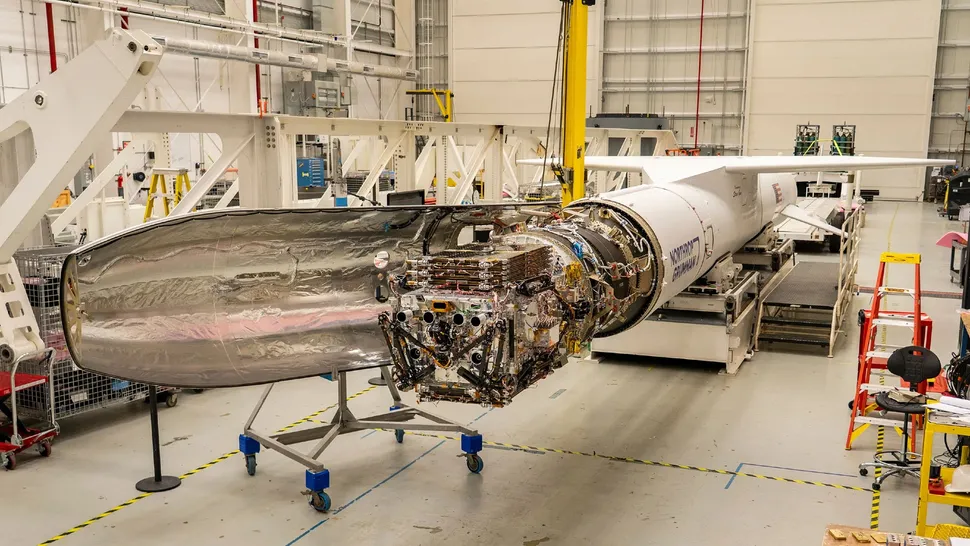
CHANDLER, Ariz. – June 13, 2021 – Northrop Grumman Corporation (NYSE: NOC) successfully launched the Tactically Responsive Launch-2 (TacRL-2) payload into orbit for the U.S. Space Force (USSF), using the company’s Pegasus XL rocket. TacRL-2 was launched from Vandenberg Space Force Base.
“This Pegasus launch was a clear demonstration of our team’s ability to provide rapid and responsive operational needs,” said Rich Straka, vice president, launch vehicles, Northrop Grumman. “Our team was able to execute the design, integration and testing of the TacRL-2 launch vehicle in less than four months from contract award.”
https://news.northropgrumman.com/ne...ches-pegasus-xl-rocket-for-the-us-space-forcehttps://www.spaceforce.mil/News/Art...s-first-tactically-responsive-launch-mission/
“This Pegasus launch was a clear demonstration of our team’s ability to provide rapid and responsive operational needs,” said Rich Straka, vice president, launch vehicles, Northrop Grumman. “Our team was able to execute the design, integration and testing of the TacRL-2 launch vehicle in less than four months from contract award.”
https://news.northropgrumman.com/ne...ches-pegasus-xl-rocket-for-the-us-space-forcehttps://www.spaceforce.mil/News/Art...s-first-tactically-responsive-launch-mission/
Last edited:
It looks like the very last Pegasus rocket launch is coming up soon to rescue the SWIFT satellite:
I don't know if there are any other appropriate threads to post this in except maybe the Astronomy thread in the Bar forum.
Last year NASA bought the space mission equivalent of a lottery ticket, a small bet on a mission which has the odds stacked against it, but could be a win on many levels. This is the last TriStar, launching the last Pegasus, carrying a never before flown spacecraft that offers the Swift telescope's last chance to avoid destruction.
NASA offered a small contract to attempt a mission to re-boost an old telescope which would otherwise burn up, $30million seemed too small, but Katalyst stepped up with work they'd already been doing on satellite servicing, and in the process they got a launch agreement to fly on the last Pegasus XL, which is carried by the worlds last TriStar jet.
This is a story that's as dramatic as they come for spaceflight without humans involved.
I don't know if there are any other appropriate threads to post this in except maybe the Astronomy thread in the Bar forum.

Forest Green
ACCESS: USAP
- Joined
- 11 June 2019
- Messages
- 14,596
- Reaction score
- 31,708
Aircraft Carrying Swift Boost Satellite Takes off From NASA Wallops
https://science.nasa.gov/blogs/swif...-boost-satellite-takes-off-from-nasa-wallops/After several seconds in free-fall, Pegasus XL will fire the first of its three-stage rocket motors, delivering Katalyst's LINK into orbit in about 10 minutes.

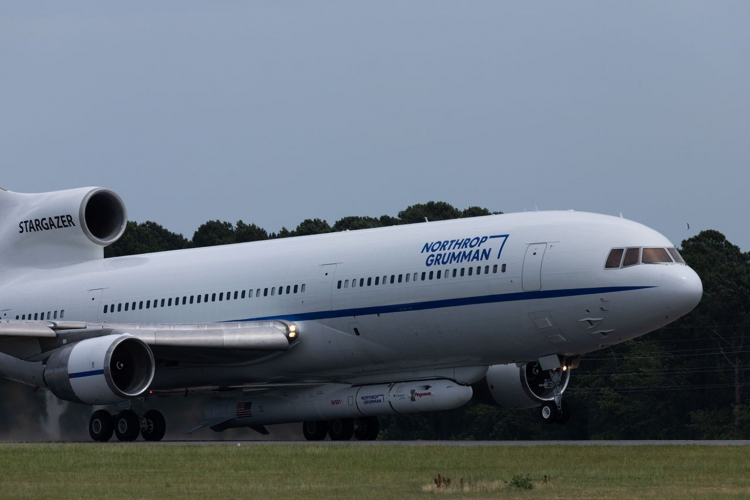
Pretty sure Stargazer is the last Tristar flying so almost certainly with no more Pegasus it will be retired. I just cannot see a justifiable reason to keep it flying.It's sad to realise that this is the very last flight of the Pegasus-XL, I wonder what will happen to the Stargazer after this last launch-flight?
I just cannot see a justifiable reason to keep it flying.
Unless there are other test-vehicles to be flown from it. I suspect that it may be kept in flyable storage for that reason and I can see NASA, the USAF and other government agencies wanting to take advantage of its unique capabilities.
LAUNCH DETAILS:
- Company: Northrop
- Vehicle: Northrop, Pegasus XL
- Payload: NASA's Katalyst’s robotic servicing spacecraft
- Destination: Low Earth Orbit - LEO
elitegamer
ACCESS: Restricted
- Joined
- 12 May 2025
- Messages
- 20
- Reaction score
- 42
NICE
Possibly. But I would expect that Stratolaunch's 747 would be able to meet any required capability with less unique support costs and perhaps more flexibility in payloads.Unless there are other test-vehicles to be flown from it. I suspect that it may be kept in flyable storage for that reason and I can see NASA, the USAF and other government agencies wanting to take advantage of its unique capabilities.
I love the Tristar but supporting a one-of-a-kind aircraft just isn't worth it now.
I love the Tristar but supporting a one-of-a-kind aircraft just isn't worth it now.
If Orbital-Science had been smart then no doubt as all of the other remaining Lockheed-1011s were retiring they were buying as many spare-parts stocks as possible along with several L-1011 airframes for both spares and spare-parts.

- Joined
- 21 January 2015
- Messages
- 15,034
- Reaction score
- 24,279
Is that smart or good money after bad? Reality is at some point something is going to break that they cannot easily fix and no amount of spare parts sitting in a warehouse is going to help that. Without a specific mission there is nothing overly unique about the Tristar that makes it more suitable that comparable likely more sustainable platforms.If Orbital-Science had been smart then no doubt as all of the other remaining Lockheed-1011s were retiring they were buying as many spare-parts stocks as possible along with several L-1011 airframes for both spares and spare-parts.
- Joined
- 21 January 2015
- Messages
- 15,034
- Reaction score
- 24,279
Swift Observatory Boost Mission will launch as soon as June 27th!
Northrop Grumman's L-1011 Tri-Star (Stargazer) aircraft has been fitted with the Pegasus XL launch vehicle with Katalyst Space Technologies' LINK spacecraft onboard.
Launch is slated for ~12:09 UTC June 27th and will launch 100 miles (160 km) Southwest of Kwajalein (Bucholz Army Airfield).
The L-1011 Tri-Star will enter a holding pattern prior to launch at around ~40kft (12km), then in the minute prior to launch, Stargazer and Pegesus XL will be flying Southeast and start a climb to ~41,500ft (12.6km) where Pegesus XL will be released, then 7 seconds later, vehicle ignition will occur, followed by pitch-up.
1st stage burnout will occur 1min 19secs into flight and will travel 470 miles (756km) downrange. The 2nd stage will ignite at 1min 35secs into flight and will burn to 2mins 50secs into flight, the 2nd stage will travel 2,200 miles (3,540km) downrange.
Following 2nd stage separation, Pegesus 3rd stage and LINK will coast for ~3mins 30secs where the 3rd stage will conduct a 1-minute insertion burn, placing LINK into a 355 x 385km x 20.6 degree orbit with a nominal cutoff velocity of 26081.6 kmh / 16206.4 mph / 7244.89 m/s.
At the time of orbital insertion, the Swift Observatory will be 250 miles (402km) north of Micronesia or 1,885 miles (3,033km) behind the LINK spacecraft at 354km.
Around four days after launch, Katalyst Space Technologies' LINK will make a close approach with the Swift Observatory. In the weeks after launch LINK is expected to capture Swift Observatory and boost the orbital altitude of Swift, extending the operational lifespan and science of the Swift Observatory.
View: https://twitter.com/Dillonshrop06/status/2069178373512085991
Katalyst Space Technologies is an aerospace company based in Flagstaff, Arizona, and was founded in late 2019. In March of 2025 Katalyst Space Technologies acquired Atomos Space which was a company that specialized in rendezvous and orbital transfer vehicles.
In September 2025 NASA awarded Katalyst Space Technologies with the Swift Rescue Mission for $30 million USD to build and develop a spacecraft capable of linking up with the Swift Observatory and boosting its orbital altitude.
- Joined
- 21 January 2015
- Messages
- 15,034
- Reaction score
- 24,279
Partners, NASA Ready for June Launch of Swift Boost Mission
A mission to raise the orbit of NASA’s Neil Gehrels Swift Observatory is poised for launch no earlier than Tuesday, June 30, 6:23 a.m. EDT (10:23 p.m. UTC+12), from Kwajalein Atoll, part of the Republic of the Marshall Islands in the South Pacific Ocean.
A robotic servicing satellite called LINK, built by Katalyst Space, will blast into orbit on a Northrop Grumman Pegasus XL rocket. LINK will rendezvous with, grapple, and slowly raise Swift’s altitude over several months, preventing it from re-entering Earth’s atmosphere later this year.
- Joined
- 21 January 2015
- Messages
- 15,034
- Reaction score
- 24,279
Nasa launches mission to save falling space telescope https://www.bbc.co.uk/news/articles/c0ry4xx7rk8o
NASA just pulled off a wild satellite rescue using a brand-new tech, and did it in nine months flat. Find out how they're saving the Swift telescope—with way more at stake than you'd think. Full breakdown on This Week in Space• America in Space - 250 Years of Bold First...
 • America in Space - 250 Years of Bold First...
 Similar threads
-

-

-

-
Gerry Anderson in memoriam "Fireball XL-5"
- Started by Justo Miranda
- Replies: 0
-
 SKYRORA - UK return to Space - This time it's Private
- Started by Michel Van
- Replies: 61