Chris has a more nuanced view of Mr Sandys which I've read and agreed with.
In particular, the P.1121 was developed as a private venture from Hawker's failed bid for F155T so Sandys can hardly be blamed for cancelling it when the RAF never wanted it in the first place.
Nuanced view indeed, but Sandys did see the way things were heading. Even he relented and kept the Lightning and Red Top (twice). He was probably as much of a fool as those who would later cancel Nimrod MRA4, fail to support the Sentry and Sentinel fleets and only order 3 x Wedgies.
Maybe some of our industry/technical members could have a ponder on this interesting exercise:
Assumptions
Fairey FD3 continued and entered service in late 1960s
By late 60s/early 70s and beyond, the main strategic threat to UK is the ballistic missile.
UK (NATO) commitment is to European Central Front and GIUK Gap.
How many tankers (plus an AEW capability that did not yet exist) would be required to support a fleet of FD.3s (each armed with two, maybe four AAMs) to patrol the GIUK Gap?
For such a large airframe, the FD.3 appears to have a small fuel load; ~12,000lb with a centerline tank and two AAMs (happy to be corrected on this as the drawing is difficult to read, 300lb might be 800lb, doesn't feel right that number). The Phantom FG.1 has a fuel load (with three tanks) of ~22,000lb (and eight AAMs.)
Victor K.2 has a fuel load of ~91,000lb, but I can't find what the 'give-away' was for a GIUK Gap mission. I have the number somewhere.
Would I be right in thinking that every time an FD.3 was launched into the GIUK Gap to chase a Bear, we'd be looking at a Black Buck style refueling operation? That is an expensive hobby even before you factor in the AEW aircraft.
Could the FD.3 mix it with the Fishbeds and Floggers over the Central Front?
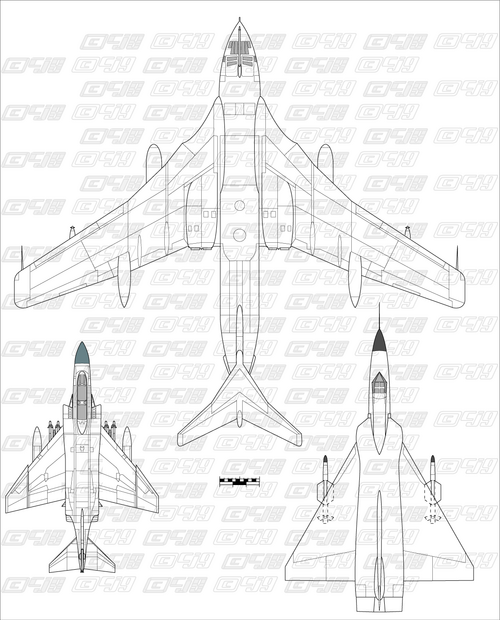
Here's a quick drawing to allow comparison of the players.
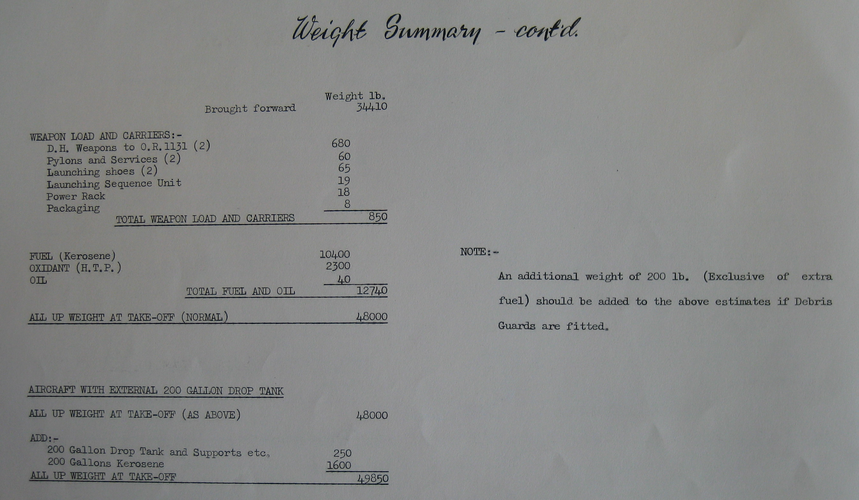
200 gallon external fuel = 1600lb extra fuel + 250lb weight of tank and support
12,000lb kerosene total
Takeoff weight: 49850lb
Fuel (kerosene) fraction was just 0.217 in normal configuration and 0.24 with external tanks. The only mission discussed is interception of high speed bombers, with ranges no longer than 200nm. Its not in any way suitable for patrolling or going long distances.
Brochure notes the rocket engine might not be necessary, in which case the HTP could be replaced by additional fuel.
Later on, the rocket engines would be dropped. This would allow additional fuel to be carried, but kerosene is a lot less dense than concentrated hydrogen peroxide, so you'd get less than 2300lb of fuel in the vacated HTP tanks. Deleting the rocket only saves 580lb.
While it would be great to get a full-scale replica of the P.1121 prototype built and flown, Paul, what do you say to any group using your research and other such information to build at the very least a full-scale plywood mockup if not an engineering mockup of the P.1121?
Sandys cancelled big cool pointy-nosed planes with big flamez coming out the back like any sensible schoolboy draws 'em, RAF roundels on the side and all.
Clearly a bad thing to do. Silly Billy.
Also I am now justifying the 'Fairey belly' I seemed to get over Christmas on a surprisingly unlikely ground attack requirement!
Assuming that someone has the money, time and effort to construct a flying replica of the P.1121, Paul, what engine would they use instead of the de Havilland Gyron turbojet?
This is what I feel is the most realistic and practical option. Akin to the "last Defiant ever built" which now resides at the Kent Battle of Britain Museum, using a number of original parts.
A static display would need no concerns of being flight suitable, and the enormous costs involved in that. That isn't to say that completing a static display version is cheap, just a considerably lesser and more viable option.
Good stuff! Really looking forward to that. As an aside, if anyone is aware of a copy of "Hawker 1103 and P1121" floating around, please let me know, been looking for one for about two years now.
I hope that they can get copies of the P.1121 engineering-drawings from BAe so that they can fabricate a replica second wing, tail-fin and tailplane along with an air-intake s that the prototype is structurally complete for a static display.
I hope that they can get copies of the P.1121 engineering-drawings from BAe so that they can fabricate a replica second wing, tail-fin and tailplane along with an air-intake s that the prototype is structurally complete for a static display.
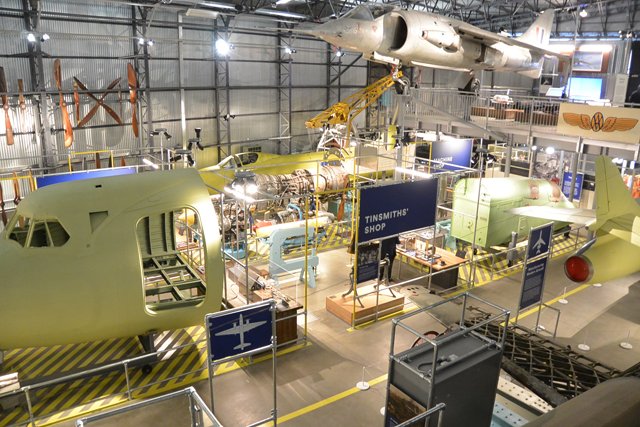
That is very unlikely, and expensive. The display area is meant to simulate a factory, so they are probably going to make a virtue of its incomplete nature.
When we started this nearly 4 years ago my 'pitch' idea to Brooklands was:
"I think a better name for the combined display would be "Making the Ultimate Bomber", with its focus on the design and build aspects of TSR2 as a programme.
P1121 is one bookend of the story and TSR2 the other.
This would also fit with the Brooklands 'factory' approach of recent years. A unique aspect of the museum is that it allows incomplete 'bits' to be shown in an enriching context to tell a fascinating story."
I was told the idea was liked and the plan was to put the 1121 next to the TSR2 cockpit section. They don't have a complete TSR2.
And of course, the P1127 'hovers' above them all, so it tells a strong story I think. If the P1121 had survived there would be no Harrier.
Also, sounds like an entirely separate discussion. Would the ideas that led to the P.1127 still not have happened at some point? Or would all involved have been consumed delivering P.1121? As I said, sounds like we need another thread....
Well, according to Ralph Hooper he was supposed to be working on P.1121 flying rig design but was bored with that and popped down to the library, where he picked up the BE.53 engine brochure, read it, and was inspired to start doodling an aircraft around it.
So you could say the P.1121 bored Hooper into inventing the P.1127.
More seriously, Camm really picked up and went with the P.1127 because there was nothing else in the pipeline. If the P.1121 was ordered, it would at least delay P.1127 development a number of years.
The UK MoD really blew when they cancelled the P.1121 because of that idiot Sandys's 1957 defence white-paper, if it had gone into production it would've been serious competition to the McDonnell F-4 Phantom.
The UK MoD really blew when they cancelled the P.1121 because of that idiot Sandys's 1957 defence white-paper, if it had gone into production it would've been serious competition to the McDonnell F-4 Phantom.
P.1121 was not cancelled because it was never ordered or intended to be ordered. It was a private venture derived from a failed submission to F155T/OR.329 which Hawker stopped work on when it became clear no orders were forthcoming.
P.1121 was not cancelled because it was never ordered or intended to be ordered. It was a private venture derived from a failed submission to F155T/OR.329 which Hawker stopped work on when it became clear no orders were forthcoming.
That is very unfortunate because if the MoD had a clue and actually ordered it things might've gone very differently for the British aerospace industry, IMO the P.1121 had a LOT of potential.
That is very unfortunate because if the MoD had a clue and actually ordered it things might've gone very differently for the British aerospace industry, IMO the P.1121 had a LOT of potential.
It sounds bizarre to us nowadays but the strategy behind the 1957 defence cuts was to free up British industry to pursue exports by reducing the burden of defence production.
Sir Edward Boyle, Conservative MP, January 1957:
The fundamental point is that the defence programme seriously competes for the same resources which we also need for our export trade, and for productive investment at home
I think it is important to remember the weight of the sheer physical burden on the top management of those firms who have to fulfil both defence contracts and large export orders. It really is not easy to find either the time or the effort to go all out for new export markets, when one has in addition the responsibility for the many miles of wiring required for a modern fighter aircraft.
So in this mindset, reducing home defence orders was supposed to free up companies to focus on products which would drive exports. Which Hawker failed to do with the P.1121, and only went ahead with the P.1127 on receipt of American funding.
Yes, the 1957 cuts were devastating for many companies but Hawker was cash-rich. Its main problem was that it had become so used to suckling from the state teat that it wouldn't risk its own money on private projects. Little wonder that American companies like Boeing and Northrop leapfrogged Britain in that era, as they often bet the entire company on a risky project.
I don't know what you are expecting, the only thing that I can think of is that the Tornado F Mk-3 was adequate as an interceptor for Tu-16s and Tu-95s and that's it.
I don't know what you are expecting, the only thing that I can think of is that the Tornado F Mk-3 was adequate as an interceptor for Tu-16s and Tu-95s and that's it.
It sounds bizarre to us nowadays but the strategy behind the 1957 defence cuts was to free up British industry to pursue exports by reducing the burden of defence production.
It doesn't seem that bizarre. Continuing to spend a higher % of state resources (money, people, facilities) on the warfare state than was happening during WW2 is obviously not sustainable.
The export market for expensive niche military jets was/is tiny compared to other manufactured goods like pots and pans, cars, trains, sewing machines etc. that the UK didn't have capacity to manufacture due to the massive state military spending.
That is very unfortunate because if the MoD had a clue and actually ordered it things might've gone very differently for the British aerospace industry, IMO the P.1121 had a LOT of potential.
Or you could do some actual research to learn about reality. He was much more experienced and informed about the British aerospace sector, and supported investment in it, than yourself.
It's a shame that so much "anti-history" continues to proliferate compared to the tired old nonsense being wheeled out again and again.
I still think it would've happened, but as a more navally-oriented airframe. CVA-01 was probably getting cancelled anyways as the UK withdrew from across the globe and focused more on ASW, so it's likely that in this situation, the Invincible-class gets ordered earlier and a more developed version of the Harrier/Sea Harrier appears around 1975, shall we say. I think that the Jaguar/Phantom combo is even less likely than the Harrier, as the RAF would already have a supersonic strike fighter in service. Probably no Lightning upgrades either and the type is gone by 1975 in favour of the P.1121 as a hypothetical P.1127 development enters service in the tactical strike role
I would compare it more to something like a mix between Mirage and Phantom. It probably could've done decently amongst a few ex-Hunter operators, and maybe some countries which were still tied down to British defence companies. With all that being said, it probably wouldn't have been nearly as successful as the Harrier was. This is in addition to the fact that a lot of analysis is being done with the benefit of hindsight. For instance, interest wa shown by various countries in the Lightning but it was always a bit of a one-trick pony; the P.1121 was probably much more suited to being used in different roles and had potential for upgradability, but this is with the benefit of hindsight of course.
Such speculation probably requires its own thread in the Alternative History section.
In all fairness to Sandys, the industry in the UK was extremely wasteful and inefficient at producing aircraft designs, and more often than not ended up making the wrong decisions. The bureaucracy failed to rapidly adapt to the changing technological environment, meaning that a world-beating aircraft in 1954 would take until 1959 to enter service, by which point it would already be verging on obsolescence. The industry and procurement system as a whole was incredibly wasteful and inefficient and needed reorganisation. Every nation with a major aviation sector suffered. The US and USSR had incredible wastage, but also had the funds to make up for it. France underwent a similar process to the UK, and ultimately was much more successful in producing successful designs, overtaking the UK on the export market in the 70's. From an enthusiast's perspective, it is perhaps angering to see such big names like Supermarine disappear, but that was what the industry needed at that time.
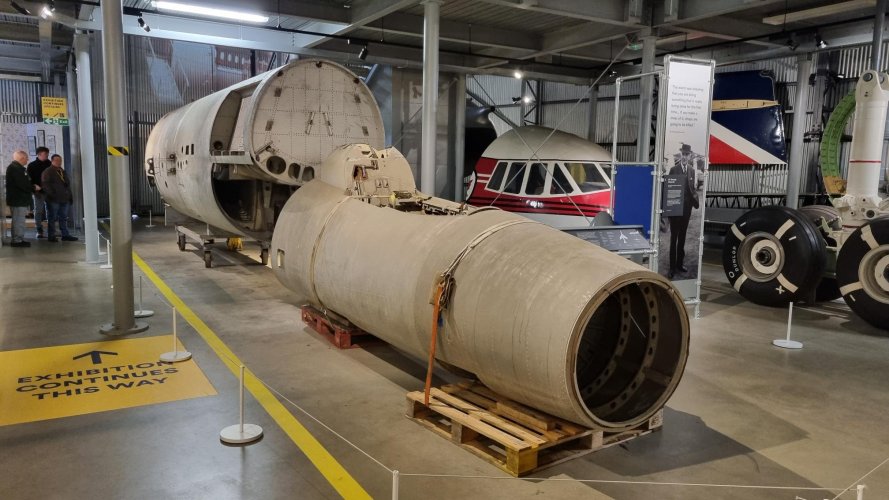
One of the volunteers working on the P.1121 at Brooklands posted the following on Facebook
"We aim to get the wing on display in the next few weeks alongside and rear of the centre fuselage. One side of the wing is open i.e. skinless so we aim to display it vertically so that both sides can be viewed with the structure of the wing on show too.
The hard work of cleaning, preservation and conservation starts shortly. Visitors to the museum will be able to see that work progress.
Dassault and its Mirage III made a carnage of public companies airplane. Circa 1958 a whole lot of types were canned : SO-4060, Trident, Leduc, Griffon, Etendard IV not navy, Vautour and SMB-2 orders.
The public companies were gradually merged from 1936 to 1970, but in the 1960s they were EXPRESSLY told by De Gaulle & co. to stop bidding on combat jets against Dassault.
Vautour was the lone exception, Jaguar started with Breguet... the last private company that was absorbed by Dassault after 1968.
This site uses cookies to help personalise content, tailor your experience and to keep you logged in if you register.
By continuing to use this site, you are consenting to our use of cookies.