Other people's Mirage F1

tomo pauk

ACCESS: Top Secret
Joined
1 May 2011
Messages
1,122
Reaction score
891
... and by 'other people' I mean the aircraft-making countries, and their perspective customers. These aircraft can be the F1s modified and adopted to the local production, or something that looks like the F1 - a fixed wing 1-engined Mach 2+ fighter that has a decent radar, or at least an acceptable radar. Wing is is neither too small nor of the too big a sweep, and also outfitted with the high-lift devices of the day. The 'day' being mid-late the 1960s. Note that wing does not have to be in the 'shoulder' position, nor the intakes need to be in the 'Mirage style' and location. Size and weight need to be, roughly within the -5% to +15% ballpark, though.

To start the ball rolling. Soviets make such an aircraft to cover for the possible problems and delays with the swing-wing designs, like the Su-17 and MiG-23. A good deal of MiG-21 parts is used to speed up the design and production phases. Aircraft ends up looking like the combo between the JL-9 and the JF-17.
 
As an alternative to working from Chinese derivatives, a Soviet rough contemporary of the Mirage F1 was the MiG 23-01 or Izdeliye 92 - a STOL tactical fighter referencing both the MiG-21 and the swing-wing MiG-23. Remove its Rybinsk liftjets and you get an F1 analogue.
 
Chinese DF- series.
https://www.secretprojects.co.uk/threads/dong-feng-east-wind-df-104-df-107-and-df-113-fighters.39/
The Deal of the Century provides a glimpse of F1 competitors, at a time when the F-16 was just a demonstrator. So - Viggen, and perhaps modified Jaguars with a single RB-199 or Spey ? for Sweden and GB.

Also Vought V-1000 and Lockheed CL-1200 Lancer. Basically all the competitors to the F-5E Tiger II in the 1968-69 IFA competition minus the F-5E and castrated Phantom. For the USA. Also, Boeing was interested in building F1s.
 
As an alternative to working from Chinese derivatives, a Soviet rough contemporary of the Mirage F1 was the MiG 23-01 or Izdeliye 92 - a STOL tactical fighter referencing both the MiG-21 and the swing-wing MiG-23. Remove its Rybinsk liftjets and you get an F1 analogue.
Good idea. A MiG-23 not incumbered by VG would be pretty formidable, close from a Viggen but with a tailed delta so a bit less draggier.
https://en.wikipedia.org/wiki/Mikoyan-Gurevich_23-01
 
Mirage F1E counts I suppose

The Greeks take up the deal offered by Dassault in 1971-72 for a 20% share in the construction of all Mirage F1. When the deal of the century comes Greece committing to buy the new version is an obvious one which forces the AdA to go through with buying the last batch of it's own aircraft as Mirage F1E. This in turn means F1E is not a paper machine there orders for at least 120 of them when the Belgians take the decision. They go for F1E too. The Dutch may or may not follow but from 1975-76 everyone who can is ordering the M53 Mirage F1. Just the Greeks are at least 160 more machines in this scenario

No Super Etendard, Mirage F1M takes its place, no Mirage 2000, Mirage F1E is already in production offering very similar performance... but Mirage 4000 is chosen in its place with an initial order for 75 to replace Mirage IV and further orders in place of OTL Mirage 2000D. By the 2000s you have Mirage F1E derivatives with M53P2 and RDY or even proposals for versions with M88 and RBE2.

No OTL Rafale given the Mirage 4000/Mirage F1E combo so Dassault will be screaming for a Mirage F1 replacement... by the time it was doing the FACE studies in OTL. So an one engined 5th generation replacement for Mirage F1 by about 2015-20, Mirage 4000 has to wait for SCAF...
 
As an alternative to working from Chinese derivatives, a Soviet rough contemporary of the Mirage F1 was the MiG 23-01 or Izdeliye 92 - a STOL tactical fighter referencing both the MiG-21 and the swing-wing MiG-23. Remove its Rybinsk liftjets and you get an F1 analogue.
Good idea.
Not designing it with the lift jets allows for a shorter airframe, too - so weight saving is huge. I'd also get it the wing shaped as the future MiG-25, in order to improve the low-speed handling while sacrificing the top speed somewhat.
Against the MiG-23, it will not have the big problems with the wing box (that was redesigned twice since the original was too weak), it will be simpler and cheaper to make and own, can cram in more fuel, wings can carry greater weight of ordnance without the need to make the swiveling racks.

(as one can discern, I'm a fanboy of the Mirage F1 idea and execution ;) )

For the British:
Let's say that TSR-2 program bears fruit, and RAF buys them in decent quantities. That will do a number on their budget for the better part of the 1960s, so when RAF wants to proceed with the high-speed trainer in the 1960s, the brass are told to make do with existing designs, suitably modified for that role. After some discussion, the decision is that the 2-seat modification of the Mirage F1 will be the best bet, powered by a British engine. At 1st, the non-afterburning Avon was favored, but this was rejected quickly since it would've meant that the aircraft is too slow, and that it will be too imbalanced with the shorter engine. At the end, it was proceeded with the A/B Avons, while also a 1-seat fully combat-capable version is made.
 
No Super Etendard, Mirage F1M takes its place, no Mirage 2000, Mirage F1E is already in production offering very similar performance... but Mirage 4000 is chosen in its place with an initial order for 75 to replace Mirage IV and further orders in place of OTL Mirage 2000D. By the 2000s you have Mirage F1E derivatives with M53P2 and RDY or even proposals for versions with M88 and RBE2.

The Mirage F1 with M88 and up-to-date radars would've been a strong contender in the lean years of 1990-2000, and still a good buy in 2000-2015. Possibly also the better air intakes? A 2D exhaust nozzle, if not 3D outright?
 
Soviets almost gotten their new light-ish fighter that might've been roughly comparable with the Mirage F1 - the Ye-8. Keep the 'normal' engine, add some area to the wings and Bob's your uncle?

Looking at the MiG-23, the 3-engined prototype seem to be heavier than even the in-service MiG-23s by about 1-1.5 tons empty - that is a lot in anyone's book.

As for the British, there was a suggestion for an RB.199-powered version of the Jaguar, that obviously gotten nowhere. Should've put them in the F1 ballpark.
 
To get the ultimate Mirage F1, you need to mix four Mirages across a few decades

1-F1E-M53, from the deal of the Century : better engine

2-F1EQ-1 to EQ-6 : the iraqi variants that got more A2G weapons that all the contemporary AdA and Aéronavale jets combined

3-The Mirage 2000 RDI to get Super 530D & look-down / shoot-down into the 1990's (to replace Cyrano IV and 530F)

4-F1 FM2000, that is the latest upgrade (for Morocco) : which has a RDY-3 for MICA, that is PESA - just like a 2000-5F or a Rafale F2 !

@Lascaris : good scenario, it has been stuck in my head since 2006 (minus the Greek connection, which is very welcome !)

Across the year 1973 Belgium was almost ready to go Mirage F1-M53, Dassault proposed a package with Alphajets plus Mercures for SABENA.
But the Prime Minister changed (Leburton, Tindemans...), legislatives happened in March 1974 - then the YF-16 flew and The Netherlands dragged Belgium, Danmark and Norway into a massive (348) F-16 buyout.

Greece is probably an easier and better path for the F1-M53. Why did the deal failed ?

To avoid a F-20 / Lavi situation of an "orphan" Mirage F1-M53 the Armée de l'Air, which had IOC F1-Atar and Jaguar in spring 1973, was ready to convert part of the 246 F1 it had ordered, into F1-M53: around a hundred of them. They were considered a low end to the ACF - just like F-16 to F-15, or 2000 to 4000 later : high-low mix.

The AdA however was obssesed by the G8A / ACF since spring 1972, first prototype was to fly in 1976 : but it was an unaffordable, F-15 size beast. When the F1-M53 lost the deal of the century, it was the final nail in the ACF coffin, and the 2000 was a go from 1976.

Meanwhile the Aéronavale dropped the Jaguar-M and picked the S.E in January 1973.
 
Last edited:
The Mirage F1 almost became NATO light fighter, but F-16 won.
the Nato Partners had locally build that Fighter,
like Belgium (also for Denmark), Netherlands, Spain and Italy
Here could happen Modification on Mirage F1 for use unter there Airforce role
like Fighter, Interceptor or Multi combat aircraft.

Special if West Germany would replace there F-104 with Mirage F1...
 
By the way, there is no reason the Mirage 2000 analog fly by wire could not be adapted to the Mirage F1. Very interestingly, Dassault modified a Mirage III with it in 1982 (the -NG).
The caveat being, the F1 had not be designed right off the drawing board with FBW in mind, so benefits might be less than with the clean sheet 2000. In the case of the Mirage IIING the gains were not very spectacular, at least not reported against cost and complexity.
In the 1970's the USAF flew a FBW Phantom and the british, a FBW Jaguar. So a FBW Mirage F1 should be easily doable.
Drawing from F-16 experience, I'd say a FBW Mirage F1 could have relaxed stability by moving the CoG rearward; and (for example) smaller and lighter control surfaces.
 
Last edited:
@Lascaris : good scenario, it has been stuck in my head since 2006 (minus the Greek connection, which is very welcome !)

Across the year 1973 Belgium was almost ready to go Mirage F1-M53, Dassault proposed a package with Alphajets plus Mercures for SABENA.
But the Prime Minister changed (Leburton, Tindemans...), legislatives happened in March 1974 - then the YF-16 flew and The Netherlands dragged Belgium, Danmark and Norway into a massive (348) F-16 buyout.

Greece is probably an easier and better path for the F1-M53. Why did the deal failed ?
Phantom and the regime of the colonels. Wanting F-4E was not new, the Greeks had first sounded the US for Phantoms in the mid 1960s. But in 1971-72 it was literally the perfect storm. For the regime ordering Phantoms then and there meant the US unofficial arms embargo was gone and the Nixon administration was visibly endorsing them. This was worth to the regime way more than the industrial advantages offered by France. Mirage F1 was then bought two years later... when the industrial offer was gone. So either keep the Nixon administration holding its nose on the colonels a bit longer... difficult when the colonels were financing the Nixon campaign. Or do away with the 1967 coup in the first place, a democratic government would be jumping with both hands on such a deal (and pressing to join EEC in 1973)

By the way, there is no reason the Mirage 2000 analog fly by wire could not be adapted to the Mirage F1. Very interestingly, Dassault modified a Mirage III with it in 1982 (the -NG).
The caveat being, the F1 had not be designed right off the drawing board with FBW in mind, so benefits might be less than with the clean sheet 2000. In the case of the Mirage IIING the gains were not very spectacular, at least not reported against cost and complexity.
In the 1970's the USAF flew a FBW Phantom and the british, a FBW Jaguar. So a FBW Mirage F1 should be easily doable.
Drawing from F-16 experience, I'd say a FBW Mirage F1 could have relaxed stability by moving the CoG rearward; and (for example) smaller and lighter control surfaces.
Did the Mirage F1E offered for the deal of the century have FBW? IMS the one offered to Egypt in 1975 did have FBW so I don't see any reason why the European version wouldn't.
 
a Soviet rough contemporary of the Mirage F1 was the MiG 23-01 or Izdeliye 92 - a STOL tactical fighter referencing both the MiG-21 and the swing-wing MiG-23. Remove its Rybinsk liftjets and you get an F1 analogue.
Yep, I like it Apophenia.
Not designing it with the lift jets allows for a shorter airframe, too - so weight saving is huge. I'd also get it the wing shaped as the future MiG-25, in order to improve the low-speed handling while sacrificing the top speed somewhat.

Always thought this myself tomo pauk. I like the idea of MiG-25-shaped wings - shoulder-mounted.
After all, TsAGI had developed the MiG-25 wing design before that of the MiG-23's complicated VG-wing design.

Regards
Pioneer
 
Last edited:
Did the Mirage F1E offered for the deal of the century have FBW? IMS the one offered to Egypt in 1975 did have FBW
Whaaaaaaaaaaaaaaat ?
 
Last edited:
My mind is completely blown ! Then again, it make so much sense. https://nobarrelrolls.blogspot.com/2019/09/deal-of-century-la-francesa-el-mirage.html

Some words about M53 variants before the M53-P2 of the 1980's. My understanding is that, before the P2 SNECMA was unable to get the thrust past 9 tons without enlarging the engine : hence it wouldn't fit anymore inside a F1 engine bay. Leaving it with the M53-2 and M53-5 variants, rated at 8200 and 8500 kg of thrust, respectively.
This penalized the F1 during the Deal of the Century : just like the airframe, the M53 "leaky turbojet" compared defavorably with the F100: more advanced, more thrust, more growth potential.

Put otherwise: the Mirage F1 as designed in 1966 was a scaled down F3, tightly wrapped around the Atar 9K50 to squeeze out best performance out of an old engine. Meanwhile the M53 early variants (the -2 and -5) were designed to be interchangeable with Atar 9K50 engine bays... but this limited their thrust to 8500 kg.

So: there were two different sizes of M53.

Now just turn that on its head: starting from the Mirage F3 and its massive TF306E american turbofan (10300 kg of thrust).

How about a scaled-down F3, but not around the Atar 9K50 (7200 kg) nor M53-2 (8200 kg) or M53-5 (8500 kg) ; BUT the "full size M53" getting past 9 tons of thrust. Somewhat like the later P2, which thrust of 9700 kg at last compared with the TF306E.

We should call that Mirage F4, because F1+F3 LMAO. Or Mirage F5.

And thus, the roaster of swept-wings Mirages would be akin to the following list...

Mirage F1: scaled-down F3 with Atar 9K50, thrust 7200 kg.
Mirage F2: the original prototype, two seater for strike (TF306E)
Mirage F3: interceptor, single-seat F2, TF306E, 10300 kg thrust.
Mirage F4: scaled-down F3, upgraded F1: with M53-2 and M53-5 later, max thrust 8500 kg
Mirage F5: scaled-down F3, upgraded F1 with "full-size M53" 9500 kg of thrust.

Among the F1 and derivates, I think the F5 would be the best choice.
 
Last edited:
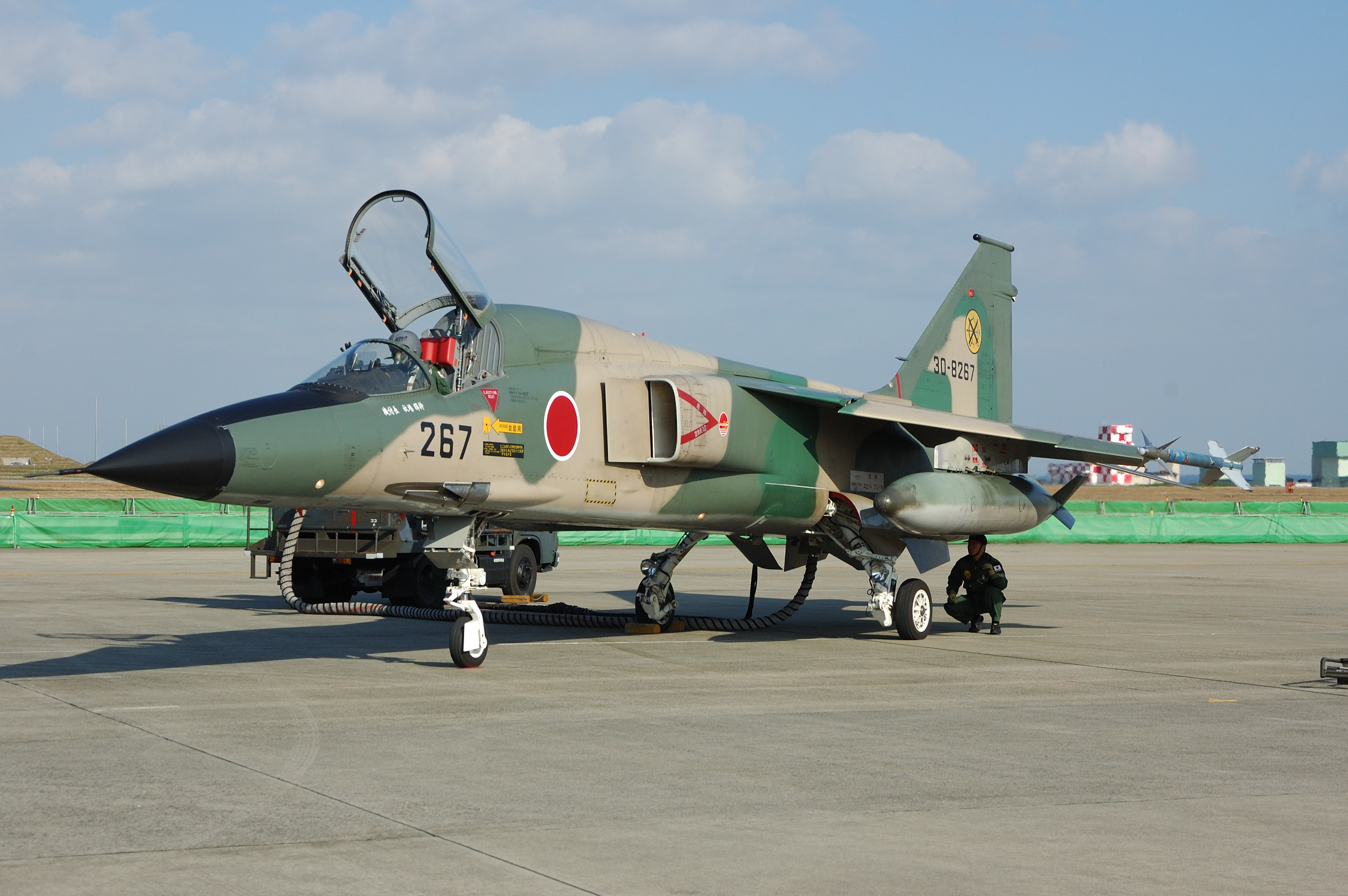
How about Dassault and Sepecat develop an F.1/Jaguar with rear section options for dual Adour, or a single Spey, Atar 09C, or Atar 09K-50? Probably looks a bit like a Mitsubishi F-1.
F-1_30-8267.jpg

Or just begin with the Jaguar and give a single-hole option.
Jaguar_singleSpey(1).jpg
 
Last edited:
How about Dassault and Sepecat develop an F.1/Jaguar with rear section options for dual Adour, or a single Spey, Atar 09C, or Atar 09K-50? Probably looks a bit like a Mitsubishi F-1.
Dassault was many things, wanting to cooperate while they don't dictate was not one of these. Also, such an aircraft competes with their stuff, so again it is a no-no for them.

With that said, the Jaguar with a single but powerful engine, like the Avon, Spey or RB.199 should've been one tough competitor in the 1970s and 80s, with a far better thrust-to-weight ratio than any historical Jaguar.
 
The Adour mk.104 solved the Jaguar lack of power. No need for RB.199 except perhaps for AST.396.
 
Last edited:
The timings not great, because the F.1 would be getting on in years, but replacing the Atar with the PW1120 would be interesting: better dry sfc, similar envelope, lighter, more dry and afterburning thrust.
 
Solved is perhaps a bit strong, certainly improved but RAF pilots still wanted more thrust.
The Mk.106s helped a little more but that wasn't long before the Jags were retired.
 
Compared to french ones ? they did. Also mk.106, as @Hood said.

As Hood notes, and I agree, 'solved' is a bit too strong wording.
Adour will not make it, being too heavy for the thrust it offered. A swap to the single RB.199 will offer the same thrust, while being lighter by more than 600 kg just in the dry engine weight.
 
The Adour mk.104 solved the Jaguar lack of power. No need for RB.199 except perhaps for AST.396.
I think the big thing with Jaguar is that it was possible to fit a lot of heavy draggy stores to it, which obviously impacts performance.

With more limited stores fits them it was pretty good performance (take-off, SEP, range).

All the various AST.396 schemes with even the likes of 2 x RB.199 didn't improve the speed that much. It's like +50kts at low altitude.

As stated before, I prefer the 1 x RB.199 variant as a lesser change as RB.199 was very similar size to Adour (length in particular ). The big advantage for this was much greater range from the lower fuel burn.

The likes of other engines such as Spey or Atar are just far too big and heavy for Jaguar. They have to be very far aft, beyond the main gear bay, which creates massive balance problem.
 
As stated before, I prefer the 1 x RB.199 variant as a lesser change as RB.199 was very similar size to Adour (length in particular ). The big advantage for this was much greater range from the lower fuel burn.

The likes of other engines such as Spey or Atar are just far too big and heavy for Jaguar. They have to be very far aft, beyond the main gear bay, which creates massive balance problem.
Believe me, I wish I had thought of RB.199 first over the Spey.
 
Another perhaps plausible engine for the 1-engined Jaguar - a trimmed-down straight-through Pegasus. It should've been a more modern engine than the Spey - a plus with regards to the future-proofing it, as well as the maintnability of the engine. By 'trimmed-down', I mean that the low pressure part of the engine is smaller, so the diameter of the whole engine can come close to 40 in (again the nod vs. Spey). Good power/weight ratio even without afterburner, again a nod to it.
The after-burning Spey was also very long; the non-A/B Spey will not cut it.
A stiff competition to that engine might've been the TF.41, engine that RR had a lot to do with it, both in development and production.
Last but not least - the lightly afterburning Spey? Custom made for the not-Jaguar, shorter and lighter than the fully-A/B Speys, doing perhaps ~75 kN instead of 91 as on the Phantoms?

Either of these engines are not as refined as the RB.199, but will have a better timing and less export restrictions, at least the two fully-British engines.
 
Just to throw more fuel on this fire.

There was potential to scale up RB.199 to match Spey but give greater efficiency and power.
Something in the order of 24,000lb reheated was conceivable during the P.146 studies '67-'69.

Frankly the Brough P.146 is a better solution than Jaguar.

But I do have a soft spot on the potential 'proto-Hornet' capability of a scaled up Jaguar with twin RB.199s. More expensive, but meshes with Tornado support and supply chains better.

Always feel there ought to a Mirage F4 with twin M.45 or even RB.199.

All said slapping that big RB.199 in an F1 might really yield results.
 
There was potential to scale up RB.199 to match Spey but give greater efficiency and power.
Something in the order of 24,000lb reheated was conceivable during the P.146 studies '67-'69.

I've been today's years old when I've found out that there was a Spey Jr. engine, a.k.a. RB.183-2, a.k.a the MK.555-15. The only user seems to be the Fokker F28 fellowship. 1st flight was in 1967.
Engine was at about 2250 lbs, or some 200 lbs lighter than the non-A/B 'normal' Speys ; thrust was also lower by about 10% . It should not be inconceivable to have a 4 to 4.5 meter long (vs. 5m A/B Spey) ~70 kN engine that weights about 3000 lbs/1400 kg for the 1st versions? Attain perhaps 75 kN later?

From the commercial side of equation, there is not a much money neither time to be spent to develop and test such an engine, price can be low for what it offers, and there will likely be no hard export restrictions for the countries that are not in the Soviet sphere. End result: a good product both for RAF needs, as well as for the export.

All said slapping that big RB.199 in an F1 might really yield results.
Agreed.
 
A modern, medium-size turbofan like F404 /RB.199 is obviously far better than plain old Atar 9K50, for a F1. Perhaps an even easier fit than M53.
And yes, Adour and M45 were worth better airframe than AFVG and Jaguar. My favorite take is a Sud Aviation licenced N-156 family for ECAT circa 1965.
Except the old J85s are replaced either by a single Adour Mk.104 or a M45G. Proto-F-20, kinda.
 
And yes, Adour and M45 were worth better airframe than AFVG and Jaguar.
I'd politely but firmly disagree with the notion that Adour was worth of a better airframe than Jaguar. The t/w ratio of 4.5:1 to 5:1 was saying late 1950s, not hello late 1960s, let alone 1970s. If anything, Jaguar was an excellent airframe where the engine was a limiting factor.
Besides the Adour being too heavy for the thrust it produced, one needed two per a combat aircraft, while the other people were installing only one engine on the combat aircraft of similar abilities and never looked back. A force of 100 Jaguars needed to maintain 200 engines at least, with perhaps another 50 in reserve, while the force of 100 Mirage F1s needed to maintain 100 engines and have another 25 in reserve.

Except the old J85s are replaced either by a single Adour Mk.104 or a M45G. Proto-F-20, kinda.
We probably don't hate the F-5/proto-F-20 pilots that much, that we'd start installing one Adour on these aircraft.
 

Similar threads

Back
Top Bottom