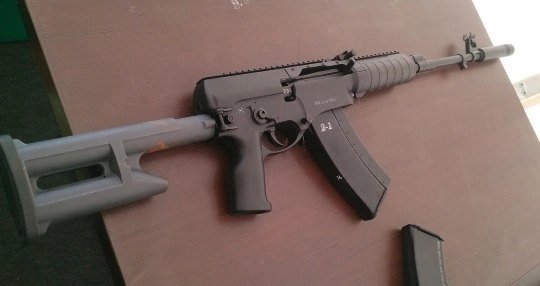
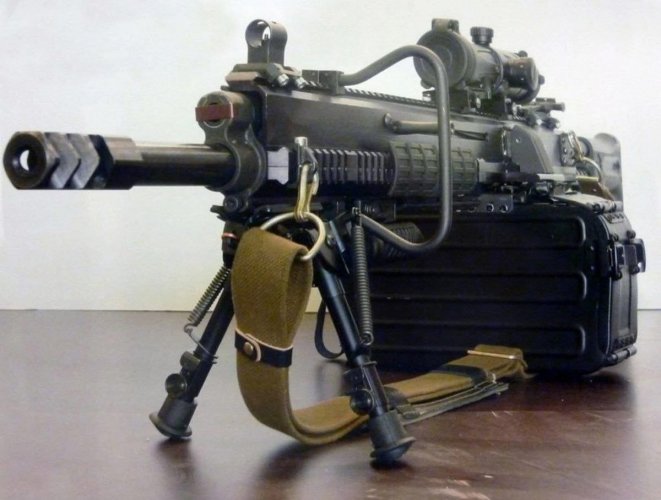
How many of these problems, like the very high chamber pressure and ammunition too expensive for training would have been ameliorated by using a bullpup design?
Still wouldn't solve the problem that 6.8mm full power ammo weighs almost as much as 7.62 NATO. So you cut each soldier's basic ammo load by at least a third (20 rd mags vs 30) and increased weight.
A basic load of 7x20rd NGSW mags weighs 9.8 lbs; 7x30rd M16 mags weighs 7.4 lbs, so 25% more weight for 33% fewer rounds. The SAW gunner's load is even worse: +30% weight for -33% rounds.
Cutting the barrel down even further than the already short 13" one seems stupid; it reduces the extended range and performance that was the entire selling point of the program. I'd wager if someone fires this without the suppressor they're going to get a concussion.
You're right of course, but there might be another implication: With a shorter barrel and a smaller, lighter suppressor, it wouldn't be too far fetched to assume that the carbine might be implicitly intended to fire the normal-pressure ammunition anyway, not the high-pressure rifle ammunition.
Not that it would dispel any of the criticisms raised against the fitness of the 6.8 mm ammunition for future infantry combat, but if I'd have to come up with a scheme to make the best out of an irreversible decision ... ;-)
Maybe the ammunition actually doesn't need to be carried around all the time anyway, if we consider just-in-time delivery by logistics drone possible. Still, this would be a work-around for a self-inflicted quandary.
Apparently xm-157 has finally arrived as the m-157. Hope so. 25rd mags seems positive as well. Doesn't sound like recoil mitigation is ever going to mentioned. The rifle/carbine needs every recoil mitigation tech it can get in order to get off the road to perdition. IMHO
@jsport a recoil mitigation technique that can halt the blowback force of this battle rifle would be too detrimental weight wise to be a successful implement. I reckon Sullivan's design could work, but it would be in IAR territory. Also, with the pencil barrel on these gun, automatic fire is more likely to burst the barrel before they can hit an enemy anyway...
Apparently xm-157 has finally arrived as the m-157. Hope so. 25rd mags seems positive as well. Doesn't sound like recoil mitigation is ever going to mentioned. The rifle/carbine needs every recoil mitigation tech it can get in order to get off the road to perdition. IMHO
many folks would beg to differ on the recoil. Anyone who watches any vid can clearly observe too much recoil. The m8 is lighter & short further worsening recoil. As have stated before. An seasoned hunter expressed , hunting is about three things,recoil, recoil & recoil.
Cutting the barrel down even further than the already short 13" one seems stupid; it reduces the extended range and performance that was the entire selling point of the program.
I honestly think that all you need to understand the M7/M8—as well as that new Russian and Chinese rounds that are around 6.5-7mm—is to understand the need to suppress at range.
The thing that kills/shifts infantry in peer conflict is drones, artillery, IFVs, etc. The job infantry needs to do is suppress/pin other infantry so that other fires can hit them. To effectively suppress, their rounds need to be accurate enough to be threatening, and have enough terminal performance to be dangerous despite the engagement range and/or body armor. The farther you can suppress, the less fire you take back. Being able to carry less ammo sucks, but it’s also no coincidence that even nominally light infantry are now getting buggies and UGVs (which would technically make them at least “motorized”?) to truck their stuff and/or selves around.
Door kickers will keep door kicking with whatever they deem does door kicking best, but most infantry aren’t living that life.
I honestly think that all you need to understand the M7/M8—as well as that new Russian and Chinese rounds that are around 6.5-7mm—is to understand the need to suppress at range.
The thing that kills/shifts infantry in peer conflict is drones, artillery, IFVs, etc. The job infantry needs to do is suppress/pin other infantry so that other fires can hit them. To effectively suppress, their rounds need to be accurate enough to be threatening, and have enough terminal performance to be dangerous despite the engagement range and/or body armor. The farther you can suppress, the less fire you take back. Being able to carry less ammo sucks, but it’s also no coincidence that even nominally light infantry are now getting buggies and UGVs (which would technically make them at least “motorized”?) to truck their stuff and/or selves around.
I honestly think that all you need to understand the M7/M8—as well as that new Russian and Chinese rounds that are around 6.5-7mm—is to understand the need to suppress at range.
Which new rounds? The Russian 6x49 is ancient unless you're referring to the 6.02x41, which lies in a different class (6.5 Grendel, 6mm ARC etc).
The Chinese round is a reactionary development and as it's already hanging around in a showcase there's little chance they're adopting it for general purpose use (as a 6.5 Creed domestic equivalent, maybe) (and not the 70s one, the new 2025 one).
There's one objective underpinning 6.8 NGSW: extended range AP performance. This quote sums up the history quite well.
The point always was a rifle. NGSW is the offshoot of NGSAR (which was supposed to be the Textron LSAT), which replaced ICRS, which was supposed to be a 7.62 NATO rifle issued to XVIII Airborne Corps and units deployed to EUCOM to use a not yet developed tungsten tipped AP round to penetrate Russia armor at long ranges, per the "overmatch" theme that was popular then. There was no fire control optic as part of ICRS, no FCO with NGAR, that requirement came with NGSW, much later, after the program requirements were set.
If it's about "suppressing", the aim would be more limited to accuracy at range, which most 556 match bullets could already do, and increase lethality at medium range against lvl 4 plates with limited BFD reqs, which could be done with improvements in material science. Thoug of course this improvement would be much better applied on a 6.5mm catridge akin to Grendel with respectable range, lethality, mass and felt recoil, not a full blown magnum rifle round. Flesh infantry is still limited to either full soft vest coverage to eat close 155mm burst, or a heavy plate carrier to eat 556/762 AP (at their respective expected combat range).
The thing that kills/shifts infantry in peer conflict is drones, artillery, IFVs, etc. The job infantry needs to do is suppress/pin other infantry so that other fires can hit them. To effectively suppress, their rounds need to be accurate enough to be threatening, and have enough terminal performance to be dangerous despite the engagement range and/or body armor. The farther you can suppress, the less fire you take back. Being able to carry less ammo sucks, but it’s also no coincidence that even nominally light infantry are now getting buggies and UGVs (which would technically make them at least “motorized”?) to truck their stuff and/or selves around.
Rifles still kill aplenty. Ironically rifle might actually kill more people in Ukr, in ratio figures, than they did in ODS if we get an accurate casualty compilation some 10 years down the line and most kills post 2023 is from people assaulting each others trenches with AK-74s and impromptu tied together grenade 6pacs. I agree with the sentiment, but warfare is dynamic, and NGSW is leaning too hard to one spectrum. We do have something that can fit perfectly in the center, 6.5 LSAT, or the 6.8 SPC if they give it P+ rated propellants and NAS3 or TV polymer case, or even the aforementioned 6.02mm Russian.
Which new rounds? The Russian 6x49 is ancient unless you're referring to the 6.02x41, which lies in a different class (6.5 Grendel, 6mm ARC etc).
The Chinese round is a reactionary development and as it's already hanging around in a showcase there's little chance they're adopting it for general purpose use (as a 6.5 Creed domestic equivalent, maybe) (and not the 70s one, the new 2025 one).
There's one objective underpinning 6.8 NGSW: extended range AP performance. This quote sums up the history quite well.
If it's about "suppressing", the aim would be more limited to accuracy at range, which most 556 match bullets could already do, and increase lethality at medium range against lvl 4 plates with limited BFD reqs, which could be done with improvements in material science. Thoug of course this improvement would be much better applied on a 6.5mm catridge akin to Grendel with respectable range, lethality, mass and felt recoil, not a full blown magnum rifle round. Flesh infantry is still limited to either full soft vest coverage to eat close 155mm burst, or a heavy plate carrier to eat 556/762 AP (at their respective expected combat range).
Rifles still kill aplenty. Ironically rifle might actually kill more people in Ukr, in ratio figures, than they did in ODS if we get an accurate casualty compilation some 10 years down the line and most kills post 2023 is from people assaulting each others trenches with AK-74s and impromptu tied together grenade 6pacs. I agree with the sentiment, but warfare is dynamic, and NGSW is leaning too hard to one spectrum. We do have something that can fit perfectly in the center, 6.5 LSAT, or the 6.8 SPC if they give it P+ rated propellants and NAS3 or TV polymer case, or even the aforementioned 6.02mm Russian.
There's absolutely no way that rifle fire is killing more people in Ukraine than explosives (be it hand grenades, artillery, kamikaze drones, mines, bombs, missiles, rockets, ATGW, etc).
Small arms (including the MG) still kill, but the trend has been incredibly stable that in conventional wars they produce ~10-30% of casualties, with the majority of lethality and casualty production coming from explosive weapons (artillery, aircraft, grenades, mines). The exact balances change over time, but if you're looking at the numbers then improving infantry lethality is going to come from enabling fires, fixing the explosive shortage, and improving the ability of small units to throw HE-FRAG at the enemy (commando mortars, FPVs, kamikaze drones, a gustav that doesn't give you brain damage, using one of those tennis ball throwers for dogs to chuck hand grenades), NOT from adopting a battle rifle.
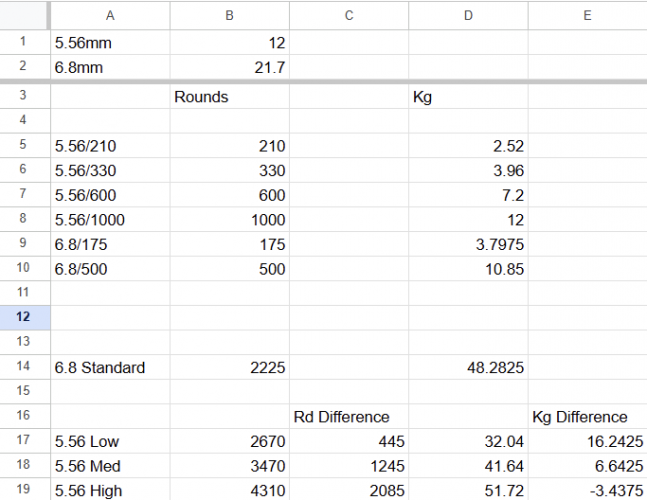
Spending >400,000,000 a year on NGSW is (IMO) pretty symptomatic of how much the Army has lost the path on infantry, in part due to the over-emphasis on light infantry and airborne. The baffling part is that 6.8x51 ammunition is nearly twice as heavy as 5.56, at ~22g vs ~12g, so even if the gun weight is held steady the infantry basic load of 210 5.56 rounds (2.5kg) either goes up to 4.6kg for 210 rounds of 6.8 or stays at 2.5kg but only gets you ~114 rounds of 6.8.
Breaking the ammunition weight out a little further, you've got:
Apologies for the inconsistent numbers, I put 21.7 into the spreadsheet instead of 22g. Generously there's a version of the squad comparison where 6.8 saves weight vs 5.56, but it saves 3.4kg per squad in exchange for carrying 2000 fewer rounds of ammunition, equivalent to both 5.56 SAW gunners! And that 3.4kg is only equivalent to 286rds 5.56/158rds 6.8!
The ammunition weight issue is unsolvable for 6.8x51, and IMO is the most lethal problem, to the program and to the infantry that have to carry it. It's a recipe to lose the volume of fire fight and have sustainment issues in the field.
Of course there's also the looming alternative that SOCOM is moving towards: high pressure 5.56x45. There's been some scuttlebutt of pushing 62 grain projectiles (i.e. M855/A1) at ~3180 ft/s (970m/s) out of an 11" barrel. That's scratching M193 20" muzzle velocities, probably faster out of a 14.5" barrel (i.e. standard infantry rifle). Flatter shooting, longer effective range, plenty of lethality, backwards compatible, no weight increase, and relatively inexpensive. NAS3 cases even are a ~4g per casing weight SAVINGS, which is 840-1320g per rifleman and 2400-4000g per SAW gunner just from a better case design.
So of course, in true Army fashion, they're spending a lot of money on fundamentally flawed rifles instead of doing the less expensive and better performing route. Just like cancelling JLTV for what is essentially the bastard child of a CUCV and the fabric roof HMMWV, because it's a great idea to get rid of shrapnel protection when battlefields are coming to be dominated by artillery and ATGW (including FPV/Kamikaze drones).
I am constantly baffled how they managed to avoid significant scrutiny, and I really wish that the Army would be hauled in front of congress and asked to answer how they made this math work.
IIRC, base load for the 6.8 is 9x magazines of 25. Which yes, weighs basically twice as much as the 5.56 load of 9 magazines of 30. (or 8 mags of 30 and one of 40+ in the weapon)
IIRC, base load for the 6.8 is 9x magazines of 25. Which yes, weighs basically twice as much as the 5.56 load of 9 magazines of 30. (or 8 mags of 30 and one of 40+ in the weapon)
Of course there's also the looming alternative that SOCOM is moving towards: high pressure 5.56x45. There's been some scuttlebutt of pushing 62 grain projectiles (i.e. M855/A1) at ~3180 ft/s (970m/s) out of an 11" barrel. That's scratching M193 20" muzzle velocities, probably faster out of a 14.5" barrel (i.e. standard infantry rifle). Flatter shooting, longer effective range, plenty of lethality, backwards compatible, no weight increase, and relatively inexpensive. NAS3 cases even are a ~4g per casing weight SAVINGS, which is 840-1320g per rifleman and 2400-4000g per SAW gunner just from a better case design.
The 100ksi NAS3 5.56 stuff looks really interesting. I would like to see that combined with a new magazine pattern that can handle a ~2.5" cartridge overall length. This would allow loading long VLD bullets with a significantly better ballistic coefficient. It would also prevent loading the longer high pressure rounds in a normal STANAG magazine/weapon while still allowing the new weapon to fire existing 5.56 ammo for training.
There was a certain renewed interest to alternative rifle cartriges, starting from 2011 onwards. OTs-123 sniper rifle and OTs-124 machine gun were developed, chambered in experimental 6,7x51 cartridge. And at least one AMK assault rifle in 6x49 was also evaluated.
The 100ksi NAS3 5.56 stuff looks really interesting. I would like to see that combined with a new magazine pattern that can handle a ~2.5" cartridge overall length. This would allow loading long VLD bullets with a significantly better ballistic coefficient. It would also prevent loading the longer high pressure rounds in a normal STANAG magazine/weapon while still allowing the new weapon to fire existing 5.56 ammo for training.
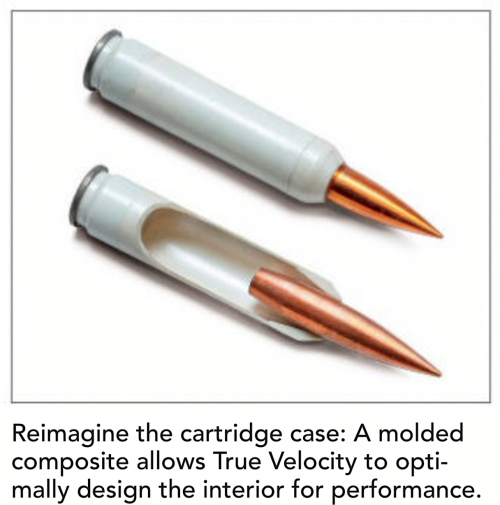
IMO the cost argument falls apart when you have to buy new receivers. NAS3 cases have more internal volume so it's possible a longer bullet could fit to get better ballistics in a 62 grain projectile. Personally I think that the steel case should be a fairly large warning that it'll blow up guns. There's also the prospect of mixing NAS3 with the neckless geometries of 5.56 that TV and some people online have played with to get the longer bullet in the same OAL. I've heard some scuttlebutt that steel has odd neck tension issues that might preclude this, but the general point is that 5.56x45's formfactor is absolutely not pushed to the limit, and there's room for a rebarrel/bolt upgrade that should make 5.56 shoot absurdly flat and punch through velocity limited plates (which is most ceramics and steel) at reasonable ranges.
A while back I sketched out a concept for 3300 ft/s 62gr with the G7 of 7N6 (.168) which ended up being comically flat shooting (a 300-350m battle zero ends up mathing out to fairly point and shoot to 500m.
The lower receivers aren't, but I'm really curious what the upper receiver feels about doing direct gas impingement on 80k PSI.
And yes, the barrels and bolts, just the most high-strength and heavy metal components of most weapons, I'm sure that uprating them to handle overpressured ammo will neither significantly increase the cost or weight of the weapon... you know, like it did in the weapon redesigned for overpressured ammo that is the entire centerpiece of this thread.
the M7 suffers from problems that stem from its design choices regarding high pressure ammo. Not the ammo or concept itself.
Since the M7 took the deranged route of AR10 pattern mags (large frame gun), Sig attempted to shave weight off the bolt and barrel (the worse possible choices)
The future of high pressure cartridges are using smaller frame designs which have a lower overall weight. That means you don’t need to shave weight from the bolt or barrel to compensate.
Things like the surefire ICAR run perfectly with the extended bolt, thicker bolt face, and stronger bolt lugs. Even better metallurgy and bolt geometry allow the Geissele GFR and Noveske 6arcs to run good. Those both work with higher pressure ammo.
The M7 is just a bad design full stop. And the contract award itself screams of corruption.
I had assumed the XM8 would be limited to a small production run before being recognized as a bad idea that eats into the long-range ballistic performance NGSW was justified and built around, but instead they've doubled down on it.
If you need something more compact and easier to handle, then use a caliber better suited to those characteristics instead of high power 6.8x51mm ammunition.
Army is still chasing the dream of having one gun that can do it all. They'll find yet again it may do everything, but it does none of it particularly well.
I disagree - both the concept and ammunition are flawed.
The ammunition is the result of trying to achieve phenomenal speed for unrealistic penetration out of an unfeasibly short barrel. The alternative, lower pressure cartridge from a long bullpup barrel, was more sensible. Or less flawed.
A lighter rifle firing the same round would have utterly devastating recoil.
I disagree - both the concept and ammunition are flawed.
The ammunition is the result of trying to achieve phenomenal speed for unrealistic penetration out of an unfeasibly short barrel. The alternative, lower pressure cartridge from a long bullpup barrel, was more sensible. Or less flawed.
A lighter rifle firing the same round would have utterly devastating recoil.
Again, certain units have been using 12.5 and 14.5 6arcs and they run just fine. As well as NAS3 ammo across 5.56, 300blk, 6.5. The problem with the NGSW platform is they wanted *large frame sized rounds / AR-10 pattern mags* in the size of a small frame gun. 13 inch barrel M7 and now a 10.4 inch XM8 / M8.
This site uses cookies to help personalise content, tailor your experience and to keep you logged in if you register.
By continuing to use this site, you are consenting to our use of cookies.