New Heavy Bomber Alternatives study FY'27 - speculation

Things also to think about... spanwise lift distribution. And asymetric loading. And flutter at n1 loading x n2 weights at n3 speeds (up to nxx to the third here.) And wing box torsion. And...
all great points !! to be honest i didnt even think of problems like asymmetric loading , yes might be a problem having one heavy loaded fuselage and a lighter loaded one. thank you this was an eye opening comment on the problems a twin fuselage heavy bomber would face
i bet the maintenance costs will not be cheap, i wonder what the calculus of cost vs ordinance delivery would be though, its sort of like having two planes in one...would that mean lower overall numbers of heavy bombers which would affect readiness rates etc.. yeah the more i think about it the more unreasonable a twin fuselage heavy bomber would be
seems that it would be then a case study of the tube with wings or a blended body design, pros and cons to each, operationally vs cost estimates, its not an easy study....
thanks aim9xray was an informative comment
cheers mate
 

Attachments

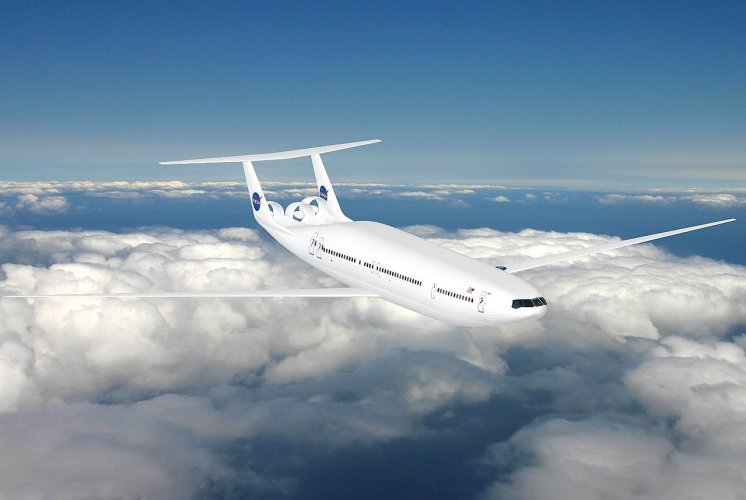
  • 1280px-MIT_and_Aurora_D8_wide_body_passenger_aircraft_concept_2010_(cropped).jpg
    1280px-MIT_and_Aurora_D8_wide_body_passenger_aircraft_concept_2010_(cropped).jpg
    147.5 KB · Views: 446
That would basically be MIT's double bubble, the Aurora D8
To maintain a twin engine that can sling a large load it needs that load centerline. That does not have any clearance along the main wing centerline.
 
Because it implies a need to distinguish from a "light" or "medium" bomber, but that's basically just a normal fighter jet. An F-16 can carry a larger payload than a World War II-era B-17.
While "light bomber" might be a cognate for "fighter", a medium bomber has longer range and/or greater bombload than any existing fighter.

Examples: F-111 or B-58, H-6/Tu-16, any of the V-bombers...

And heavy bombers carry at least twice the load of a medium for mind-boggling distances. If not more.
 
While "light bomber" might be a cognate for "fighter", a medium bomber has longer range and/or greater bombload than any existing fighter.

Examples: F-111 or B-58, H-6/Tu-16, any of the V-bombers...

And heavy bombers carry at least twice the load of a medium for mind-boggling distances. If not more.
The fact that the F-111 has an F designation proves my point
 
The fact that the F-111 has an F designation proves my point
The fact that, despite its' academic "F" designation, the F-111 had no real-world Air Superiority capability, and indeed a barely relevant air-to-air (Sidewinder) capability, would tend to disprove your point.

Look beyond designations and labels to discern reality.
 
The fact that the F-111 has an F designation proves my point
The F-111 (as a bomber) would have had an A-for-Attack designation like the A-5 Vigilante if it had been designed for the USN as a bomber. But the USAF demanded that every "fighter" carry a nuclear bomb.

The only air-to-air weapon that the F-111 carried was the Sidewinder.
 
Allegedly, the F-117 had Sidewinder capability for popping Soviet AWACS. And maybe should have had an A-series number as well. Remember, the entire reason that the Nighthawk Stealth "Fighter" got that number was because Lockheed had printed the Flight Manual with the classified code number used by the pilots flying it for their logbooks, and the USAF was too cheap to pay for a reprint (and didn't have the political capital to make Lockheed pay for it as an error).
 
Heavy bomber was used mostly prior to the jet age, but it is still relevant in the context of a heavy lift bomber. The Cold War seemed to use tactical and strategic bomber designations. But there was quite a gap between different bombers. The B-57 and Canberra were not much bigger than many attack planes. And the Navy and USAF used different definitions for A-3 and B-66 when they were from the same base production line. So there will always be disagreement in the definitions as long as there are people involved.
 
Because in terms of required payload mass the change from chemical explosives to nuclear payloads fundamentally changed the categories.
Yes and no.

Most "light bombers" or fighter-bombers carry 1-2 nukes. The V-bombers were called medium bombers and still only carried 2 nukes, just a lot farther than the fighter-bombers. The B-21 is also considered a medium bomber by weapons capacity, and can carry 8 nukes even farther than the B-2 can fly.

While a B-52 can carry up to 20, a B-1 could carry 24 internally and another 12-14 externally, and a B-2 could carry 16.
 
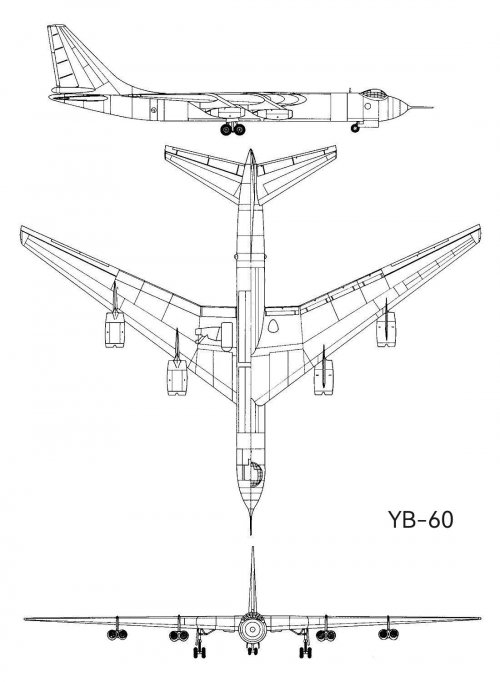
I want to see it. It's older than the B-52, but, it's new.
 

Attachments

  • v2-3e7fa8e6644f173e5b3dce9b44fd3f88_r.jpg
    v2-3e7fa8e6644f173e5b3dce9b44fd3f88_r.jpg
    132.5 KB · Views: 93
I want to see it. It's older than the B-52, but, it's new.
It's bigger than the B-52 as well!

YB-60 stats:
  • Length: 171 ft (52 m)
  • Wingspan: 206 ft (63 m)
  • Height: 60 ft 6 in (18.44 m)
  • Empty weight: 153,016 lb (69,407 kg)
  • Gross weight: 300,000 lb (136,078 kg)
  • Bombload: 72,000 lb internal
B-52H stats:
  • Length: 159 ft 4 in (48.5 m)
  • Wingspan: 185 ft 0 in (56.4 m)
  • Height: 40 ft 8 in (12.4 m)
  • Empty weight: 185,000 lb (83,250 kg)
  • Gross weight: 265,000 lb (120,000 kg)
  • Bombload: ~24,000 lb internal on the rotary rack, up to 42,000 lb in Big Belly configuration; up to ~36,000 lb external with cruise missiles, 18,000 lb external conventional (24x 750lb). 60,000lb max
Though I will note that the B-52H has a higher (likely) MTOW at 488,000lbs, while the B36 only had a 410,000lb MTOW. B36 is 10ft shorter length but 30ft longer wing, I figure the MTOW is likely a wash between B36 and B60.
 
I mean humans collectively as a species. Nuclear weapons haven't been used in war since 1945
Thankfully yes, but unfortunately history and even its more or less informed extrapolations are extremely poor predictors of the future.
 
At this point it would just be a clean sheet design that vaguely resembles the Vulcan's shape without sharing any DNA (it *is* a late 40s/early 50s design, anyway). AGM-183 or similar would replace Skybolt anyway while weighing less.
 
Yes so in general a large delta wing to hold 6× large hypersonic weapons. b-52 was planned to carry only 4 gam-87 and currently testing with 4 ARRW.
 
Not sure if it has been mentioned by could a modernised Avro Vulcan B.3 be a possible replacement? It could use 4× F-135 or future ACE engines. A loadout of 6× GAM-87 skybolt implies a payload of 30 tons.

Image of it found in a previous discussion
An aircraft with four F135s could be somewhere between the B-1 and the Tu-160 in size, probably with an empty weight around 100 tons, an MTOW around 250 tons, a payload around 50 tons, and a top speed around Mach 2 if it has variable inlets. Four F135s would give the Vulcan an afterburning TWR around 1:1 at MTOW, but an 80 ton airplane just isn't big enough to replace a 220 ton heavy bomber.

If you're just looking for a long-range ALBM carrier, then the B-52 make a lot of sense (except for the age). The B-52H fleet was basically unused until the early 1990s and the fact that they switched from the low-altitude profile the B-52H was designed for back to the high-altitude profile the B-52s used up to the D model means they essentially have 100 years of flight hours left before parts reach their structural fatigue lives.

The main reason I think the B-52 replacement could be wrapped up with some sort of tanker is because tankers carry fuel while heavy bombers carry mostly fuel and a few weapons. Both fuel and weapons are extremely dense. Transports, on the other hand, carry cargo that is generally much less dense than fuel or weapons, so a transport carrying a huge load of fuel or weapons is also carrying a huge amount of unnecessary structural volume. Additionally, the kinds of wings and high-lift devices you need to land on short fields and FOBs are not compatible with long endurance flights at high altitudes and high cruising speeds, so you have a mismatch between the requirements for transports and the requirements for tankers and bombers.

My proposal earlier in the thread was for a take on the B-21 but doubled in size, with four engines instead of two and payload for roughly 120 tons of weapons and fuel.
Yes so in general a large delta wing to hold 6× large hypersonic weapons. b-52 was planned to carry only 4 gam-87 and currently testing with 4 ARRW.
If the B-2 can fly halfway around the world with 30 tons of ordnance, its replacement should be able to do the same thing with 10 ARRWs, which weigh about 3 tons each. A B-52 fully loaded with CALCMs is carrying 35-40 tons of missiles. The limit of 4 Skybolts or ARRWs is due exclusively to the hardpoint situation, but a new aircraft could be designed to carry larger numbers of big weapons like the ARRW.

 
Use the de-funct Spirit jets as the Walmart of Bombers and just they had a special on the new Bankrupter Stand-Off Weapon (BSOW), may cause potential financial ruin to someone, the AI Corporate Terminal Guidance System is still having some issues but the bugs are still being worked out with a parallel program Project Black Flag, isn't tech fascinating?
 
Use the de-funct Spirit jets as the Walmart of Bombers and just they had a special on the new Bankrupter Stand-Off Weapon (BSOW), may cause potential financial ruin to someone, the AI Corporate Terminal Guidance System is still having some issues but the bugs are still being worked out with a parallel program Project Black Flag, isn't tech fascinating?
B-2 Spirit Airlines?
 

Similar threads

Back
Top Bottom