New book: A detailed analysis and comparison of the Spitfire Mk I’s and Bf 109 E’s flight performance utilizing computer simulations.

Hi Anders,

Does anyone have the numbers for the Spitfire Mk II and Bf 109 E's with the DB 601 N engines during the BoB period? Would be nice to see the relative strength of these fighters month by month from the July to the end of October 1940 then.

I tried to figure out when the Me 109E-4/N came in, and from memory, it was probably fairly late in the battle. I seem to remember figuring out that a group each of JG 26 and of JG 51 were converted to this typ, but it wasn't really well-documented, so some inductions and guesswork might have been involved.

I believe the Spitfire IIa with Merlin XII according to the data on Mike Williams' site had a bit more drag than the Spitfire I with Merlin III, so it Me 109E-4/N according to an estimate I made quite a while back compared more favourably to that type than the Me 109E-4 with DB 601A to the Spitfire I. Of course, such calculations are always based on the current state of available data, and there has been a lot of interesting data been published and shared since I made that estimate, so it's certainly not even an attempt at a final word on the matter :)

Regards,

Henning (HoHun)
 
I believe the Spitfire IIa with Merlin XII according to the data on Mike Williams' site had a bit more drag than the Spitfire I with Merlin III, so it Me 109E-4/N according to an estimate I made quite a while back compared more favourably to that type than the Me 109E-4 with DB 601A to the Spitfire I. Of course, such calculations are always based on the current state of available data, and there has been a lot of interesting data been published and shared since I made that estimate, so it's certainly not even an attempt at a final word on the matter :)

Having the externally-mounted bullet-proof glass on the Spitfires and Bf 109s did them no favors wrt. the streamlining.
 
High wing loading makes higher performance possible, but you need to moderate wing loading to
- shorten necessary runways / make necessary airfields smaller
- reduce landing speed to reduce accident rate especially with rookie pilots
- have reserves for growth and external stores
- have minimum agility for scissors defensive manoeuvre to be useful
- have minimum agility to move a bit around to lessen accuracy of incoming fire from 6 o'clock so wingman has some time to save you
- be able to drop bombs low and turn the dive into a climb for survival

Going all-in on performance leads to F-104-style straight flyers that can't do much more than barrel rolls for defensive manoeuvres.

Moreover, low wing loading helps with high altitude flying A LOT.

Finally, post-WW2 with wet wings (fuel stored directly in wings without fuel bags, pioneered with wet wings in Me 264 during WW2), lower wingload => more fuel => more range or more time on afterburner

For sure, there are many considerations to take into account when deciding on a suitable wing loading. And that is a good list you put together there since it highlights that it’s always about a compromise.

And this is exactly the point Voldemar Voigt is making in his paper: You have the “English” and the “German” schools of thought in fighter design: One is characterized by a low- and the other by a high wing loading. There is no free lunch and you have to choose. And in the book I have a whole long chapter on wing loading, that’s how important I think it is.
 
Hi Anders,

I tried to figure out when the Me 109E-4/N came in, and from memory, it was probably fairly late in the battle. I seem to remember figuring out that a group each of JG 26 and of JG 51 were converted to this typ, but it wasn't really well-documented, so some inductions and guesswork might have been involved.

I believe the Spitfire IIa with Merlin XII according to the data on Mike Williams' site had a bit more drag than the Spitfire I with Merlin III, so it Me 109E-4/N according to an estimate I made quite a while back compared more favourably to that type than the Me 109E-4 with DB 601A to the Spitfire I. Of course, such calculations are always based on the current state of available data, and there has been a lot of interesting data been published and shared since I made that estimate, so it's certainly not even an attempt at a final word on the matter :)

Regards,

Henning (HoHun)

Hi Henning,

The book I have written is actually focused on the aircraft it lists in the title: The Spitfire Mk I and the Bf 109 E.

And when it comes to the Bf 109 E, it’s really about the DB 601 A powered E-3 and E-4 versions since I only cover cannon armament for the Bf 109 in the armament section, i.e. not the E-1.

Then about the DB 601 N powered versions: Those are actually included in the same “what if” section in the book as the hypothetical Spitfire with reduced wing area and the Bf 109 E with a high pressure cooling system.

So the book is really about how the flight performance of the bulk of the versions that did combat during BoB compared: The Spitfire Mk I and the Bf 109 E-3/E-4 versions. And if one was to be picky, it could be argued that I should have talked more about the E-1 since it was present in numbers as well during BoB.

When it comes to the Spitfire however, I thought it appropriate to include the +12 psi boosted variant in the main part of the book since the evidence to me suggests that that conversion was actually widely fielded at the time, although you know how controversial this viewpoint is in some quarters.

However, I have in the main part of the book made sure to include both the +6.25 and +12 psi boosted Spitfire Mk I in the comparisons, so it's up to the reader to choose which variants to compare.

Best wishes,

Anders
 
Last edited:
Hi Anders,

For example, the P-51D is actually not a bad turn fighter at all if you compare it fairly with the late Bf 109's, as in with a fuel status for similar endurance. However, in many cases people insist on doing comparisons at T/O weights with full internal fuel, thus unfairly penalizing the P-51 for its better endurance.

I have to admit that I'm guilty of that, too. However, I'd attribute that at least in part to being heavily criticized for a comparison in which I had tested every aircraft model in a computer game with a full fuel load, except for the Mustang :) My reason back then was that the P-51 had so much more endurance than the other fighters that it seemed pointless to fully fill the tanks, considering that the combat missions in that game hardly lasted longer than an hour.

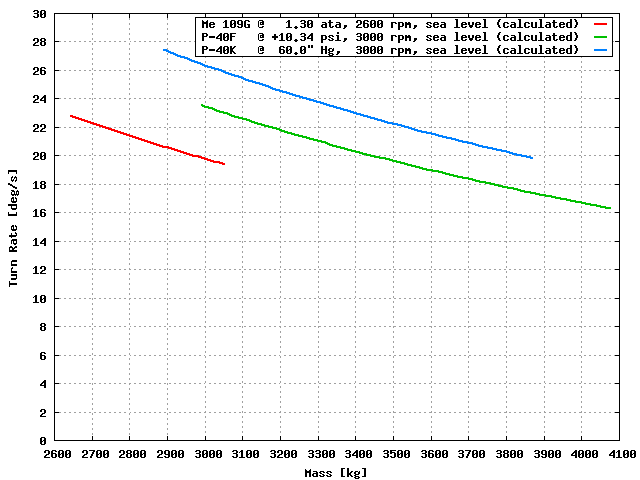
The following graph stems from a calculation I did a while back in order to illustrate the effect of weight on sustained turn performance, albeit the USAAF aircraft used as a benchmark is the P-40 rather than the P-51:

P-40_Turnrate_over_Weight.png

It's not a super information-dense diagram, but somehow I like it ... at the right end of each type's line, the aircraft is at full take-off weight, and at the left end, the aircraft has expended all of its fuel and ammunition.

It's telling there's a lot of overlap in the possible turn rates, and either type might be better depending on which exact flying weight the compared aircraft actually have at the moment of the encounter.

And of course, this is just the sea level comparison ... at any other altitude, the picture would look somewhat different.

Regards,

Henning (HoHun)
 
Very nice Henning! And I like the way you made that figure.

For my next book project I was thinking of doing the P-51 versus the Fw 190/ Ta 152 in the Battle of the Reich era, and up till now was just planning to (just as I do in my current book) mention this effect in text. But now that I’ve seen your idea, I’m thinking about “stealing” it if you don’t mind since it’s very illustrative. :)

I like the idea with the two end points at fully loaded and fully empty like you use them in that figure. And since the P-51 carries so much more internal fuel that the German fighters, it will be both illustrative and useful, since a reader can use it to gauge relative turn performance just after a P-51 has shed its external fuel tanks, and when it is time to turn home. That could be an extra touch: To mark on the curve the point at which it’s time for an escorting Mustang to RTB to England from a given point inside Germany.

In my current book about the Spitfire Mk I and Bf 109 E I do something similar as your figure but for turns: I have an instantaneous turn performance comparison which shows the Spitfire and Bf 109 both doing a maximum rate instantaneous turns staring off close to the top speed, showing how the turn rate and speed bleeds off, and with both curves ending when the aircraft have done two complete circles, thus not only showing that the Spitfire does so faster, but exactly how big the difference is.

Best wishes,

Anders
 
Hi Anders,

But now that I’ve seen your idea, I’m thinking about “stealing” it if you don’t mind since it’s very illustrative. :)

Of course you're free to "steal" it ... usually I have to resort to ramming my ideas down other people's throats, it's quite a pleasant change of pace that for once, I don't have to twist any arms to get an idea accepted! ;-)

That could be an extra touch: To mark on the curve the point at which it’s time for an escorting Mustang to RTB to England from a given point inside Germany.

Good one, too! Another reason I always listed the P-51's performance with a full fuel load is that it is not trivial to figure out just how much fuel is available on a typical mission, so this post might be of interest, in particular the large table hidden behind the spoiler warning:


With Bill's invaluable feedback on operational practices of the USAAF and based on the flight planning charts in the aircraft manuals, relying on some interpolation where necessary, I have caculated some comparative ranges for a realistic escort mission profile. These calculations can be re-arranged to give fuel load and thus weight at any point in the mission. As it's an OpenOffice ODS file, I can't upload the calculations here, but if you're interested, I'll send the file per email.

Reaching the performance chapter in your book, some quick questions:

- Are your Spitfire results for an aircraft with or without pilot armour and external armour glass? The weight is listed with both, but the speeds appear to be the speeds of an aircraft without these. Also, I seem to remember that at least some Boscombe Down tests were "reduced" to something like 96% flying weight - did you consider this?
- You notice that you get a full throttle height of 17400 ft for the Spitfire I in level flight, and it appears to be about 5.3 km for the Me 109E. How did you calibrate these values? I usually use a known top speed at altitude data point, and use this in conjunction with the engine graph to calibrate the ram efficiency of the intake system.

A comment on the term "Arbeitshöhe" mentioned on p. 219: I am not sure about the early time period, but I have encountered the same term used in mid- or maybe late-war documents, and it was used to define the altitude where the climb rate falls to 2 m/s.

I have an instantaneous turn performance comparison which shows the Spitfire and Bf 109 both doing a maximum rate instantaneous turns staring off close to the top speed, showing how the turn rate and speed bleeds off, and with both curves ending when the aircraft have done two complete circles, thus not only showing that the Spitfire does so faster, but exactly how big the difference is.

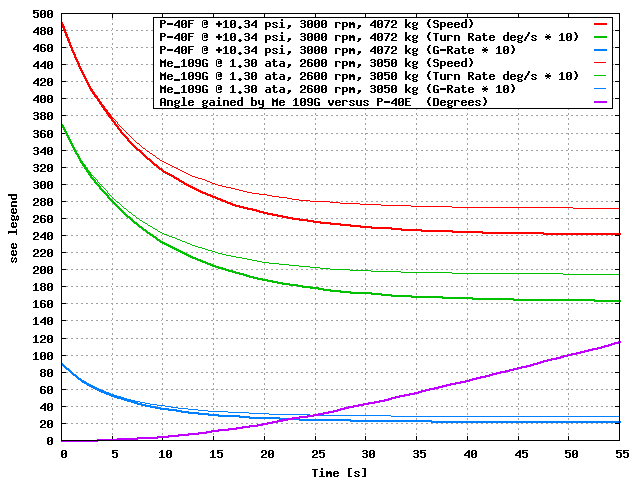
Ah, I see. I prepared something similar for my P-40N vs. Me 109G comparison too, including the use of a slightly confusing multi-parameter scale! :-D

P-40_Break_Turn.png

(Please ignore the typo "P-40E" in the legend ... it's for the same P-40F, of course.)

The one feature my graph adds is that it shows the cumulative angle gained. Somehow, I think I should have made that made more clear ... in the first 20 seconds of turning, the Me 109 only gains 20 degrees on the P-40, but in the subsequent 40 seconds, it gains another 120 degrees. As long as both fighters have kinetic energy to "burn", the turn rates are not that different. That's where the Me 109 vs. P-40 pairing differs from the Me 109 vs. Spitfire pairing, I believe - if I read your diagram correctly, the Spitfire gains most quickly at the beginning of the turn.

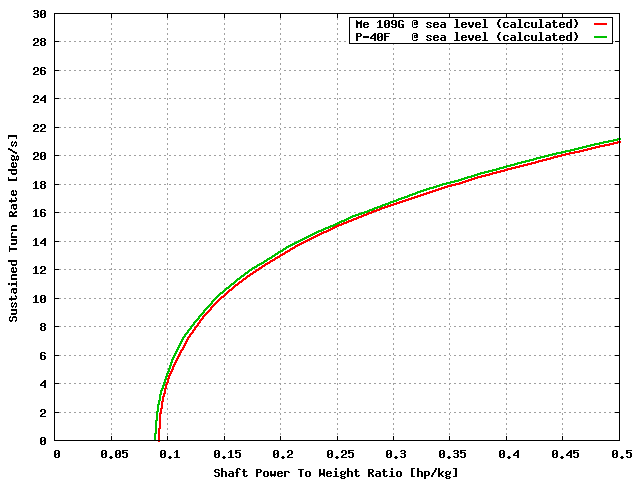
I created this diagram back then to illustrate the general similarity of the P-40 and the Me 109 ... it's basically the same idea as you used to show the impact of power loading on climb rate! :)

Me109G_Turnrate_over_Power.png

Tactically, my conclusion is that you had to commit to making the fight a turn fight to get results, staying in it for a significant amount of time to gain an advantage, and due to the unknowns with regard to the performance of the opponent, mainly his weight status but also the quality of his individual aircraft and (especially) engine, the outcome wasn't really certain, on top of the inevitable pilot skill topic (which as in the example of the RAF pilot in his prize Messerschmitt out-turning technically better-turning British fighters, was quite real).

Regards,

Henning (HoHun)
 
Hi Henning,

That was a lot of good info and feedback crammed into one single post, but I’ll try to answer it all below!

First of all, I would be very interested if you and Bill would share your data and analysis on the P-51’s range under different conditions, since many numbers in other books just seem to have propagated between them. Not saying that they necessarily need to be wrong, but in my book I do a deeper analysis of the Bf 109’s often criticized range, and conclude that while it certainly may have been limited, it might not have been quite as bad as many sources suggest. Now, if you and Bill have more “nuanced” numbers on the P-51’s range , with what I’m sure is a sensible analysis to back them up, I’m all ears, since it might even save me some time in my next book if you have numbers I can cite.

Regarding the data in my book: I do believe my weight and speed data for the Spitfire (2794 kg or 6154 lb) is with armour and armoured windscreen. But if you have data indicating this is wrong then I’d be interested to hear about it. For the Bf 109 E-4 though, I’m not 100% sure since the only speed figure I’ve deemed reliable enough does not list this, but I suspect it’s without the external armoured windscreen.

Then your question about the FTH at top speed: The numbers I’ve arrived at for both the Bf 109 and Spitfire are both based on calculations in my C++ program, based on both engines static performance with no ram. (Edit: May sound like I don't account for ram which is incorrect, but what I mean is I do calculate the gain in FTH altitude iteratively using the static engine data as a base).

Good one about "Arbeitshöhe"Henning, did not know that that was coupled to 2 m/s climb rate, so thanks for info!

When it comes to your turn histograms, well since you have my book you can see that we basically present it in the same way ;-)

The angular gain you introduced was a nice new addition in these types of figures, and as you know I do the same thing but with range in dive, and dive and zoom analysis.

Regarding where the Spitfire gains most in an instantaneous turn, I make the same analysis as you: It’s in the beginning, but then with the twist that the Bf 109 has a higher turn rate for a couple of seconds, since the Spitfire reaches speed for best turn rate slightly before the Bf 109, and therefore needs to unload g's slightly earlier. Not that it helps the Bf 109 much though, since it takes it about 6 s longer to finish two complete turns at 6 km altitude anyway.

Then with regards to the utility of turns in WW2 air combat: I agree with your conclusions, and in addition, in my book write that the Bf 109 being able to out-turn the +6.25 psi boosted Spitfire (not the +12 boosted though) at lower altitudes with 40 deg flaps is largely just an academic result, since doggedly slowing down and dropping flaps to try to shoot down that “Tommy” in a Spitfire over London in 1940, was most likely just a pass straight to British captivity or worse, for any Luftwaffe pilot who was foolish enough to attempt it.

Best wishes,

Anders

Reason for edit: Explanation about how ram is taken into account added.
 
Last edited:
Slight tangent, The Spit MK III was intended to be a higher performer of course but, with the myriad changes to the basic design, how would it have performed in this comparison?
 
IIRC then the Spitfire Mk III, amongst other things like you say, had clipped wings and I have not modeled that yet in my C ++ simulation. Not that it's particularly difficult to do, just that I have not had reason to do so so far so unfortunately I have no numbers on that.
 
Hi Anders,

Regarding the data in my book: I do believe my weight and speed data for the Spitfire (2794 kg or 6154 lb) is with armour and armoured windscreen.

I was confused by footnote 176, which indicates that Spitfire N.3171 did not have the armoured windscreen and the extra armour in "one test", and this was the same aircraft you used as the basis for your speed calibration. So I'm unsure whether the speed calibration included the armoured windscreen or not.

(Edit: May sound like I don't account for ram which is incorrect, but what I mean is I do calculate the gain in FTH altitude iteratively using the static engine data as a base).

In my calculations, I use top speed at altitude, compared with static full throttle height, to determine the ram efficiency percentage, which is an interesting number to look at when it's made explicit. I presume you're basically doing the same or something similar, but without either ram efficiency or static altitude listed (so far ... I'm still reading on :), it's a bit intransparent to me.

Then with regards to the utility of turns in WW2 air combat: I agree with your conclusions, and in addition, in my book write that the Bf 109 being able to out-turn the +6.25 psi boosted Spitfire (not the +12 boosted though) at lower altitudes with 40 deg flaps is largely just an academic result, since doggedly slowing down and dropping flaps to try to shoot down that “Tommy” in a Spitfire over London in 1940, was most likely just a pass straight to British captivity or worse, for any Luftwaffe pilot who was foolish enough to attempt it.

Absolutely, and in addition, it's worth pointing out that the Me 109 pilot would have to crank at the flap wheel for quite a while to get the flaps out that far.

However, I have to admit that in Price's "Spitfire" history, there is an example where both a Spitfire and a Me 109 pilot dropped their flaps - albeit in an attempt to stay behind the other guy after accidentally forming up on each other, with both of them having mistaken the enemy for their own wingman! :-D So apparently, it was not unthinkable for the Me 109 to drop flaps in combat, unless the story grew in the telling maybe.

Regards,

Henning (HoHun)
 
I was confused by footnote 176, which indicates that Spitfire N.3171 did not have the armoured windscreen and the extra armour in "one test", and this was the same aircraft you used as the basis for your speed calibration. So I'm unsure whether the speed calibration included the armoured windscreen or not.

On page 217 in the book, I list a top speed of 570 km/h (354 mph) for the Spitfire at FTH (+6.25 psi boost) with armoured glass windshield, and in the report I reference, there is actually a chart of Spitfire Nr 3171 where the speed is listed with and without this item added. And with it on (in fact it explicitly says so in the chart) it looks like the top speed is a smidge lower than 355 mph, which is good enough for me. ;)

In my calculations, I use top speed at altitude, compared with static full throttle height, to determine the ram efficiency percentage, which is an interesting number to look at when it's made explicit. I presume you're basically doing the same or something similar, but without either ram efficiency or static altitude listed (so far ... I'm still reading on :), it's a bit intransparent to me.

I find the best way to estimate performance (both speed and climb) is to use the engine’s characteristics in static conditions, because then you are not reliant on charts showing the effects of ram. I then use the static engine data and work out both the power reduction and gain of FTH due to ram in the C++ model, and this is also why my process to determine top speed is iterative, since the code gradually converges towards a FTH and top speed depending on how fast the aircraft goes. So even small changes in weight or drag will produce tangible results.

Absolutely, and in addition, it's worth pointing out that the Me 109 pilot would have to crank at the flap wheel for quite a while to get the flaps out that far.

However, I have to admit that in Price's "Spitfire" history, there is an example where both a Spitfire and a Me 109 pilot dropped their flaps - albeit in an attempt to stay behind the other guy after accidentally forming up on each other, with both of them having mistaken the enemy for their own wingman! :-D So apparently, it was not unthinkable for the Me 109 to drop flaps in combat, unless the story grew in the telling maybe.

For sure, and I’m not saying flaps were never used in combat, only that I believe it was a quite unusual and a dangerous tactic if other enemy aircraft are around. In fact, in Shaw’s excellent book Fighter Combat, there is a passage of a P-51 pilot having an extended turn fight with a IIRC “long nosed Focke-Wulf” and dropping flaps to gain an advantage.

So certainly it was done also IRL, and in addition, I think in modern day flight simulators it’s not uncommon at all that people drop flaps in turn fights, and in this context I think it could be interesting for ardent sim pilots to get second source on how these aircraft actually perform, not in the least since the modeling of the flaps effect on turn performance in some simulators has been, shall we say creative, sometimes.

But, in conclusion, since on the Bf 109 you could crank out flaps gradually as you say, I'm sure it was done sometimes. Maybe someone has some more examples? Maybe there is some story of that master of deflection shooting Marseille, doing it during the North African campaign perhaps?
 
Last edited:
Hi Anders,

On page 217 in the book, I list a top speed of 570 km/h (354 mph) for the Spitfire at FTH (+6.25 psi boost) with armoured glass windshield, and in the report I reference, there is actually a chart of Spitfire Nr 3171 where the speed is listed with and without this item added. And with it on (in fact it explicitly says so in the chart) it looks like the top speed is a smidge lower than 355 mph, which is good enough for me. ;)

Thanks for the clarification!

Unfortunately, Mike Williams' great site is down currently, but I found the N3171 report on this inofficial backup site here:


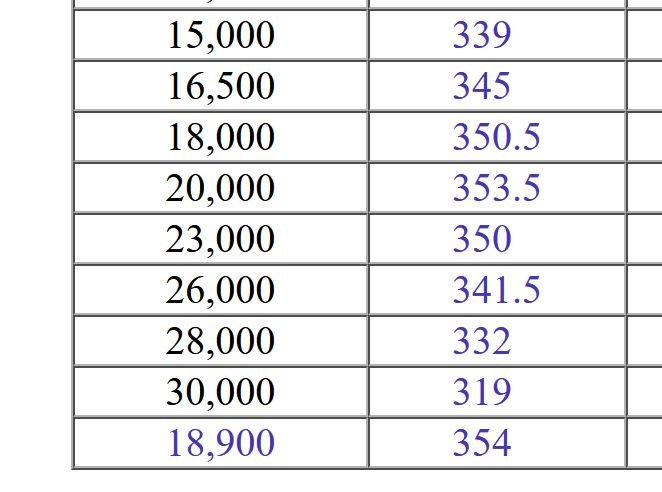
Could it be that the (out-of-sequence) value 354 mph @ 18900 ft from the table got accidentally dropped out from the data on p. 212 in your book? I noticed the text below the table states you get the same top speed, albeit at a slightly lower altitude, which sounds like this bit of text assumes the 354 mph to be in the table above.

I then use the static engine data and work out both the power reduction and gain of FTH due to ram in the C++ model, and this is also why my process to determine top speed is iterative, since the code gradually converges towards a FTH and top speed depending on how fast the aircraft goes.

Ah, I see. What I do is to take a top speed at full throttle height reference data point for calibration, iterating ram efficiency until the reference static full throttle altitude delivers the correct rammed full throttle height.

That's why the ram efficiency is an explicit value of interest for me. I find it to be around 50% for the Me 109E in general, and for N3171 specifially, it's seems to be <edit: 58%, not as originally posted 29%>, based on its engine inspection and test certificate:

https://wwiiaircraftperformance.com...e.com/MK1/IMAGES/n3171-test-certificate-c.jpg

... but ignoring that the rated boost was +6.25 psi and the table shows an indication of just +6.1 psi.

For sure, and I’m not saying flaps were never used in combat, only that I believe it was a quite unusual and a dangerous tactic if other enemy aircraft are around.

Absolutely, and I'm glad your book investigates this in detail, as combat in WW2 was not a controlled environment in which pilots could establish solid turn performance figures with confidence! :)

What I'd stress is that the manual control of the Me 109's flaps made lowering and raising them a bit of a lengthy affair during which the pilot's left hand was fully occupied and couldn't control the throttle without making flaps operation even more of a lengthy affair. With regard to general flying, it was a good system well-liked by German pilots, and commented on favourably by Allied test pilots too, but it didn't lend itself well to quick reaction in combat. Of course, if you're in a circling fight with a Spitfire that's inching closer and closer toward a shooting position on your tail, and have no other option, then these disadvantages don't really matter! ;-)

With regard to the value of turn rate in combat, the book "Spitfire Manual", edited by Dilip Sarkar, is a great source. Unlike what one might think from the name of the book, it's not just another reproduction of an aircraft manual, but it reproduces a variety of WW2 RAF write-ups on air combat tactics, including some in comic-book style :) One revelation from that material was that experienced RAF fighter pilots considered turning a pretty risky move, even flying a Spitfire pilot and starting in an advantageous position.

Regards,

Henning (HoHun)
 
Last edited:
Could it be that the (out-of-sequence) value 354 mph @ 18900 ft from the table got accidentally dropped out from the data on p. 212 in your book? I noticed the text below the table states you get the same top speed, albeit at a slightly lower altitude, which sounds like this bit of text assumes the 354 mph to be in the table above.

Well the table on that page (212) contains data from the trial, and IIRC then they only listed speeds for even multiples of 1000 ft in the report so that’s why there is no FTH speed in it. But I see a typo now in the simulation FTH for the Spitfire: it should read 18,700 ft for the 354 mph figure, and not 17,400 ft. I even re-ran the simulation to verify this yesterday, and it could be that the FTH for the Bf 109 slunk in there instead. Will update this, and definitely something I will add under “Addendum and erratum” on my webpage.

However, with all of that having being said, this is a typo in the verification data, and does not affect the simulations, for example the speed figure on page 217, which then seems quite well aligned with what could be expected from a Spitfire Mk I equipped with an armoured glass windscreen.

Absolutely, and I'm glad your book investigates this in detail, as combat in WW2 was not a controlled environment in which pilots could establish solid turn performance figures with confidence! :)

What I'd stress is that the manual control of the Me 109's flaps made lowering and raising them a bit of a lengthy affair during which the pilot's left hand was fully occupied and couldn't control the throttle without making flaps operation even more of a lengthy affair. With regard to general flying, it was a good system well-liked by German pilots, and commented on favourably by Allied test pilots too, but it didn't lend itself well to quick reaction in combat. Of course, if you're in a circling fight with a Spitfire that's inching closer and closer toward a shooting position on your tail, and have no other option, then these disadvantages don't really matter! ;-)

With regard to the value of turn rate in combat, the book "Spitfire Manual", edited by Dilip Sarkar, is a great source. Unlike what one might think from the name of the book, it's not just another reproduction of an aircraft manual, but it reproduces a variety of WW2 RAF write-ups on air combat tactics, including some in comic-book style :) One revelation from that material was that experienced RAF fighter pilots considered turning a pretty risky move, even flying a Spitfire pilot and starting in an advantageous position.

Yes, and when the Fw 190 first appeared over the channel, RAF pilots who complained were supposedly told by their higher ups that they had a better turning airplane, to which some are said to have replied that turning does not win battles, which of course is true.

And as you observe, turning’s utility in combat is probably not that high, but it’s still an item in the pilot’s toolbox, and since the relative turning capabilities of the Spitfire and Bf 109 has always been an area of contention, I have dug into this, and as I point out in my book, some German aces like Helmut Lipfert really did use the Bf 109 as a turn fighter, and seem to have been quite successful even so. ;)
 
Hi Anders,

Well the table on that page (212) contains data from the trial, and IIRC then they only listed speeds for even multiples of 1000 ft in the report so that’s why there is no FTH speed in it.

The strange thing about that table is that they simply appended the "odd" 18900 ft full throttle height at the end (and so "out of sequence"):

N3171 18900ft.jpg

With regard to the odd full throttle height on the climb, do you think it could be because the climb data is for +6.4 psi at 2600 rpm? That's how I read the table - a very unusual power setting, and the combination of low engine speed with the high boost pressure would indeed give a lower full throttle height just as you pointed out.

Yes, and when the Fw 190 first appeared over the channel, RAF pilots who complained were supposedly told by their higher ups that they had a better turning airplane, to which some are said to have replied that turning does not win battles, which of course is true.

I believe it's also figured in James E. ("Johnny") Johnson's book, "Full Circle", and Eric Brown pointed it out several times as well! :)

And as you observe, turning’s utility in combat is probably not that high, but it’s still an item in the pilot’s toolbox, and since the relative turning capabilities of the Spitfire and Bf 109 has always been an area of contention, I have dug into this, and as I point out in my book, some German aces like Helmut Lipfert really did use the Bf 109 as a turn fighter, and seem to have been quite successful even so. ;)

Absolutely, and it's great to have a look at it from the engineering perspective because different pilots' experiences frequently can be difficult to reconcile when they don't seem to agree at all!

Regards,

Henning (HoHun)
 
Hi Anders,


The strange thing about that table is that they simply appended the "odd" 18900 ft full throttle height at the end (and so "out of sequence"):

View attachment 795539

With regard to the odd full throttle height on the climb, do you think it could be because the climb data is for +6.4 psi at 2600 rpm? That's how I read the table - a very unusual power setting, and the combination of low engine speed with the high boost pressure would indeed give a lower full throttle height just as you pointed out.


I believe it's also figured in James E. ("Johnny") Johnson's book, "Full Circle", and Eric Brown pointed it out several times as well! :)


Absolutely, and it's great to have a look at it from the engineering perspective because different pilots' experiences frequently can be difficult to reconcile when they don't seem to agree at all!

Regards,

Henning (HoHun)

Hi Henning, yes, I suspect that the low FTH is because the engine was run at 2600 rpms only. Because the Pilot's Notes for the Spitfire Mk I with the Merlin II and III says that while +6.25 psi boost and 3000 rpm is allowed for 5 minutes, it looks like for extended climbs longer than that that the Spitfire pilot would not only need to reduce boost, but also rpms down to 2600 rpms. But I’m unsure if they were running the engines for longer times at 3000 rpms than that already in the BoB.

I've forwarded these questions to an engine expert in the UK who I hope will be able to answers this. But if you or someone else in the forum can bring clarity to this, this would of course be most helpful.

In addition, does anyone have an engine power chart (engine power versus altitude) for the Merlin III at this 2600 rpm power setting that they could post here or PM me? Currently I have to extrapolate this data, and a chart similar to the one I have for 3000 rpm would be most helpful.
 
Last edited:
Hi Anders,

In addition, does anyone have an engine power chart (engine power versus altitude) for the Merlin III at this 2600 rpm power setting that they could post here or PM me? Currently I have to extrapolate this data, and a chart similar to the one I have for 3000 rpm would be most helpful.

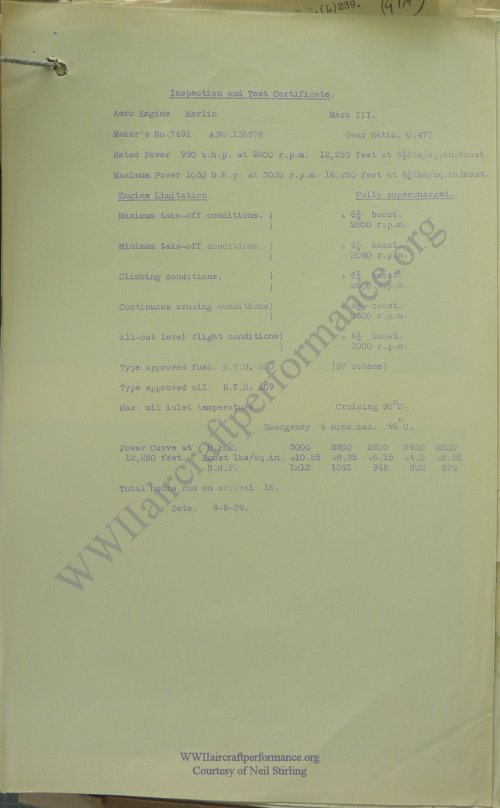
Isn't the Inspection and Test Certficate for the engine of N3171 a suitable source for the key data points at least?


n3171-test-certificate-c.jpg

For my method of ram efficiency determination, I use the ambient pressure associated with the static full throttle height, 54.36 kPa, and find the ram efficiency value that delivers the same total intake pressure at the ambient pressure of the published full throttle height at the published top speed, 48.75 kPa at 18900 ft and 354 mph. This works out to a ram efficiency of 62% for Spitfire I N3171.

For increased accuracy, as the above top speed figures were actually achieved at +6.1 psi, an additional correction is necessary to calculate the actual ram efficiency. Since the rated +6.25 psi boost would be reached at a slightly lower altitude though, which - assuming that the supercharger compression ratio remains constant for this small change - I calculate as 18790 ft, the more accurate value for the ram efficiency would be 58%.

A Spitfire I using the correct +6.25 psi would be very slightly faster at 18790 ft than the historical N3171 at 18900 ft, but I calculate this as 570.3 km/h vs. 569.6 km/h, so the difference is less than 1 km/h and thus hardly worth mentioning.

Regards,

Henning (HoHun)
 
Isn't the Inspection and Test Certficate for the engine of N3171 a suitable source for the key data points at least?

Yes, that is a good starting point, but I was looking for the type of power versus altitude charts you can find for the Merlin III at 3000 rpm for various boosts, e.g. like @tomo pauk posted here, but for 2600 rpm. And yes, I know you can estimate this. And this is also what I have done in the chart attached below, but I was hoping for more accurate data. In addition, maybe someone has info about some wartime technical order/directive which allowed 2850 (like on the Merlin XII) or 3000 rpm for periods longer than 5 min also for the Merlin III? This was what I wanted to find out.

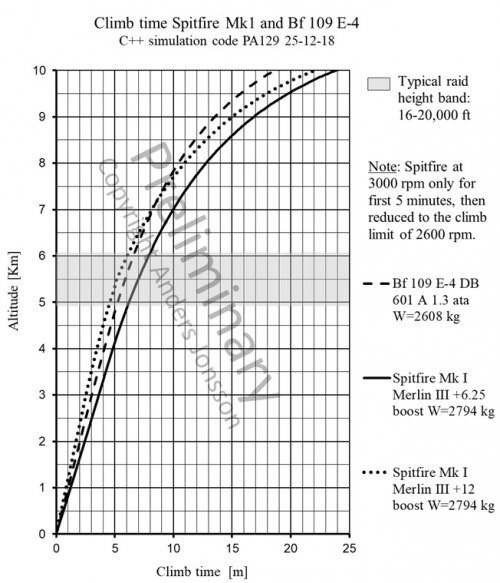
However, as things stand now, it looks like assuming full out climb at 3000 rpm for the Spitfire Mk I with the Merlin III for longer periods than 5 min is optimistic, and which is why I added this new text to my homepage:

"Under investigation: The Spitfire’s climb times in the chart on page 225 is probably overly optimistic since it assumes that the climb is done at 3000 rpm, while it’s more likely that the pilot would have adhered to Pilot’s Notes and reduced the rpm to 2600 after an initial 5 minutes of climb (see chart below). However, the chart on page 225 is still interesting, since under combat situations, it’s not unlikely that the Spitfire pilot would have ignored this restriction and continued at 3000 rpm. For the Bf 109 E-4 however, the climb time remains unchanged since the data sheet for the DB 601 A shows that the engine may be run with 2400 rpm for 30 minutes above 5 km altitude."


Spitfire Mk I climb time with 2600 rpm including watermark.jpg
 
Hi Anders,

Yes, that is a good starting point, but I was looking for the type of power versus altitude charts you can find for the Merlin III at 3000 rpm for various boosts, e.g. like @tomo pauk posted here, but for 2600 rpm. And yes, I know you can estimate this. And this is also what I have done in the chart attached below, but I was hoping for more accurate data. In addition, maybe someone has info about some wartime technical order/directive which allowed 2850 (like on the Merlin XII) or 3000 rpm for periods longer than 5 min also for the Merlin III? This was what I wanted to find out.

Ah, I see. With regard to the permissible speeds, so far I have only seen this referred to in the test data on Mike Williams' site. For the purpose of performance comparison, personally I've been using 3000 rpm mostly since it gives an impression of the types' short-term specific excess power, which I am mostly interested in.

When it comes to steady-state climbs in a tactical environment, I think that normally wasn't done at combat power, and probably it wasn't even done at full climb power either, as due to the performance differences between individual aircraft and the need to have a power reserve for station-keeping in formation flight, a somewhat lower power level would have to be used.

I believe in Alfred Price' "Spitfire History", there are two articles dealing with this topic, but they're both not directly dealing with the Battle of Britain context, one being about the use of +16 psi boost on the Spitfire V and the other, which I only vaguely remember and have no opportunity to check right now, dealing with formation intercepts, the code words and air speeds associated with that, and the power settings too.

(I am sure the Luftwaffe had similar practices, but I am not aware of these.)

However, as things stand now, it looks like assuming full out climb at 3000 rpm for the Spitfire Mk I with the Merlin III for longer periods than 5 min is optimistic, and which is why I added this new text to my homepage:

Really great to see you're keeping the comparison continuously updated! :)

Regards,

Henning (HoHun)
 
Hi Anders,

Just reached about a quarter of your book, reading about the placement of the Me 109's wing spar quite far aft (at about 45% of the chord).
Might that have been one the reasons why its high-speed roll rate was so bad (compared to the Spitfire's but also to other fighters of similar size like the Russian Yak- and La-fighters), because of the added torsional loads?

And very interesting was the section which included the report of Dr. Woldemar Voigt regarding wing loading.
Most literature tend to imply that a high wing load is something detrimental.
 
Hi Spicmart,

And very interesting was the section which included the report of Dr. Woldemar Voigt regarding wing loading.
Most literature tend to imply that a high wing load is something detrimental.

Here's a link to an interview with Prof. Messerschmitt, published in the German news magazine "Der Spiegel" in 1964, that casts some more light on this:

Original German: http://www.spiegel.de/spiegel/print/d-46162688.html

Regards,

Henning (HoHun)
 
Hi Anders,

Ah, I see. With regard to the permissible speeds, so far I have only seen this referred to in the test data on Mike Williams' site. For the purpose of performance comparison, personally I've been using 3000 rpm mostly since it gives an impression of the types' short-term specific excess power, which I am mostly interested in.

When it comes to steady-state climbs in a tactical environment, I think that normally wasn't done at combat power, and probably it wasn't even done at full climb power either, as due to the performance differences between individual aircraft and the need to have a power reserve for station-keeping in formation flight, a somewhat lower power level would have to be used.

I believe in Alfred Price' "Spitfire History", there are two articles dealing with this topic, but they're both not directly dealing with the Battle of Britain context, one being about the use of +16 psi boost on the Spitfire V and the other, which I only vaguely remember and have no opportunity to check right now, dealing with formation intercepts, the code words and air speeds associated with that, and the power settings too.

(I am sure the Luftwaffe had similar practices, but I am not aware of these.)

Really great to see you're keeping the comparison continuously updated! :)

Regards,

Henning (HoHun)

Hi Henning,

I agree that for most performance analysis the higher power settings, i.e. like for the Spitfire Mk I either +6.25 or +12 psi boost and 3000 rpm is the most appropriate to use since 5 minutes is probably quite enough for most combat engagements. And that is also why all but one of the figures in my book (the climb time chart) are for these power settings.

However, that having being said, both the Spitfire and Bf 109 were originally conceived as interceptors, i.e. to climb as fast as possible to a high altitude to chase bombers, and in such a scenario the climb performance for longer periods of time than 5 minutes is important as well. In addition, even though the raid heights during the BoB were in the 5-6 km range, both escorts and attackers wanted a height advantage, and even at full throttle you could only get so high in 5 minutes, and the power setting you could use after that is not without importance as well I think.

Finally, for sure, tactical climbing was probably in most cases done at significantly lower settings, both to save engine life and to keep the formation together. However, the book is about performance and what the aircraft as such are capable off. And from that perspective I think it’s interesting to see how they compare looking at how do they perform at power settings which can be used both for 5 and 30 minutes respectively.

Best wishes,

Anders

PS: About the updates: Yes, well our knowledge of these birds is a moving target, and I'm sure more interesting observations will be made going forward as well. ;)
 
Hi Anders,

Just reached about a quarter of your book, reading about the placement of the Me 109's wing spar quite far aft (at about 45% of the chord).
Might that have been one the reasons why its high-speed roll rate was so bad (compared to the Spitfire's but also to other fighters of similar size like the Russian Yak- and La-fighters), because of the added torsional loads?

And very interesting was the section which included the report of Dr. Woldemar Voigt regarding wing loading.
Most literature tend to imply that a high wing load is something detrimental.

Yes, with the spar so far back, at high speeds the torsional loads will tend to twist the wing to increase the angle of attack which is not good. On the other hand, given that the Bf 109 had the slats, this probably meant that it still had decent handling qualities for accelerated stalls. In fact, the Fw 190 suffered from this IIRC: It had good stall characteristics at low speeds, but g-stall were nasty, and the aircraft tended to flick in accelerated stalls.

Theoretically, since the Russian aircraft had “plywood” skinning, one would expect poor torsional properties, but the wing skin was relatively thick and the wooden composite they used had a quite decent modulus of elasticity, so it’s difficult to say. I have tried to find data on aileron reversal speeds for WW2 Russian aircraft but have come up short, and if anyone has data on this that would be very interesting indeed.

OTOH for roll performance, the spar further back like on the Bf 109 would actually be better, but for a single spar design it is anyway more about how well the torsional loads are carried in the wing skin, i.e. how thick it is, and can you minimize the effects of elastic buckling and loss of torsional stiffness from cut-outs and access panels etc.

Then about Voigt: Yes, I find his treatise arguing the case for high wing loadings truly compelling, and the day I found that microfilm about 20 years ago was a happy one indeed. And as you say, most people think of a high wing loading as something bad, but in the chapter about wing loading in my book, there is a you know a passage about Kelly Johnson’s ideas on this, and it’s interesting to note that he advocated for even higher wing loadings!
 
Hi again,

Here's a link to an interview with Prof. Messerschmitt, published in the German news magazine "Der Spiegel" in 1964, that casts some more light on this:

Original German: http://www.spiegel.de/spiegel/print/d-46162688.html

As a follow-up, here my translation of the relevant bits:

"MESSERSCHMITT: I was called to Berlin, where I was told: We have issued orders for the development of a modern fighter to three other companies already, but we would agree to issue an equivalent order to your company, too. I studied the tender and then went back to Berlin to tell the Gentlemen that I didn't like the conditions. 'With a fighter like that, you'll never shoot down a high-speed bomber, which is a technologically feasible aircraft today and certainly will be built sooner or later. Does it even make sense to build your fighter at all?'

SPIEGEL: And what did Berlin reply?

MESSERSCHMITT: The chief of the general staff Wever, a very intelligent man, contributed to the issue of an order without any conditions, so that I could design a fighter entirely according to my own ideas."

So, wing loading wasn't explicitely mentioned, but from the mention of the Schnellbomber, it is fairly clear that Messerschmitt favoured top speed over other considerations, while the original specification had defined a maximum wing loading which Messerschmitt didn't conform with.

Heinkel's hectic development of He 112 versions with smaller wings seems to indicate that once Messerschmitt had broken the doctrinal mold, the advantages of higher wing loading were obvious.

Regards,

Henning (HoHun)
 
Anders, you mentioned in your book that there is not much to choose in terms of efficiency of Allied and German propellers. Yet postwar the more square Allied prop types seemed to have prevailed whereas the more curved paddle bladed German prop types seemed to have all but vanished.
The Allied props blades were said to be better for top speed and the German ones better for climb? There were differences between metal and wooden versions of the same propeller type, too. Maybe in a non-war environment climb performance is not as important as speed.

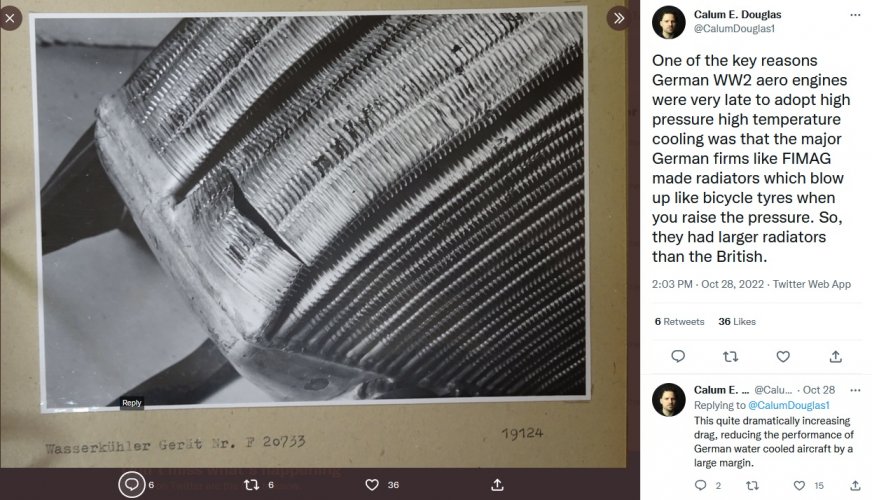
And is it known why the Germans failed to introduce high pressure radiators at all except for industrial reasons?
 
Last edited:
Well the Allies had already taken the plunge to four and five bladed propeller hubs, so reverting back to three blades from that position after the war makes no sense. In addition, the Germans were towards the end of the war hard pressed to keep production volumes of conventional piston engined fighters up, and adding hubs with more blades would probably drain more engineering and production resources than simply making bigger prop blades when needed for their ubiquitous three bladed hubs.

Then when it comes to square versus round tip propeller blades: For a given diameter and solidity, making rounder propeller blades is more feasible if a larger main chord can be accommodated, as when wooden blades are used.

Regarding why the Germans never went with high pressure cooling systems, I think Calum Douglas may have a better answer, but I think it was a combination of the shortage of copper in Germany in combination with an uncertainty about the DB engines ability to handle the higher coolant pressures.
 
Last edited:
And is it known why the Germans failed to introduce high pressure radiators at all except for industrial reasons?
Regarding why the Germans never went with high pressure cooling systems, I think Calum Douglas may have a better answer, ........
In October 2022 Calum posted a tweet about this, but I didn't save the URL of that tweet, and I can't locate it via google either.

I did however at that time save a screenshot of it:
 

Attachments

  • German WW2 radiator.jpg
    German WW2 radiator.jpg
    312.1 KB · Views: 22
Hi Anders,

In summary, this book digs deeper into these aircraft’s flight performance than any previous book has ever done, introducing for example acceleration, energy retention, sustained and instantaneous turn comparisons, dive, dive and zoom comparisons all in an attempt to determine just how close or far apart or close together they were regarding each particular performance aspect.

I've now read the chapter on diving/zooming - very good discussion of the topic, and I like the term "drag loading" you're introducing! :)

Some random thoughts: It might be interesting to add a "total specific energy" graph to (one of the) dive diagrams, to show where energy is gained and where it is lost during a zoom. Conveniently, Etot/g is a height value, so it can be graphed on the same scale as the main diagram.

Another consideration for diving is that the carburettor of the Merlin engine doesn't work perfectly even in a steady-state dive, as a diagram showing the effect of longitudinal and lateral accelerations reproduced in Calum's "Secret Horse Power Race" illustrates. With the difference between the Me 109 and the Spitfire being fairly small, this effect, though probably small itself, could shift the comparison a bit in the Me 109's favour, I'd speculate.

Something else I'd find interesting would be a look into the question how much of an advantage in diving the Me 109 would get from a negative-G pushover from level flight to induce the dive, in comparison to a Spitfire limiting itself to zero G (or maybe a low positive G value) to initiate the dive in order to keep the engine from cutting out. Again, probably not that much of a difference, but it's such a well-established Battle-of-Britain narrative that the Me 109 had a great advantage there, it would be interesting to look at it from a performance point of view! :)

Regards,

Henning (HoHun)
 
Hi Henning,

Yes, drag loading is quite useful I think. And as far as I can tell it provides a good first order indication of how different aircraft compare to one another when it comes to dive performance. However, it’s in this context important to note that this is when it comes to dive performance in long dives and at higher speeds, since as you can see from the simulations in my book, the P/W ratio is in fact quite important as well also for dives and zooms, although this metric is usually only mentioned in conjunction with climb performance.

Now in view of their reputations, I was actually a bit surprised myself that the Bf 109 E was not so much better than the Spitfire Mk I in dives when I first analysed the simulation results. But when one looks closer at the initial parts of the dives, it’s quite clear that both these aircraft had such an efficient engine and propeller installation that they literally pull themselves earthward in dives, and then in the zooms, then a good P/W ratio means you are not slowed down as fast either.

And just how important this is also for dives (the P/W ratio), is highlighted by the fact that if both aircraft are assumed to be using 87 octane fuel, then the Bf 109 pulls ahead in a dive and zoom, but if the Spitfire is using 100 octane fuel, then the tables are reversed, with the Spitfire ending up ahead following the zoom.

And yes, I found Calum Douglas’ videos and book quite informative when it comes to the problems with carburetion, and added to what you said about dives, IIRC then he also mentions that the carburetor was not always very happy will bank angles either, unless these were of the coordinated type as I understand it.

About the transient effects, I have thought about trying to include that as well in the simulations, but it seems difficult since it involves making a correct assumptions of how the engine thrust varies during the negative g’s, and I think modeling both the rpm, engine power and how much the propeller would brake under those conditions would be quite a challenge indeed.

Nowadays though, they are very careful with their Merlin engines as you can see in this clip from my flight in ML407, where the pilot I was flying with that day was quite clear on how the engine should be pampered. ;)

Cheers

Anders
 
Last edited:
Hi Anders,

About the transient effects, I have thought about trying to include that as well in the simulations, but it seems difficult since it involves making a correct assumptions of how the engine thrust varies during the negative g’s, and I think modeling both the rpm, engine power and how much the propeller would brake under those conditions would be quite a challenge indeed.

Nowadays though, they are very careful with their Merlin engines as you can see in this clip from my flight in ML407, where the pilot I was flying with that day was quite clear on how the engine should be pampered. ;)

What I learned from that G-effects-on-carburettor graph in Calum's book is that the effects were not strictly speaking transient only. If carburation depends on longitudinal G vector, the effect is actually stationary in a steady-state dive, leading to a power loss throughout the dive. As I don't have the book at hand at the moment, I'm afraid I can't look it up though - I'm not sure the illustration directly specifies a power loss.

Must have been a wonderful experience to have the finer points of Spitfire operation explained to you by means of demonstration! :)

My thinking about the initiation of the dive is that it wouldn't be necessary to know the transient effects, as the proper pilot technique basically was avoidance of these effects. As I understand it, flooding the carburettor by application of negative Gs would lead to a rich cut-out, followed by lean-cut out, and it could take a second or more for the engine to develop power again.

However, pondering dive initiation a bit more, it seems possible that a zero-G entry wouldn't make so much difference for the kind of graph you're developing in your book, as it's a brief effect, and energy-wise a gradual dive entry might be more beneficial than a harsh push-over.

My impression always has been that for dives as a combat manoeuvre, geometry is actually as important as (or more important than) mere speed, with control at high speed being the key to manipulating geometry. But also on dive entry, starting the dive from a nose-down position when the opponent is still in a nose-high attitude will give the diving aircraft a fair headstart, which can be exploited even better when flying the aircraft with the better power-to-weight ratio.

I'd say the analysis in your book nicely demonstrates that simply pointing the nose down and diving will not be of much tactical value for either a Me 109 or a Spitfire pilot, because the airplanes are so evenly matched! :)

By the way, in Price's "Spitfire History", there is an interesting article by a British aerodynamicist, who said words to the effect, "Before the war, we thought that diving all-out was only an academic exercise, until combat experience showed otherwise". You're probably aware of that article, as I think you're referring to Price repeatedly! :)

Regards,

Henning (HoHun)
 
Hi Henning,

Well the Grace Spitfire has a Merlin 66 with a float-less Stromberg carburetor AFAIK, so the type of power cut-out they had to contend with on the Merlin IIIs is not a problem on ML407, and I think the reason the pilot I was flying with was so careful, had more to do with the oil feed and that he was very careful with it.

Now when I flew the Mustang, that pilot was much more lenient, and both he and I pushed the plane into dives. However, that being said, we were nowhere near 0 g’s and had positive g’s all the time, so I’m sure all the oil stayed in the sump where it belonged.

So I’m assuming this had more to do with these two pilot’s preferences, because AFAIK there are no major differences between the Packard Merlin V-1650-7 and the Merlin 66 when it comes to the oil system, but that the Packard built Merlins may have slightly better crankshaft bearings? But if anyone knows if/why they would be more or less susceptible to negative g’s, that would be interesting info.

Then regarding evasive maneuvers with negative g’s: Wasn’t it Hartmann who did the “stick hard forward to the left or right” to get away? Now that properly executed producing negative g’s in combination to the out of plane movement should be quite effective to throw off the aim of any float-carbureted Spitfire for sure! ;)

And yes, a head start seems to be important even if you have a plane that dives better in the long run: Because even the mighty Thunderbolt will get into trouble if it has a Bf 109 on its tail and the dive starts off at low to moderate speeds, because in the initial stages, it’s more about the P/W ratio, and it will have the Bf 109 sitting there or even gaining on it in the initial stages.

Cheers

Anders
 
Hi Anders,

In addition, the entire performance envelope is investigated: So not just speed and climb, but also acceleration, sustained and instantaneous turn, dive, and dive and zoom performance.

You've neglected to mention that your book also covers range! :) Very interesting chapter, and considering that I've recently drawn a lot of circles on maps too (to highlight 8th Air Force escort ranges), I was quite thrilled to see the exact counterparts for the Battle of Britain! :)

Personally, I'd have been curious to see a range circle for a hypothetical Luftwaffe Spitfire escorting bombers to Britain, to see how the two types compare with regard to this mission, as this would have put another angle on Galland's "I'd request to have my wing equipped with Spitfires" remark (which of course, as you correctly point out, was Galland's sarcastic way of telling Goering that his close-escort orders didn't make sense).

I'd also have found it interesting if the what-if chapter on the hypothetical small-wing Spitfire had touched upon the question of range. Without doing any calculations, I'd assume that escort range would have increased due to the drag reduction, but I'm not so sure about maximum still air range at the airspeed for best range.

By the way, Price' Spitfire book reproduces a memorandum on cruise speeds for the Spitfire V facing Fw 190 opposition, in the context of explaining the utilization of the +16 lbs/sqin boost limit then freshly introduced. The considerations highlighted in that memorandum probably can be applied to the Battle of Britain situation as well, as both sides would be cruising in contested airspace where an encounter with enemy high-performance fighters was possible at any time.

With regard to Sakai's comment on flying the Zero for longest range ("[...] we hung on the fringe of losing engine power at any time and stalling"), I'd say this wasn't intended to convey the picture that they were literally at flying speed, but merely close to the speed for minimum required power. Any slight decrease in power input or equally slight increase in drag would then decrease the flying speed, which without a power adjustment would lead to further deceleration unless the pilot intervened.

If I remember correctly, someone posted a (translated, most likely) Japanese characteristics sheet on A6M Zero ranges on j-aircraft.com some years ago, and I was surprised to see that their actual operations against Guadalcanal exceeded the ranges listed in that document by a considerable margin. No wonder the Japanese pilots were keenly interested in the best techniques for long range flying ... they were probably operating without the sensible reserves tactical range calculations usually include.

Regards,

Henning (HoHun)
 
Q 'hypothetical small-wing Spitfire' sounds intreguing. A surface area exercise ? or did you try drawing it up to see how it looks and if it fitted, re guns etc.?

cheers, Joe
 
Hi Anders,


You've neglected to mention that your book also covers range! :) Very interesting chapter, and considering that I've recently drawn a lot of circles on maps too (to highlight 8th Air Force escort ranges), I was quite thrilled to see the exact counterparts for the Battle of Britain! :)

Personally, I'd have been curious to see a range circle for a hypothetical Luftwaffe Spitfire escorting bombers to Britain, to see how the two types compare with regard to this mission, as this would have put another angle on Galland's "I'd request to have my wing equipped with Spitfires" remark (which of course, as you correctly point out, was Galland's sarcastic way of telling Goering that his close-escort orders didn't make sense).

I'd also have found it interesting if the what-if chapter on the hypothetical small-wing Spitfire had touched upon the question of range. Without doing any calculations, I'd assume that escort range would have increased due to the drag reduction, but I'm not so sure about maximum still air range at the airspeed for best range.

By the way, Price' Spitfire book reproduces a memorandum on cruise speeds for the Spitfire V facing Fw 190 opposition, in the context of explaining the utilization of the +16 lbs/sqin boost limit then freshly introduced. The considerations highlighted in that memorandum probably can be applied to the Battle of Britain situation as well, as both sides would be cruising in contested airspace where an encounter with enemy high-performance fighters was possible at any time.

With regard to Sakai's comment on flying the Zero for longest range ("[...] we hung on the fringe of losing engine power at any time and stalling"), I'd say this wasn't intended to convey the picture that they were literally at flying speed, but merely close to the speed for minimum required power. Any slight decrease in power input or equally slight increase in drag would then decrease the flying speed, which without a power adjustment would lead to further deceleration unless the pilot intervened.

If I remember correctly, someone posted a (translated, most likely) Japanese characteristics sheet on A6M Zero ranges on j-aircraft.com some years ago, and I was surprised to see that their actual operations against Guadalcanal exceeded the ranges listed in that document by a considerable margin. No wonder the Japanese pilots were keenly interested in the best techniques for long range flying ... they were probably operating without the sensible reserves tactical range calculations usually include.

Regards,

Henning (HoHun)

Hi Henning,

Good point about the range: I really should highlight that more in the book description. Especially seeing that all of 22 pages in my book are devoted to the subject. ;)

And I do think it is important to cover range in conjunction with the Battle of Britain: After all, a lot has been said about the Bf 109’s limited range as one of the major factors for the Germans failing to subjugate the RAF during the battle of Britain. However, I would argue that the range radiuses drawn in some previous books are done with a very conservative approach given that while the Bf 109’s range certainly was limited, it was perhaps not quite as bad as some would have us believe. Reverse engineering some of these range numbers, it seems to me that they are drawn assuming that the Bf 109 will take off, and then fly at full throttle to London and back. In addition, they seem to assume a very generous 20 min reserve, which seems excessive seeing that that is more than enough fuel to fly from central London back to Calais on this fuel alone.

And if one instead assumes a reserve of 10 minutes, then even at the maximum continuous 1.15 ata setting, this is enough to extend the Bf 109’s range to touch Bristol and Birmingham, even if 10 minutes of combat at 1.3 ata over the target area is assumed (as outlined in the book). In addition, if one instead assumes that the outbound leg is flown at 0.76 ata at a speed closer to the bomber formation speed until contact is made with RAF fighters, then the range radius can be extended even further. So while the Bf 109’s range certainly is limited, I would argue that the range radius drawn on the Wikipedia Battle of Britain page here which barely reaches London from the Audembert area airfields in France, are very conservatively drawn indeed. On the other hand, I can imagine that the Luftwaffe would have been more than happy to fan the flames and blame the Bf 109’s range for their failure, rather than face the fact that it was Fighter Command’s numbers, in combination with a competent, dogged and tenacious defense that was the decisive factor.

Then when it comes to a comparison of the Spitfire Mk I and Bf 109 E on the subject of bomber escort, I think the Spitfire would have done even worse given that the DB 601 was roughly 25% more fuel efficient looking at liters per hp and hour fuel consumption, and that both had engines with roughly the same power output, and that their fuel capacity was roughly the same.

However, neither the Spitfire nor the Bf 109 were designed with bomber escort missions in mind, since both were really conceived as interceptors, meant to climb up quickly and at high speed catch up to bombers and shoot them down, and not to loiter around bombers at low power settings for extended periods of time. So that the Bf 109 did not excel at this job was hardly Willy Messerschmitt’s fault, and it’s hard to see that the Spitfire would have done any better. But since the RAF was fighting over home grounds, they could just land on any nearby airfield when running low on fuel, and which I guess is why we don’t hear much about the Spitfire’s endurance being much of a problem at this stage in the war.

Then about Sakai: I’m pretty sure Caidin has quoted him as saying he experimented until he found the settings which gave him the longest endurance as in time airborne. However, this of course need not be true since Caidin may have misquoted him, but it could equally also be so that Sakai assumed that this would give the longest range, and not realizing that flying at the best L/D ratio would have been better, given that he was a pilot and not an engineer. But with that having been said, Sakai certainly does seem to have extended the Zero’s range far beyond official figures with the “low revs high boost” concept.

Cheers

Anders
 
Q 'hypothetical small-wing Spitfire' sounds intreguing. A surface area exercise ? or did you try drawing it up to see how it looks and if it fitted, re guns etc.?

cheers, Joe

To a large extent it is only a surface area exercise, in that I did not as you say look into fitting in the guns or the landing gear etc. However, I thought it an interesting exercise even so, since the drag contribution on an aircraft (especially one as clean as the Spitfire) is to a large extent driven by its wetted surface area which of course goes down proportionally if one decreases the wing size, thus allowing higher speeds to be attained.

In addition, a smaller wing leads to a positive weight spiral not only from the smaller wing itself, but also from lower loads leading to less material needed to carry the forces. So climb rate is also improved somewhat up to quite high altitudes, even beyond typical Battle of Britain raid heights (See figure on page 343 in book).

Now the wing profile is of course also important, and many attribute the low drag of the Spitfire as being due to its thin wing. However, the drag of the Bf 109’s NACA 2R1 wing profile is actually lower at high speed than the Spitfire’s NACA 22-series profile even though the latter is thicker, so there is more to it than that. So to make more space for guns and gear in a smaller wing, a slightly thicker wing profile like the NACA 2R1 could be used.

But for sure, trying to get the wing size down by means of a different slightly thicker profile and maybe even some small blisters here and there would require a lot of work. However, even so, if one premiers climb and speed, then a smaller sized Spitfire wing would have yielded higher performance I think.

Interestingly, AFAIK the Supermarine entry was actually in danger of being struck from the list for not complying too the landing speed requirement even with the original wing. However, the powers that be were duly impressed by the Spitfire’s performance, and it was allowed to stay in the race even so with known results.

As far as I can gather from his other design work, my impression is that Reginald Mitchell was not one to shy away from high wing loadings, and as I write in my book, if he had been given the same chance as Willy Messserschmitt got with the Bf 109, I would not be surprised if the Spitfire would not have been designed with a wing loading similar to the Bf 109's.

And if Mitchell would have been allowed to go for a higher wing loading on the Spitfire, then it would have been a much better performing aircraft than the Bf 109, which frankly relies a lot on its small wing for its performance. As it was, it’s impressive that it managed to match the Bf 109 even so, given that it was lugging around a wing that was all of 37% larger.
 
However, the drag of the Bf 109’s NACA 2R1 wing profile is actually lower at high speed than the Spitfire’s NACA 22-series profile even though the latter is thicker, so there is more to it than that. So to make more space for guns and gear in a smaller wing, a slightly thicker wing profile like the NACA 2R1 could be used.
Seems not consistent to me (but I'm not an aerodynamicist).
 
Hi Anders,

And if Mitchell would have been allowed to go for a higher wing loading on the Spitfire, then it would have been a much better performing aircraft than the Bf 109, which frankly relies a lot on its small wing for its performance. As it was, it’s impressive that it managed to match the Bf 109 even so, given that it was lugging around a wing that was all of 37% larger.

Now I wonder how the small-wing Spitfire would have performed with a DB 601 engine! :)

Considering that the Germans actually converted a captured Spitfire V to accept a DB 605 engine, that seems a realistic proposition.

Likewise, the question how a Me 109E would have performed with a Merlin II arises, as the combination of Me 109 airframes with Merlin engines was a regular subtype of the Spanish Messerschmitt production variant.

Regards,

Henning (HoHun)
 
Seems not consistent to me (but I'm not an aerodynamicist).

For a given wing profile then sure, the drag will be lower if you make it thinner. However, the profile as such is even more important.

Hi Anders,


Now I wonder how the small-wing Spitfire would have performed with a DB 601 engine! :)

Considering that the Germans actually converted a captured Spitfire V to accept a DB 605 engine, that seems a realistic proposition.

Likewise, the question how a Me 109E would have performed with a Merlin II arises, as the combination of Me 109 airframes with Merlin engines was a regular subtype of the Spanish Messerschmitt production variant.

Regards,

Henning (HoHun)

The DB 601 and the Spitfire probably have the makings of a happy marriage, but the Merlin in the Bf 109? I can think of few aircraft uglier than the Buchon TBH!
 
Back
Top Bottom