I don't see why not.
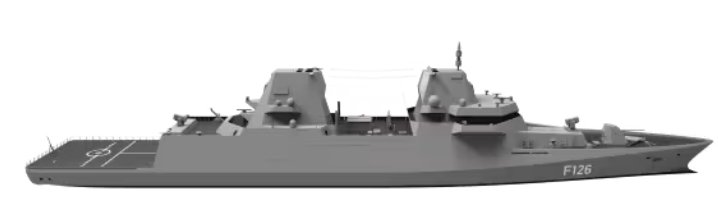
It might be easier with electric propulsion, because it removes complex gearbox, which is heavy and expensive (for example, one of the main problems with Russian 22350 frigates was a gearbox for CODAG - they spent quite a lot of time and money to localize it's production and build a special testbed for it).
CONAS is easier in this regard, as you can have common turbine with two separate steam feeds.

But I don't see a use for it apart being an auxiliary/reserve power source.
Problems still n present integrated electric propulsion. Type 45 spent several years in drydock undergoing refits, plagued reliability issues, quality issues Thats more likely contractor issue.

Other issue is high power and High voltage run risks electrical fire and short out failures. The problems with Ford class. These all impound issues of concerns of All electric warship.

Sometimes analog is better-log. Burkes have a very decent reliability record despite being on gas guzzler side.
Better resolve is reduction in voltage with network smaller more abundant podded drives.
1000034576.jpg
 
Most frigates cant handle length Pacific journey, Destroyer territory. Screenshot_6-8-2026_10457_www.damen.com.jpeg
While nuclear power offers infinite range that's costly, but that's a issue amortization and simplification.
I said before in other brackets, Heat Pipe reactor is wave potential future naval propulsion because it doesn't need complex and heavy steam system. No boiler, condenser or hulking doohickeys. Only brayton cycle gas turbine, and cooled by passive sea water heat exchange.

Screenshot_6-8-2026_103034_antaresindustries.com.jpeg
 
Most frigates cant handle length Pacific journey, Destroyer territory.View attachment 820206
While nuclear power offers infinite range that's costly, but that's a issue amortization and simplification.
I said before in other brackets, Heat Pipe reactor is wave potential future naval propulsion because it doesn't need complex and heavy steam system. No boiler, condenser or hulking doohickeys. Only brayton cycle gas turbine, and cooled by passive sea water heat exchange.
You're still going to have a large "condenser," as you push the hot CO2 or Helium or whatever your working gas is through the turbine to cool it. It just won't get the working fluid cold enough to turn liquid.

Flow cycle: Reactor makes a hot, high-pressure gas. Hot, High Pressure gas flows through a turbine to expand it and reduce the pressure (mostly). Hot, Low Pressure gas now needs to cool off in a heat exchanger. Cold, low pressure gas needs to be compressed in a pumping mechanism to go into the reactor as a relatively cold but high pressure gas.
 
You're still going to have a large "condenser," as you push the hot CO2 or Helium or whatever your working gas is through the turbine to cool it. It just won't get the working fluid cold enough to turn liquid.

Flow cycle: Reactor makes a hot, high-pressure gas. Hot, High Pressure gas flows through a turbine to expand it and reduce the pressure (mostly). Hot, Low Pressure gas now needs to cool off in a heat exchanger. Cold, low pressure gas needs to be compressed in a pumping mechanism to go into the reactor as a relatively cold but high pressure gas.
So what. Still not as big as steam driven systems.
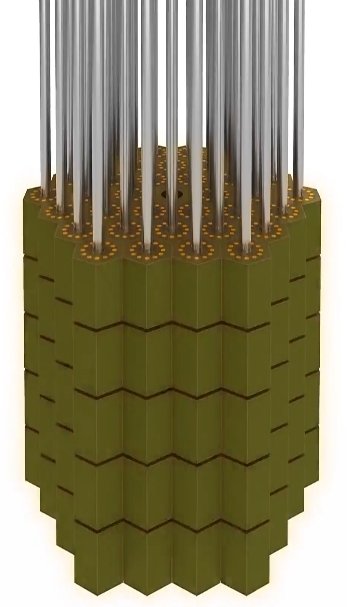
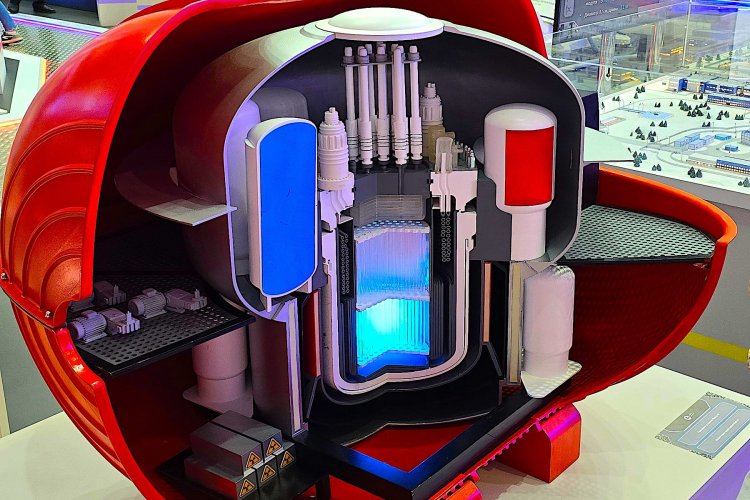
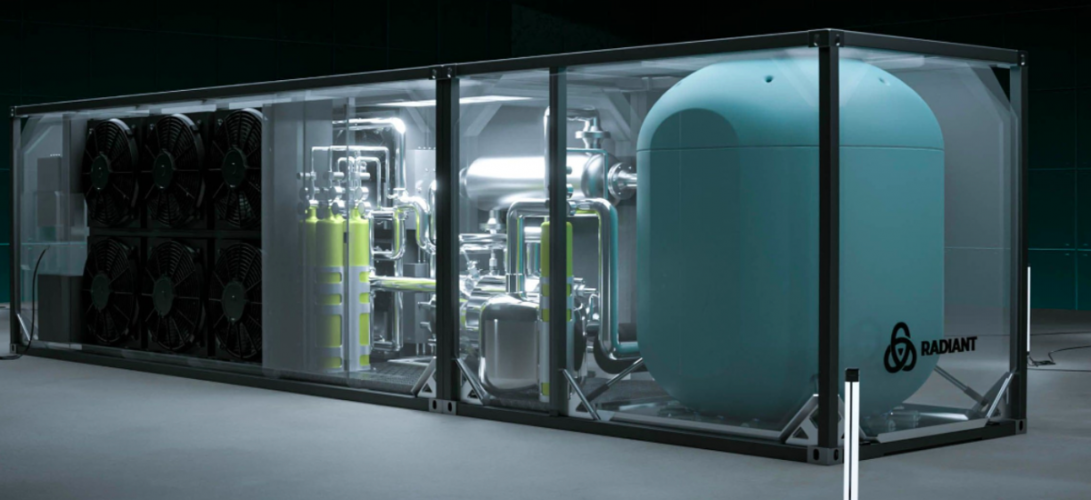
Nitrogen provides higher mass flows to compensate for lower thermal conductivity compared to helium, while. Ot as good as water its effective in lack steam saturation. Unlike nitrogen based reactors, the gas never inside to interact core medium. Steam turbines take up more space. Steam generators for nuclear plant is bigger than the reactor. While civilian versions heat pipe reactors have lower core density, power density in naval subset, over 3-30 Megawatts per cubic meter. So reactor size of a 20 foot shipping container could output 300 MW thermal, conversion 60-80 thousand horsepower, plus electricity.


1000043002.jpg

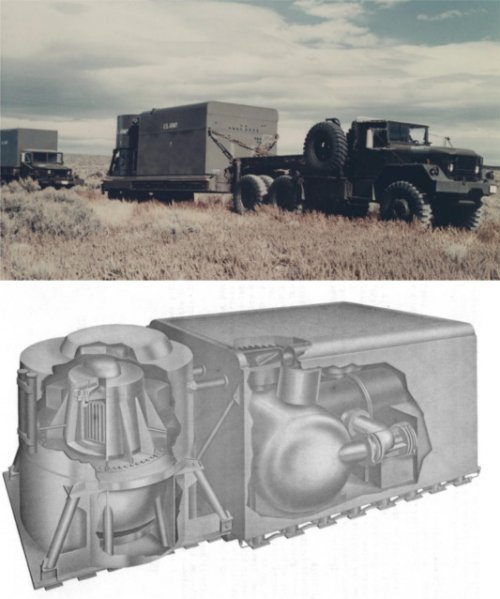
The Idea Nitrogen brayton cycle in nuclear dates back ML-1.

1000043003.jpg

If you want steam, that's also doable as a rating 650 degrees C coolant means supercritical boiler heat exchanger like designs used past. Nuclear steam generation need huge generators and condenser, and pressurizers for their lower thermal output.
 
@spikedpsycho After reading a review article on Heat Pipe Reactors (https://www.sciencedirect.com/science/article/pii/S1364032125001595) I don't see how they offer substantial advantages for naval nuclear propulsion, which also being completely untested for that purpose.

Keep in mind that naval reactors are not commercial power reactors. They have to deal with swings in power demand and temperature that would be dangerous in a power reactor. They have to be very robust to withstand shock. And they must be exceptionally reliable under those demanding conditions to ensure the safety of the ship/submarine.

Just one example of a glaring issue with Heat Pipe Reactors is that the working fluid is usually an alkali metal, which is indeed possible to use on a naval vessel but presents radiation and explosive hazards. The Seawolf had a sodium-cooled reactor for a few years, and it did (sort of) work, but it was plagued with technical issues and replaced with a pressurized water reactor.

The Heat Pipe Reactor appears to be a slightly more compact repackaging of something like the Seawolf's reactor, which itself was extremely compact. However, her reactor compartment was actually much longer than the Nautilus' because the sodium would be highly radioactive for some time after the reactor shut down, thus the entire primary coolant volume had to be removed and stored in shielded tanks for the crew to enter the reactor compartment shortly after shutdown. So the Heat Pipe Reactor might save volume or weight in one area, but might negate those advantages for practical considerations like crew safety.

Pressurized water reactors work very well for naval nuclear propulsion and I have not seen any new reactor technology that has much promise to replace them for this application. The issue is that laypeople see the work that is being done on small, land-based power reactors and think that they can be easily adapted to work on ships/submarines, which they invariably cannot.
 
And since it does not require high volume cooling it clearly has lower power density and generation. Ofc you could always spam them but then again that goes counter to all the savings it offers.
 
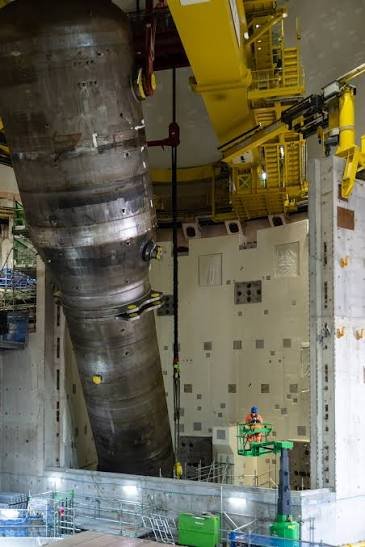
On Nuclear Propulsion front, cruiser USS Truxton had a deckhouse forward of her superstructure that had two hatches on top to be able to access the reactor cores & keep from having to tear her apart. Rather innovative compared to casual and expensive method.
1000043601.jpg


Reactor safety takes precedence over combat capability. Another problem with the nuclear Cruisers was during the Gulf war, exposing them to return fire from shore, Had the vessels been sunk, what/how recover or if the reactor leak?
However Persian Gulf fairly shallow.

On other hand ship operating like that would have undoubtedly escorts galore beyond its own armament.

Or Trumps mind the battleship Infinity poops out array of frigates
1000043602.jpg
 
Snark:
And, as ever, 'Commercial' fusion power reactors seem to stay a decade away...
Of course, one of the 'Little Approaches' may come good before the massive Tokomak / JET...
Then, tech is still at the 'James Watt' stage, where steam-power took a while to catch the train.
At least this time around there's not likely to be that unseemly patent war over cranks and stuff, cruelly repeated when the Wright Bros tried to monopolise aircraft design.
IIRC, Edison (US) and Swann (UK) fought years over electricity generation & distribution patents. Until, one day, they realised only their lawyers were getting rich. So, pooled patents, shook on it...
/
In truth, I've watched the discovery of quarks, Higgs' whatsits, neutrinos to have just enough mass to change type and solve the Solar Problem etc. Lasers, micro-chips, too enthusiastic 'clippy' AIs etc etc.
But controlled fusion ?
Yes, it would solve a bunch of problems here and, with weight reduced, open entire solar system.

When ?? It was thought 'pending' when I was at school. Which was a life-time ago...

Back on topic: IMHO, we're still a decade from even the most innovative 'Little Approach' fusion plant generating useful power. And JET-type would just about fit into a 'floating dock'.
Upside, fusion power would be significantly safer than fission to put 'In Harm's Way'.

So, for the next round of nuclear water-craft, seems to stay the same options: US / UK prefer long-cycle HEU, with French & others MEU/LEU on shorter cycle...

Plus the USN facing ever increasing electrical demands beside witless political interference...
{ Sigh. }
 
Snark:
And, as ever, 'Commercial' fusion power reactors seem to stay a decade away...
Of course, one of the 'Little Approaches' may come good before the massive Tokomak / JET...
Then, tech is still at the 'James Watt' stage, where steam-power took a while to catch the train.
At least this time around there's not likely to be that unseemly patent war over cranks and stuff, cruelly repeated when the Wright Bros tried to monopolise aircraft design.
IIRC, Edison (US) and Swann (UK) fought years over electricity generation & distribution patents. Until, one day, they realised only their lawyers were getting rich. So, pooled patents, shook on it...
/
In truth, I've watched the discovery of quarks, Higgs' whatsits, neutrinos to have just enough mass to change type and solve the Solar Problem etc. Lasers, micro-chips, too enthusiastic 'clippy' AIs etc etc.
But controlled fusion ?
Yes, it would solve a bunch of problems here and, with weight reduced, open entire solar system.

When ?? It was thought 'pending' when I was at school. Which was a life-time ago...

Back on topic: IMHO, we're still a decade from even the most innovative 'Little Approach' fusion plant generating useful power. And JET-type would just about fit into a 'floating dock'.
Upside, fusion power would be significantly safer than fission to put 'In Harm's Way'.

So, for the next round of nuclear water-craft, seems to stay the same options: US / UK prefer long-cycle HEU, with French & others MEU/LEU on shorter cycle...

Plus the USN facing ever increasing electrical demands beside witless political interference...
{ Sigh. }
If your reactor is easy to install and service, LEU is ideal. If it has engineering circumstances limit reactors ability to be serviced then fuel longevity is more advantageous.

Electric demands are problematic. Namely better radar, an/spy-6 uses 12 Megawatts. Spare electricity is premium but what to do with excess or acquire it?

The US Military transitioned from large generators to small networked generators in Afghanistan and Iraq wjere day/night time power demands fluctuate but power/fuel consumption was static. All more reason think about small auxiliary reactor even for oil/diesel fired ships just for electric power.

3-10 MW sufficient. Eliminating rationing energy consumption so water/Showers.
Desalination, spare power for humanitarian needs.

USNS Comfort/Mercy in disaster zones, could produce electricity/fresh water for months at a time.


1000043688.jpg
1000043686.png
1000043687.jpg
 
Electric demands are problematic. Namely better radar, an/spy-6 uses 12 Megawatts. Spare electricity is premium but what to do with excess or acquire it?

The US Military transitioned from large generators to small networked generators in Afghanistan and Iraq wjere day/night time power demands fluctuate but power/fuel consumption was static. All more reason think about small auxiliary reactor even for oil/diesel fired ships just for electric power.
Ships don't experience power/utility fluctuation for the crew because nobody is leaving the ship. The same is true for civilian ships, too.
Biggest fluctuation ofc comes from propulsion, radar and others.
In WWII the power consumption increased by +25% for normal operation just due to readyness. Actual increase due to combat and increased deployment & movement are unknown to me.

With Integrated Power System(IPS) and today's Integrated Power and Energy System(IPES) we don't have to worry as much about increased fuel need for readiness other than real range needs.
It looks to me like there's a shift toward more diesel and less gas. Nuclear has been returning due to the small form factors getting traction now. The main push being driven by the Army, though. The navy clearly keep onto their existing ones. So I doubt these new reactors will get a chance now. One reason being not mature and tested enough for the military.
It seems South Korea is the first to re-introduce it into civil service again.
https://interestingengineering.com/energy/worlds-first-nuclear-powered-lng-carrier
 
All more reason think about small auxiliary reactor even for oil/diesel fired ships just for electric power.

3-10 MW sufficient. Eliminating rationing energy consumption so water/Showers.
Desalination, spare power for humanitarian needs.
So, you're still basically talking about a reactor the size of an S5W. (~11MW out the main engines, plus likely another 4-6MW for ship's electrical load)

The Steam 'still only made about 10k gallons per day, the vacuum 'still made about 3k.
 
Thanks for this input and study PDF. It’s very interesting.

The Westinghouse idea you shared makes me think that we could “basically” put a compact Gas turbine modular helium reactor (GT-MHR) into a ship. Which looks interesting as it’s a quite safe and efficient design, to my knowledge.

On the long term it can even lead to a fast neutrons gas-cooled reactor.

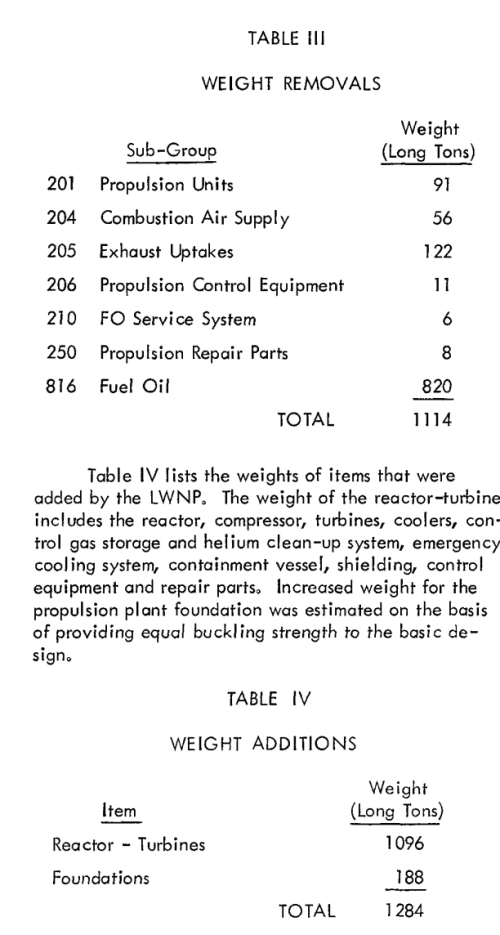
Regarding the study, I see one main issue: the weight. Figure 7 in page 6 indicate that a paired “LWNP” power plants would be 274 tons, while paired LM-2500 are 22.75 tons. But table III and IV (page 7) indicate removing all LM-2500 installation would remove 1114 tons, and that the proposed “LWNP” installation would be 1284 tones. So it ‘only’ adds 170 tons to the ship.
It's because the LWNP installation removes all of the intake and exhaust ducting through the superstructure that a conventional LM2500 plant requires (178 tonnes) along with all of the fuel mass (820 tonnes), which is counted as part of the total installed powerplant mass for the comparison.
 

Attachments

  • Screenshot 2026-08-18 001307.png
    Screenshot 2026-08-18 001307.png
    156.7 KB · Views: 9
It's because the LWNP installation removes all of the intake and exhaust ducting through the superstructure that a conventional LM2500 plant requires (178 tonnes) along with all of the fuel mass (820 tonnes), which is counted as part of the total installed powerplant mass for the comparison.
Should not remove all the fuel. You still need the emergency diesel generator(s) for when the reactor scrams. Plus the fuel acts as part of the reactor shielding.

I'm not sure how much fuel a Trident loads on (I may have known at one point, but...), For an estimate let's say a tank the entire width of the hull (13m diameter) and 2m wide. That's 265 cubic meters of volume, about 225 tons of fuel.
 
That’s just the fuel load for the conventional propulsion turbines that they’re deleting, any auxiliary diesel and/or gas turbine generators and their fuel loads aren’t being included in the total installed weight breakdown.
 
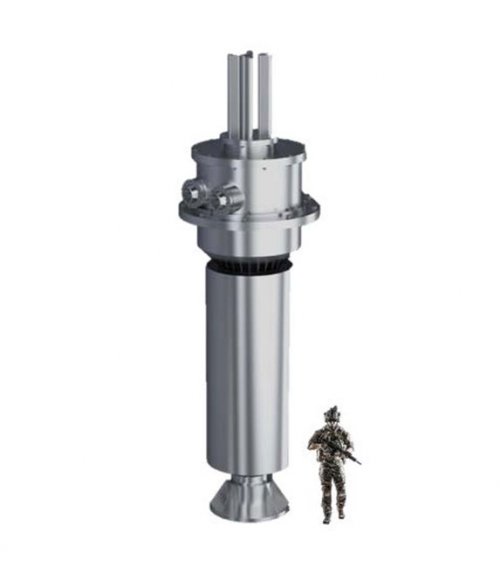
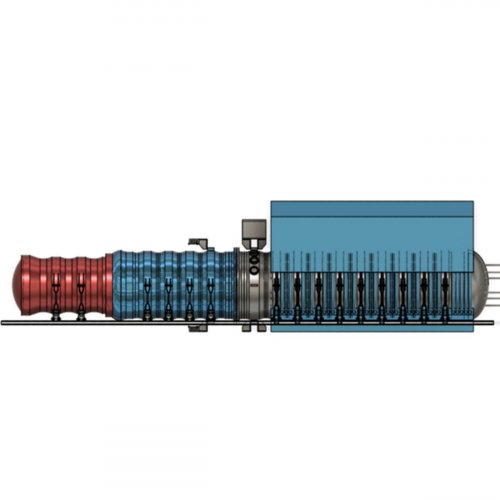
Horizontal gas turbine reactor by Boston
Atomics. 1000043714.jpg

Though made commercial setting, the idea of Horizontal integration isnt bad. Vertical integration requires vertical space which on a ship isnt abundant or wise. Though some designs th reactor remains only core must be removed/replaced. Gas cooled core and seawater heat exchange. A gas turbine or Steam turbine is conceivable.

What made industrial revolution revolutionary came with Henry Ford. Horizontal integration eliminated transportation and lifting steps, allowed product leave facility as is.

On tight confines of a ship vertical is probably better for loading. Horizontal integration may be advantageous for traversing because ships have side doors for installation machinery without cutting.

Military reactors host superior core densities so design function fit within narrow confiens of floor to ceiling.
Savannah was based civilian friendly tech so was larger. Gas core reactors have higher temps thus higher thermal efficiencies. Advantage of Steam turbine is abundance makers where as observed gas turbine market is heavily delayed. But steam design needs more machinery namely leggings, pipes..super critical steam better than sub critical steam but requires tougher boiler.
Gas turbine is mechanically simpler but requires more stressmitigation; A process addressed with dual turbines, more so since gas maybe high temperature there are no fouling or combustion products.

For a frigate, twin reactors, dual turbines, one which catered electric power to either run systems or produce motive power for quiet operation in shallow water.
 
I don't want to be rude @spikedpsycho but your posts here don't really have anything to do with actual naval nuclear propulsion. It's just random stuff from the land-based power generation sector. Enormous amounts of funding have been devoted to naval nuclear propulsion, mostly in the United States and Soviet Union/Russia. Even though a few exotic designs have been considered or tested (gas-cooled reactors, organic-cooled reactors, liquid-metal-cooled reactors), ultimately nothing has better met the requirements for naval use than pressurized water reactors feeding steam to a Rankine-cycle secondary plant.
 
I don't want to be rude @spikedpsycho but your posts here don't really have anything to do with actual naval nuclear propulsion. It's just random stuff from the land-based power generation sector. Enormous amounts of funding have been devoted to naval nuclear propulsion, mostly in the United States and Soviet Union/Russia. Even though a few exotic designs have been considered or tested (gas-cooled reactors, organic-cooled reactors, liquid-metal-cooled reactors), ultimately nothing has better met the requirements for naval use than pressurized water reactors feeding steam to a Rankine-cycle secondary plant.
Private sectors namely new startups offer huge area of growth for reactor designs that skip over established quo.

1000043725.jpg

Designs like Ford A1B, Virginia, and Columbia hope offer lower costs in terms of manpower requirements and mechanical simplicity.

Land commercial sector develops faster outputs than military. Naval reactors predominantly developed by Bechtel/Westinghouse cartel, first new reactor since LA class in 30 years.

Private developers may allow production reactors backwards compatible to other design machinery. Including drop in module that could power steam or diesel powered ships,
 
That’s just the fuel load for the conventional propulsion turbines that they’re deleting, any auxiliary diesel and/or gas turbine generators and their fuel loads aren’t being included in the total installed weight breakdown.
If there's actually separately allocated fuel loads, that's better.

But to my knowledge, all ship's fuel loads are a single thing.


Horizontal gas turbine reactor by Boston
NO.

A horizontal reactor cannot use gravity to pull the rods into the reactor to force a shutdown. That is NOT improving safety.
 
If there's actually separately allocated fuel loads, that's better.

But to my knowledge, all ship's fuel loads are a single thing.


NO.

A horizontal reactor cannot use gravity to pull the rods into the reactor to force a shutdown. That is NOT improving safety.
the reactors they want in Pele and Army portable are horizontally integrated.

Gas-cooled nuclear reactor, the void coefficient of reactivity is zero (or practically negligible). Liquid water in standard reactor vessel acts as both a coolant and a neutron moderator (slowing down neutrons). When liquid water turns to steam or higher critical fluid, it creates voids that disrupt neutron moderation. Gas coolants don't have this issue since non reactive gasses are chosen, and possess no inherent reactivity properties. Most gas cooled designs have fuel temperature threshold dissipate fission if it gets too hot. Since the gas has little effect on neutron behavior, emptying or changing the pressure of the gas coolant adds zero net reactivity.

Second design criteria of horizontal control the rods are embedded in reactor permanently and reflector drums move to lower/raise reactivity.
 
Private sectors namely new startups offer huge area of growth for reactor designs that skip over established quo.

Designs like Ford A1B, Virginia, and Columbia hope offer lower costs in terms of manpower requirements and mechanical simplicity.

Land commercial sector develops faster outputs than military. Naval reactors predominantly developed by Bechtel/Westinghouse cartel, first new reactor since LA class in 30 years.

Private developers may allow production reactors backwards compatible to other design machinery. Including drop in module that could power steam or diesel powered ships,
These start-ups are not designing naval reactors. They are designing civilian power reactors. These are not the same thing, for reasons mentioned above. I really don't understand the point you are trying to make.
 
@spikedpsycho After reading a review article on Heat Pipe Reactors (https://www.sciencedirect.com/science/article/pii/S1364032125001595) I don't see how they offer substantial advantages for naval nuclear propulsion, which also being completely untested for that purpose.

Keep in mind that naval reactors are not commercial power reactors. They have to deal with swings in power demand and temperature that would be dangerous in a power reactor. They have to be very robust to withstand shock. And they must be exceptionally reliable under those demanding conditions to ensure the safety of the ship/submarine.

Just one example of a glaring issue with Heat Pipe Reactors is that the working fluid is usually an alkali metal, which is indeed possible to use on a naval vessel but presents radiation and explosive hazards. The Seawolf had a sodium-cooled reactor for a few years, and it did (sort of) work, but it was plagued with technical issues and replaced with a pressurized water reactor.

The Heat Pipe Reactor appears to be a slightly more compact repackaging of something like the Seawolf's reactor, which itself was extremely compact. However, her reactor compartment was actually much longer than the Nautilus' because the sodium would be highly radioactive for some time after the reactor shut down, thus the entire primary coolant volume had to be removed and stored in shielded tanks for the crew to enter the reactor compartment shortly after shutdown. So the Heat Pipe Reactor might save volume or weight in one area, but might negate those advantages for practical considerations like crew safety.

Pressurized water reactors work very well for naval nuclear propulsion and I have not seen any new reactor technology that has much promise to replace them for this application. The issue is that laypeople see the work that is being done on small, land-based power reactors and think that they can be easily adapted to work on ships/submarines, which they invariably cannot.
Seawolf reactor was sodium cooled, but sodium was in core direct fuel element and needed contact thermal exchange thru water which in lies it danger.
Heat pipe configuration the actual quantity of sodium is miniscule and variants other coolant exists, separated by layers of material. HPR already dissipates thermal energy thru solid medium contact.

Idaho National Labs already testing heat pipes in configurations where temperatures beyond their typical parameters at 800° C. Heat pipes were invented Los Alamos in 1963 for space based nuclear Satellite(SNAP) for criteria where factors such as human maintainence would not be induced or present.

American Bureau Shipping studied utilization heat pipes reactor for container vessels. Granted Not naval vessels but ideal circumstances of reduced maintenance is there. Namely reduction pumps and moving parts.

1000043733.jpg
 
@spikedpsycho I don't understand what would make this type of reactor advantageous for naval nuclear propulsion. No alternative has been found that is superior to the pressurized water reactor for naval nuclear propulsion.

I recommend you heed the words of Rickover when trying to associate developments in the (hypothetical) commercial power sphere to naval nuclear propulsion: https://whatisnuclear.com/rickover.html
 
No alternative has been found that is superior to the pressurized water reactor for naval nuclear propulsion.
A nuclear gas turbine, as studied in the 70s, may offer substantial weight savings and in theory change manning requirements vs a nuclear steam turbine (this is why various forms of nuclear gas turbine were considered for aircraft applications).
While none of the benefits are well proven and there is not necessarily a reason to believe that the new companies will be successful, it is generally hoped that new technology will generally attack the problems of manpower, weight, and space needed for a nuclear powerplant.
 
A nuclear gas turbine, as studied in the 70s, may offer substantial weight savings and in theory change manning requirements vs a nuclear steam turbine (this is why various forms of nuclear gas turbine were considered for aircraft applications).
While none of the benefits are well proven and there is not necessarily a reason to believe that the new companies will be successful, it is generally hoped that new technology will generally attack the problems of manpower, weight, and space needed for a nuclear powerplant.
Maybe, but many exotic alternatives were explored for the S6W in the 1980s and Naval Reactors ended up choosing a pressurized water reactor. Over the years, manning has (slightly) decreased and efficiency, both in the primary and secondary systems, has increased significantly. Frankly a lot of the supposed alternatives in this thread strike me as a solution in search of a problem.
 
A nuclear gas turbine, as studied in the 70s, may offer substantial weight savings and in theory change manning requirements vs a nuclear steam turbine (this is why various forms of nuclear gas turbine were considered for aircraft applications).
While none of the benefits are well proven and there is not necessarily a reason to believe that the new companies will be successful, it is generally hoped that new technology will generally attack the problems of manpower, weight, and space needed for a nuclear powerplant.
The gas turbine nuclear integration isnt new. Dates back Aircraft programs however silly or misguided.
1000043748.jpg

But in a stationary position more ideal for naval propulsion.

Manpower: is a regulatory issue. You simply have to have specific quantity of labor and manning for safety sake? Or for NRC/DOE requirements. Reduction in amount and size of mechanical components.

Weight: yes weight is a concern but compared to. The power to weight ratio of nuclear plant is modest. That's more issue temperature and thermodynamic efficiency. PWR has thermal efficiency 32-35%, in marine engine configuration it's somewhat lower. Weight mostly comes from shielding. PWR has water in core as neutron shield. Surrounded layers concrete and steel. Shielding narrow diameter of a submarine, Contemporary design gas system a shield composed lead blankets and water shield.

As for Space, if designs eliminate need much needed components like steam generators. Arleigh Burke has 7 gas turbines aboard. 4 propulsion, 3 electric power. There's space. A1B is 20% smaller than predecessor reactors and produces 25% more power. So issue core density.
 
As for Space, if designs eliminate need much needed components like steam generators. Arleigh Burke has 7 gas turbines aboard. 4 propulsion, 3 electric power. There's space. A1B is 20% smaller than predecessor reactors and produces 25% more power. So issue core density.
A steam generator lives inside the Reactor Compartment. Which is not "usable" volume in the submarine. For that matter, I suspect that most of the size of the RC is for achieving neutral buoyancy of the mass of the reactor, anyways. So a 1200ton reactor setup would take up ~1200cubic meters submerged. For an Ohio-class with a 13m hull diameter, that would be a reactor compartment about 9m long, which sounds about right based on memory of how many steps to clear the RC tunnel. You're not supposed to linger in there, shielding is thinner compared to forward or aft of the RC.

And that just means you're only saving the maintenance on the steam generators.

Look. Until you find an advanced reactor design with massively better power density than a PWR running on 90+%HEU, you're going to have a really hard sell. And I mean both power per kg and power per cubic meter densities.

Then we can start arguing the design safety of fully passive circulation and control rods dropping by gravity in a scram. Plus scoop injection for the Main Seawater in the condensers.

Also, since we're talking naval reactors, you're going to need to also address silencing questions.
 
A steam generator lives inside the Reactor Compartment. Which is not "usable" volume in the submarine. For that matter, I suspect that most of the size of the RC is for achieving neutral buoyancy of the mass of the reactor, anyways. So a 1200ton reactor setup would take up ~1200cubic meters submerged. For an Ohio-class with a 13m hull diameter, that would be a reactor compartment about 9m long, which sounds about right based on memory of how many steps to clear the RC tunnel. You're not supposed to linger in there, shielding is thinner compared to forward or aft of the RC.

And that just means you're only saving the maintenance on the steam generators.

Look. Until you find an advanced reactor design with massively better power density than a PWR running on 90+%HEU, you're going to have a really hard sell. And I mean both power per kg and power per cubic meter densities.

Then we can start arguing the design safety of fully passive circulation and control rods dropping by gravity in a scram. Plus scoop injection for the Main Seawater in the condensers.

Also, since we're talking naval reactors, you're going to need to also address silencing questions.
Having the phase change in the working fluid (water/steam, or other) greatly helps efficiency and reduces the mass flow relative to the energy moved. The feed water pumps or forced pressure induction increase the pressure of water, which is dense and potentially allows for compaction. Compressing gas can be quite inefficient by comparison but if it's functional inside pre determined volume gas ideal working fluid if temperatureis superior. Gas cooled reactor can run a steam cycle, since gas runs above 550° C compared to sub critical water at 300°. Gas turbine direct drive will have some efficiency losses but less so in sub critical domain.

As passive safety, gas reactors already engage natural circulation since volumetric density of gas is inferior a thermodynamic design that allows constant motion thru passive heat exchanger.

Before advent diesel and gas turbines steam turbines powered surface ships well into 1970s... Knox being last class conventional high temp steam. What reduces labor costs is how many and how big the doohickeys are you must inspect and maintain. Gas reactor may be in infancy in terms naval application, frought some difficulties. But lack scaled prototype and insufficient operational interest was culprit.
 
A closed cycle gas turbine nuclear reactor, like the LWNP design, has a significantly higher overall power density than any PWR plant. It's pretty much the selling point of the technology for vehicle propulsion applications. For a conventional monohull surface ship or submarine it's debatable how much of an advantage this would be, but one of the intended applications of the LWNP design (besides that it could act as a drop-in replacement for ships powered by LM2500s) was in a scaled up version to power some the high speed surface effect ships the USN was looking into at the time, where a conventional PWR plant would absolutely not have been able to deliver the power necessary to get the 80+ knot top speeds they were envisioning (which would require more power than a Nimitz class plant in a hull like 1/10th the size).
 
I still don't like the French LEU reactors because it forces you to refuel every 7-8 years and costs you at least one deployment cycle in the process. Yes, there's a big hatch on the hull of the sub to access the reactor, but you have to make sure it seals perfectly. I cannot imagine the tension for the first dive after a refueling.

PWR are chosen over BWR because of their core density which is important for ships confines, BWR doesn't need a "steam generator" because essentially it is one. However PWR can isolate its hot water from steam production to avoid contaminants.

Back in 2013 Naval academy Physics paper noted prospects utilitization of LEU fuel for naval reactor application.
Proposed new core geometry placed vast majority enriched elements in central perimeter and new neutron reflector would distribute accessory neutrons otherwise lost to convert and utilize core outer elements, as core consumes more and more reflectors convert. Fuel life expectancy between 11-18 years and possibility 25+

LEU (enriched 5%) costs 2-3 thousand dollars per kilogram.
HALEU (20%) 15,000 dollars
HEU (classified likely above 93% ) cost $150,000 per kg.

A submarine fuel core can be 15-20% price initial vessel. Using LEU it's down like 2-5%. You can down blend HEU fuel 20 fold and make 20 cores for same money and reactor doesn't know the difference anymore between "regular and premium"
 

Similar threads

Back
Top Bottom