Naval Modular Missile Program (NMM)

No, the TSI is only 7-8" in diameter. It's a pretty small missile, roughly speaking it's the same size as the Cuda or halfRAAM.

The Navy document referenced by AWST and TWZ says the TSI is 10 inches in diameter.

The way I'm looking at NMM, the booster for the submarine version is smaller diameter than the surface ER. Booster is proportionally longer since it's packed into a smaller diameter tube.

The TSI fuselage in both images is the same size, so they are at the same scale. That makes the ER-S fuselage very close to the same diameter as the DP-ER.
 
The way I'm looking at NMM, the booster for the submarine version is smaller diameter than the surface ER. Booster is proportionally longer since it's packed into a smaller diameter tube.

Because a 500km ~8" diameter missile is not worth as much as a Tomahawk to me. Don't care that the missile is doing Mach 6, it's still only a 300lb missile so the missile KE is only that of ~600lbs of TNT. At most.

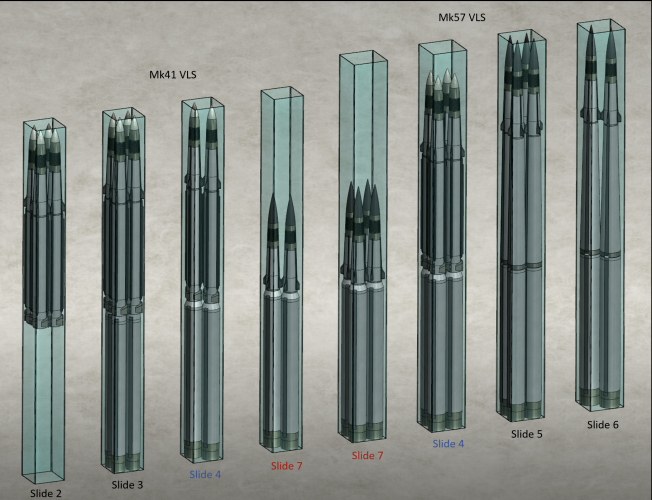
I do not see the logic in 7x NMM-ER-S versus 7x Tomahawks. But you can pack 7x 10" diameter missiles into a ~40" diameter tube for a 34" diameter missile with 2" of shock-absorbing space around it.
Given that the TSI body is uniform across them all (circa 10" dia.), the booster for the ER-S version looks slightly wider than the DP-ER booster and a bit longer.
So the Phoenix is again reborn from its ashes?
TSI is basically an aerodynamic KKV. At this stage I'm not sure if it has any divert propulsion but presumably there must still be a version with divert propulsion for exo-intercepts.

The TSI fuselage in both images is the same size, so they are at the same scale.
Yes. The only thing not to scale is the VPM itself, which is about half size relative to rest.
 
I just dont understand the submarine variant, considering using a SAM in an area as highly monitored as the SCS or other highly monitored areas would immediatly alert the enemy.

A long range Anti sub missile similar to the Indian SMART would be able to deal with a manned sub considering the speed and range of LWTs as long as the tracking is relatively accurate. Im sure the chinese are developing long range anti sub weapons as well.

I could be very wrong though so could anyone actually explain why this would be useful in a highly contested region?
 
I just dont understand the submarine variant, considering using a SAM in an area as highly monitored as the SCS or other highly monitored areas would immediatly alert the enemy.

A long range Anti sub missile similar to the Indian SMART would be able to deal with a manned sub considering the speed and range of LWTs as long as the tracking is relatively accurate. Im sure the chinese are developing long range anti sub weapons as well.

I could be very wrong though so could anyone actually explain why this would be useful in a highly contested region?

One would be as a SAM trap -- the sub waits until some high value air targets are in reach (tracked by off board sensors, possibly even satellites), then lofts a volley of missiles and runs like hell.

The other, possibly more likely, is as an adjunct strike weapon, in the same way that Standard (especially SM-6) has an alternative anti-surface role. Given the modularity inherent in the NMM approach, you might see a strike-optimized ER-S with a different warhead (lateral EFPs, perhaps, rather than fragmentation).
 
Last edited:
I just dont understand the submarine variant, considering using a SAM in an area as highly monitored as the SCS or other highly monitored areas would immediatly alert the enemy.

A long range Anti sub missile similar to the Indian SMART would be able to deal with a manned sub considering the speed and range of LWTs as long as the tracking is relatively accurate. Im sure the chinese are developing long range anti sub weapons as well.

I could be very wrong though so could anyone actually explain why this would be useful in a highly contested region?
Yields the advantage of an adversary not knowing so clearly where surface-based air defences are, or how many interceptors are guarding each ship, which complicates strike planning on their behalf.
 
TSI is basically an aerodynamic KKV. At this stage I'm not sure if it has any divert propulsion but presumably there must still be a version with divert propulsion for exo-intercepts.

Exo-atmospheric TBMD doesn't seem to be part of the NMM problem set. It's likely to remain in its own SM-3 evolutionary path.

I don't know how settled the actual configuration of the TSI is. It's still being competed, I think, so we might see competing versions with aero controls vs side thrusters.
 
Last edited:
In trying to figure out the NMM-ER-S conops, people are assuming the VPM is in a Virginia (or AUKUS), that isn't necessarily the case given the proliferation of UUVs....
 
In trying to figure out the NMM-ER-S conops, people are assuming the VPM is in a Virginia (or AUKUS), that isn't necessarily the case given the proliferation of UUVs....

A UUV big enough to hold a VPM/MAC would be huge.
 
Agreed, but one could be risked where you couldn't risk a Virginia.
As big as the UUV would have to be it'd be too expensive to throw away. Effectively the size and cost of a KSS-3.


The Navy document referenced by AWST and TWZ says the TSI is 10 inches in diameter.
Huh. I'm trying to parse how that works when the bottom stage in the quad pack cannot be more than 11" diameter to be able to quadpack and the interstage between TSI and quad pack booster has a lot more taper than 1/2" either side.


The TSI fuselage in both images is the same size, so they are at the same scale. That makes the ER-S fuselage very close to the same diameter as the DP-ER.
13-13.5" booster means you're not packing 7 of those into the tube a CPS fits into, and there'd be a huge amount of unused volume in the tube if the ER-S are replacing the Tomahawk in a MAC. If the USN only wants to put 7x ER-S into a MAC, fine, but FFS at least use the 21" boosters to base the submarine launched missile on!

The CPS/LRHW tube is going to be ~38.5" inside diameter (34.5" missile plus 2" on each side for shock absorbtion), so the biggest missile you could reasonably pack 7 into that is 9.5-10". And that's going with very thin cell walls around each missile.
 
As big as the UUV would have to be it'd be too expensive to throw away. Effectively the size and cost of a KSS-3.


Huh. I'm trying to parse how that works when the bottom stage in the quad pack cannot be more than 11" diameter to be able to quadpack and the interstage between TSI and quad pack booster has a lot more taper than 1/2" either side.

The booster tapers to meet the boat tail on the TSI. But the booster's main diameter looks to be the same as the TSI.


13-13.5" booster means you're not packing 7 of those into the tube a CPS fits into, and there'd be a huge amount of unused volume in the tube if the ER-S are replacing the Tomahawk in a MAC. If the USN only wants to put 7x ER-S into a MAC, fine, but FFS at least use the 21" boosters to base the submarine launched missile on!

The CPS/LRHW tube is going to be ~38.5" inside diameter (34.5" missile plus 2" on each side for shock absorbtion), so the biggest missile you could reasonably pack 7 into that is 9.5-10". And that's going with very thin cell walls around each missile.

I'm pretty sure that the ER-S needs an exhaust plenum of some sort that isn't present in the Tomahawk MAC. The simplest way to do that is a concentric canister so the actual MAC is basically unchanged. And that's consistent with the experimental SubSAM designs we've discussed elsewhere.
 
The booster tapers to meet the boat tail on the TSI. But the booster's main diameter looks to be the same as the TSI.
Which would be 10" for the booster, then. Maybe 11" for the shroud over the TSI.


I'm pretty sure that the ER-S needs an exhaust plenum of some sort that isn't present in the Tomahawk MAC. The simplest way to do that is a concentric canister so the actual MAC is basically unchanged. And that's consistent with the experimental SubSAM designs we've discussed elsewhere.
Why the heck are people designing a submarine-launched missile with hot launch? If it's gotta be a different booster anyways go ahead and design for cold launch like a civilized human!
 
As big as the UUV would have to be it'd be too expensive to throw away.
We've expended some pretty big ships over the years when the situation called for it, the Zeebrugge raid planned to expend six cruisers in one operation (five as blockships, Vindictive as an assault ship)
 
All I can say is that installing the ER-S system on submarines offers tremendous benefits (notwithstanding the downsides).

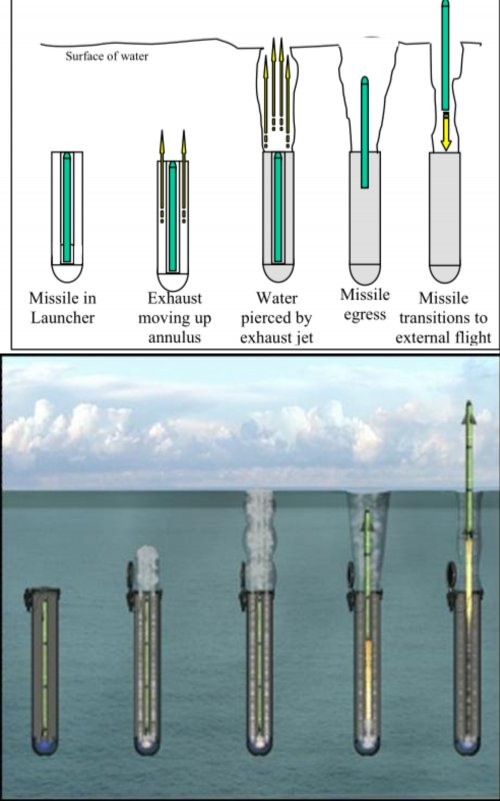
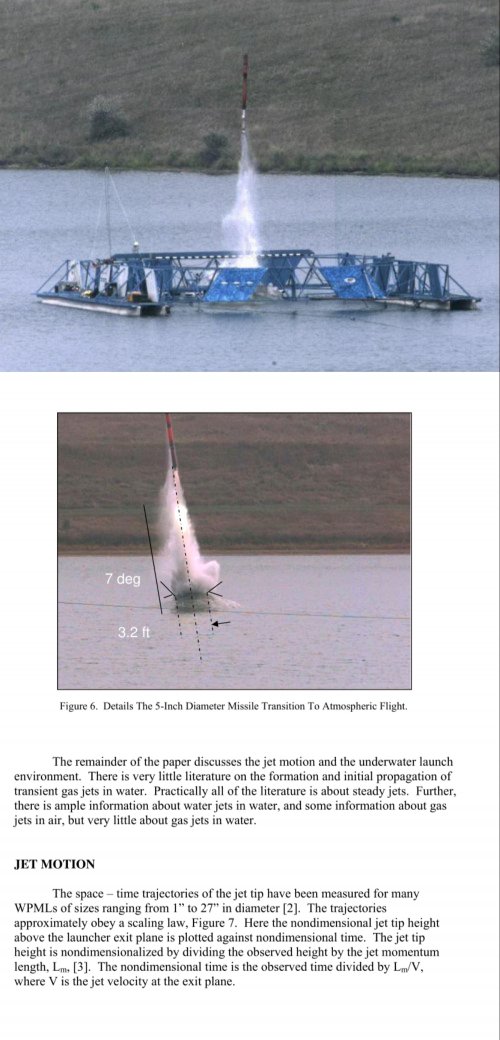
Furthermore, the U.S. has also explored launching missiles from the seabed (see image).

Image source: WPML
 

Attachments

  • IMG_20260803_133457.jpg
    IMG_20260803_133457.jpg
    796.3 KB · Views: 79
  • IMG_20260803_201708.jpg
    IMG_20260803_201708.jpg
    1.4 MB · Views: 68
All I can say is that installing the ER-S system on submarines offers tremendous benefits (notwithstanding the downsides).

Furthermore, the U.S. has also explored launching missiles from the seabed (see image).

Image source: WPML
That's actually not a bad idea, nothing says the module has to be on a submarine. They could simply be on the sea bed, protecting the launchers from incoming missiles, while also providing air defence via a sonar relay or surface buoy connection of some kind.
 
Which would be 10" for the booster, then. Maybe 11" for the shroud over the TSI.

The QP-MR isn't shrouded. The ER-S is, probably to protect against water, and the LR is, probably to deal with thermal loads. But the DP-ER and QP-MR have bare upper stages.

Why the heck are people designing a submarine-launched missile with hot launch? If it's gotta be a different booster anyways go ahead and design for cold launch like a civilized human!

Take it up with the Navy. The most recent SubSAM experiments (admittedly 15 years ago) used hot launch. They must have reasons.

(Come to think of it, if the speculation that Sea Dragon is basically a sub-launched SM-6 is correct, it might also use hot launch.)

I was talking more in respect to its shape..

I suppose. You could just as well say Falcon, which is closer to the right size as well.

But again, I am not convinced that this is a definite shape or just a placeholder pending the outcome of the actual competition. I would not be shocked to see a final TSI shaped more like Cuda or Peregrine.
 
Subsurface is interesting. Could just be about strike but it might also open the door for the return of Son of SubSAM. Self-defense for starters, obviously.

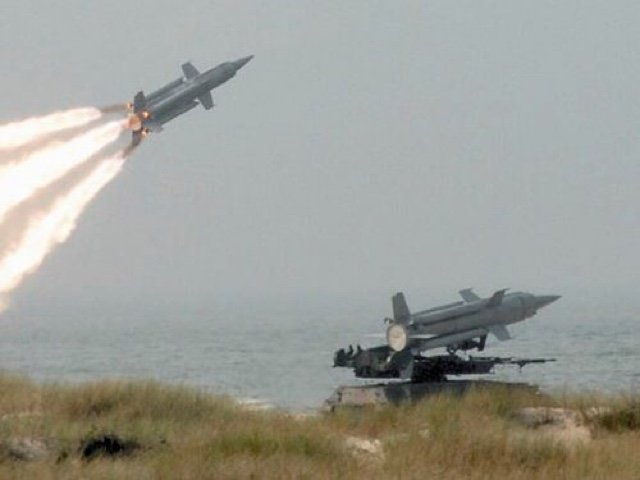
But these days, with active seekers and distributed (and possibly space-based) target tracking, you could actually make a submerged SAM trap a viable technique. An SSGN with a clutch of SAMs could do nasty things to high value air assets that thought they were far enough up-threat.
Yep. Debated this with a bunch of people online about a decade ago. According to them it would be unpossible because "someone would see the missile come out of the water and attack you immediately".

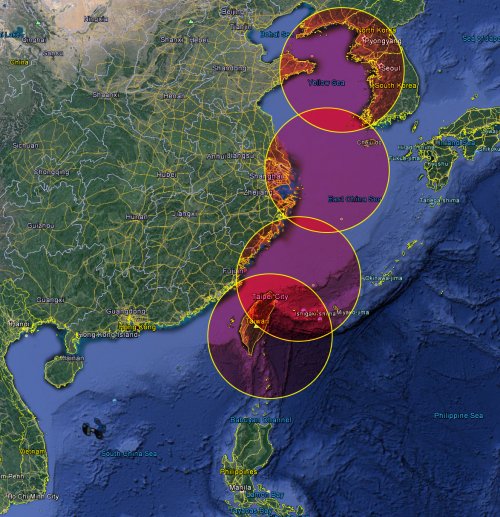
Circles are about 500 miles in diameter.
 

Attachments

  • Capture2.jpg
    Capture2.jpg
    1.6 MB · Views: 58
https://aviationweek.com/defense/mi...als-details-standard-missile-replacement-plan

U.S. Navy Reveals Details Of Standard Missile Replacement Plan​

A newly obtained document reveals the full scope of the U.S. Navy’s preliminary plans for replacing all members of the venerable, RTX-made Standard Missile (SM) series with a family of new air and missile interceptors that are focused on boosting load-outs and raising performance. The family of Navy...

View attachment 819393
*cough*
 

Attachments

  • 1786318046313.png
    1786318046313.png
    3.4 MB · Views: 73
Modular implies part commonality, swapable components,
None which applicable in this sense. Unless you can fabricate a universal mother board chip for every missiles computer only require program change.

Modularity isnt issue, if it were fuselage panelkng woikd be identical, all missiles same diameter, smae seeker or family seekers. Military bizarre perversion of the term modular really needs to stop. It serves no purpose except excite hawkish subcommittee.

Modularity don't matter for something you purposely intend to destroy.
True modular construction means same factories and overall tooling. Procuring missiles on a budget means production on a budget. Peace time industry only produces an average 100 missiles a year which in a war or even protracted engagement can be exhausted in less 2 weeks.
Missiles need be produced in automotive style assembly lines where production numbers in 1000-2000 a year. 2 put of every ten need picked random from litter testing. This allow amortization and stockpile. Also allow more missiles to be deliberately destroyed in tests and training. 2016, USS Mason expended 25 million dollars hardware in 3 separate engagements to counter cold war surplus Silkworm missiles. The missile longevity can be addressed with recycling program. Once a missile is 2-3 years old it is removed from service and recycled, only warhead chemical longevity needs be destroyed or disposed of in live firings. Factory would essentially stay open 365 days a year. This would also create a surplus stockpile. We stockpile bullets and artillery shells.
 
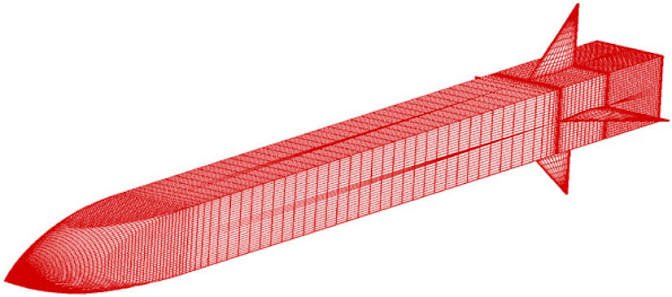
Why not just make square missiles, a circle inside a square only occupies max 76% area so cylinder vs Square prism 24% interior cell, strakes instead of integrated fins wouldnt be necessary.
1000043068.jpg
 
Why not just make square missiles, a circle inside a square only occupies max 76% area so cylinder vs Square prism 24% interior cell, strakes instead of integrated fins wouldnt be necessary.
View attachment 820626
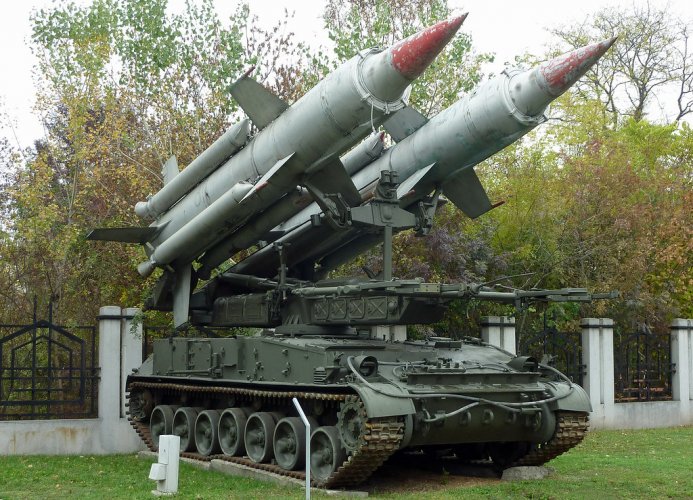
Was in a composites class in uni decades ago and we had a guy from Thiokol (which became ATK then NG) come in to talk about composites. He brought a triagular cross-section of a missile motor the US Army had asked them to develop. "So the rockets would fit in the rocket pod, like sections of an orange." "Problem is rocket motors want to be round when you light 'em." Yeah. . .

One thing you could do is have parallel boosters in the corners of the cell. Not sure it would be worth the trouble though.
 

Attachments

  • Krug__28c_29b693.jpg
    Krug__28c_29b693.jpg
    367.9 KB · Views: 39
  • blogger-image-729487713.jpg
    blogger-image-729487713.jpg
    52.4 KB · Views: 14
Was in a composites class in uni decades ago and we had a guy from Thiokol (which became ATK then NG) come in to talk about composites. He brought a triagular cross-section of a missile motor the US Army had asked them to develop. "So the rockets would fit in the rocket pod, like sections of an orange." "Problem is rocket motors want to be round when you light 'em." Yeah. . .

One thing you could do is have parallel boosters in the corners of the cell. Not sure it would be worth the trouble though.
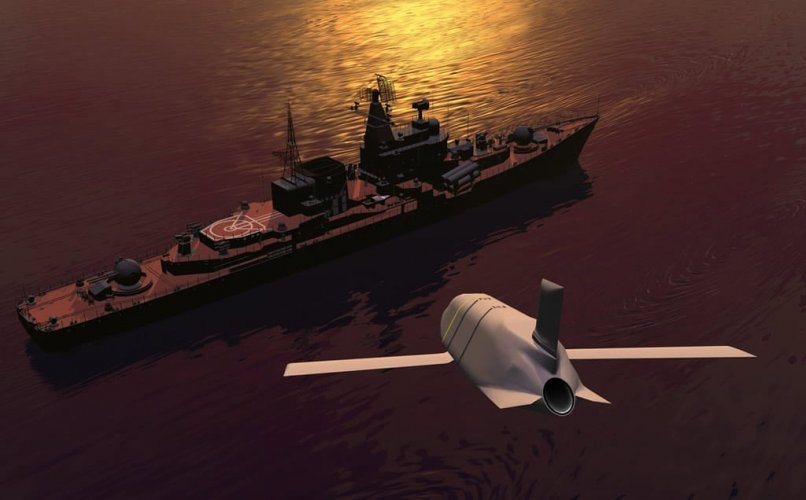
I'm seeing design philosophy of square-ish
LRASM, And the Mako.
1000043070.jpg
1000043072.jpg
1000043073.png

Squareish fuselage, rounded propulsion
 
LRASM is an air-breather (and more triangular than square), with a round engine, and Mako is round (aside from a small fairing for lugs).
 

Attachments

  • mako-config.jpg.pc-adaptive.1280.medium.jpg
    mako-config.jpg.pc-adaptive.1280.medium.jpg
    148.7 KB · Views: 28
Last edited:

Similar threads

Back
Top Bottom