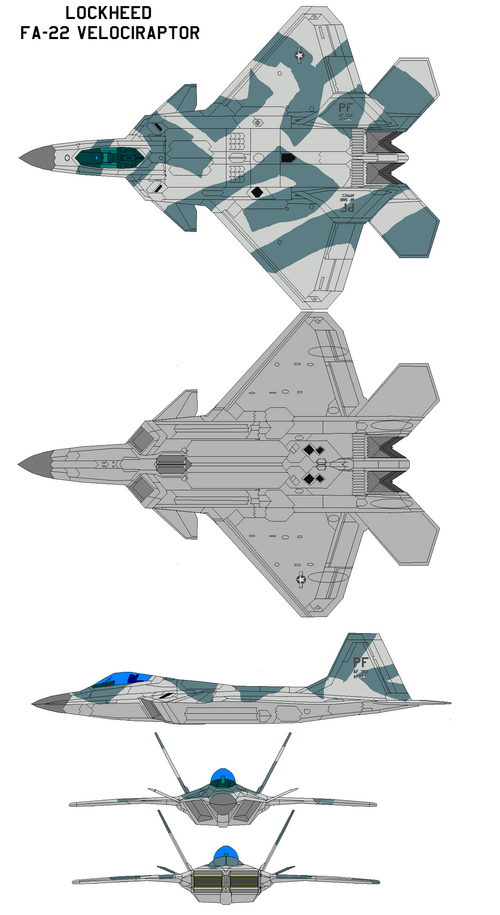
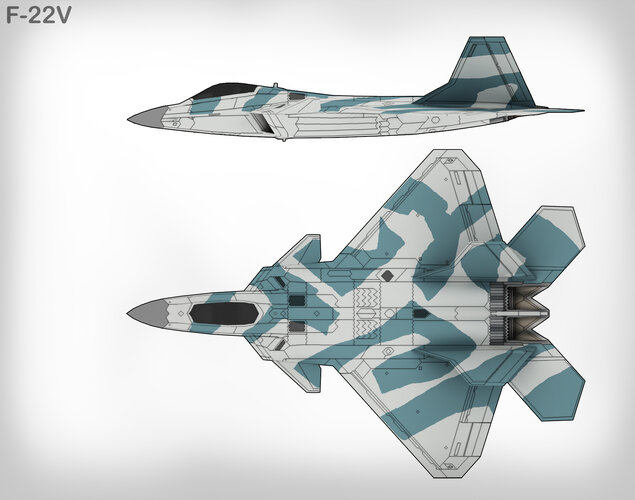
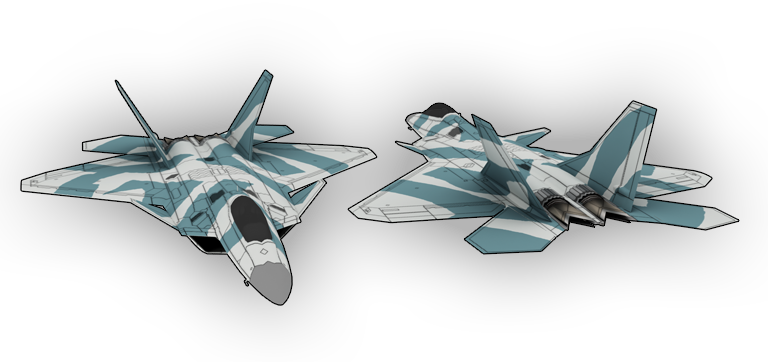
I've been obsessing over the naval version of the F-22 for the past few weeks, ruling out variable geometry because of the cost of maintenance and the problem it poses for stealth, I think including canards could provide the lift needed to land on a carrier. Searching the internet I found these images, I think they are from a video game, what do you think? Could this be a realistic design for a possible F-22N? With canards and thrust vectoring, could a version very similar to the Raptor operate from aircraft carriers?

You are using an out of date browser. It may not display this or other websites correctly.
You should upgrade or use an alternative browser.
You should upgrade or use an alternative browser.
My Naval F-22
- Thread starter mdf15c
- Start date

- Joined
- 27 December 2005
- Messages
- 19,225
- Reaction score
- 35,635
Moved to correct section.
What changes would you make to make a naval version of the Raptor that kept most of the original without resorting to swing wings? Maybe increase the wing area like the F-35C does over the F-35A?

SSgtC
ACCESS: Top Secret
- Joined
- 13 July 2020
- Messages
- 1,303
- Reaction score
- 3,112
Adopt variable geometry wings. This was studied, heavily. And the conclusion was that only a swing wing would meet the performance requirements (namely excellent low speed characteristics and excellent high speed characteristics).What changes would you make to make a naval version of the Raptor that kept most of the original without resorting to swing wings? Maybe increase the wing area like the F-35C does over the F-35A?
Thanks for the reply.Adopt variable geometry wings. This was studied, heavily. And the conclusion was that only a swing wing would meet the performance requirements (namely excellent low speed characteristics and excellent high speed characteristics).What changes would you make to make a naval version of the Raptor that kept most of the original without resorting to swing wings? Maybe increase the wing area like the F-35C does over the F-35A?
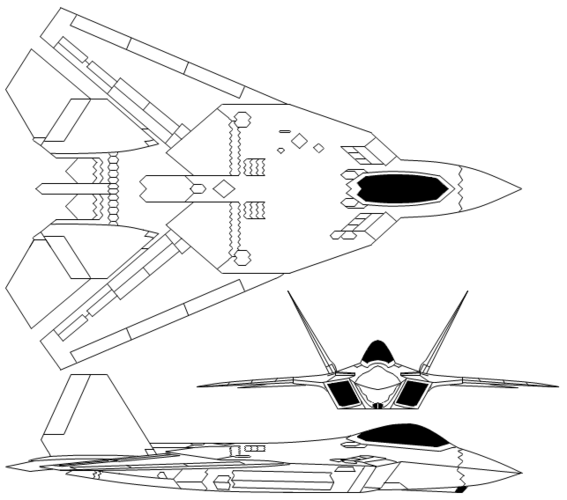
I have been analyzing the NATF-22 proposal, I think like you that it is a good alternative. But wouldn't swing wings increase the aircraft weight, requiring more powerful engines? How would it affect the radar signature? And to the maintenance of the plane?
Attachments
SSgtC
ACCESS: Top Secret
- Joined
- 13 July 2020
- Messages
- 1,303
- Reaction score
- 3,112
Yup. And those are all reasons it wasn't pursued. It would have been heavier, slower, less stealthy and more maintenance intensive than the USAF version. Though on the flip side, it would likely have been more maneuverable.

- Joined
- 1 April 2006
- Messages
- 12,276
- Reaction score
- 15,084
They just have studied it more and had some educational and practical background.
I have been analyzing the NATF-22 proposal,
And develop more powerful engines than the Raptor's F119? Perhaps that would have compensated for the differences in the flight envelope?Yup. And those are all reasons it wasn't pursued. It would have been heavier, slower, less stealthy and more maintenance intensive than the USAF version. Though on the flip side, it would likely have been more maneuverable.
I hope so, since I do not dedicate myself professionally to it. LOLThey just have studied it more and had some educational and practical background.
I have been analyzing the NATF-22 proposal,
SSgtC
ACCESS: Top Secret
- Joined
- 13 July 2020
- Messages
- 1,303
- Reaction score
- 3,112
Probably not. The F119 was already going to need a lot of work to navalize them. I doubt they're going to go higher thrust as well. Doing that runs the risk of decreasing the engine reliability. Look up all the hell the Navy went through with the Tomcat's development and the F401 engine to see why it's doubtful they'd try to uprate the engine.And develop more powerful engines than the Raptor's F119? Perhaps that would have compensated for the differences in the flight envelope?Yup. And those are all reasons it wasn't pursued. It would have been heavier, slower, less stealthy and more maintenance intensive than the USAF version. Though on the flip side, it would likely have been more maneuverable.
Was it? I recall that makeing the f-22 naval wouldn't have been that hard and that it was all the extra requirements that the navy had that made swing wing a "requirement" , something suspiciously not needed in any other naval aircraft sense the f-14.Adopt variable geometry wings. This was studied, heavily. And the conclusion was that only a swing wing would meet the performance requirements (namely excellent low speed characteristics and excellent high speed characteristics).
SSgtC
ACCESS: Top Secret
- Joined
- 13 July 2020
- Messages
- 1,303
- Reaction score
- 3,112
It "wasn't needed" because the Navy accepted huge tradeoffs in performance. Namely, the Hornet and Super Hornet's wings are very draggy, drastically reducing their speed and fuel efficiency (which in turn cuts deep into their range).Was it? I recall that makeing the f-22 naval wouldn't have been that hard and that it was all the extra requirements that the navy had that made swing wing a "requirement" , something suspiciously not needed in any other naval aircraft sense the f-14.
For a modern example, look at the F-35. To get the same range and payload capabilities as the Air Force version, the Navy version needs a wing that is almost 50% bigger (460sq ft vs 668sq ft) and needs to carry almost 2,000 pounds more fuel. The F-35C is also limited to only 7.5g while the A model can pull 9. The C model is also almost 2 tons heavier than the A when both are empty.
Now extrapolate that out to the F-22. To get the performance that the Navy wanted out of it, they pretty much had to go to a swing wing. Why? Speed. With full flaps, the Raptor lands at around 160 knots. The Tomcat? Right around 120 depending on what you're bringing back to the boat. Same for the Hornet and Super Hornet. And that's about as fast as the Navy wants any aircraft to land at on a carrier.
Could you get the Raptor to land at those speeds? If you had a much bigger wing with BLC and angle of attack changes, sure. But that much bigger, draggier wing? It just killed your top speed from Mach 2.25 to Mach 1.6-1.8. You also lost a lot range unless you want to increase how much fuel you're carrying. That's why the Navy said only a swing wing would meet their performance criteria.

- Joined
- 27 September 2006
- Messages
- 6,622
- Reaction score
- 7,442
As a fan of the Tomcat ever since first seeing the prototypes when I was still at school I have to admit to loving swing wing aircraft generally. There is no rational basis for this just a teenage crush.
So the swing wing F22 alongside the A12 Flying Dorito Avenger on a Nimitz class carrier is my idea of a perfect combat naval air wing. F18s are boring in comparison.
So the swing wing F22 alongside the A12 Flying Dorito Avenger on a Nimitz class carrier is my idea of a perfect combat naval air wing. F18s are boring in comparison.

EmoBirb
ACCESS: Top Secret
- Joined
- 18 January 2025
- Messages
- 2,693
- Reaction score
- 6,919
As a fan of the Tomcat ever since first seeing the prototypes when I was still at school I have to admit to loving swing wing aircraft generally. There is no rational basis for this just a teenage crush.
So the swing wing F22 alongside the A12 Flying Dorito Avenger on a Nimitz class carrier is my idea of a perfect combat naval air wing. F18s are boring in comparison.
Just a shame that variable geometry wings probably don't lend themselves well to low observability.

njiiaf
ACCESS: Confidential
- Joined
- 6 December 2021
- Messages
- 155
- Reaction score
- 511
The C model has considerably more range than the A.For a modern example, look at the F-35. To get the same range and payload capabilities as the Air Force version, the Navy version needs a wing that is
SSgtC
ACCESS: Top Secret
- Joined
- 13 July 2020
- Messages
- 1,303
- Reaction score
- 3,112
Not according to Lockheed Martin. It's a 10nm difference between the two. And to get that difference, the C has to carry almost 2,000 pounds more fuel.The C model has considerably more range than the A.
SSgtC
ACCESS: Top Secret
- Joined
- 13 July 2020
- Messages
- 1,303
- Reaction score
- 3,112
To be fair, i only mentioned the Tomcat to show the difference in landing speeds between the F-14D (which landed between 120 and 125 knots depending on configuration), and the F-22A (which the NATF was to based on) that lands at roughly 160 knots. To shave those 40 knots off would mean either accepting the same kind of tradeoffs that the Navy did with the Hornet and Super Hornet, or building it with a swing wing to keep the high end performance, and the required lower landing speeds. It's not a fun decision to make, and one that the Navy happily passed onAs a fan of the Tomcat ever since first seeing the prototypes when I was still at school I have to admit to loving swing wing aircraft generally. There is no rational basis for this just a teenage crush.
So the swing wing F22 alongside the A12 Flying Dorito Avenger on a Nimitz class carrier is my idea of a perfect combat naval air wing. F18s are boring in comparison.
njiiaf
ACCESS: Confidential
- Joined
- 6 December 2021
- Messages
- 155
- Reaction score
- 511
Those figures are for the C flying a carrier profile while the A is for a land based profile.Not according to Lockheed Martin. It's a 10nm difference between the two. And to get that difference, the C has to carry almost 2,000 pounds more fuel.
Scott Kenny
ACCESS: USAP
- Joined
- 15 May 2023
- Messages
- 19,511
- Reaction score
- 27,956
Yes.I have been analyzing the NATF-22 proposal, I think like you that it is a good alternative. But wouldn't swing wings increase the aircraft weight,
Maybe. (Note that the F-35C is significantly heavier but its engine still makes the same thrust as the -A model's engine) The F-14D was 43klbs empty, while the F-15C was only 29k, and they both have roughly-equally-powerful engines.requiring more powerful engines?
The RCS would be bigger. How much bigger is likely classified, but an order of magnitude from "bug" to "marble" isn't a terrible thing. Two or three orders of magnitude would be bad. It's my understanding that the F-22A is on the order of 7 orders of magnitude smaller RCS than the F-15, so F-22N RCS being 4 orders of magnitude smaller than the F-15 would put it roughly on par with the F-117 in terms of RCS size.How would it affect the radar signature?
@stealthflanker have you done any RCS guesstimates for the F-22N with swing wings? And/or any RCS guesstimates for the F-22 as is? You're the go-to guy with the RCS computations all set up, I'd like to get my thoughts confirmed by someone who understands the math a lot better than I do.
Yes, it'd take more maintenance.And to the maintenance of the plane?
It's worth noting that both Lockheed's NATF and A/F-X proposals featured a swing wing. It's why I'm not completely discarding the idea of the FAXX having a swing wing!
SSgtC
ACCESS: Top Secret
- Joined
- 13 July 2020
- Messages
- 1,303
- Reaction score
- 3,112
That's...kind of the point? That to make the F-35 carrier capable required trade offs. And flying in their respective environments and expected missions, the C model has only a 10nm difference in range from the A model, but has to carry significantly more fuel to do so.Those figures are for the C flying a carrier profile while the A is for a land based profile.
njiiaf
ACCESS: Confidential
- Joined
- 6 December 2021
- Messages
- 155
- Reaction score
- 511
Mate a carrier profile involves loitering around the carrier for 20min. If you have them flying the same profile the C has significantly longer rangeThat's...kind of the point? That to make the F-35 carrier capable required trade offs. And flying in their respective environments and expected missions, the C model has only a 10nm difference in range from the A model, but has to carry significantly more fuel to do so.
SSgtC
ACCESS: Top Secret
- Joined
- 13 July 2020
- Messages
- 1,303
- Reaction score
- 3,112
Dude, I'm not arguing with you over this. Not when the aircraft's manufacturer says it's only a 10nm difference.Mate a carrier profile involves loitering around the carrier for 20min. If you have them flying the same profile the C has significantly longer range
njiiaf
ACCESS: Confidential
- Joined
- 6 December 2021
- Messages
- 155
- Reaction score
- 511
Here dude, take it from an active duty USN pilot. View: https://www.reddit.com/r/WarCollege/comments/1ddtfkj/comment/l8791u6/Dude, I'm not arguing with you over this. Not when the aircraft's manufacturer says it's only a 10nm difference.
View: https://www.reddit.com/r/WarplanePorn/comments/ydooi8/comment/ittl9y9/

SSgtC
ACCESS: Top Secret
- Joined
- 13 July 2020
- Messages
- 1,303
- Reaction score
- 3,112
You're seriously quoting Reddit as a reliable source? I think I'm gonna take Lockheed's word over a Reddit postersHere dude, take it from an active duty USN pilot. View: https://www.reddit.com/r/WarCollege/comments/1ddtfkj/comment/l8791u6/
View: https://www.reddit.com/r/WarplanePorn/comments/ydooi8/comment/ittl9y9/
View attachment 770086
njiiaf
ACCESS: Confidential
- Joined
- 6 December 2021
- Messages
- 155
- Reaction score
- 511
Do you not see his name typed out on the MFD of the F-18? Jesus Christ, just believe what you want to believe at this point. Facts are just a suggestion after all/You're seriously quoting Reddit as a reliable source? I think I'm gonna take Lockheed's word over a Reddit posters
njiiaf
ACCESS: Confidential
- Joined
- 6 December 2021
- Messages
- 155
- Reaction score
- 511
Here's Billie Flynn F-35 test pilot stating "[F-35C's wing] was the wing that was meant to be on the aircraft" "It will stay on station for ever and ever" @1:11:52
View: https://www.youtube.com/watch?v=jUGND1LkUMI

F22 Fanatic
ACCESS: Restricted
- Joined
- 11 June 2025
- Messages
- 6
- Reaction score
- 0
Honestly, the canards could work, but it sacrifices a TON of stealth, so here my suggestion. The canard retreats into the wing after take off/landing, or retracts into the nose in a similar fashion to idk, landing gears. Not only would it lose less stealth than if it has permanent canards, but it also provides better lift for maneuverability. Let’s say there’s jet A and jet B. Jet A is currently dogfighting another jet with bad quality missles. Jet B has to take down the anti air systems to make way for jet A. Which one would be shot down first? Jet A which has permanent canards, or Jet B which has retractable canards?
SSgtC
ACCESS: Top Secret
- Joined
- 13 July 2020
- Messages
- 1,303
- Reaction score
- 3,112
That's just a swing wing with extra steps...Honestly, the canards could work, but it sacrifices a TON of stealth, so here my suggestion. The canard retreats into the wing after take off/landing, or retracts into the nose in a similar fashion to idk, landing gears. Not only would it lose less stealth than if it has permanent canards, but it also provides better lift for maneuverability. Let’s say there’s jet A and jet B. Jet A is currently dogfighting another jet with bad quality missles. Jet B has to take down the anti air systems to make way for jet A. Which one would be shot down first? Jet A which has permanent canards, or Jet B which has retractable canards?
F22 Fanatic
ACCESS: Restricted
- Joined
- 11 June 2025
- Messages
- 6
- Reaction score
- 0
lol no. It’s not a swing wing, the delta wing remains in place, but the canards are only for takeoff/landing, also if the pilot doesn’t require much stealth in certain operations.
SSgtC
ACCESS: Top Secret
- Joined
- 13 July 2020
- Messages
- 1,303
- Reaction score
- 3,112
First, the F-22 is not a delta wing. Second, what you're suggesting is, again, a swing wing with extra steps. Why? Well, what's a wing? A lift generating device. What is a canard? A lift generating device. What does that mean? Your canard's pivot point and mechanism need to be built exactly the same way as a traditional swing wing's pivot point and mechanism. So no saving weight or maintenance man hours over a swing wing by using, a swing wing.lol no. It’s not a swing wing, the delta wing remains in place, but the canards are only for takeoff/landing, also if the pilot doesn’t require much stealth in certain operations.
F22 Fanatic
ACCESS: Restricted
- Joined
- 11 June 2025
- Messages
- 6
- Reaction score
- 0
Sorry I meant clipped delta wings, also the canards would be primarily for maneuverability, not just take off/landing.
SSgtC
ACCESS: Top Secret
- Joined
- 13 July 2020
- Messages
- 1,303
- Reaction score
- 3,112
Which is the point of, again, using swing wings. And that doesn't change what canards are. They generate lift. By the time you add in the weight of the pivoting equipment, the weight of the canards themselves, and the recessed slots for them to retract into, at best you're weight neutral to a traditional swing wing. And you still need all the exact same maintenance tasks and man hours to maintain your retracting canards as you do a regular swing wing. You're basically combining all the negatives of having canards with all the negatives of having a swing wing.Sorry I meant clipped delta wings, also the canards would be primarily for maneuverability, not just take off/landing.
F22 Fanatic
ACCESS: Restricted
- Joined
- 11 June 2025
- Messages
- 6
- Reaction score
- 0
Still though, I think the f22v looks better than the f22. Just saying. Also, just wondering, where did you get these images for the concept?
Similar threads
-
Eureka ! a naval Northrop N-156
- Started by Archibald
- Replies: 17
-

-
 Three generations of Northrop naval fighters?
- Started by Lascaris
- Replies: 27
-

-
What if the AFVG was a success??
- Started by kpuscas
- Replies: 1