
Recently that_person submitted a FOIA request regarding a program to re-engine the Algol class FSS. These files are attached below, alongside an accompanying explanatory piece.
SeaLand Services, a now defunct American shipping line (RIP), constructed the eight 33-knot SL7-class container ships in the early 1970s. These 950-foot ships ran twin shafts on a 90MW steam powerplant. During their short operational life with SeaLand, they turned a steady profit, but continued operation became economically impossible due to the 1970s oil crisis. In the 50 years since, no similar ships have been built. These are truly unique vessels.
After the vessels were laid up, the USN took notice. Their size and speed made them perfect for surge sealift in REFORGER or Desert Shield-type operations. Because of this, the USN purchased all eight vessels in the 1980s, renamed them Algol-class Fast Sealift Ships (FSS), and had their center container hold converted to RORO garages. In this configuration, they have some 205k sq feet of RORO capacity.
They saw service in the Persian Gulf, before being transferred to MARAD’s Ready Reserve Fleet (RRF) in 2007. In the RRF, they would be retained to ROS-5 readiness at strategic outports across the CONUS, where they could be activated to provide initial “surge” sealift capacity in the event of conflict or national emergency. They remained in this status until 2025.
As of 2021, the vessels’ were in “great” material condition, and had only seen 11 years of sea time, despite being built in the early 70s. It was estimated that with proper refurbishment, their hull lived could be extended another 20-30 years. However, as the merchant marine transited away from steam, finding qualified engineers to run the aging steam plants became difficult. If the vessels were to be retained, their powerplants would require a complete refit. Knowing just how unique these vessels are, with no commercially available replacement for the high speed sealift role, MARAD commissioned TOTE Services (American shipping manager and vessel construction manager), and Bruce S. Rosenblatt & Associates (NavArc firm) to study “re-powering” options for the vessels. Phase I considered a wide variety of alternatives, ranging from automated steam, diesels, gas turbines, various combinations of the latter two, in direct and electric drive configurations. Eventually, it was decided to pursue an electric drive with three LM2500+ turbines. This would produce slightly less power than the existing plant, and thus speed would be reduced by 2-3 knots, but the vessels would be significantly easier to operate and maintain.
With the new plant selected, the study moved into Phase II. In order to remove the steam plant, the aft deckhouse would have to be removed. The forward pilothouse was also removed, and moved to a new aft deckhouse.
The cranes and mooring gear would also be replaced, a turtledeck built over the bow to protect against spray, and the aft container holds converted into RORO space. Total capacity expanded from ~205k to ~340k sq feet, just 50k less than a purpose-built LMSR (~7 knots slower).
Phase II came out to ~$373M in FY22 dollars, and MARAD asked for a more austere option to save on cost.
Phase III retained the basics of Phase II, but scaled down. The powerplant was reduced to 2x LM2500+G4s, further reducing speed (60MW vs 83MW). The aft container holds would still be converted to RORO garages, but these would not extend all the way to the keel. Total capacity now totaled 280k sq feet. The turtledeck was also deleted in favor of a more basic breakwater. Mooring gear and cranes would merely be refurbished, not replaced.
Phase III came out to $300M in FY22 dollars, a $73M reduction, but was ultimately not pursued.
Note: In the documents, RORO capacities are given as Military Usable Space, a 75% modifier of total capacity, assuming 25% is lost to lashing, spacing, etc. The numbers in this write up at 100% capacity.
This option was ultimately not pursued, and instead USTRANSCOM opted for more readily available commercial alternatives, and new domestic RORO production. This represented the death of high speed sealift.
Just 1 domestic construction RORO, built to a commercial design, costs $600M in FY23 dollars, when near identical ships can be bought second hand for $90M/hull. This highlights why restarting domestic production merchantmen is a fools errand, and should not be pursued. Strategic sealift is ultimately a numbers and cost efficiency game, not about where the vessels are built.
The Re-Powering options were considered to expensive compared to commercial alternatives, and ultimately not pursued. All eight vessels have been listed as non-retention status, and two have already been sold off. This represents the loss of a commercially irreplaceable assets, and the last great American naval architecture project.
Pics of FSS arriving at Brownsville:
https://www.facebook.com/groups/PicturesOfPadre/posts/3019062998304116
https://www.facebook.com/groups/PicturesOfPadre/posts/3023360127874403
Help save an SL7 / FSS:
https://sl7expo.org
Documents obtained by that_person via FOIA request with MARAD, February 2026.
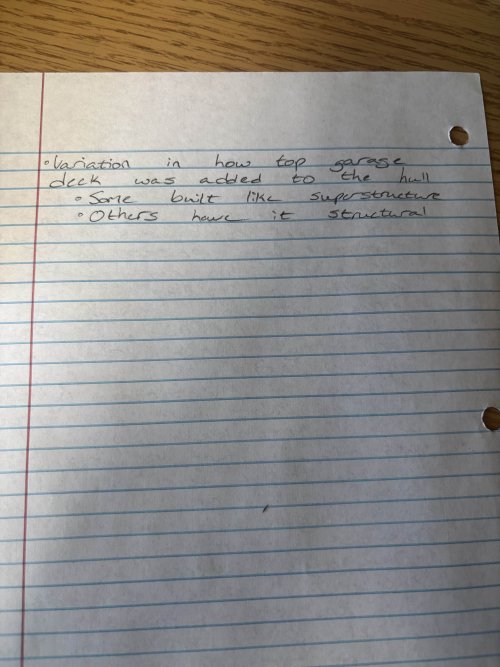
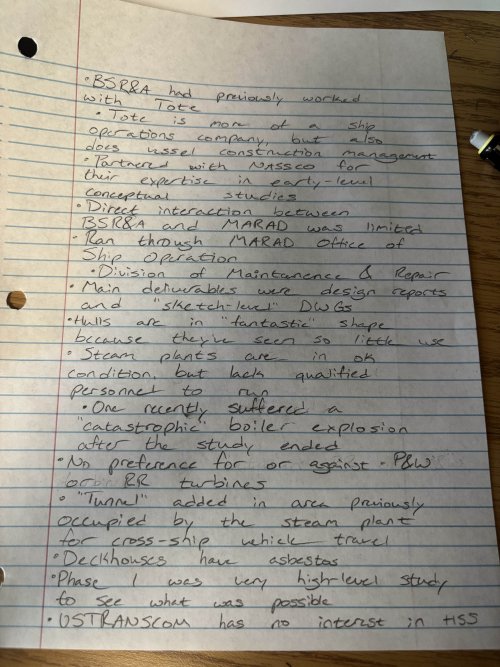
The lined notebook paper contains notes from interview with naval architect from BSR.
Also attached is a variety of general documentation pertaining to the SL-7s/Algols, including general arrangement details.
Enjoy
SeaLand Services, a now defunct American shipping line (RIP), constructed the eight 33-knot SL7-class container ships in the early 1970s. These 950-foot ships ran twin shafts on a 90MW steam powerplant. During their short operational life with SeaLand, they turned a steady profit, but continued operation became economically impossible due to the 1970s oil crisis. In the 50 years since, no similar ships have been built. These are truly unique vessels.
After the vessels were laid up, the USN took notice. Their size and speed made them perfect for surge sealift in REFORGER or Desert Shield-type operations. Because of this, the USN purchased all eight vessels in the 1980s, renamed them Algol-class Fast Sealift Ships (FSS), and had their center container hold converted to RORO garages. In this configuration, they have some 205k sq feet of RORO capacity.
They saw service in the Persian Gulf, before being transferred to MARAD’s Ready Reserve Fleet (RRF) in 2007. In the RRF, they would be retained to ROS-5 readiness at strategic outports across the CONUS, where they could be activated to provide initial “surge” sealift capacity in the event of conflict or national emergency. They remained in this status until 2025.
As of 2021, the vessels’ were in “great” material condition, and had only seen 11 years of sea time, despite being built in the early 70s. It was estimated that with proper refurbishment, their hull lived could be extended another 20-30 years. However, as the merchant marine transited away from steam, finding qualified engineers to run the aging steam plants became difficult. If the vessels were to be retained, their powerplants would require a complete refit. Knowing just how unique these vessels are, with no commercially available replacement for the high speed sealift role, MARAD commissioned TOTE Services (American shipping manager and vessel construction manager), and Bruce S. Rosenblatt & Associates (NavArc firm) to study “re-powering” options for the vessels. Phase I considered a wide variety of alternatives, ranging from automated steam, diesels, gas turbines, various combinations of the latter two, in direct and electric drive configurations. Eventually, it was decided to pursue an electric drive with three LM2500+ turbines. This would produce slightly less power than the existing plant, and thus speed would be reduced by 2-3 knots, but the vessels would be significantly easier to operate and maintain.
With the new plant selected, the study moved into Phase II. In order to remove the steam plant, the aft deckhouse would have to be removed. The forward pilothouse was also removed, and moved to a new aft deckhouse.
The cranes and mooring gear would also be replaced, a turtledeck built over the bow to protect against spray, and the aft container holds converted into RORO space. Total capacity expanded from ~205k to ~340k sq feet, just 50k less than a purpose-built LMSR (~7 knots slower).
Phase II came out to ~$373M in FY22 dollars, and MARAD asked for a more austere option to save on cost.
Phase III retained the basics of Phase II, but scaled down. The powerplant was reduced to 2x LM2500+G4s, further reducing speed (60MW vs 83MW). The aft container holds would still be converted to RORO garages, but these would not extend all the way to the keel. Total capacity now totaled 280k sq feet. The turtledeck was also deleted in favor of a more basic breakwater. Mooring gear and cranes would merely be refurbished, not replaced.
Phase III came out to $300M in FY22 dollars, a $73M reduction, but was ultimately not pursued.
Note: In the documents, RORO capacities are given as Military Usable Space, a 75% modifier of total capacity, assuming 25% is lost to lashing, spacing, etc. The numbers in this write up at 100% capacity.
This option was ultimately not pursued, and instead USTRANSCOM opted for more readily available commercial alternatives, and new domestic RORO production. This represented the death of high speed sealift.
Just 1 domestic construction RORO, built to a commercial design, costs $600M in FY23 dollars, when near identical ships can be bought second hand for $90M/hull. This highlights why restarting domestic production merchantmen is a fools errand, and should not be pursued. Strategic sealift is ultimately a numbers and cost efficiency game, not about where the vessels are built.
The Re-Powering options were considered to expensive compared to commercial alternatives, and ultimately not pursued. All eight vessels have been listed as non-retention status, and two have already been sold off. This represents the loss of a commercially irreplaceable assets, and the last great American naval architecture project.
Pics of FSS arriving at Brownsville:
https://www.facebook.com/groups/PicturesOfPadre/posts/3019062998304116
https://www.facebook.com/groups/PicturesOfPadre/posts/3023360127874403
Help save an SL7 / FSS:
https://sl7expo.org
Documents obtained by that_person via FOIA request with MARAD, February 2026.
The lined notebook paper contains notes from interview with naval architect from BSR.
Also attached is a variety of general documentation pertaining to the SL-7s/Algols, including general arrangement details.
Enjoy
Attachments
-
Attachment 02 - 085-002 - Removals Sketch 12-30-21.pdf30.8 KB · Views: 33
-
Attachment 03 - 234-001 - Propulsion Power and Endurance.pdf1.1 MB · Views: 25
-
Attachment 04 - 310-001 - EPLA 12-23-21.pdf116.6 KB · Views: 25
-
Attachment 06 - 673-001 - MUS Drawing.pdf187 KB · Views: 22
-
Attachment 07 - 673-002 - Cargo Paths 12-30-21.pdf136.5 KB · Views: 20
-
Attachment 08 - 101-001 - FSS Scantlings 12-29-21.pdf261.1 KB · Views: 17
-
Attachment 09 - 096-001 - Weight Curves 12-22-21.pdf1.2 MB · Views: 16
-
Attachment 10 - 096-002 - SWBS Weight Estimate 12-17.pdf972.9 KB · Views: 15
-
Attachment 11 - 097-001 - CargoMax - Max RORO.pdf2.1 MB · Views: 14
-
Attachment 12 - 097-002 - CargoMax - Max Containers.pdf2.1 MB · Views: 15
-
Attachment 13 - 097-003 - CargoMax - Ballast.pdf2.1 MB · Views: 15
-
Attachment 14 - 097-004 - CargoMax - Towing.pdf282.4 KB · Views: 15
-
Attachment 15 - 301-001 - Electrical One Line.pdf155 KB · Views: 14
-
Enclosure (1) Outboard Profile Comparison.pdf109.9 KB · Views: 18
-
Enclosure (2) FSS General Arrangement Comparison.pdf7.5 MB · Views: 19
-
Enclosure (3) FSS General Arrangement Conversion.pdf1.2 MB · Views: 16
-
Enclosure (4) FSS General Machinery Arrangement Comparison.pdf1 MB · Views: 16
-
Enclosure (5) FSS Conversion Preliminary Weight Estimate.pdf985.6 KB · Views: 16
-
Enclosure (6) FSS Major Conversion Determination Narrative.pdf234.7 KB · Views: 15
-
FSS Feasibility Study Propulsion Updates [May 28, 2021].pdf1.9 MB · Views: 16
-
FSS Gas Turbine Electric Propulsion Option [June 7, 2021].pdf1.2 MB · Views: 14
-
FSS Major Conversion Feasibility Study Update Report [July 30, 2021].pdf5.4 MB · Views: 14
-
FSS Military Useful Space Report 6.18.21.pdf2.3 MB · Views: 16
-
FSS Phase II Re-Powering Feasibility Study.pdf3.5 MB · Views: 14
-
FSS Re-Powering Phase II GA.pdf1.2 MB · Views: 16
-
FSS Re-Powering Phase II Machinery Arrangement.pdf2.3 MB · Views: 15
-
FSS Re-Powering Phase III GA and Machinery Arrangement.pdf1.8 MB · Views: 14
-
H2-2200243.pdf195.7 KB · Views: 14
-
MARAD request USCG MSC determination (signed).pdf205 KB · Views: 14
-
Reference (a) PRG.GEN-06.2021.01.14.Major Conversion Determinations Letter.pdf297 KB · Views: 16
-
Conversion of SL-7 container ships (1).pdf1.2 MB · Views: 21
-
Algol General Arrangement.pdf3 MB · Views: 22
-
Algol Capacity Plan.pdf3.4 MB · Views: 20
-
 CEC89272-864C-436D-8F88-960BAE6C308B.jpg9 MB · Views: 25
 -
 FB8D5346-0217-4232-A1D5-0E3E7B4ECF25.jpg9.6 MB · Views: 25


