Lockheed Martin Vectis CCA

My gripe is why talk about it now if it’s two years from flying? Perhaps it’s a style difference w current LM leadership - but quiet conversations with customers over the next two years and then releasing a video of it actually flying and doing stuff would have been a lot more credible. Assuming it flies in two years….

Because this creates buzz and support for the effort both internally and externally. And because this is not a 'top secret' classified program and LM is allowed to and able to publicly talk about it, CMMT, SpeedRacer and other company efforts and investments - something that it needs to talk about and share with its investors and customers alike. There are not a lot of skunk works programs they are able to openly talk about.

Folks are getting tied up with the two years to flight milestone. The USAF appears to be nowhere near finalizing its future CCA requirements for what follows the current two increment 1 designs. Being too early might mean they miss capturing some of those requirements even if the AF moves towards higher end systems. This seems to be timed for a particular post increment 1 CCA program in which case a 2 year design, development and prototyping effort seems just about right and would pretty much put them at the front of the line, or close to it, in terms of competitor OEMs flying higher end / 'more survivable' CCA candidates.
 
So Vectis must be for CCA Increment 2. NG and Boeing are also pursuing CCA I2.

CCA Increment I
General Atomics YFQ-42
Anduril YFQ-44

CCA Increment II
LM Vectis
NG TBD
Boeing TBD
How about the Kratos Thanatos, isn't that for Increment 2 as well?
 
My gripe is why talk about it now if it’s two years from flying? Perhaps it’s a style difference w current LM leadership - but quiet conversations with customers over the next two years and then releasing a video of it actually flying and doing stuff would have been a lot more credible. Assuming it flies in two years….
We were talking about F-47 years before it's about to take to the skies, something that presumably hasn't even happened yet. In terms of development to announcement to first flight two years is actually rather short imo. Especially given that Lockheed Martin is working on various known and unknown projects simultaneously.
 
@bring_it_on no doubt you listed good reasons for any other legacy aerospace company to do what LMT just did, but my point is hot off the heels of the GAO report sometimes keeping your head down and saying nothing to keep a low profile until there’s a tangible way to change the narrative (like BA w EX and F-47 after the MAX/KC-46/T-7 challenges or even NOC w B-21).

Nonetheless, you make good points about engaging stakeholders but we simply differ in weighing how LMT does that.

Whatever the reasons, the bottom line is Lockheed and Shield AI ended up doing two similar social media stunts that aren’t going great in terms of how they are being received in the moment, which is the ultimate phenotypic assay readout for a social media effort, make no mistake about it. It’s like a C grade has been actor and a A++ multiple Oscar winning actor being caught on the same red carpet wearing the exact same thing that was controversial at best and silly at worst. It was a win for Shield and a loss for LM that they did the same mid reveal garbage; Shield should be ecstatic and LM PR department should be getting a Ferrari NASCAR earful from JT!

If LMT want to engage strategic partners, they could easily do that in person. the more they tried to keep it quiet the more people would talk, and the right kind of intrigue would have a better chance of building. Instead they copy pasta’d a shoe drop.

If they want to get their stock out of the shitter during the greatest defense stock bull market in at least 30 years, then aside from firing Jim and replacing him with someone with enough engineering and production experience to call bullshit on her own people, a simple analyst day in DFW or California - perhaps one for covering analysts and another for serious US institutional investors - are simple ways of giving those people a glimpse of the capabilities that would enable the production of this CCA, which in the end matters a lot more than what particular CCA one makes. But instead they showed color enhanced CFD animations.

That’s kinda what I was really saying but I take and like a lot of the points you made. As I said, it’s a management and corporate style and approach I take issue with, which normally would be bar talk but again look at their equity ownership - just a quick and dirty look but it’s ETFs and retail until you get to CapRe who owns less than 1.5% and the last filing shows them selling. compare that w BA or NOC. Fundamental institutional investors don’t seem to want to own LMT in the way they want to own other aerospace companies. Stocks are not everything, and may not mean much, but sometimes they can say a lot about things. For the record, the bombastic comments made by Jim on the last call suggests he gives zero foxtrots, so it’s all actually very consistent, but disappointing to me bc im old enough to want all three US legacy aerospace firms alive and kicking.

Also your last paragraph really hit home bc I just read a Code One archive article about LMs ATF winning strategy to allow the customer to have input on critical trades as a way of arriving at a final concept vs presenting a final concept with those critical trades already made. Point v well taken. Hopefully LM crams a beautiful CCA down my throat.

 
Last edited:
@bring_it_on no doubt you listed good reasons for any other legacy aerospace company to do what LMT just did, but my point is hot off the heels of the GAO report sometimes keeping your head down and saying nothing to keep a low profile until there’s a tangible way to change the narrative (like BA w EX and F-47 after the MAX/KC-46/T-7 challenges or even NOC w B-21).

What does the GAO report have to do with Vectis? Why would LM not benefit from publicizing internal investment to develop advanced combat aircraft and capabilities, at its own expense, if it was just on the receiving end of a negative GAO report? LM is already paying a cost due to F-35 delays. They are not receiving their full payments and the services have slashed orders and will likely not be buying previously stated quantities. That's all lost revenue. More delays in the future will lead to even more of the same.

As someone else wrote, they did not 'reveal' this for internet forums. No one really cares about us really to do that. They did it for, government customers, investors, and other internal and external stakeholders. Having lost Increment 1 CCA, and not been selected to move forward on NGAD, highlighting something like this (a future program that the company is investing its own funds to mature and demonstrate capability) seems like a very logical thing to do. The AFA event this week provided them a platform to do so. Its that simple really. Other things they can reveal are out of their control from an information release and timing standpoint. That includes their classified programs, and other possible plans on government funded programs (like the F-35 5+ gen upgrades). Highlighting a relatively small IR&D program seems logical.
 
Last edited:
Autonomous Collaborative Platform is the UK MoD term for a CCA, so we can have a good guess where this is aimed.
Not quite: ACP is a USAF term. CCA is a subset of ACP.

Or they're all just drones.
 
If your operating area can be covered by stand in CCAs, you might be able to just transition between different webs of CCA networks that are loitering or are launched to support incoming manned fighters as needed. Granted itll still be highly contested and how well this idea works depends on how many stand in CCA type platforms you can launch and how wide an area you can cover, but this is the only way I see subsonic CCAs working.

I dont believe that something as glaring as lacking supersonic speed would be overlooked by planners nor do I think its difficult for any number of these competitors to build a supersonic CCA. The choice appears to be deliberate with incr 1 and increasingly incr 2. The military also sees fine with subsonic CCAs so... there must already be plans, doctrines and tactics developed to use subsonic CCAs.

I think it depends on what detection range is envisioned. If it’s a knife fight in a phone booth, high performance is helpful but not decisive. If engagements are longer ranged, then the higher performance UAV can fire and potentially evade return fire with energy maneuvers that its opponent cannot duplicate. AAMs with wider ‘no escape zones’ will extend the range at which higher performance is only a modest benefit. The downside to supersonic performance is of course cost, and presumably platform numbers.

That said, US planning might also make STOL performance a major consideration, where as the PLAAF can reasonably assume it has sufficient airfields in most any hypothetical situation.
 
higher performance UAV can fire and potentially evade return fire with energy maneuvers that its opponent cannot duplicate.
That can be true if it's a smaller or limited engagement, but with the kind of numbers top rate air forces want to procure CCAs and all the larger to medium tiers of drones types in , even if you are defending returning fire in a supersonic aircraft, you might well maneuver into the sights of another platform besides the one(s) you are engaging. With stuff like long shot, Vbat sized ISR drones, X-58 etc. these all seek to open different lines of engagement that makes it extremely hard to just have a geometrically and directionally localized fight. At least that's what comes to mind whenever ShieldAI or GA says they are "creating dilemmas" for enemies. All of this predicates on coordination and sustainence though. Without these two, you'd be better off going with supersonic CCAs.
 
That can be true if it's a smaller or limited engagement, but with the kind of numbers top rate air forces want to procure CCAs and all the larger to medium tiers of drones types they have, even if you are defending returning fire in a super sonic aircraft, you might well maneuver into the sights of another platform besides the one(s) you are engaging. With stuff like long shot, Vbat sized ISR drones, X-58 etc. these all seek to open different lines of engagement that makes it extremely hard to just have a geometrically and directionally localized fight. At least that's what comes to mind whenever ShieldAI or GA says they are "creating dilemmas" for enemies.

Yes, and though there is very little discussion on sub CCA UAVs by USAF, we know those are in development too for the NGAD system of systems. At a minimum these likely include ESM/ECM/IRST sensor platforms, but they might also include Long Shot style weapon delivery vehicles. Especially with the increased range of AIM-260, it might be the case that supersonic performance is of very limited value compared to total numbers, sensor integration/fusion, and over arching control software.
 
As for Victus, I get a meh feeling. What does it bring to the table over a half dozen similar systems already actively flying? Modest LO improvements?
 
Addendum to the above: communication links between UAV and manned aircraft, or even orbit, are also likely another major enabler of NGAD UCAVs. Based on what I’ve seen so far I think manned local control is an initial step before satellite control plus local automation, with manned controllers being a fallback position in the case of interruptions of low latency LEO connections. My personal guess. The first SDA comsats launched a week or two ago, and incr1 should continue to launch almost ever month for ten launches, and supposedly incr2 is still on time (incr1 was delayed a year for supply chain reasons) which would mean it basically starts launching as soon as Incr1 is orbiting. By the end of 2027, there should be several hundred SDA LEO comsats, on top of fallback commercial constellations like Starlink.
 
As for Victus, I get a meh feeling. What does it bring to the table over a half dozen similar systems already actively flying? Modest LO improvements?
It seems to have some more exquisite sensors in addition to being more stealthy.
Addendum to the above: communication links between UAV and manned aircraft, or even orbit, are also likely another major enabler of NGAD UCAVs.
Also in regards to more higher end CCA/UAVs, I read another article from Air and Space Forces Magazine today that talks about taking the computing to the edge of the network so as to not overwhelm the information throughput the satellites can handle. I think the capability is natural and complementary to the communication links and it is another reason to have higher end UCAVs.

The idea is that most of the time sensors capture 90% noise and 10% actual targets. Yet often times its feeding all of that information back to a processing node (a satellite image is what they talked about, but we can think of optical and IR photos and videos that need to be processed for target recognition, classification and engagement). This takes up a lot of the precious bandwidth you get with the SDA's satellite layer especially under strenuous conditions of a peer war.

So there's a lot of value in moving that processing burden away from space or ground based processing centers towards all kinds of edge nodes that already include your manned fighters, but will also include all manners of UAVs. I expect CCAs to take on that processing burden and the share they takek on scales with their cost. That will greatly speed up the engagement loop, highly compress information packets and also have sporadic data uplinking without the need to bounce huge and persistent chunks of data back to some out of theater computing / processing node, then bounce the result back. Given the sheer amount of data even a single node can capture, you would probably have some AI filtering actual targets from noise, then pass only the useful information.

So for vectus, given that speed and kinematic ability isn't a priority, then I think the majority of the cost could go into having a full suite of sensors in addition to being a more powerful processing / command node. Not sure how well incr 1 CCAs do this though.

Further edit: I know all manned fighting units already do this to some extent, but given the sheer amount of unmanned systems coming online, even manned fighters may or may not have enough processing power to adequately perform the information processing being gathered by so many unmanned nodes in real time.
 
Last edited:
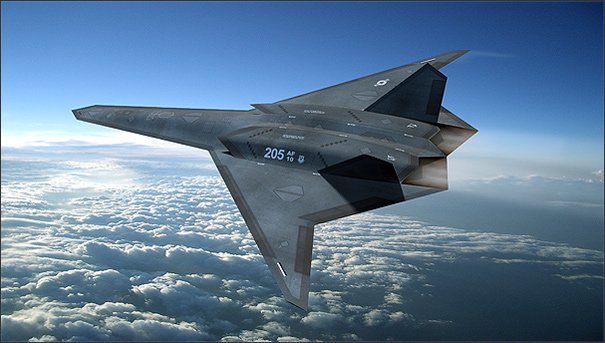
7. Airbus CCA and Vectis have a very unique configuration* traced to LM (as explained, for example, in TWZ piece)
Food for thought, makes me wonder where the X-9 Ghost design from Macross Plus (1994) comes from that predates them. Considering the necessary mechanical design work for the toy that needed to be done before any storyboard drawing & planning are made let alone actually screen footage drawing... at least 2 years would have gone into pre-work. And since it's inspired by the YF22 (1990 Sept.) the earliest time to start work would be in 1991. Any other source of inspiration for this particular planform must predate LM's revelation of the YF22 let alone any detail revelation of the design phase at the time. What other source could that be?
 
Also in regards to more higher end CCA/UAVs, I read another article from Air and Space Forces Magazine today that talks about taking the computing to the edge of the network so as to not overwhelm the information throughput the satellites can handle. I think the capability is natural and complementary to the communication links and it is another reason to have higher end UCAVs.

The idea is that most of the time sensors capture 90% noise and 10% actual targets. Yet often times its feeding all of that information back to a processing node (a satellite image is what they talked about, but we can think of optical and IR photos and videos that need to be processed for target recognition, classification and engagement). This takes up a lot of the precious bandwidth you get with the SDA's satellite layer especially under strenuous conditions of a peer war.

So there's a lot of value in moving that processing burden away from space or ground based processing centers towards all kinds of edge nodes that already include your manned fighters, but will also include all manners of UAVs. I expect CCAs to take on that processing burden and the share they takek on scales with their cost. That will greatly speed up the engagement loop, highly compress information packets and also have sporadic data uplinking without the need to bounce huge and persistent chunks of data back to some out of theater computing / processing node, then bounce the result back. Given the sheer amount of data even a single node can capture, you would probably have some AI filtering actual targets from noise, then pass only the useful information.
It's more for resilience and continuation to prevent the kill chain from being broken as well as loss of contacts and cued tasks which would incur re-establishing contact & re-evaluation etc. leading to unnecessary delays.

Sensor signal processing is always done on the fly in real-time due to the huge amount of data coming in and only ~1% is of interest for actual analysis & evaluation. I doubt video will always be transmitted from fighting CCA elements. On demand yes but not always. It's different for ISR specific elements ofc. I would say the limitation is with rather with the volume of tracked items within a certain area. Each CCA probaly won't track more than say a dozen contacts but a manned aircraft with 5 CCA would increase by 60 on top of its own track list. A node would reasonably have to deal with a few thousand if not more.

As for subsonic vs supersonic CCA it depends on the order of battle.
Expandable front line fighting is done by cheap subsonics CCA. While the presumely more expensive high-end stealthy supersonic CCA would be for direct escort where supersonic capability affords them to intercept away fom their ward. Vectis with its large wing area seems to offer extensive subsonic endurance or long-range ideal for escorting. This is ture for all the other subsoics, though. I presume it's supersonic capable due to its wing sweep angle.
 
I have no doubt a lot of edge processing is required…but if you have a fairly reliable level of local automation, something you likely require for local manned control by humans, perhaps constant connections to your UAV from orbit, at least in terms of rough target updates and target sets/behavior priorities, are not much more of a stretch?
 
It's more for resilience and continuation to prevent the kill chain from being broken as well as loss of contacts and cued tasks which would incur re-establishing contact & re-evaluation etc. leading to unnecessary delays.
Yeah probably
Sensor signal processing is always done on the fly in real-time due to the huge amount of data coming in and only ~1% is of interest for actual analysis & evaluation.
According to the article, the navy (and the army) sees value in pushing more computing to the edge apparently. A lot of targeting data is already processed by the sensing node, but the bigger picture of the tactical situation isn't always sensed or processed at the edge. Instead, it has to go out to space, make its way through the custody and transport layers, then come down to a central node - whether that's ground control, an E-7 or any other battle management node where the big picture is collated, processed, and the prescribed action determined before said commands are sent out back through the satellite network to their receivers.

However, if you have local, in theater edge processing nodes, your feedback loop can be a lot faster. You don't need to do the entire edge-space-ground-space-edge loop. You can synthesize the picture locally, and engaging the target won't require the delay it takes to go to ABMS and back. In fact, target engagment and ABMS updating would happen in parallel, with engagement completely unaffected by any delays going to and from ABMS via whatever hops are available.
I have no doubt a lot of edge processing is required…but if you have a fairly reliable level of local automation, something you likely require for local manned control by humans, perhaps constant connections to your UAV from orbit, at least in terms of rough target updates and target sets/behavior priorities, are not much more of a stretch?
From what I understand, even passing through the satellite layer with laser datalinks still requires tens of ms at best to hundreds and lower thousands of ms at worse. This doesn't account for the processing, which usually takes longer. The downlinking is even more problematic as it's subject to weather and or jamming. Instead, direct laser links between edge nodes would skip those things entirely. They are much closer, which means they can use direct links and are less likely to be intercepted and jammed. In addition, I don't really have a great idea of just how much data is being gathered and sythesized by the force that the DoD wants to field. If it's just CCAs, then maybe it won't be bad, but it'll most definitely include smaller ones possibly all the way down to your quad copter drones (it was demonstrated not too long ago that an F-35 engaged a target lased by a quad copter).

Having said all that, it would depend a lot too on what information you are passing. For target tracks, we may not need to pass targeting info constantly through the network. On the edge, as sensors move around, tracks could be handed off and custody can change. Yet, all that needs to be handed through the network is the current owner of the track, which only requires updating if ownership changes. When your shooter needs to shoot and have the weapon be guided, you'd only need to pass the shooter the contact handle of the current track's owner or a series of satellites that can bounce less frequent telemetry to get the weapon in the right direction. You only need constant and precise updating when the weapon nears it's target / the sensing node that has track custody. So all you have to do is just hand off contact to the sensing node via the node's Id / handle / positioning info and guidance becomes direct.
 
Yeah probably

According to the article, the navy (and the army) sees value in pushing more computing to the edge apparently. A lot of targeting data is already processed by the sensing node, but the bigger picture of the tactical situation isn't always sensed or processed at the edge. Instead, it has to go out to space, make its way through the custody and transport layers, then come down to a central node - whether that's ground control, an E-7 or any other battle management node where the big picture is collated, processed, and the prescribed action determined before said commands are sent out back through the satellite network to their receivers.

However, if you have local, in theater edge processing nodes, your feedback loop can be a lot faster. You don't need to do the entire edge-space-ground-space-edge loop. You can synthesize the picture locally, and engaging the target won't require the delay it takes to go to ABMS and back. In fact, target engagment and ABMS updating would happen in parallel, with engagement completely unaffected by any delays going to and from ABMS via whatever hops are available.
I think the big picture (processing) is meant to apply to contacts like hypersonic/ABM defense rather than locally limited range contacts & weapons. Because these require a deeper layered defense response over wider ranges and areas outside the local element's reach.

From what I understand, even passing through the satellite layer with laser datalinks still requires tens of ms at best to hundreds and lower thousands of ms at worse. This doesn't account for the processing, which usually takes longer. The downlinking is even more problematic as it's subject to weather and or jamming. Instead, direct laser links between edge nodes would skip those things entirely. They are much closer, which means they can use direct links and are less likely to be intercepted and jammed. In addition, I don't really have a great idea of just how much data is being gathered and sythesized by the force that the DoD wants to field. If it's just CCAs, then maybe it won't be bad, but it'll most definitely include smaller ones possibly all the way down to your quad copter drones (it was demonstrated not too long ago that an F-35 engaged a target lased by a quad copter).
At an orbit range of about 500 km the beam would end up as wide as at least 0.1 km. Power requirement for the satelite lasers presumely at least about 2 W. So it's not that bad or concerning. Most of the aicrafts are going to fly at or above altitude, hence above most thick clouds. It shouldn't be as much of an issue as close to the ground where the density is up to 3.2-10x higher.
I think keeping available bandwidth, hence, low delay, for the local elements is the reason to keep the theater related traffic & processsing away which often aren't necessary relevant to them.
Another reason might be the goal of having original source datatransfer packets kept going around rather than justs secondhand processed data from a node. Presumely, this is for allowing verification and redundant analysis checks.
 
Don't forget the bulk size of AI generating engagement solutions. Those can't be packed in a 707 or 767 derivative for now while still deemed a game changing capability essential for tomorrow. That means that part of the data would have to be send and back to CONU.
 
As for Victus, I get a meh feeling. What does it bring to the table over a half dozen similar systems already actively flying? Modest LO improvements?

Vectis is being designed as a highly survivable CCA. Survivability is highlighted in LMs announcement and the rendering they've shared is a tailess stealthy aircraft that appears to be consistent with that. As per the head of the Skunk Works, “Vectis provides best-in-class survivability at the CCA price point”. This goes to show the intent with the effort. Probably in addition to that it is also going to be able to pack a more sophisticated sensor suite over current Increment 1 systems.

I don't know half a dozen other already flying CCA systems that pack the level of survivability the Skunk Works team appears to be aiming to achieve with Vectis. But perhaps I simply haven't looked hard enough. If indeed there are that many such crafts already fltying, Lockheed would need to work on their design a bit more to offer the 'best in class survivability for the CCA price point' aim it is shooting for. They have two years to complete development and build initial prototype. And then they can further refine it based on lessons learnt so the final proposal to a future CCA acquisition program could be even better.
 
Last edited:
So far it seems like all US CCA iterations bifurcate into two types: munitions carrier (two AMRAAM, MALD type things or a JDAM) and a sensor or ISR bird.

i always thought an unmanned aircraft with the power generation capability to enable powerful stand in jamming would be interesting to the USN and USAF, even if the NGAD FoS is spinning up super MALD type systems that can provide some SDR enabled jamming capability or something like that. I wonder if it’s just not relevant, not possible, not cost efficient or some or all of the above.
 
Last edited:
i always thought an unmanned aircraft with the power generation capability to enable powerful stand in jamming would be interesting to the USN and USAF, even if the NGAD FoS is spinning up super MALD type systems that can provide some jamming capability. I wonder if it’s just not relevant, not possible, not cost efficient or some or all of the above.
A stand in EW platform the size of an Increment 1 CCA is probably not a great idea. Multiple smaller platforms that can be paired with larger CCA and manned platforms seems like a better option. That is where I think solutions like AirWolf, Mako, SpeedRacer derived CMMT (X/D) etc will play a role. Carried and launched by fighters, bombers, transport aircraft and in the future CCAs as well.

Having said that, an increment 1 class CCA with a sophisticated EW suite and countermeasures could play a role in escorting high value assets like tankers, AEW platforms and non stealthy aircraft. I think that is a better use for such a vehicle size (cost and performance) than stand in jamming payloads assuming these payloads are at the expense of other mission systems (to keep costs low).
 
So far it seems like all US CCA iterations bifurcate into two types: munitions carrier (two AMRAAM, MALD type things or a JDAM) and a sensor or ISR bird.

i always thought an unmanned aircraft with the power generation capability to enable powerful stand in jamming would be interesting to the USN and USAF, even if the NGAD FoS is spinning up super MALD type systems that can provide some SDR enabled jamming capability or something like that. I wonder if it’s just not relevant, not possible, not cost efficient or some or all of the above.

EW has changed massively in the last 5 years. Prepare to be wowed
 
i always thought an unmanned aircraft with the power generation capability to enable powerful stand in jamming would be interesting to the USN and USAF
In addition to what quellish said, EW isn't just about trying to directly disable your enemies systems. It's also done to degrade the entire EW environment your enemy wants to operate in. Having many many small stand-in jammers means trying to destroy enemy jammers would be like swatting mosquitos while running a fruit stand next to a swamp.
 
I think the big picture (processing) is meant to apply to contacts like hypersonic/ABM defense rather than locally limited range contacts & weapons. Because these require a deeper layered defense response over wider ranges and areas outside the local element's reach.
Definitely this, but doesn't ABMS also get used to manage the broader battlefield engagement too? If we go with what the air force wants, which is surging and creating temporary air superiority, then you'd still have to have big picture stuff being transmitted far back to the ABMS
I think keeping available bandwidth, hence, low delay, for the local elements is the reason to keep the theater related traffic & processsing away which often aren't necessary relevant to them.
This is what I think too. It's just that maybe the difference is okay we have N level of different tiered systems all sending info directly back to ABMS right now, but instead of that, lets process the information at a local level, then send a concise message back. Though this is just me guessing. The article really really doesn't want to make clear exactly what things are like now and exactly what kind of computing they want to push to the edge.
 
EW has changed massively in the last 5 years. Prepare to be wowed

I know you do not like to post specifics because random blogs steal your shit.

But kinda yes/no question that no one could make an article from me:

ECM will occur at the expendable/optionally recoverable end of the spectrum and be controlled from CCAs?

I get it if you feel no interest in responding; we have hardly had good interactions. And everyone else.
 
In addition to what quellish said, EW isn't just about trying to directly disable your enemies systems. It's also done to degrade the entire EW environment your enemy wants to operate in. Having many many small stand-in jammers means trying to destroy enemy jammers would be like swatting mosquitos while running a fruit stand next to a swamp.

I would just add, USAF has explicitly said it wants to confuse the difference between aircraft, CCAs, optionally recoverable UAVs

They want to make a lot of radar returns that may or may not be armed, and deliberately confuse the two.
 
Back
Top Bottom