First, the F-35 Joint Program Office is negotiating a $1.6 billion spare parts contract with Lockheed Martin.
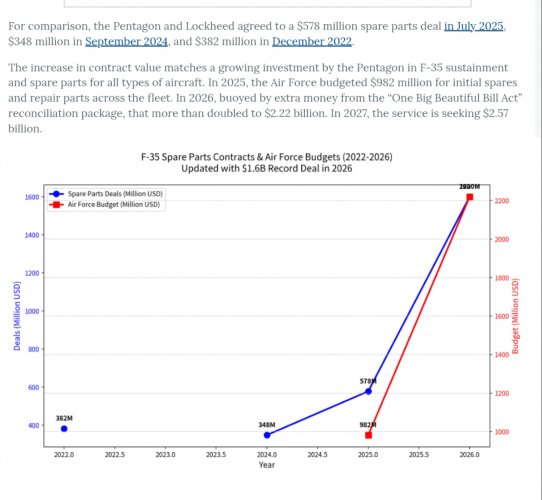
This refers to what is being described as the Pentagon's largest-ever F-35 spare parts contract, set for 2026 (Image 2).
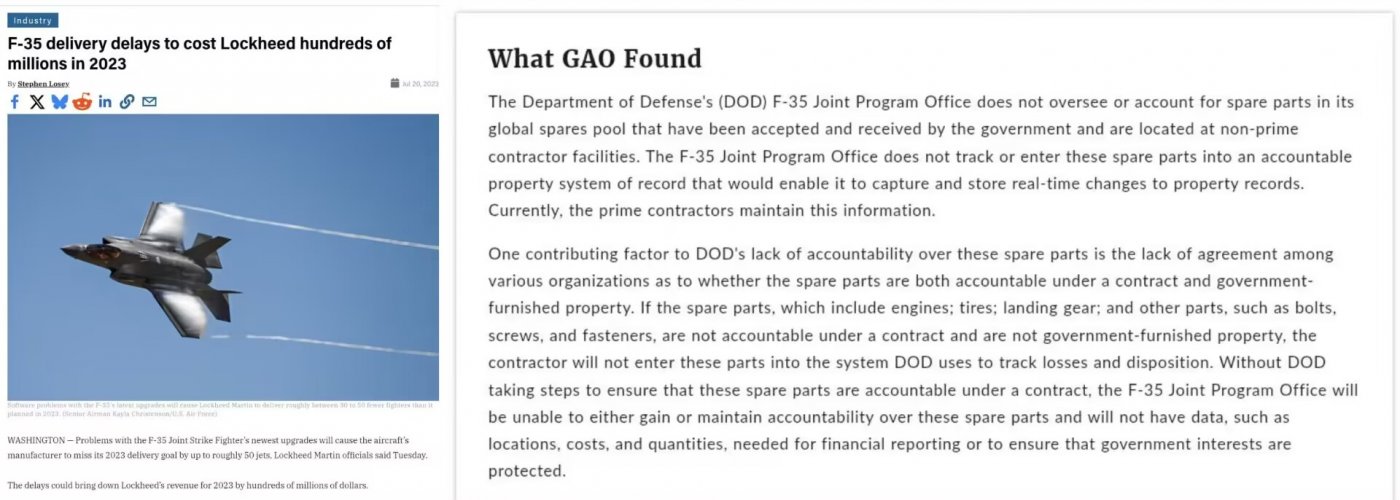
A 2023 GAO report revealed that over a million spare parts had gone missing or could not be tracked over the preceding years; additionally, issues with TR-3 hardware led to a suspension of F-35 deliveries (Image 3).
Image 2: The figure rose from $382 million in 2022 to $1.6 billion for 2026 (an increase of approximately 4.16 times); the $1.6 billion total includes about $1 billion in self-funded investment by Lockheed Martin.
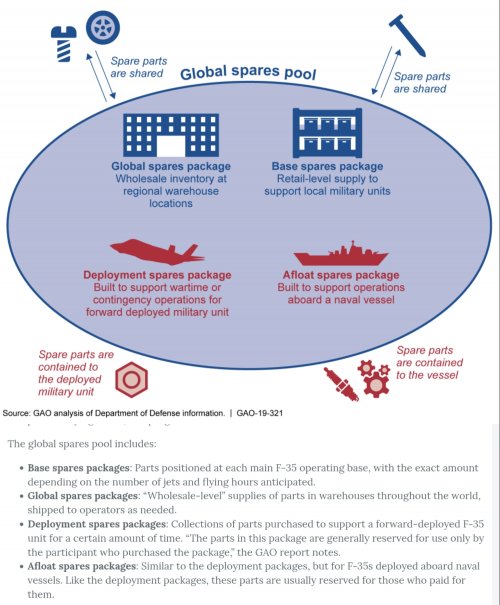
Contract categories: Base package, Global package, and Deployment/Carrier-based package.
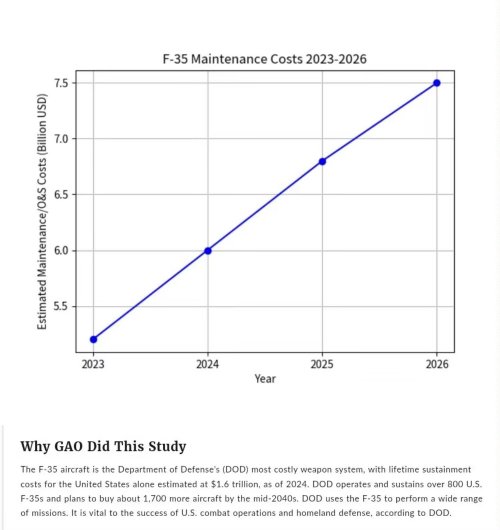
These measures address symptoms rather than root causes—specifically, low efficiency in production and sustainment (F-35 parts feature complex designs and extremely high maintenance costs; for instance, the estimated lifecycle cost for the U.S. fleet alone is around $1.6 trillion as of 2024).
Furthermore, the GAO has criticized both Lockheed Martin and the Pentagon for poor oversight of the global spare parts pool, citing issues such as the TR-3 hardware problems.
This refers to what is being described as the Pentagon's largest-ever F-35 spare parts contract, set for 2026 (Image 2).
A 2023 GAO report revealed that over a million spare parts had gone missing or could not be tracked over the preceding years; additionally, issues with TR-3 hardware led to a suspension of F-35 deliveries (Image 3).
Image 2: The figure rose from $382 million in 2022 to $1.6 billion for 2026 (an increase of approximately 4.16 times); the $1.6 billion total includes about $1 billion in self-funded investment by Lockheed Martin.
Contract categories: Base package, Global package, and Deployment/Carrier-based package.
These measures address symptoms rather than root causes—specifically, low efficiency in production and sustainment (F-35 parts feature complex designs and extremely high maintenance costs; for instance, the estimated lifecycle cost for the U.S. fleet alone is around $1.6 trillion as of 2024).
Furthermore, the GAO has criticized both Lockheed Martin and the Pentagon for poor oversight of the global spare parts pool, citing issues such as the TR-3 hardware problems.