- Joined
- 17 October 2006
- Messages
- 2,400
- Reaction score
- 1,293
"Death-defying moves"? What part of the 1920s is that headline-writer trapped in?


Our F-16s will have to retire soon after 2030. Happy to report that DSTA and @TheRSAF have completed their technical evaluation, and decided that the F-35 would be the most suitable replacement fighter. We will procure a few planes first, before deciding on a full fleet.


GTX said:It has long been speculated that Singapore would buy F-35s. It is also speculated likely to be F-35Bs.

sferrin said:GTX said:It has long been speculated that Singapore would buy F-35s. It is also speculated likely to be F-35Bs.
I'm wondering if South Korea will do a Japan and put F-35Bs on flat tops.
LowObservable said:"Death-defying moves"? What part of the 1920s is that headline-writer trapped in?
During a tree, the anti-spin logic engaged as a direct result of this unpredictability. The F-35 had gained a 3/9 advantage and the pilot desired to maneuver behind the bandit. A full rudder input had no result initially but after a few seconds the jet began to maneuver simultaneously to the command being abandoned and replaced with stick input. Once the delayed result appeared from the initial rudder input, the rudder was promptly re-input to encourage the aircraft to continue. A fantastic yaw rate followed, only to be spoiled by the anti-spin logic. The anti-spin logic was surprisingly pronounced. As has been experienced on other high AOA missions, there is ample control authority for arresting yaw rate. Whereas rudder inputs often feel sluggish/gradual or delayed, the anti-spin logic is immediate, abrupt, and forceful.
Therefore, there were multiple occasions where it would have been tactically sound to accept excessive energy loss in order to achieve a fleeting WEZ. The CLAW prevented such shot opportunities (and hindered defeating shots).
However, during a dynamic fight, where attention is focused on the bandit rather than the specific AOA, the lateral/directional response was often confusing. There were multiple times where a roll rate was expected yet not achieved or a body-axis yaw rate was expected and beta resulted. In other cases, the response changed during the maneuver as the AOA blended into this region.
Pitch rates were too slow to prosecute or deny weapons. Loads remained below limits and implied that there may be more maneuverability available to the airframe.
Although the F-35 is designed primarily for attack rather than air combat, U.S. Air Force and Lockheed Martin test pilots say the availability of potential margin for additional maneuverability is a testament to the aircraft’s recently proven overall handling qualities and basic flying performance. “The door is open to provide a little more maneuverability,” says Lockheed Martin F-35 site lead test pilot David “Doc” Nelson.
“It was an early look at any control laws that may need to be tweaked to enable it to fly better in future. You can definitely tweak it—that’s the option.”
“Pilots really like maneuverability, and the fact that the aircraft recovers so well from a departure allows us to say [to the designers of the flight control system laws], ‘you don’t have to clamp down so tight,’” says Nelson.
It's not that either, it's just a fact that popular segments of the media have mistakenly or purposefully contributed to the notion (sometimes very literally arguing) that the F-35 is vulnerable to 60 year old fighter designs in a dogfight. Kcran's mistaken / prior judgement of the F-35's agility is not a unique one. I've encountered countless people (and still continue to) who believe things like that the F-35 is inferior to F-16s and F/A-18s in any air-to-air work, that the F-35 has a shorter range than the F-16 & F/A-18, that the F-35 has no utility outside of being a strike aircraft, etc.LowObservable said:And it's not that the F-35 flies like a third-generation fighter (whatever that is) but that aircraft design is full of trades and compromises.
kaiserd said:sferrin said:GTX said:It has long been speculated that Singapore would buy F-35s. It is also speculated likely to be F-35Bs.
I'm wondering if South Korea will do a Japan and put F-35Bs on flat tops.
The equivalent Japanese ships are substantially larger with room for larger air wings and support.
While it’s very likely the Korean ships could carry and operate the F-35B that would have to be very small numbers and potentially could limit their helicopter complement to the point of having not enough of either.
Especially when taking into account everything that has to be brought along to sustain operations.
However a relatively token F-35B deployment aboard what historicaly would have been considered light carriers may become a new fashion for countries in the region with regional power aspirations.
The likes of India could (and have) done worse.
And it had been my understanding that Singapore’s interest in the F-35B was more related to concepts of dispersed deployment of them away from their small in number major airbases due to concerns related to their almost complete lack of strategic depth and potential vulnerability to first strikes.


More at the JUMP'Lethal' F-35A heading to Red Flag 19-1
HILL AIR FORCE BASE, Utah -- --
Pilots and maintainers from the 388th Fighter Wing are bringing the F-35A and ‘increased lethality’ as they take a lead role in Red Flag 19-1 at Nellis Air Force Base, Nevada,
From Jan. 26 - Feb. 15, approximately 200 Airmen from Hill AFB, including reservists from the 419th Fighter Wing, will participate in what is known as the Air Force’s premier combat training exercise.
The 388th FW debuted the F-35A Lightning II at Red Flag in 2017 and came away with a 20:1 kill ratio. The jet is even more capable now, pilots say.
“We have an upgraded software suite that has improved our sensor fusion. We’ve got an expanded flying envelope with more maneuverability. We have the ability to employ more weapons, including the 25-mm cannon,” said Lt. Col. Yosef Morris, 4th Fighter Squadron commander. “When you couple those things with the two years we’ve had to improve our tactics, we’re bringing a much more lethal F-35A to this Red Flag and ultimately to the battlefield.”
LowObservable said:When you've been in development for 22 years and "lethal" is still in quotes.... ;D

LowObservable said:When you've been in development for 22 years and "lethal" is still in quotes.... ;D
Yes, as have the USMC.Triton said:LowObservable said:When you've been in development for 22 years and "lethal" is still in quotes.... ;D
Haven't the Israelis flown their F-35s into combat?

LowObservable said:When you've been in development for 22 years and "lethal" is still in quotes.... ;D
LowObservable said:Btw, official dev did not start till 2001 as X-35 and X-32 were tech demonstrators, not "prototypes".
Factual correction: The X-35 and X-32 were, from Nov 1996 onward, part of a well-defined formal development program that was unambiguously planned to continue through to procurement, as is made abundantly clear here:
http://archive.defense.gov/Transcripts/Transcript.aspx?TranscriptID=3814
LowObservable said:Interesting...
In his first press conference since assuming the role of acting secretary of defense, Shanahan called concerns about him favoring Boeing "just noise."
"I am biased towards performance," he said. "I am biased towards giving the taxpayer their money's worth. The F-35, unequivocally I can say, has a lot of opportunity for more performance."
https://www.investors.com/news/secretary-of-defense-shanahan-boeing-bias-lockheed-f35-troops-colombia/
LowObservable said:"Performance". At least in this context...
• The program should:
1. Continue to work with the Services to prioritize and correct the remaining Category 1 and 2 deficiencies discovered during SDD.
2. Apply lessons learned from SDD and other programs for scoping the amount of C2D2 testing that can be done in laboratories and simulations, compared with the need for flight testing.
3. Reassess the C2D2 plan to ensure adequate test infrastructure (labs, aircraft, and time) is provided and modifications are aligned with other fielding requirements.
4. Assess the annual cost of software sustainment.
5. Determine the cause of the accuracy problems with the F-35A gun firing and implement a solution for increasing gun accuracy for the fielded aircraft.
6. Develop a consolidated and adequate ALIS test venue to ensure ALIS capabilities are fully tested prior to fielding to operational units
7. Conduct a study to determine the optimum balance of additional spare parts procurement versus adding depot capacity to repair spare parts, in order to decrease the percentage of NMC aircraft waiting for spare parts.
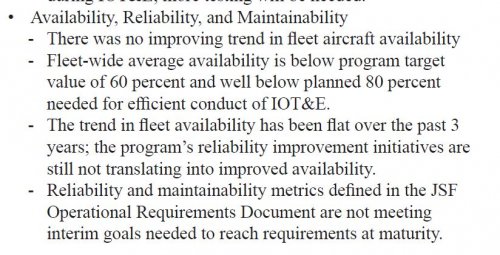
8. Continue implementing measures to improve fleet availability.
9. Make actual aircraft or appropriate hardware- and software-in-the-loop facilities available to enable operationally representative air vehicle cyber testing.
10. Continue conducting periodic rounds of cybersecurity testing and correcting open cyber deficiencies.
11. Continue testing the integrity and security of the JSF supplychain, expanding on initial testing conducted in 2018.
• The JPO should:
1. Complete contracting actions to procure a second F-35B ground test article in order to complete at least two lifetimes of structural durability testing to validate the wing-carrythrough structure.
2. Fund and contract for the 16-20 recommended signal generators called for in the JPO’s own 2014 gap analysis study.
3. Fund and contract for the necessary hardware upgrades to the USRL to support Block 4 development and testing.
Based on durability testing, the service life of early-production F-35B aircraft is well under the expected service life of 8,000 flight hours, and may be as low as 2,100 flight hours. Fleet F-35B aircraft are expected to start reaching their service life limit in CY26, based on design usage. The JPO will continue to use Individual Aircraft Tracking (IAT) of actual usage to help the Services project changes in timing for required repairs and modifications, and aid in Fleet Life Management.
LowObservable said:Thanks for summary, Rosie. (As in "Rosie Scenario")
However....
LowObservable said:https://en.wikipedia.org/wiki/Whataboutism

LowObservable said:The difference is that some people (including senior AF leaders and the SecDef) appear to have concerns relating to the ability to meet the goals of the NDS with the resources available, while others are interested in scoring debating points.
If you want to go and find foreign-aircraft availability data (in comparable format), knock yourself out, but it has less-than-the-cube-root-of-****-all to do with meeting the needs of the US forces, since nobody is saying that the USAF needs to go buy Typhoons.

https://en.m.wikipedia.org/wiki/Sunk_cost#Loss_aversion_and_the_sunk_cost_fallacyLowObservable said:https://en.wikipedia.org/wiki/Whataboutism