
You are using an out of date browser. It may not display this or other websites correctly.
You should upgrade or use an alternative browser.
You should upgrade or use an alternative browser.
Lockheed Martin F-35 Lightning II Joint Strike Fighter (JSF)
- Thread starter Triton
- Start date

seruriermarshal
ACCESS: Top Secret
- Joined
- 4 May 2008
- Messages
- 1,180
- Reaction score
- 587

- Joined
- 9 November 2008
- Messages
- 1,070
- Reaction score
- 177
price falls before $90M for first time ever in new deal (Final Lot11 Contract Deal)
More at the Jump
https://www.defensenews.com/air/2018/09/28/-price-falls-before-90m-for-first-time-ever-in-new-deal/
WASHINGTON — The price of a conventional model has fallen below $90 million for the first time through a deal between the Pentagon and Lockheed Martin announced Sept. 28.
The Defense Department’s joint program office and prime contractor Lockheed have finalized a $11.5 billion contract for the eleventh batch of s. The deal comprises 141 new jets and follows a handshake deal between the two parties that was announced in July.
The agreement pushes the cost of the conventional model — used by the U.S. Air Force and most foreign buyers — to $89.2 million per aircraft, a 5.4 percent reduction from the $94.3 million in the tenth batch of aircraft.
...
The government contracts separately for the ’s engines, the F135 built by Pratt & Whitney, but the pricing information issued Friday includes both the airframe and the engine. The parties reached a $2 billion agreement for the LRIP 11 engines in May.
More at the Jump
https://www.defensenews.com/air/2018/09/28/-price-falls-before-90m-for-first-time-ever-in-new-deal/
F-35B crashed in South Carolina. It is believed the pilot ejected safely.
https://www.marinecorpstimes.com/news/your-marine-corps/2018/09/28/an-f-35b-has-crashed-near-marine-corps-air-station-beaufort/
https://www.marinecorpstimes.com/news/your-marine-corps/2018/09/28/an-f-35b-has-crashed-near-marine-corps-air-station-beaufort/
- Joined
- 9 November 2008
- Messages
- 1,070
- Reaction score
- 177
All LRIP F-35 upgrades to Block 3F are fully funded.
More at the jump:
http://www.airforcemag.com/Features/Pages/2018/October%202018/F-35s-Behind-Line-Needs-More-Automation-Services-Plan-to-Mod-Early-Jets.aspx
Winter also said the services have “fully funded” modifying all their early-production F-35s to the Block 3 standard, but Winter said some may be upgraded to the Tech Refresh-2 and some to the Tech Refresh-3 configuration. The TR-2 includes the Integrated Core Processor, a “panoramic cockpit” display and memory system, and the -3 includes additional improvements. This will make a “considerable difference in reliability and availability” of the aircraft, Winter said.
More at the jump:
http://www.airforcemag.com/Features/Pages/2018/October%202018/F-35s-Behind-Line-Needs-More-Automation-Services-Plan-to-Mod-Early-Jets.aspx

- Joined
- 21 April 2009
- Messages
- 14,350
- Reaction score
- 9,433
http://alert5.com/2018/10/07/f-35b-connects-to-himars-for-rocket-shot/
B)The U.S. Marines were able to link the F-35B to a M142 High Mobility Artillery Rocket System (HIMARS) and help the HIMARS achieve a rocket shot by sharing of data.
F-35B fleet grounded.
http://aviationweek.com/awindefense/f-35b-fleet-grounded-following-september-crash
Lara Seligman tweets:
http://aviationweek.com/awindefense/f-35b-fleet-grounded-following-september-crash
Lara Seligman tweets:
BREAKING: JPO confirms all U.S. and international #F35 fighter jets are grounded while the enterprise conducts a fleet-wide inspection. Looks like problem is a faulty fuel tube within the engine. A source tells me this is not the same problem that grounded the F-35As a while back. According to the JPO, if suspect fuel tubes are installed, the part will be removed and replaced. If known good fuel tubes are already installed, then those aircraft will be returned to flight status. Inspections are expected to be completed within the next 24 to 48 hours.
TomcatViP said:Not good. Might impact other models it says.
I saw a follow-on that Italy already did their inspection and cleared their jets to operate.

FighterJock
ACCESS: Above Top Secret
- Joined
- 29 October 2007
- Messages
- 7,228
- Reaction score
- 8,538
And now the UK F-35's are grounded.
https://www.theguardian.com/uk-news/2018/oct/11/ministry-of-defence-grounds-fleet-of-16-new-f-35-fighter-jets
https://www.theguardian.com/uk-news/2018/oct/11/ministry-of-defence-grounds-fleet-of-16-new-f-35-fighter-jets
Oh, Fuel line... Again?!
Source:
MilitaryTimes.com: https://www.militarytimes.com/news/your-military/2018/10/11/dod-announces-global-grounding-of-all-f-35s/
Inspections are expected to be completed within the next two days, according to a statement issued Thursday morning. If “suspect” fuel tubes are installed, the part will be removed and replaced. If the tubes are deemed acceptable, those aircraft will return to flight status.
investigators to suspect there is a widespread problem with the advanced fighter’s fuel tubes.
“The U.S. Services and international partners have temporarily suspended F-35 flight operations while the enterprise conducts a fleet-wide inspection of a fuel tube within the engine on all F-35 aircraft,” the F-35 Joint Program Office announced in a statement Thursday morning.
“If suspect fuel tubes are installed, the part will be removed and replaced. If known good fuel tubes are already installed, then those aircraft will be returned to flight status. Inspections are expected to be completed within the next 24 to 48 hours.”
[...]
The issue as described by the JPO indicates the issue is believed to come from a subcontractor who supplied the fuel tubes for engine manufacturer Pratt & Whitney.
Source:
MilitaryTimes.com: https://www.militarytimes.com/news/your-military/2018/10/11/dod-announces-global-grounding-of-all-f-35s/
- Joined
- 9 November 2008
- Messages
- 1,070
- Reaction score
- 177
The RCPFH numbers for FY2019 just came in. For the most part they are stable (went up a little due to fuel costs) across the board except for the F-18C which shot up substantially. Also, the F-35B and C are on the list for the 1st time. I have added them to the graph. The plateauing of the F-35 numbers are related to the ongoing Parts/Depot issues.


- Joined
- 9 November 2008
- Messages
- 1,070
- Reaction score
- 177
More at the jumpNearly a day after the Pentagon grounded all U.S. F-35s, the 13th Marine Expeditionary Unit and all three active Marine air wings are back to normal F-35 flight operations.
https://www.militarytimes.com/news/your-marine-corps/2018/10/12/f-35s-with-13th-meu-and-marine-air-wings-are-back-to-normal-flight-operations-after-temporary-grounding-2/

- Joined
- 3 June 2006
- Messages
- 3,538
- Reaction score
- 6,212
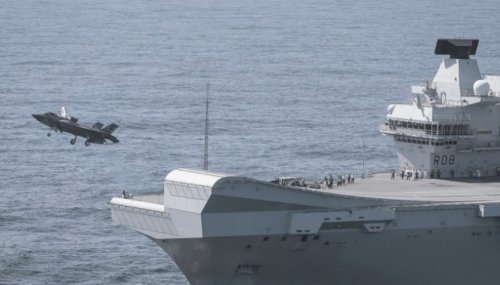
Twitter: https://twitter.com/HMSQnlz/status/1051489641340313601HMS Queen Elizabeth said:Disk Brakes Engaged!
Yesterday one of our #F35 performed the Worlds first Shipborne Rolling Vertical Landing.
With this capability @thef35 can land with increased fuel and munitions load resulting in less wastage.
Looks pretty cool too!
[Video]
Without air recon, as you say, the target has no way to detect anything but the point from where the battery did fire. Hence - to me - the offset firing position that leave all other components safe without having to be on the move. But obviously this video was shot during training.

- Joined
- 17 October 2006
- Messages
- 2,400
- Reaction score
- 1,293
It's well known that supersonic stealth fighters are the ideal tools for artillery spotting.

- Joined
- 3 June 2011
- Messages
- 20,896
- Reaction score
- 19,084
LowObservable said:It's well known that supersonic stealth fighters are the ideal tools for artillery spotting.
And that flying at 200 mph at 3,000 feet is the best way to avoid ground fire.
- Joined
- 9 November 2008
- Messages
- 1,070
- Reaction score
- 177
That only works if the aircraft is within WVR range and visual LOS of the arty piece. Counter-Battery radar can back-track the trajectory based on a ballistic arc calculations well after the shell clears any LOS issues (mountains, forests, etc)
If the munition is guided (GMLRS, Excalibur, etc) then this kind of calculation is not possible as it can alter it's ballistic arc in flight.
If the munition is guided (GMLRS, Excalibur, etc) then this kind of calculation is not possible as it can alter it's ballistic arc in flight.
LowObservable said:It's well known that supersonic stealth fighters are the ideal tools for artillery spotting.
Just because the F-35 can fly supersonically, doesn't mean it has to. But at least it can.
- Joined
- 9 November 2008
- Messages
- 1,070
- Reaction score
- 177
That video is showing an "icing on the cake" feature that is really nice to have since you are going to be in the area anyways. Obviously a high-endurance drone would be a better platform in the long run. However, most drones will not have the CPU power to properly analyze the feeds on such a large scale.
Btw, the new EODAS modules coming in 2023 will give 5x the resolution of current systems.
Btw, the new EODAS modules coming in 2023 will give 5x the resolution of current systems.
NUSNA_Moebius
I really should change my personal text
- Joined
- 26 May 2012
- Messages
- 256
- Reaction score
- 169
fredymac said:Odd. You would think this old video might cause some measure of caution in casting easy dismissals.
https://www.youtube.com/watch?v=fHZO0T5mDYU
I remember first hearing about that and couldn't help but glee at the idea of some Macross Plus level stuff finally entering the real world. Seeing right through the floor........


- Joined
- 19 July 2016
- Messages
- 4,814
- Reaction score
- 4,273
That would be the BaE P.125.

Grey Havoc
ACCESS: USAP
- Joined
- 9 October 2009
- Messages
- 24,500
- Reaction score
- 18,170
https://www.defensenews.com/air/2018/11/09/italy-signals-slowdown-on-f-35-orders/
F-35 and QE
https://youtu.be/1So6Snrw3tQ
(nice slowdown at the end of 35 rolling out the ski ramp)
https://youtu.be/t_cKiULCLKE
(no real interest)
https://youtu.be/x-E1nkBcUC4
And one of the video posted recently has this (below). What is this?
https://youtu.be/1So6Snrw3tQ
(nice slowdown at the end of 35 rolling out the ski ramp)
https://youtu.be/t_cKiULCLKE
(no real interest)
https://youtu.be/x-E1nkBcUC4
And one of the video posted recently has this (below). What is this?
Attachments

FighterJock
ACCESS: Above Top Secret
- Joined
- 29 October 2007
- Messages
- 7,228
- Reaction score
- 8,538
TomcatViP said:F-35 and QE
https://youtu.be/1So6Snrw3tQ
(nice slowdown at the end of 35 rolling out the ski ramp)
https://youtu.be/t_cKiULCLKE
(no real interest)
https://youtu.be/x-E1nkBcUC4
And one of the video posted recently has this (below). What is this?
It is the BlackSwift Hypersonic Cruise Vehicle as featured in Steve Pace's Skunk Works book, the program itself was canceled.
NUSNA_Moebius
I really should change my personal text
- Joined
- 26 May 2012
- Messages
- 256
- Reaction score
- 169
Was the rolling short landing ever attempted with the Harrier? Not sure if it was simply too dangerous to try (obviously easier with F-35B), or if it was because "Harrier carriers" were simply too small and couldn't afford to leave such space. The QE is pretty damn big, and well laid out for it's intended air compliment.

- Joined
- 6 September 2006
- Messages
- 5,316
- Reaction score
- 11,544
Britain has committed to another 17 F-35Bs, bringing the total order so far to 35.
https://www.flightglobal.com/news/articles/uk-confirms-new-deal-for-17-f-35bs-453689/
https://www.flightglobal.com/news/articles/uk-confirms-new-deal-for-17-f-35bs-453689/

Dragon029
ACCESS: Top Secret
- Joined
- 17 March 2009
- Messages
- 881
- Reaction score
- 449
https://www.navyrecognition.com/index.php/news/defence-news/2018/november-2018-navy-naval-defense-news/6689-japan-set-to-procure-f-35b-stovl-aircraft-for-jmsdf-izumo-class-helicopter-destroyer.html
The Japanese government has decided to procure the F35B short take-off and vertical-landing (STOVL) stealth fighter aircraft as part of the new defense plan to be outlined next month.
In February 2018, the Yomiuri Shimbun reported that Japan was planning to acquire 40 vertical takeoff and landing F-35Bs, which could be operated from these ships with some alterations. In March this year, the ruling LDP called upon the Japanese government to develop its own aircraft carriers and operate F-35B aircraft, which has been thought to include refitting the Izumo class.

Japan to order 100 more F-35 fighters from US
Nikkei staff writers
November 27, 2018 11:26 JST
TOKYO -- Japan is preparing to order another 100 F-35 stealth fighter jets from the U.S. to replace some of its aging F-15s, according to sources.
The plan can be considered a response to China's military buildup, as well as a nod to U.S. President Donald Trump's call for Tokyo to buy more American defense equipment. Japan already intended to procure 42 of the new fighters.
A single F-35 costs more than 10 billion yen ($88.1 million), meaning the additional order would exceed 1 trillion yen.
Japan's government plans to approve the purchase when it adopts new National Defense Program Guidelines at a cabinet meeting in mid-December. It will also include the F-35 order in its medium-term defense program, which covers fiscal 2019 to fiscal 2023. The government wants to obtain 42 F-35s as successors to its F-4s by fiscal 2024.
The 42 fighters Japan originally planned to buy are all F-35As, a conventional takeoff and landing variant. The additional 100 planes would include both the F-35A and F-35B, which is capable of short takeoffs and vertical landings.
At present, Japan deploys about 200 F-15s, roughly half of which cannot be upgraded. The Defense Ministry wants to replace the planes that cannot be upgraded with the 100 F-35s, while enhancing and retaining the remaining F-15s.
To accommodate the F-35Bs, the government intends to revamp the Maritime Self-Defense Force's JS Izumo helicopter carrier to host the fighters.
Japan's neighbors are busy introducing their own advanced military aircraft. China deployed its homegrown J-20 stealth fighter in February, and by 2030 some experts expect the country to build a fleet of more than 250 fifth-generation jets -- as the latest generation of fighters like the F-35 is known.
Russia, too, is expected to introduce its fifth-generation Sukhoi Su-57 in 2019, at the earliest.
To keep up, Tokyo believes it is imperative to significantly increase its procurement of the most sophisticated stealth jets.
At the same time, Trump has repeatedly urged Japan to purchase more American hardware and reduce the trade imbalance between the countries. Buying more of the high-priced fighters is a quick way to do that.
In September, Japanese Prime Minister Shinzo Abe told Trump, "Introducing high-performance equipment, including American [materiel], is important for our country to strengthen its defense capabilities."
Grey Havoc
ACCESS: USAP
- Joined
- 9 October 2009
- Messages
- 24,500
- Reaction score
- 18,170
https://about.bgov.com/blog/f-35-combat-testing-phase-begins-15-month-delay-pentagon/
Similar threads
-
Lockheed Martin F-16 Fighting Falcon News and Developments
- Started by seruriermarshal
- Replies: 882
-

-

-
 Lockheed JSF evolution: ASTOVL, SSF, CALF, JAST
- Started by Antonio
- Replies: 176
-
 USAF/USN 6th Gen Fighters - F/A-XX, F-X, NGAD, PCA, ASFS News & Analysis [2008- 2025]
- Started by Matej
- Replies: 10K