- Joined
- 25 June 2009
- Messages
- 15,515
- Reaction score
- 9,447
I am desperately trying to gather up information on an elusive French design team of the 1930s called L'Alcya.
It was officially established in January 1934 by Léon Levavasseur, son of the eponymous pioneer, an engineer from the Arts-et-Métiers institute, and a respected aircraft designer in his own right. The story of his short-live design office began in 1930 with the creation of the glider club Les Alcyons d'Antony by Edmond Gentil, with Levavasseur as their technical expert. The club is said to have organized glider training sessions for its first members using "the Rigault winch" and the "Alcyon glider".
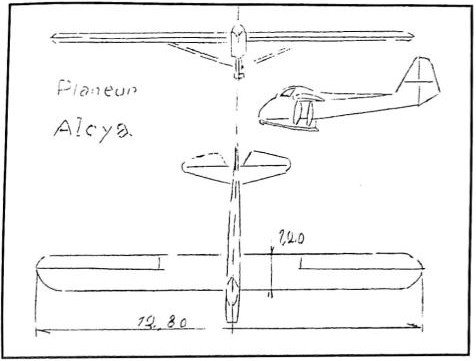
We'll talk a bit about Rigault later on, but that glider was Levavasseur's L.20 Alcyon. Was it an original design? Or was it inspired by the early Italian glider of the same name? I couldn't say, but it was a successful machine which had logged 500 launches by the end of 1931, before being revised in Rigault's workshop, notably by the addition of shock absorbers to the landing skid. It flew again in early 1932, but suffered a rough landing that resulted in the change of both spars and a few ribs, as well as a new fabric covering for the wing. Eventually, the Alcyon was sold to L'aile tendue, a gliding club located in Alfortville (south-east of Paris) which regularly flew it either from the Hameau de Mesly field in Créteil or at the Villeneuve-Prairie site—18 launches performed on January 27, 1935 alone. L'Aile Tendue had also set up a model airplane club, and was providing its young members with technical documents graciously provided by L'Alcya (Levavasseur's group was also going to add a similar club to its already broad field of activities).

Although a mere template for a children's cardboard model, Roland Claudel's RC 3 was probably
typical of the primary gliders flown by aspiring pilots at his Alfortville-based club.
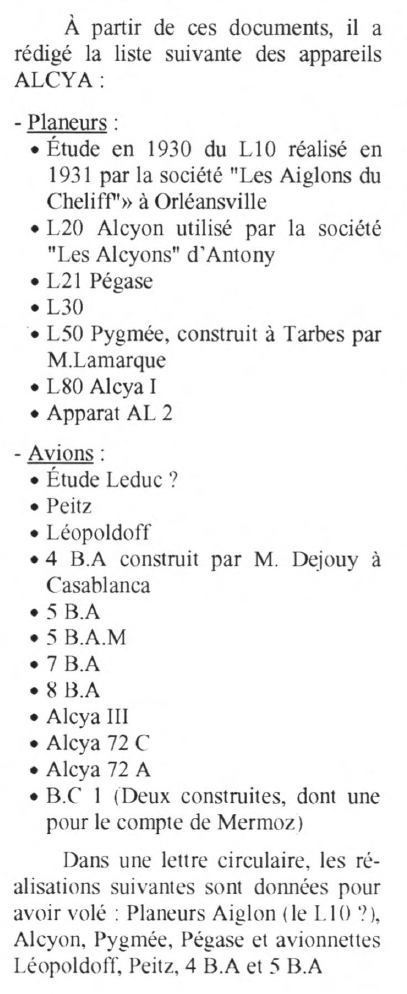
 Besides the L.20, Levavasseur also designed the L.10 Aiglon (eaglet) glider in 1930, which was built the following year by a group called Les Aiglons du Chéliff in Orléansville (French Algeria) (see photo, right). As early as 1931, Levavasseur was already working on a second school-type glider (likely the L.21 Pégase), as well as a "planeur de demi-performance", the L.30, which was to be tested during the following spring.
It was obvious that Les Alcyons was becoming much more than a simple flying club, and pretty soon, at Levavasseur's request, the senior members of the Alcyons club came together to form L'Alcya, with the purpose of experimenting with sailplanes, and more generally "to conduct all possible research or study profitable to the improvement of whatever material currently exists." The Alcya group, officially founded in January 1934, was encouraged to help individuals or flying clubs benefit from their experience and provide them with all technical details. It was officially based in Bourg-la-Reine (not far from Antony, south of Paris), with the board consisting of Levavasseur (from Paris) as president and technical director, Gibout (from Versailles) as vice-president, Rigault (from Antony) as Treasurer and Vayrac (also from Antony) as secretary. In order to keep all of its members connected, L'Alcya published a quarterly bulletin that was free of charge for them, and six issues had been published by mid-1935.
L'Alcya's very first task in the winter of 1933-34 was the creation of a "performance glider", with Rigault and Thomas in charge of building the wings, while Gibout was completing the fuselage.The name and/or designation of that sailplane is not established for certain, but it was probably the glider refered to as the L.80 Alcya I. Early in 1933, Levavasseur also designed the L.50 Pygmée glider, a 10-meter span man-powered glider to be built for use by the flying school and "experiments on human flight". This was a pedal-powered project supervised by Thomas, another member of L'Alcya, and was still in the final design stage two years later, but according to Claude Salaün in Le Trait d'Union, it was eventually completed and flown.
Les Alcyons and L'Alcya's activities didn't stop at gliders and sailplanes, however. Their work included the development of what we would now designate as "ultralight" aircraft, a field that the junior Levavasseur had always been interested in. The famous Léopoldoff L.3 was reputedly designed with the help of L'Alcya, but since it was designed in 1932 and first flown on September 27, 1933 (over three months before L'Alcya was officially created), it is more likely that Levavasseur and his friends helped Léopoldoff perfect the design while still in the Alcyons club. The collaboration may even have sparked the idea of creating a proper entity for similar collaborations.

The prototype and the production version of the Léopoldoff L.3 were practically two different aircraft.
It is most likely that part of the redesign resulted from the work of Levavasseur and his L'Alcya team.
 At least five other light aircraft of that era were created with the help of Levavasseur and L'Alcya:

"Looking for an aeronautical engineer liable to show interest in the construction of a small tourism light plane. R. Peitz, 47 rue des Bertauds, Rosny-sous-Bois."
Peitz found that aeronautical engineer in Levavasseur, who provided his technical expertise and the calculations that enabled Peitz to obtain the go-ahead from the S.T.I.Aé., the almighty authority that could make or break an aircraft; but when the type's approval took place in 1933, L'Alcya did not exist yet—it was still only Les Alcyons d'Antony, the gliding club!


The Peitz 101 parasol monoplane, which benefitted from Levavasseur's expertise, even before L'Alcya was founded.
L'Alcya produced a lot of studies and designs in its short existence, several of which, such the 7 B.A and 8 B.A, didn't leave the drawing board. One final design, however, was pretty much advanced at the time of Levavasseur's untimely death (at age 41): the Alcya 72-C, a two-seater school machine (and probably a development of the unbuilt Alcya 72-A). In its February 28, 1935 issue, Les Ailes presented the 72-C as "the most recent", fitted with "the latest aerodynamic and structural solution that were developed through previous types". They described the aircraft as "a machine with a low wing fitted within the fuselage, guyed by masts above." To stabilize the aircraft over its central wheel, "side crutches were controlled by the pilot along with the ailerons." The Alcya 72-C used a 35 hp engine, sufficient for cheap student training1. A week later, commenting upon Levavasseur's passing (on September 17, 1935, at the age of only 41), Les Ailes described the 72-C as "almost completed", adding that death had deprived the engineer of "the supreme satisfaction of watching the trials of his latest creation." But the machine was no longer heard of after that.
And so I appeal to all the forum members with a love for both aviation mysteries and vintage French aviation to have a look at their files... Any photos of the Alcyon? The Dejouy avionnette? The Alcya 5 B.A.? Or other Levavasseur projects not mentioned in this article? It would be neat to be able to further illustrate the short but meaningful career of L'Alcya!
1. A 60 hp engine was possible for more experienced students willing to obtain their licence, since a 360-meter climb in 3 minutes was required
It was officially established in January 1934 by Léon Levavasseur, son of the eponymous pioneer, an engineer from the Arts-et-Métiers institute, and a respected aircraft designer in his own right. The story of his short-live design office began in 1930 with the creation of the glider club Les Alcyons d'Antony by Edmond Gentil, with Levavasseur as their technical expert. The club is said to have organized glider training sessions for its first members using "the Rigault winch" and the "Alcyon glider".
We'll talk a bit about Rigault later on, but that glider was Levavasseur's L.20 Alcyon. Was it an original design? Or was it inspired by the early Italian glider of the same name? I couldn't say, but it was a successful machine which had logged 500 launches by the end of 1931, before being revised in Rigault's workshop, notably by the addition of shock absorbers to the landing skid. It flew again in early 1932, but suffered a rough landing that resulted in the change of both spars and a few ribs, as well as a new fabric covering for the wing. Eventually, the Alcyon was sold to L'aile tendue, a gliding club located in Alfortville (south-east of Paris) which regularly flew it either from the Hameau de Mesly field in Créteil or at the Villeneuve-Prairie site—18 launches performed on January 27, 1935 alone. L'Aile Tendue had also set up a model airplane club, and was providing its young members with technical documents graciously provided by L'Alcya (Levavasseur's group was also going to add a similar club to its already broad field of activities).
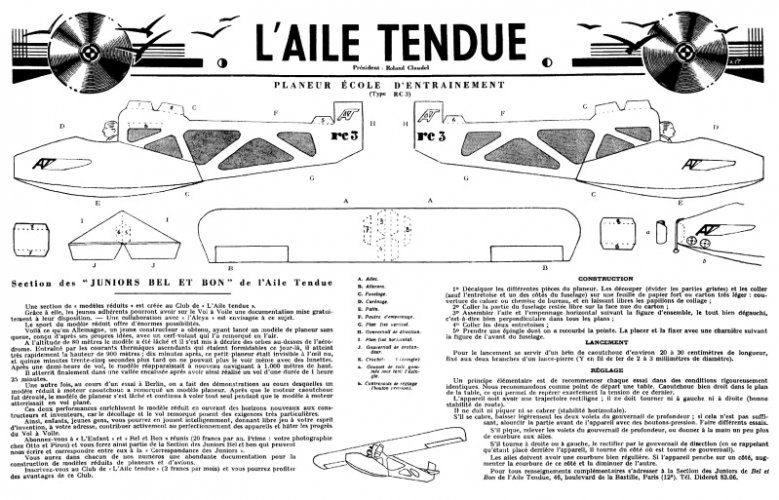
Although a mere template for a children's cardboard model, Roland Claudel's RC 3 was probably
typical of the primary gliders flown by aspiring pilots at his Alfortville-based club.
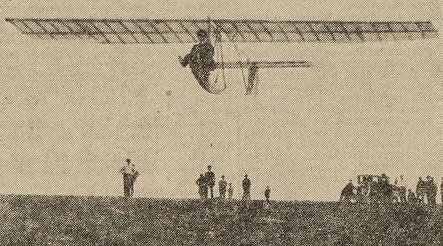 Besides the L.20, Levavasseur also designed the L.10 Aiglon (eaglet) glider in 1930, which was built the following year by a group called Les Aiglons du Chéliff in Orléansville (French Algeria) (see photo, right). As early as 1931, Levavasseur was already working on a second school-type glider (likely the L.21 Pégase), as well as a "planeur de demi-performance", the L.30, which was to be tested during the following spring.
It was obvious that Les Alcyons was becoming much more than a simple flying club, and pretty soon, at Levavasseur's request, the senior members of the Alcyons club came together to form L'Alcya, with the purpose of experimenting with sailplanes, and more generally "to conduct all possible research or study profitable to the improvement of whatever material currently exists." The Alcya group, officially founded in January 1934, was encouraged to help individuals or flying clubs benefit from their experience and provide them with all technical details. It was officially based in Bourg-la-Reine (not far from Antony, south of Paris), with the board consisting of Levavasseur (from Paris) as president and technical director, Gibout (from Versailles) as vice-president, Rigault (from Antony) as Treasurer and Vayrac (also from Antony) as secretary. In order to keep all of its members connected, L'Alcya published a quarterly bulletin that was free of charge for them, and six issues had been published by mid-1935.
L'Alcya's very first task in the winter of 1933-34 was the creation of a "performance glider", with Rigault and Thomas in charge of building the wings, while Gibout was completing the fuselage.The name and/or designation of that sailplane is not established for certain, but it was probably the glider refered to as the L.80 Alcya I. Early in 1933, Levavasseur also designed the L.50 Pygmée glider, a 10-meter span man-powered glider to be built for use by the flying school and "experiments on human flight". This was a pedal-powered project supervised by Thomas, another member of L'Alcya, and was still in the final design stage two years later, but according to Claude Salaün in Le Trait d'Union, it was eventually completed and flown.
Les Alcyons and L'Alcya's activities didn't stop at gliders and sailplanes, however. Their work included the development of what we would now designate as "ultralight" aircraft, a field that the junior Levavasseur had always been interested in. The famous Léopoldoff L.3 was reputedly designed with the help of L'Alcya, but since it was designed in 1932 and first flown on September 27, 1933 (over three months before L'Alcya was officially created), it is more likely that Levavasseur and his friends helped Léopoldoff perfect the design while still in the Alcyons club. The collaboration may even have sparked the idea of creating a proper entity for similar collaborations.
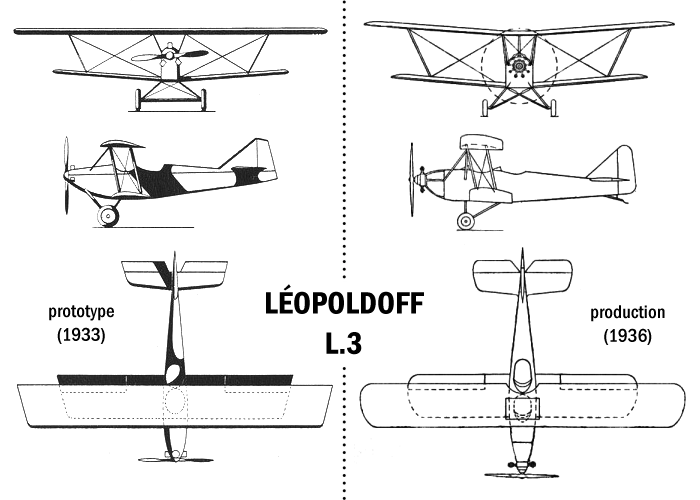
The prototype and the production version of the Léopoldoff L.3 were practically two different aircraft.
It is most likely that part of the redesign resulted from the work of Levavasseur and his L'Alcya team.
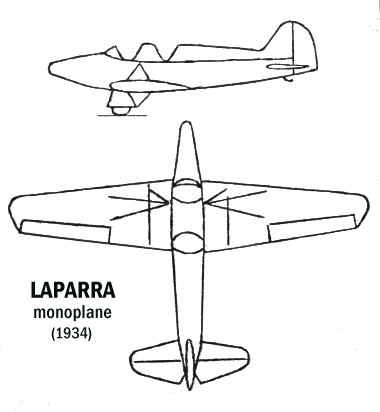 At least five other light aircraft of that era were created with the help of Levavasseur and L'Alcya:
- The Peitz Type 101 avionnette, an all-metal parasol-wing tourism monoplane powered by a 50 hp Anzani.
- The Dejouy avionnette of 1934, designed by Levavasseur, designated 4 B.A by L'Alcya and built by Jacques Dejouy in Casablanca (Morocco). It was powered by an old 50 hp Anzani engine and flown successfully in the spring. It was officially presented before representatives from the Ministère de l'Air in early July 1934, and unanimously acclaimed; Dejouy had plans to build a small batch of them and market them for less than 20,000 Francs—but of course that didn't happen.
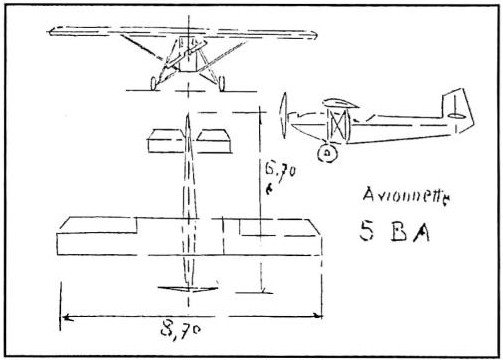
- The Alcya 5 B.A, a side-by-side seating avionnette of 1934 powered by a 20 hp engine, with a 12-square-meter wing which was equipped with curvature ailerons directly operated by the stick. Several examples were said to have been started by amateur builders by mid-1935, and one might even have been built in Brazzaville (French Congo) by Alcya member Chaix. An unspecified variant designated 5 B.A.M was also studied.
- The Rigault R.3, started in 1934. The same Rigault was L'Alcya's treasurer and the inventor of the winch that was used in the early flights. He also built an all-plywood glider in Antony in 1931. He had a "Pou-du-Ciel" type two-seater in the works in June 1935, had the engine already fitted and was beginning to cover the airplane with fabric, so this could be the same as the R.3.
- The Laparra low-wing tandem-seat sports monoplane, to be powered by a 50/60 hp engine, also started by Les Alcyons d'Antony in 1934 and possibly never completed.
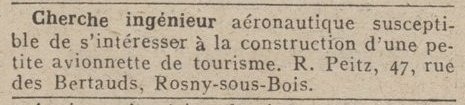
"Looking for an aeronautical engineer liable to show interest in the construction of a small tourism light plane. R. Peitz, 47 rue des Bertauds, Rosny-sous-Bois."
Peitz found that aeronautical engineer in Levavasseur, who provided his technical expertise and the calculations that enabled Peitz to obtain the go-ahead from the S.T.I.Aé., the almighty authority that could make or break an aircraft; but when the type's approval took place in 1933, L'Alcya did not exist yet—it was still only Les Alcyons d'Antony, the gliding club!
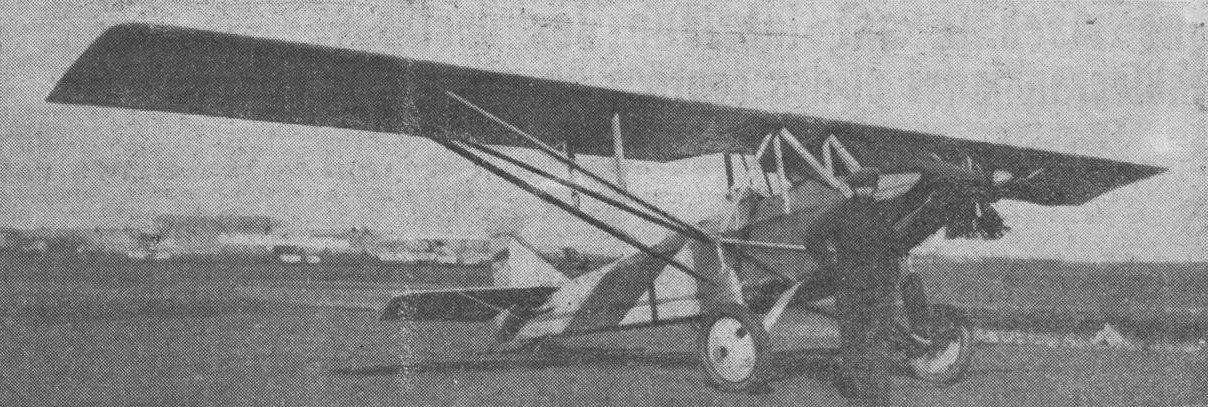
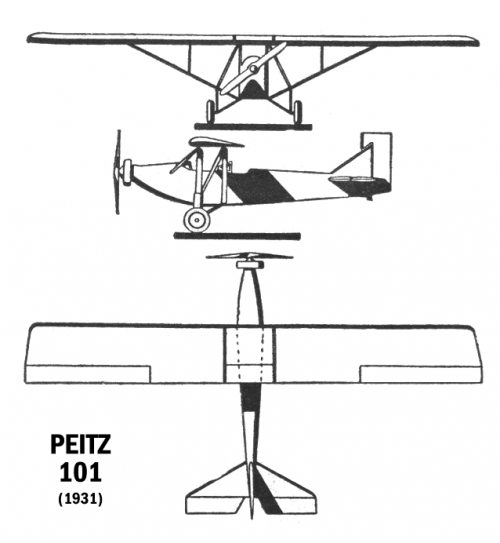
The Peitz 101 parasol monoplane, which benefitted from Levavasseur's expertise, even before L'Alcya was founded.
L'Alcya produced a lot of studies and designs in its short existence, several of which, such the 7 B.A and 8 B.A, didn't leave the drawing board. One final design, however, was pretty much advanced at the time of Levavasseur's untimely death (at age 41): the Alcya 72-C, a two-seater school machine (and probably a development of the unbuilt Alcya 72-A). In its February 28, 1935 issue, Les Ailes presented the 72-C as "the most recent", fitted with "the latest aerodynamic and structural solution that were developed through previous types". They described the aircraft as "a machine with a low wing fitted within the fuselage, guyed by masts above." To stabilize the aircraft over its central wheel, "side crutches were controlled by the pilot along with the ailerons." The Alcya 72-C used a 35 hp engine, sufficient for cheap student training1. A week later, commenting upon Levavasseur's passing (on September 17, 1935, at the age of only 41), Les Ailes described the 72-C as "almost completed", adding that death had deprived the engineer of "the supreme satisfaction of watching the trials of his latest creation." But the machine was no longer heard of after that.
Whatever happened to L'Alcya after Levavasseur's passing is not clear; the fact that the Groupe de Recherche et Études Aéronautique (sic) Alcya was officially registered as an association on April 18, 1936, with the purpose of "studying and practising aviation" (Journal Officiel de la République Française, May 15, 1936) seems to indicate that the rest of the team was willing to honor their departed friend by keeping his vision alive; however, no trace of any activity can be found after that.
I told you at the beginning of this post that L'Alcya was putting me in a state of desperation, and perhaps you understand why: very few sources can be found on that entity which existed for less than two years, and most of their projects, whether sailplanes or light planes, can't be found in either photo or plan form! It is frustrating that Les Ailes and the other aviation-related publications of the time did not publish even a rough sketch of the Dejouy, Peitz and Rigault machines... and equally frustrating that the 72-C two-seater, a nearly-completed prototype, was probably scrapped before any photos could be circulated...
And so I appeal to all the forum members with a love for both aviation mysteries and vintage French aviation to have a look at their files... Any photos of the Alcyon? The Dejouy avionnette? The Alcya 5 B.A.? Or other Levavasseur projects not mentioned in this article? It would be neat to be able to further illustrate the short but meaningful career of L'Alcya!
1. A 60 hp engine was possible for more experienced students willing to obtain their licence, since a 360-meter climb in 3 minutes was required
Last edited: