Late 70s RN fleet carrier design?

For what it's worth, I don't think CVA-01 could realistically operate more than ~36 fighters without locking the deck. (Plus 8-10 Sea King helos or Gannets for ASW/AEW). Anything more than that would significantly impact aircraft turnaround times and sortie rates.

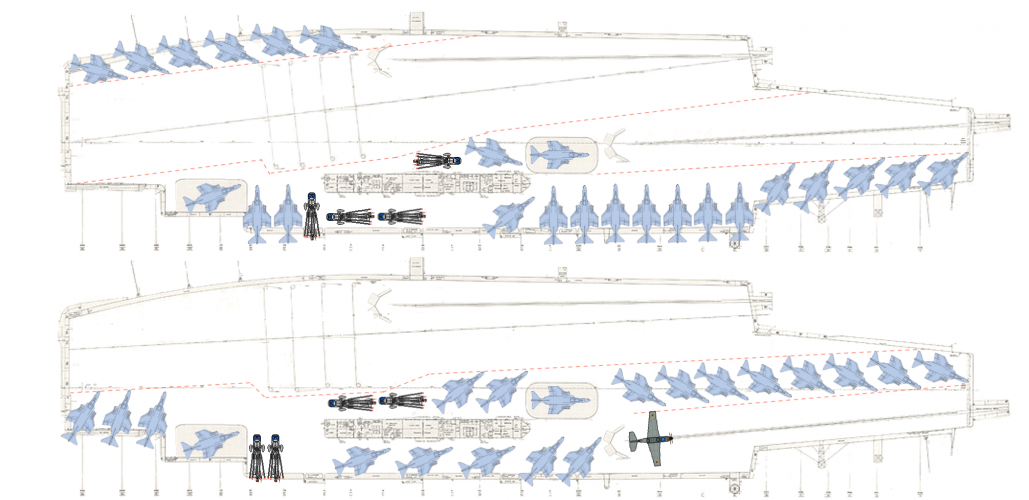
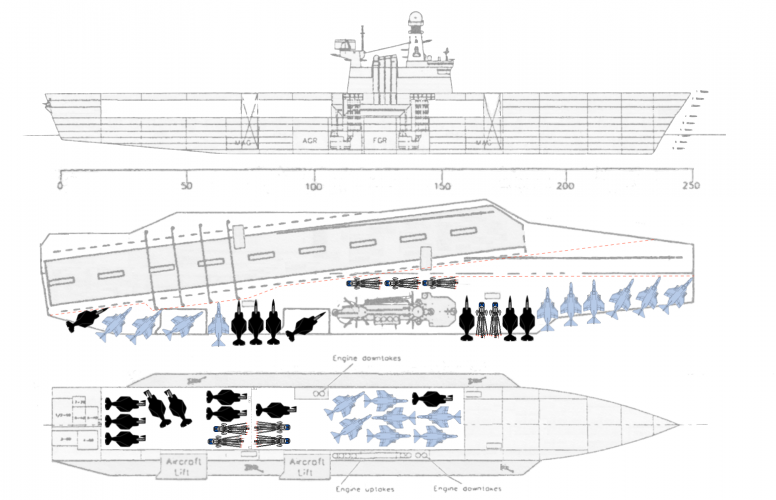
Here's CVA-01 (bottom) with 40x F-4 Phantoms and 8 Sea Kings. The bow catapult and Alaskan taxiway are locked, making aircraft movements difficult until after the first launch. You really don't get the benefit of simultaneous launch & recovery until you launch a half dozen aircraft (at least) and clear both sides of the island. Moreover, the bow deck park is very tight - barely suitable if you need to launch a Gannet (56' span), let alone an E-2 Hawkeye (80' span)... these would have to use the port catapult on the angled deck.

Personally I prefer a conventional layout like my notional 35,000t carrier (top). Even with 30x F-4 Phantoms the layout is very flexible and deck/hangar movements straight forward, even though this is optimized for more traditional cyclic operations (aside from deck launched interceptors and buddy tankers which can be launched at any time).

Top: 35,000t CV with 30x Phantoms (15 on flight deck + 15 in hangar)
Bottom: 54,000t CVA-01 with 40x Phantoms (20 on flight deck + 20 in hangar)

View attachment 786426
1759204036080.jpeg

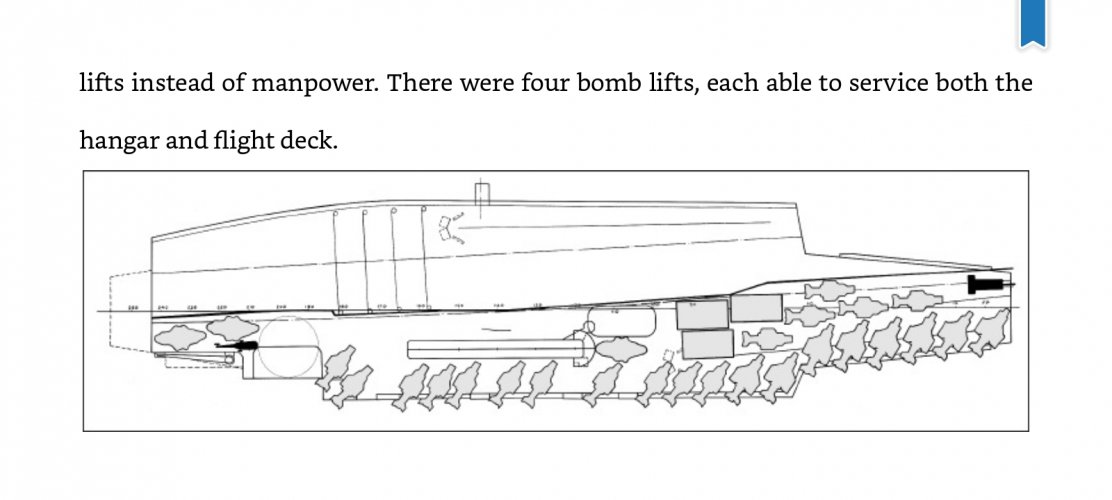
Deck spotting from Hobbs, Br A C.
 
View attachment 786471

Deck spotting from Hobbs, Br A C.
Thanks - very interesting. That’s a pretty packed deck… 8 fighters, 16 Buccaneers, 3 AEW, 3 ASW helos and 1 SAR helo. Total 31 aircraft.

With 16 aircraft blocking the bow catapult, another 6 blocking the Alaskan taxiway, and only 2 with a clean taxi to the port catapult for deck launched intercept, I would not want to be responsible for air ops and sortie generation!
 
Thanks - very interesting. That’s a pretty packed deck… 8 fighters, 16 Buccaneers, 3 AEW, 3 ASW helos and 1 SAR helo. Total 31 aircraft.

With 16 aircraft blocking the bow catapult, another 6 blocking the Alaskan taxiway, and only 2 with a clean taxi to the port catapult for deck launched intercept, I would not want to be responsible for air ops and sortie generation!

That's the other end of the 1/3 - 2/3 arc:- 2/3 of the CAG on deck and serviceable.

Not something they'd do all the time, but when they need to do it they really need to do it.
 
Thanks - very interesting. That’s a pretty packed deck… 8 fighters, 16 Buccaneers, 3 AEW, 3 ASW helos and 1 SAR helo. Total 31 aircraft.

With 16 aircraft blocking the bow catapult, another 6 blocking the Alaskan taxiway, and only 2 with a clean taxi to the port catapult for deck launched intercept, I would not want to be responsible for air ops and sortie generation!
He adds "Note that space is still available in Fly 2 to park more aircraft if necessary.".

But it looks like the Oriskany loadout in Vietnam, assuming that your air group will shrink pretty quickly anyway.
 
Aircraft portside of the island were if memory serves, depicted as facing sternwards. Treating the island as a sort of roundabout.
 
Now the conversation has turned to links between USN and RN carrier doctrine, does anyone know why the CVA-01 developments never caught on for carriers more generally? All CATOBAR carriers at present still insist on eliminating the port quarter deck space and instead use fully angled decks across to the starboard side. I know that the USN copied RN advancements with carrier aviation in the past, why not these ones?
I can see particular opportunities with CdG, for example, where there are no port-side lifts and nuclear power reduces the deck space required for an inboard island.
The Fords, too, use a huge amount of area for an ESSM launcher that would allow a full-sized parallel deck.
 
Probably because the parallel deck was never built and therefore no operational experience was ever gathered on actual day-to-day flight deck operations and landings.
I suspect that it's theoretical advantages are probably lessened on something the size of a Nimitz or Ford. Some of the early CVF studies did revisit the concept though, not sure that any of the CdG preliminaries did though.
 
While we focus on the similarities, the USN, RN and MN operate differently enough to reach their own conclusions with details like deck layout.
 
Probably because the parallel deck was never built and therefore no operational experience was ever gathered on actual day-to-day flight deck operations and landings.
I suspect that it's theoretical advantages are probably lessened on something the size of a Nimitz or Ford. Some of the early CVF studies did revisit the concept though, not sure that any of the CdG preliminaries did though.
That makes sense, we only sold the steam catapult to the US by demonstrating that we could launch a jet with a 10 knot tailwind at anchor!
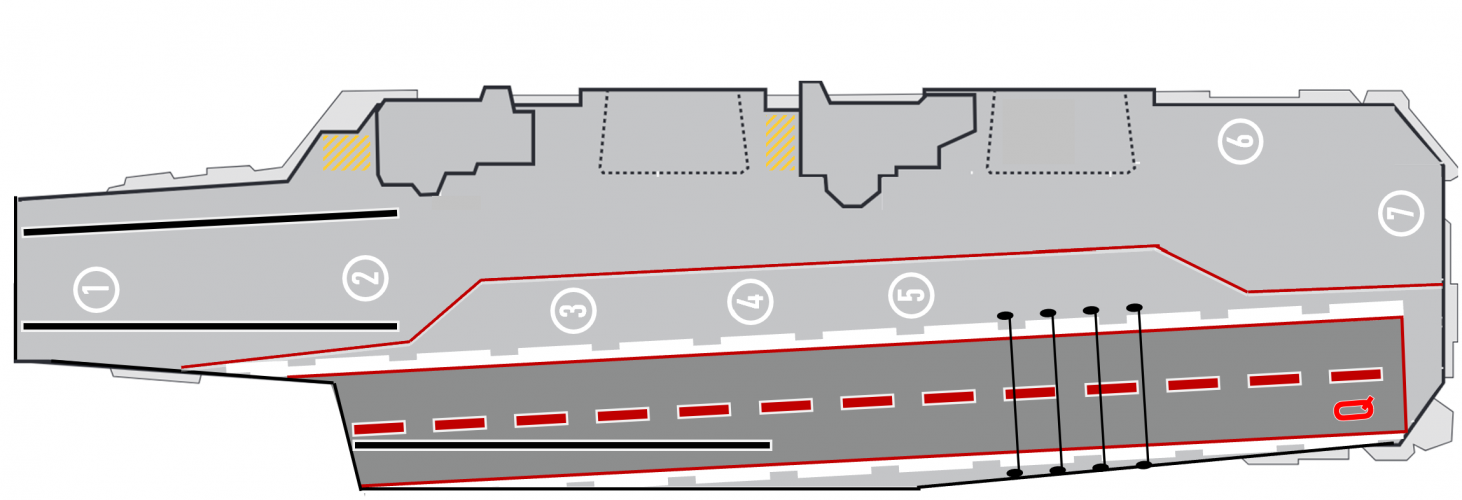
I spent a few weeks last year playing around with the CVF layout and came up with this CVA-F one (in the style of your CVA-01 Shipbucket drawing), which I think is a pretty decent example of a parallel landing deck on a larger carrier:
1759229033761.png
 
I suspect that it's theoretical advantages are probably lessened on something the size of a Nimitz or Ford. Some of the early CVF studies did revisit the concept though, not sure that any of the CdG preliminaries did though.
The parallel deck has as many downsides as it has theoretical advantages.

It reduces the size of the bow deck park (due to the safety line running closer to the bow) and makes it harder to place your bow cat to port. You regain some of that space in the stern deck park, but the real estate forward is more valuable as it allows you to recover large alpha strikes. The angle deck also allows for some alert aircraft and strikes to be ranged to port and on large USN carriers enables the redundancy of having a port elevator.

In addition the parallel deck requires a very wide flight deck and beamier hull at the waterline, which may not be great for powering at high speed and stability/seakeeping. It becomes progressively harder on smaller hulls, so probably not feasible on a 30-40,000 ton carrier.

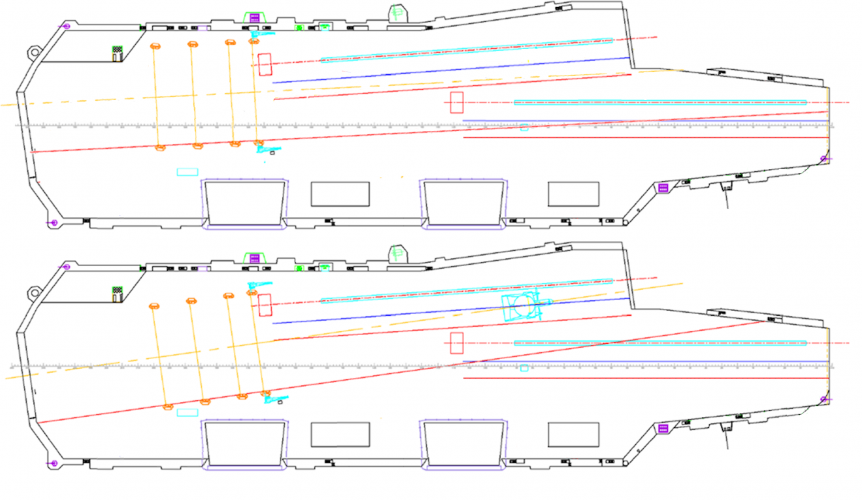
Here's a comparison of CVA-01 with an angle deck vs. parallel deck. The angle deck has a bigger deck park - I was able to fit 24x F-4 Phantoms on the angle deck, versus only 20x on CVA-01. Which layout provides the better flow is also a matter of operational practice... personally I would stick with USN style cyclic operations, with aircraft being recovered forward and strikes being readied in the port rear and starboard bow deck park areas.

Angle deck (top) vs. Parallel deck (bottom):
24 vs. 20 fighters in deck park
CVA-01 parallel vs angle deck 2px=1ft.png
 
Last edited:
Angle deck (top) vs. Parallel deck (bottom):
24 vs. 20 fighters in deck park
Your space analysis more or less resembles that of the original analysis - although the forward cat wasn't moved.
The designers wanted a 0 degree true parallel deck but couldn't get enough beam so went for 2.5 to 3 degrees.
I have a feeling that the Sea Dart launcher issue played as much a role in the selection as the aircraft circulation.

I can't help wondering if pilots swapping between landings on the older angled-deck ships and the parallel decked CVA-01 would have had any practical problems adjusting? In theory it shouldn't matter and the mirror landing sight should be their focus anyway, but I wonder if it would have had a psychological impact (positive or negative) (having watched that video of the RAF Bucc pilot who takes about seven attempts to get his aircraft down on Ark!).
 
The parallel deck has as many downsides as it has theoretical advantages.

It reduces the size of the bow deck park (due to the safety line running closer to the bow) and makes it harder to place your bow cat to port. You regain some of that space in the stern deck park, but the real estate forward is more valuable as it allows you to recover large alpha strikes. The angle deck also allows for some alert aircraft and strikes to be ranged to port and on large USN carriers enables the redundancy of having a port elevator.

In addition the parallel deck requires a very wide flight deck and beamier hull at the waterline, which may not be great for powering at high speed and stability/seakeeping. It becomes progressively harder on smaller hulls, so probably not feasible on a 30-40,000 ton carrier.
Ok, that makes sense. The deck park and beam thing is why I think the QEs are better candidates for parallel decks, as they have a fineness ratio of 3.9 against 4.6 for a Gerald R Ford and 5.0 for CVA-01 (at least according to Wikipedia, sorry!) and they have that big long sponson on the port side.
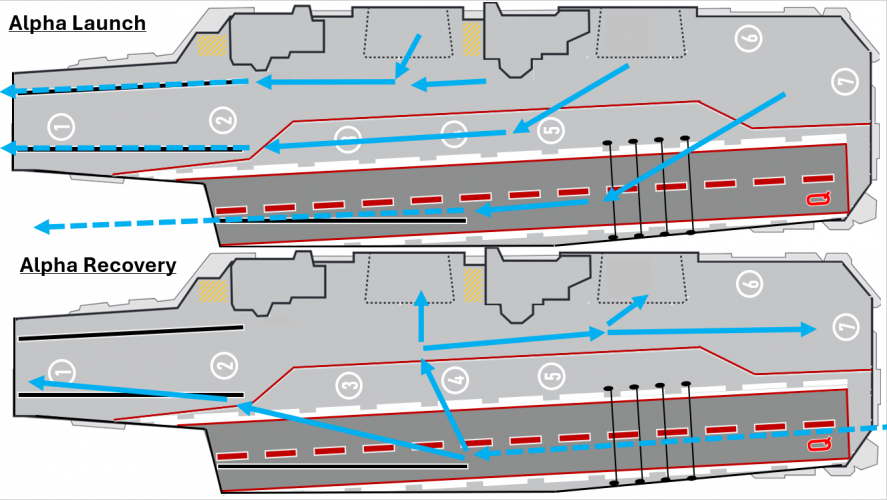
Could you elaborate further on the alpha strike thing? In my head, surely it would be just as quick to have the jets turn aft after landing as to have them park forwards? I've tried to mock it up here with aircraft emerging from the deck parks next to the island and on the starboard quarter, please do explain to me if my PowerPoint arrows are stupid:
1759249858249.png
It blocks up the port bow catapult, but I believe that's pretty normal for USN operations?
 
Could you elaborate further on the alpha strike thing? In my head, surely it would be just as quick to have the jets turn aft after landing as to have them park forwards?
Yes CVF has such a big (and wide) deck that jets could clear the runway then taxi back without interfering with the islands.

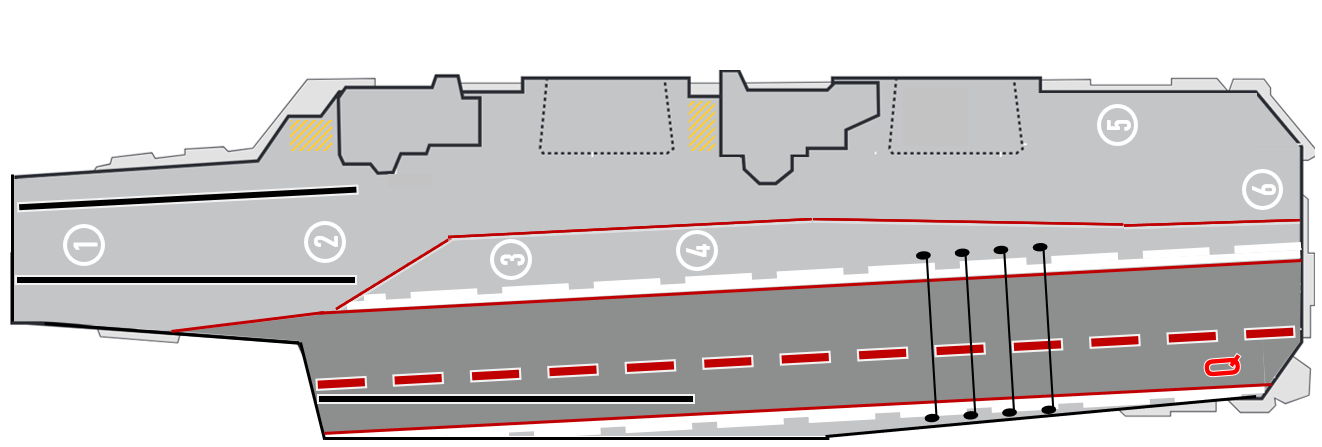
Keep in mind though that there's a pinch point around the arrestor wires which are very wide (110-120ft wide). I don't think your drawing shows them to the correct scale. You probably should widen the wires and shift the entire parallel deck to the right.
 
Yes CVF has such a big (and wide) deck that jets could clear the runway then taxi back without interfering with the islands.

Keep in mind though that there's a pinch point around the arrestor wires which are very wide (110-120ft wide). I don't think your drawing shows them to the correct scale. You probably should widen the wires and shift the entire parallel deck to the right.
Like this? I eliminated one of the helo spots to make some more room next to the lift, the island overhangs a lot so the diagram isn't representative of deck level:
1759258587071.png
 
Thanks - very interesting. That’s a pretty packed deck… 8 fighters, 16 Buccaneers, 3 AEW, 3 ASW helos and 1 SAR helo. Total 31 aircraft.

With 16 aircraft blocking the bow catapult, another 6 blocking the Alaskan taxiway, and only 2 with a clean taxi to the port catapult for deck launched intercept, I would not want to be responsible for air ops and sortie generation!
Hobbs is not realy clear on this, but I would have thought this is a spotting after recovery?
 
I have a feeling that the Sea Dart launcher issue played as much a role in the selection as the aircraft circulation.

I'm inclined t agree that this was a factor, and therefore the 78 carrier would have had a greater angle on the landing deck.

IIUC USN carriers had an evolution going to greater landing deck angles but then reducing them, like going from 8 degrees to 13 and then back to 9 or so. If so the RN reducing the landing deck angle isn't totally alien.

I can't help wondering if pilots swapping between landings on the older angled-deck ships and the parallel decked CVA-01 would have had any practical problems adjusting? In theory it shouldn't matter and the mirror landing sight should be their focus anyway, but I wonder if it would have had a psychological impact (positive or negative) (having watched that video of the RAF Bucc pilot who takes about seven attempts to get his aircraft down on Ark!).

Given squadrons are allocated to carriers for prolonged periods of time I doubt it would cause problems after the first few flying cycles.
 
Like this? I eliminated one of the helo spots to make some more room next to the lift, the island overhangs a lot so the diagram isn't representative of deck level:
View attachment 786554
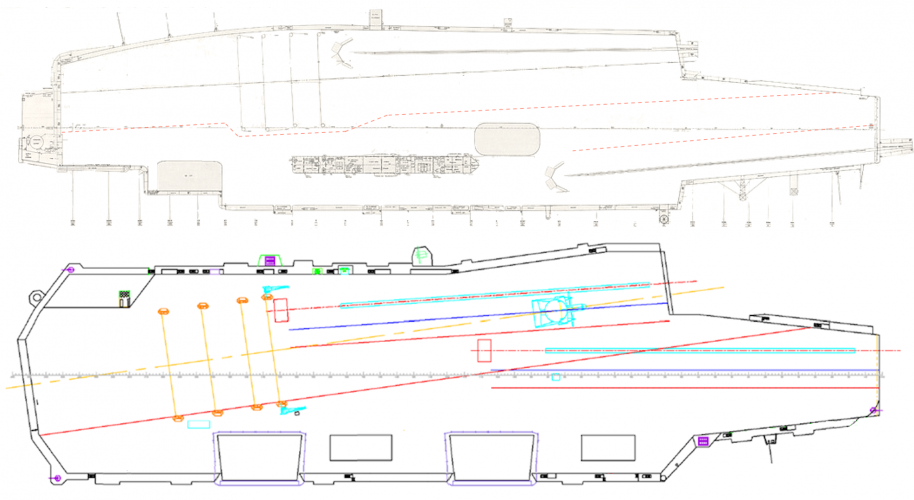
See below... here's CVF with parallel vs angled decks (the angled deck layout is an actual PA2 plan).

Note how wide (!) the landing area has to be if you're using modern Mk 7 wires and allowing for E-2 Hawkeye landings (80ft wingspan). The wires are ~115ft wide vs. ~100ft on CVA-01, the safety line is ~55ft wide vs. ~45ft on CVA-01, plus there's a 130ft-140ft wide barricade (none on CVA-01??). All together these shift the centerline by ~20ft to starboard vs. CVA-01 and the safety line by ~30ft to starboard.

Basically the parallel deck might have worked on CVA-01 but it would still eat up a ton of deck parking space forward. Plus I wonder about how the distance from the centerline would impact landings on a rolling deck?

CVF/PA2 with parallel deck (top) vs. angle deck (bottom)
Scale: 2px=1ft (Shipbucket scale)

CVF angle deck vs parallel deck 1ft=2px v2.png

And as a bonus, here's CVF/PA2 vs. CVA-01. One often forgets just how big the CVF flight deck is!
CVF PA2 vs CVA-01 2px=1ft v2.png
 
Last edited:
Here's a comparison of CVA-01 with an angle deck vs. parallel deck. The angle deck has a bigger deck park - I was able to fit 24x F-4 Phantoms on the angle deck, versus only 20x on CVA-01. Which layout provides the better flow is also a matter of operational practice... personally I would stick with USN style cyclic operations, with aircraft being recovered forward and strikes being readied in the port rear and starboard bow deck park areas.

I wouldn't get hung up on the flow when 24 jets are on deck, it was an edge of the envelope requirement likely for unusual circumstances where continuous flight operations weren't required for the period when this amount of aircraft were on deck. Perhaps something like the RN's first strike on Port Stanley after the Vulcan when all 12 of Hermes' Sea Harriers were sent on a dawn strike against 2 targets. The deck would have been packed in the hours before the strike, empty once it launched and frantic during recovery in order to switch to a regular pattern of operations.
 
While these enlarged CVA-01 discussions are entertaining, they just don't seem remotely realistic given the 70s timeframe. So I was wondering where to take this thread... IMHO the aspirations for a full size carrier and air wing were unaffordable. So what's the alternative?

I go back to the Falklands as the key mission (and not only in hindsight)... the basic requirements were to put up a 24/7 CAP, ensure sea control, and send some limited strikes against enemy airfields, naval task forces, or strategic ground targets. Even if the Falklands hadn't happened, other potential Cold War conflicts existed in the Middle East (Yemen, Lebanon), Africa, South East Asia. Not to mention the Soviet threat. There has to be some room to replace Ark Royal in the late 70s with something better than the RN's small VSTOL carriers that doesn't cost as much as a full size 50,000+ ton carrier... let's call it the "minimum size Phantom carrier".

The key to this is sortie rates... in the Falklands the Harriers' peak sortie rate was 60-70 sorties/day x 6 days, i.e. about 2-2.5 sorties/day per aircraft. (The CAP-focused Sea Harriers on Invincible flew 2.5-3 sorties/day per aircraft, while the slightly more strike focused Sea Harriers and GR3s on Hermes flew ~2 sorties day). An air wing of 30 Phantoms & Buccaneers should be sufficient to deliver a similar sortie volume, but to much greater effect in terms of weapons load, range, and combat capabilities (relative to Sea Harrier).

So let's set the requirement at 30 aircraft.
- 14 F-4 Phantoms x 2.5 CAP sorties/day = 35 sorties/day
- 16 Buccaneers x 2 strike sorties/day = 32 sorties/day
Total 30 aircraft x 2.25 sorties/day = 67 sorties/day

Ideally add 1-2 attrition replacements for each type, for a total of 32-34 jets onboard.

Looking at the 35,000 ton carrier that I drew up earlier, I'm able to fit 34 jets + 9 helos with room to spare, in a fairly efficient layout for both sustained cyclic ops and alpha strikes. Seems to be no reason why 60-70 sorties/day wouldn't have been achievable, assuming a fairly large complement of 1,500-1,700 men (900-1,000 ships company, 600-700 air wing).

Basically this would be halfway between a Clemenceau and Charles de Gaulle, both of which could operate similar sized air wings and AFAIK could also achieve similar sortie rates.

CV 35000t 2px=1ft 34x F-4s & Buccaneers.png
 
Last edited:
Aaaannnnd.....at 32 aircraft we have the 1960 comparison study of a 42,000ton vessel.
Which would have been slightly easier had it utilised two sets of plant for 68,000shp for a total of 136,000shp.
Instead of the same 45,000shp sets of three for 135,000shp.

And just to cap it all off said study would fit existing drydocks. Not just Devonport No.10

But what such has over a 35,000ton ship like Victorious is greater aviation fuel, greater munitions storage and the Broomstick 3D radar with ADAWS. Along with 225ft catapults and modern arrestor engines.
Lacks Sea Dart or Tartar SAM and notionally used Sea Cat, but had it gone ahead..... Sea Wolf.
All for 40 million?

Good enough for F4 and Buccaneer. Good enough for Jaguar or AFVG.
Good enough for Hornet and Super Hornet.
Just 18 OR.346 for which we can envision F111B or F14. Not that either is likely.

But perhaps crucially, very close to Civil Lord of the Admiralty suggestion of a 40,000ton carrier for an initial airwing of Sea Vixen and Buccaneer (maybe a few Scimitar) with successor as P1154RN.....

But three such carriers delivers approximately the TAU. Though you'd need a total of 6 in service to be able to surge that for a few months at best.
 
See below... here's CVF with parallel vs angled decks (the angled deck layout is an actual PA2 plan).

Note how wide (!) the landing area has to be if you're using modern Mk 7 wires and allowing for E-2 Hawkeye landings (80ft wingspan). The wires are ~115ft wide vs. ~100ft on CVA-01, the safety line is ~55ft wide vs. ~45ft on CVA-01, plus there's a 130ft-140ft wide barricade (none on CVA-01??). All together these shift the centerline by ~20ft to starboard vs. CVA-01 and the safety line by ~30ft to starboard.

Basically the parallel deck might have worked on CVA-01 but it would still eat up a ton of deck parking space forward. Plus I wonder about how the distance from the centerline would impact landings on a rolling deck?
Oh, I can see the problem with how much bigger arrestor wires have become. Even on the Ford they take up half of the width of the stern! I had initially gone into the CVF editing from the perspective of adapting it to UCAV operation rather than manned aircraft, which is probably why I underestimated the length of the cables.
While these enlarged CVA-01 discussions are entertaining, they just don't seem remotely realistic given the 70s timeframe. So I was wondering where to take this thread... IMHO the aspirations for a full size carrier and air wing were unaffordable. So what's the alternative?

I go back to the Falklands as the key mission (and not only in hindsight)... the basic requirements were to put up a 24/7 CAP, ensure sea control, and send some limited strikes against enemy airfields, naval task forces, or strategic ground targets. Even if the Falklands hadn't happened, other potential Cold War conflicts existed in the Middle East (Yemen, Lebanon), Africa, South East Asia. Not to mention the Soviet threat. There has to be some room to replace Ark Royal in the late 70s with something better than the RN's small VSTOL carriers that doesn't cost as much as a full size 50,000+ ton carrier... let's call it the "minimum size Phantom carrier".

The key to this is sortie rates... in the Falklands the Harriers' peak sortie rate was 60-70 sorties/day x 6 days, i.e. about 2-2.5 sorties/day per aircraft. (The CAP-focused Sea Harriers on Invincible flew 2.5-3 sorties/day per aircraft, while the slightly more strike focused Sea Harriers and GR3s on Hermes flew ~2 sorties day). An air wing of 30 Phantoms & Buccaneers should be sufficient to deliver a similar sortie volume, but to much greater effect in terms of weapons load, range, and combat capabilities (relative to Sea Harrier).

So let's set the requirement at 30 aircraft.
- 14 F-4 Phantoms x 2.5 CAP sorties/day = 35 sorties/day
- 16 Buccaneers x 2 strike sorties/day = 32 sorties/day
Total 30 aircraft x 2.25 sorties/day = 67 sorties/day

Ideally add 1-2 attrition replacements for each type, for a total of 32-34 jets onboard.

Looking at the 35,000 ton carrier that I drew up earlier, I'm able to fit 34 jets + 9 helos with room to spare, in a fairly efficient layout for both sustained cyclic ops and alpha strikes. Seems to be no reason why 60-70 sorties/day wouldn't have been achievable, assuming a fairly large complement of 1,500-1,700 men (900-1,000 ships company, 600-700 air wing).

Basically this would be halfway between a Clemenceau and Charles de Gaulle, both of which could operate similar sized air wings and AFAIK could also achieve similar sortie rates.
So is this essentially a direct replacement for Ark Royal?
 
While these enlarged CVA-01 discussions are entertaining, they just don't seem remotely realistic given the 70s timeframe.

On the contrary, with the 52 Carrier and CVA01 in ongoing service and Phantomised Eagle needing replacement by the 78 Carrier sheer momentum will drive the RN to a similar ~55,000t carrier. Indeed with 2 big carriers in service, big aircraft needing big carriers with long catapults and the looming need to buy the only AEW aircraft on the market going down any other route is a deviation from the path of least resistance.

I go back to the Falklands as the key mission (and not only in hindsight)... the basic requirements were to put up a 24/7 CAP, ensure sea control, and send some limited strikes against enemy airfields, naval task forces, or strategic ground targets. Even if the Falklands hadn't happened, other potential Cold War conflicts existed in the Middle East (Yemen, Lebanon), Africa, South East Asia. Not to mention the Soviet threat.

This is pretty much what I envisage the requirement to be.

The key to this is sortie rates... in the Falklands the Harriers' peak sortie rate was 60-70 sorties/day x 6 days, i.e. about 2-2.5 sorties/day per aircraft. (The CAP-focused Sea Harriers on Invincible flew 2.5-3 sorties/day per aircraft, while the slightly more strike focused Sea Harriers and GR3s on Hermes flew ~2 sorties day). An air wing of 30 Phantoms & Buccaneers should be sufficient to deliver a similar sortie volume, but to much greater effect in terms of weapons load, range, and combat capabilities (relative to Sea Harrier).

So let's set the requirement at 30 aircraft.
- 14 F-4 Phantoms x 2.5 CAP sorties/day = 35 sorties/day
- 16 Buccaneers x 2 strike sorties/day = 32 sorties/day
Total 30 aircraft x 2.25 sorties/day = 67 sorties/day

Ideally add 1-2 attrition replacements for each type, for a total of 32-34 jets onboard.

In the Falklands Sea Harriers and GR3s flew very short missions, 75 minutes at most. Phantoms and Buccaneers can fly for twice as long, so half the number of sorties equates to the same flying time. In addition, when calculating the number of weapons carried the Phantom and Buccaneer carry much greater payloads so are even more 'productive'. This is handy because I've seen somewhere (I couldn't provide a source) that in recent decades the big USN carriers have only flown 0.9 - 1.1 sorties per aircraft per day: lower rates than land-based aircraft.
 
So is this essentially a direct replacement for Ark Royal?

I imagine Ark Royal has been replaced by CVA01 in 1973.

The 78 carrier will be to replace Eagle, which got a major refit to give her 15-20 years life from 1964.

The RN carrier force has gone from 4.5 carriers in 1965 to 3 in 1973 with the major reduction East of Suez and the dissolution of CETNO.
 
On the contrary, with the 52 Carrier and CVA01 in ongoing service and Phantomised Eagle needing replacement by the 78 Carrier sheer momentum will drive the RN to a similar ~55,000t carrier
This requires 3 massive departures from historical, in 3 different decades (50s, 60s, 70s). That’s really stretching it IMHO, even for alternate history… closer to complete fiction.

Whereas what I’m suggesting is indeed a direct Ark Royal replacement, which would reuse the existing Phantoms and Buccaneers without requiring a new investment in Sea Harrier. However while it would serve the same function as Ark Royal it could come in a smaller package with advances in propulsion (gas turbines) and looking more like the French medium carriers (Clemenceau / PA58 / CdG give us a nice continuum of potential baselines from 33,000 to 45,000 tons).
 
Last edited:
But what such has over a 35,000ton ship like Victorious is greater aviation fuel, greater munitions storage and the Broomstick 3D radar with ADAWS. Along with 225ft catapults and modern arrestor engines.
Lacks Sea Dart or Tartar SAM and notionally used Sea Cat, but had it gone ahead..... Sea Wolf.
All for 40 million?

How do you get 40 million for all that? In about 1963-64 the 53,000t CVA01 was estimated to cost 60 million pounds, with the cost breakdown being 25% for the hull, 25% propulsion and 50% for everything else.

The 'everything else' you've listed will still cost about 30 million, maybe going to Sea Cat will reduce that will drop that to 28 million. 3 shaft propulsion will cost 15 million, maybe less if they're smaller units than CVA01s. The hull will cost 9 or 10 million instead of 15 million, giving a total of about 50 million.
 
This requires 3 massive departures from historical, in 3 different decades (50s, 60s, 70s). That’s really stretching it IMHO, even for alternate history… closer to complete fiction.

Yes, I acknowledged that from the very start. However, I wanted to look at the technical aspects of what a ~55,000t carrier would look like in an era where steam was on the way out and GTs were taking hold plus all the other stuff that happened since 1966.

Getting wrapped around the axles of realistically building such a ship takes away from the interesting technical discussion.
 
Getting wrapped around the axles of realistically building such a ship takes away from the interesting technical discussion.
FWIW, studies around such projects were performed more or less regardless of current political or economic limitations, and this can be considered as such.

What I see as problematic is an attempt to consider non-uniform carriers within relatively small timeframe. If the size of the ship is limited to CVA-equivalent, it would be infinitely more effective - from logistical, training and maintenance points of view - to add another unit of the same deck layout, internal arrangements and machinery instead of adding a different one that would offer exactly the same capabilities, but would require a totally different learning curve for all involved personnel and industrial support. To justify this it should be either smaller (Invincible+) or larger (full scale flagship carrier), or otherwise conceptually different (like VSTOL CVF), but not the same.
 
Last edited:
By 1978 the Olympus GT was pretty much the standard RN propulsion unit, used in the Types 82, 42, 21 and 22 so using it in the carrier would be using a standard major item. I think most people have suggested that the 78 carrier largely draw on CVA01, and I pretty much agree with them. It would be ludicrous not to incorporate lessons of earlier ships in the interests of standardisation; however, the advantages of change need to outweigh the drawbacks of non-standard items and procedures.
 
It would be ludicrous not to incorporate lessons of earlier ships in the interests of standardisation; however, the advantages of change need to outweigh the drawbacks of non-standard items and procedures.

So more or less we are looking at CVA-01 with different engines, maybe different electronic and air-defense systems (with a hope to update the first carriers as well), but otherwise I'd be very careful touching anything, especially aircraft handling procedures and deck layout.

Is objection to large nuclear carrier is considered purely economic?
 
So more or less we are looking at CVA-01 with different engines, maybe different electronic and air-defense systems (with a hope to update the first carriers as well),

That seems to be what people here are thinking, I'm inclined to agree.

I'd be very careful touching anything, especially aircraft handling procedures and deck layout.

CVA01's deck layout was novel and may not have worked as hoped in practice. If it needs improving on the 78 carrier then it should be improved.

Is objection to large nuclear carrier is considered purely economic?

Pretty much. I'd add that in the mid 70s the British nuclear industry was in a shambles due to poor decisions in the mid 60s around what the 2nd generation of nuclear power plants would be. I can't help but think that if the British had made better decisions around their civilian nuclear power programme, then the economics of a nuclear carrier in 1978 might look substantially different.
 
CVA01's deck layout was novel and may not have worked as hoped in practice. If it needs improving on the 78 carrier then it should be improved.

Squadron interchangeability and emergency handling may get in the way here. Think of a pilot landing in combat and/or at night, on differently configured deck with different procedures where he has to remember the differences, and discarding this option is an organizational headache, so it's either change all of them, or leave the new one identical.

I would suppose that the correctable layout problems would be ironed out on existing ships before this (3rd? 4th?) carrier is laid down, but I think it's very important to keep them synchronized.
 
If the '52 CV is built then the argument for a completely new design is the most expensive option.
Whereas a evolution of that design is logically the loslwest cost increase above a straight repeat build.
What was driving the new CVA-01 design was the expected future of fast jet aircraft.
Namely OR.346 and TFX (what became F111B) but press aged by the A5 Vigilante.

But.....if your future is MOTS F4, which is discernable during that design process and your long-term future is expected to be AFVG. Then the remaining driver is cross decking USN aircraft.
But that would logically drive you to make your carrier deck as similar to USN designs as possible to ease familiarity
 
Additional after checking my Friedman and the 1960 table of studies.
Two of 48,000tons
Both with 150,000shp on three sets for 29kts dirty.
Both with the same hull. 2 lifts, 2 catapults, 4 wires. The same fuel and the same armament.

One has 165ft wide flight deck and a height from keel to flight deck of 83.5ft. Fitting some 41 buccaneers 15 on deck and 26 in hanger.

The other 200ft wide and a height of 76.5ft fitting some 43 buccaneers. 23 on deck and 20 in hanger.

Is this the study and the moment the parallel deck concept was applied to what very likely was the ultimate Medium Fleet carrier?

What we know for certain is by '58 that study process had grown from it's '54 to '56 version of 35,000tons to 45,000tons.

And equally just to rub things in for a scenario of the '52 CV being built.
There is the '52 CV hull type but with just three sets of plans for 150,000shp for 28kts dirty.

Which implies the most logical path forward in light of the 1952 CV being built.....is another similar ship...
 
But.....if your future is MOTS F4, which is discernable during that design process and your long-term future is expected to be AFVG. Then the remaining driver is cross decking USN aircraft.
But that would logically drive you to make your carrier deck as similar to USN designs as possible to ease familiarity
Another reason, from Hobbs for the 1950s at least: "The American ships were intended to operate jet bomber designs of up to 70,000lb that evolved into the Douglas A-3 Skywarrior, at that time the largest aircraft ever designed for carrierborne operation, and the Admiralty had to consider the likelihood that in any major conflict the RN would have to absorb USN aircraft provided under the MDAP agreement, since the run-down British aircraft industry would be fully absorbed building aircraft for the RAF."
 
Additional after checking my Friedman and the 1960 table of studies.
Two of 48,000tons
Both with 150,000shp on three sets for 29kts dirty.
Both with the same hull. 2 lifts, 2 catapults, 4 wires. The same fuel and the same armament.

One has 165ft wide flight deck and a height from keel to flight deck of 83.5ft. Fitting some 41 buccaneers 15 on deck and 26 in hanger.

The other 200ft wide and a height of 76.5ft fitting some 43 buccaneers. 23 on deck and 20 in hanger.

Is this the study and the moment the parallel deck concept was applied to what very likely was the ultimate Medium Fleet carrier?

What we know for certain is by '58 that study process had grown from it's '54 to '56 version of 35,000tons to 45,000tons.

And equally just to rub things in for a scenario of the '52 CV being built.
There is the '52 CV hull type but with just three sets of plans for 150,000shp for 28kts dirty.

Which implies the most logical path forward in light of the 1952 CV being built.....is another similar ship...

I hadn't given the scenario much thought, but I suspect you're right and the mid 60s carrier would be an improvement over the 1952 carrier. Without the huge gap between laying down, and without the dire need 3-5 carriers the pressure wouldn't be so great to save costs and limit the ship's displacement.

That said I suspect by 1978 technology would have improved to the point that the RN could take a big chunk of cost out of their proposed carrier by going from 4 shafts to 3 on the same ~55,000t displacement.
 
What was driving the new CVA-01 design was the expected future of fast jet aircraft.
Namely OR.346 and TFX (what became F111B) but press aged by the A5 Vigilante.

But.....if your future is MOTS F4, which is discernable during that design process and your long-term future is expected to be AFVG. Then the remaining driver is cross decking USN aircraft.
Another reason, from Hobbs for the 1950s at least: "The American ships were intended to operate jet bomber designs of up to 70,000lb that evolved into the Douglas A-3 Skywarrior, at that time the largest aircraft ever designed for carrierborne operation, and the Admiralty had to consider the likelihood that in any major conflict the RN would have to absorb USN aircraft provided under the MDAP agreement, since the run-down British aircraft industry would be fully absorbed building aircraft for the RAF."

I'd forgotten about the A3 and A5, but these and the F111B and F14 really do add to the strong logic of the 55,000t carrier for the RN all the way back to the 50s.

The requirement to use US aircraft changes from the need to use MDAP in the 50s to the economics of tiny RN fighter fleets in the 60s onwards, but it doesn't go away.
 
I looked on at the Wikipedia entry on 25th May as part of my research for Message 14 on the Alternative ADF Procurement thread to see when she was taken out of service. The article says.
Work began in 1988 to refit the carrier, with it being planned to replace her steam turbines with gas turbines, while providing an auxiliary steam plant to power the ship's steam catapults. By 1994, the ship's machinery had been removed, but a shortage of funds led to work stopping.
Does anyone know more about it? If someone does, it may give us a clue about what a GT powered development of CVA.01 would look like.
 
An auxiliary steam boiler to power catapults was studied it appears. This document (from 1966) (link https://library.imarest.org/record/9505/files/v16b3p04a.pdf), summarised findings were:

To supply steam catapults independent of ship's boilers, an auxiliary boiler was designed, developed and installed at the Naval Air Department Bedford, It appeared to work successfully supplying steam to experimental land-based catapults.

It was a La Mont, forced circulation boiler of 110,000 lb/hr evaporation rate and variable working pressure up to 1,025 Ib/sq in. saturated steam. It was fully automatic in the pressure range 550-1,000 lb/sq in. and burnt Diesel fuel through eight 'keyhole' type combustors.

Although a reasonably compact self-contained unit, it was not as small as was hoped and the evaporation rate required to meet a cycle time of 30 seconds was about twice that possible from the boiler.

The key point was that a boiler twice the size, sited in its own boiler room complete with full auxiliaries, was considered to be too
great a penalty in space and weight for back fitting into existing carriers.


So would have one been too great a penalty if in a carrier powered by GTs? Interesting question.

The archive of Journal of Naval Engineering articles on the site linked to has all sorts of interesting historical tidbits.
 
Last edited:
I’m going to go off at something of a tangent on this discussion….I.E. Britain is in a better position financially than in actuality…
I have often wondered what might have been achieved re the U.K. Armed Forces if things had turned out while not exactly fantastically differently, perhaps more economically stable…
There were post war hopes for a more ‘United’ Commonwealth to follow on from the rose tinted glasses view of the Sunlit Uplands of the days of Empire (my terminology..)…
So, IF the Politicians take a slightly different perspective and, to over simplify, stop thinking that they always have to be ‘Top Dog’, the total break-up of the old Empire doesn’t occur (okay, India is no doubt too far down the road to change anything there)…
So… A more unified Commonwealth of Nations as a trading and defensive Bloc arises…
Britain’s future, although not a glorious new World, is at least more financially and, Internationally, Politically more stable, which results in an easier economic situation.
Right, that’s the background setting…
Going forwards…
HMS Victorious is taken in hand for modernisation, but, instead of spending MANY years in hand, it is realised that you cannot squeeze the proverbial ‘quart into a pint pot’ and is instead ‘updated’ and, allowing for the general original timeline, is modified with a (nearly?) fully angled flight deck and, as it has been realised that new carriers are needed, becomes trials and training ship. Eagle is completed as original , as is Ark Royal (even with the awful upper hanger side lift)…
Knowing that technology and aircraft are fast outstripping even the two Audacious’s, a ‘1952’ Carrier is laid down, followed by a second ship…both completing late 1950’s/1962…(bearing in mind they are approx the size of the USS Midway, the operation of Phantoms should not be too much of a challenge.
Eagle gets an ‘interim’ angled deck and steam catapults, and Ark loses the deck-edge lift…they soldier on into the mid (poss late 1960’s).
With the better financial position, a third new Carrier is laid down circa 1963/4 (an combination of an iodated ‘52 carrier and early CVA-01 design) replacing the Ark, and then, the creme de la creme, a fourth ship (aka CVA-01 proper) follows to replace Eagle. (The 5 carrier fleet having been accepted by their Lordships at the Admiralty as asking too much even with the improved ‘brave new world).
The Hermes never gets completed for the R.N. (Commonwealth sell-off?) and the three Centaurs (Bulwark, Albion and Centaur) become Commando Carriers….
The fourth Carrier (‘CVA-01’) remains steam powered…I think it’s asking too much to go to Gas Turbines for a Conventional carrier at this time, and, after all, there are papers showing that the ‘Donkey Boiler’ catapult option isn’t really practicable…
That’s my two-penny worth….
(Now dives for cover as my ‘Fantasy’ is torn to shreds)…
 
Last edited:
A continuous build of one new medium to large carrier and one new commando carrier per decade would be ideal.

Maybe one CVA and one CVS per decade, with the oldest CVS cascading to the commando carrier role.
 
Back
Top Bottom