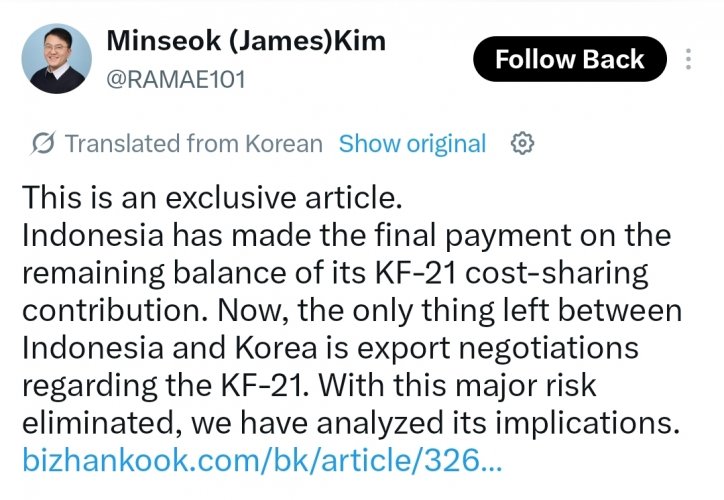
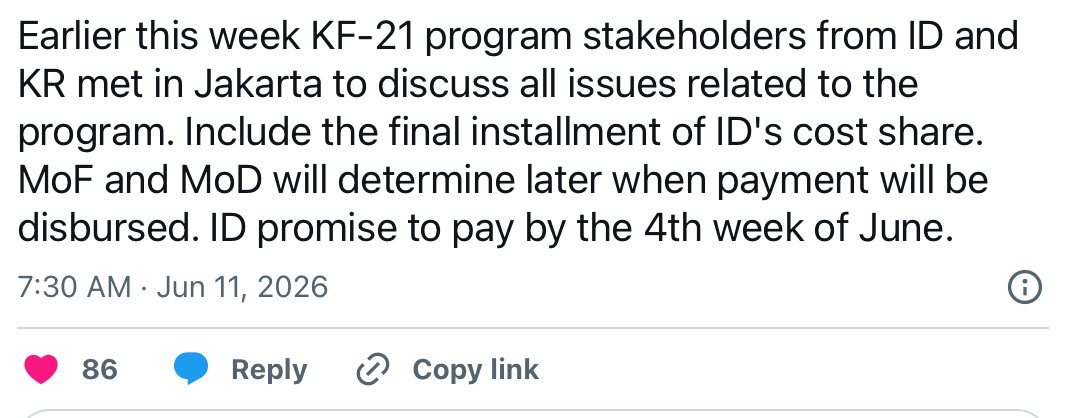
KAI: Handover of KF-21 prototype jet to Indonesia awaits transfer mechanism

Seoul (ANTARA) - Korea Aerospace Industries (KAI) stated on Thursday (June 11) that the handover of a KF-21 fighter jet prototype to Indonesia is awaiting completion of the transfer mechanism.

KAI International Business Development Asia Team 2 Team Leader Park Seonghee said the two governments have reached an agreement to transfer one prototype aircraft to Indonesia.

"Currently, the two governments are discussing the transfer mechanism, particularly regarding the technological aspects and the implementation schedule," Park said in Sacheon, South Korea.

https://m.antaranews.com/berita/560...upa-jet-kf-21-ke-ri-tunggu-mekanisme-transfer
 
Let's wait and see if the negotiations go as planned for Indonesia's purchase of the KF-21 Boramae fingers and toes firmly crossed for this to happen. I want it to because if it does it will open the gates for other countries to start purchasing the KF-21.
 
I find that a strange choice since bleeding edge fighter technology tends to begin with attack versions then become fighters. Programs like the F-15 or ATF are extremely rare to create an air superiority fighter first using bleeding edge technology.
Name an attack aircraft that became a "bleeding edge fighter". In the "fighter first" category we have:

F-4
F-14
F-15
F-16
YF-17/F/A-18
Typhoon
F-22
MiG-25
MiG-31
Su-27
 
will open the gates for other countries to start purchasing the KF-21.
Southeast Asia as a whole is the main market with then a western expansion towards the Gulf (KSA?) and more westward, in my opinion. Indonesia and Philippines (probably) being the first two buyers, it might as well have a good shot with Malaysia as well.
 
Southeast Asia as a whole is the main market with then a western expansion towards the Gulf (KSA?) and more westward, in my opinion. Indonesia and Philippines (probably) being the first two buyers, it might as well have a good shot with Malaysia as well.
Koreans certainly know how to win tenders in SE Asia...

it might as well have a good shot with Malaysia as well.
However, would the RMAF really be willing to replace both its F/A-18s and Su-30s with the KF-21B1? (Let's just say the stealthier B2 is unlikely to materialize unless Poland ends up placing an order for it, which also seems unlikely given its F-35 acquisition). Without consolidating both fleets into a single replacement, a KF-21 acquisition would hardly be feasible or justify itself...

Materially, it'd amount to a ~1:1 replacement for the Bugs with virtually no capability gain beyond --inherently-- better radars and missiles (i.e., not a transformational leap), while entailing a fairly significant loss in range, altitude, and payload (sans Meteors vs. old R-77s, and perhaps ALBMs if that ends up happening) should it also replace the Su-30s. APY-016K would provide more reliable tracking, whereas the Bars would retain an edge in sheer brute-forcing.

Usually, the whole point of a generational replacement is to deliver a meaningful leap in capability, and I just don't think the KF-21B1 could offer that in this scenario...
 
Last edited:
A reason why South Korea does well in SE Asian markets include a combination of the following:
- generally cheaper than a US or European alternative
- faster delivery times
- relatively nearby, making support more accessible
- politics. the US tends not to sell their best aircraft to many SEA countries. Additionally, several of the countries there are playing a balancing game between major powers (US and China especially). Buying Korean addresses both issues.

However Turkey is quickly becoming another "Korea", potentially offering much of the same things to SEA air forces with the benefit of possibly receiving funding from a rich gulf country to help them to purchase it. Delivery time frames, for the time being, is the key difference as Korea can deliver them faster.

Reports say Malaysia is interested in retiring both their Hornets and Flankers in the 2030s. They recently made an order for the FA-50, the first of which has already been spotted in Malaysian colors at KAI's factory. By that time, the KF-21 will already be in production and likely KAAN.

Finally, there's all kinds of reports on the status of Indonesia and KF-21, so best to take it with a grain of salt. Especially posts from random internet people who claim to be "in the know" about the KF-21. These are the same people who've kept saying Indonesia has secretly cancelled the KF-21 for the last 3 years
 
Reports say Malaysia is interested in retiring both their Hornets and Flankers in the 2030s.
Malaysia's official position is that their Hornets will be kept in service until at least 2035
They recently made an order for the FA-50, the first of which has already been spotted in Malaysian colors at KAI's factory.
They have an order in place for 18 FA-50Ms - these are essential replacements for the BAE Hawk 100/200s. That said, the have heard some murmurings of concern re the level of support the Koreans are willing to provide longer term. This is partially driven by what the Phillipines, Indonesia and Thailand have already experienced with their T-50s.
By that time, the KF-21 will already be in production and likely KAAN.
Both are definite candidates for future RMAF requirement. I would also put the Saab Gripen E/F in there - IMHO this would be a good match for the RMAF's needs/capabilities/budget.
 
That said, the have heard some murmurings of concern re the level of support the Koreans are willing to provide longer term. This is partially driven by what the Phillipines, Indonesia and Thailand have already experienced with their T-50s.
could you expand on this point? very curious.
I know Poland was having some issues with their FA-50s, but not sure if it was the US side or the Korean
 
Name an attack aircraft that became a "bleeding edge fighter". In the "fighter first" category we have:
You answered your own question. F-4 was planned as multirole from the outset, long before the designation change. The Navy initially wanted Phantom as an interceptor, not fighter. It had 11 attachment points for a reason, to switch out crew and components to use the airframe on attack missions. To name a few that it couldn't attack better were the A2F, A3D, A3J, or A4D. F4H-1F was a bit of a failure overall. Weak structure. Underpowered. Poor access for maintenance. Began with parts it was never meant to use during production. Most early jet-age Navy fighters were being retired within six years, so it fit right in.
 
Both are definite candidates for future RMAF requirement. I would also put the Saab Gripen E/F in there - IMHO this would be a good match for the RMAF's needs/capabilities/budget.
Does the Gripen E/F have the range to patrol across the SCS?
 
You answered your own question. F-4 was planned as multirole from the outset, long before the designation change.
Nope. It was an air-to-air fighter before they even started cutting metal. It even got a new number. It didn't beat out the XF8U-3 because it could carry more bombs.
 
Does the Gripen E/F have the range to patrol across the SCS?
It depends upon how one defines "patrolling" - it's not like they just have fighters just burning circles in the sky, especially given the cost that entails. As it is, a quick look at available publicly available data indicates the Gripen E/F is well placed compared to the KF-21 and Kaan in terms of combat range (I have included the existing F/A-18Ds for comparison too):
  • F/A-18D: ~740 km
  • Gripen E/F: ~1,300 km
  • KF-21: ~1,100 km
  • Kaan: ~1,000+ km
Now, obviously there is a lot that can vary this such as weapons load, environmental conditions etc etc...but in general I think the three are close in basic capability with the latter two obviously having potential benefits in some respects. Overall I think will come down to the budget.
 
could you expand on this point? very curious.
I know Poland was having some issues with their FA-50s, but not sure if it was the US side or the Korean
I can't point to any articles per se, as the intel' has come from multiple verbal discussions with those involved. The common thread has been people are frustrated with the level of support (or lack thereof) provided by the Koreans. They seem more focussed upon the initial sales but not the sustainment side post that.
 
It depends upon how one defines "patrolling" - it's not like they just have fighters just burning circles in the sky, especially given the cost that entails. As it is, a quick look at available publicly available data indicates the Gripen E/F is well placed compared to the KF-21 and Kaan in terms of combat range (I have included the existing F/A-18Ds for comparison too):
  • F/A-18D: ~740 km
  • Gripen E/F: ~1,300 km
  • KF-21: ~1,100 km
  • Kaan: ~1,000+ km
Now, obviously there is a lot that can vary this such as weapons load, environmental conditions etc etc...but in general I think the three are close in basic capability with the latter two obviously having potential benefits in some respects. Overall I think will come down to the budget.
Thank you!

I'd expect that most patrolling would be more for Air Policing than Antiship Strike. Which would mean 2x WVRAAMs, 4x BVRAAMs, and at least one external tank. Saab is claiming >1hr at 500nmi radius, which isn't terrible.
 
It depends upon how one defines "patrolling" - it's not like they just have fighters just burning circles in the sky, especially given the cost that entails. As it is, a quick look at available publicly available data indicates the Gripen E/F is well placed compared to the KF-21 and Kaan in terms of combat range (I have included the existing F/A-18Ds for comparison too):
  • F/A-18D: ~740 km
  • Gripen E/F: ~1,300 km
  • KF-21: ~1,100 km
  • Kaan: ~1,000+ km
Now, obviously there is a lot that can vary this such as weapons load, environmental conditions etc etc...but in general I think the three are close in basic capability with the latter two obviously having potential benefits in some respects. Overall I think will come down to the budget.
I am not sure actual integration of 450 gal tanks happened with Gripen E/F. It was meant to, but i failed to find photos (ancient demonstration doesn't count).
With that in mind, all 3 mirageski aircraft are quite long ranged; that's their purpose in the first place...
I'd expect that most patrolling would be more for Air Policing than Antiship Strike. Which would mean 2x WVRAAMs, 4x BVRAAMs, and at least one external tank. Saab is claiming >1hr at 500nmi radius, which isn't terrible.
6 missiles(4 BVR) is soto kill as many civilian airliners as possible on a major route before AC reacts and they run away?

Air policing is two WVR weapons on low drag stations.
 
Last edited:
I am not sure actual integration of 450 gal tanks happened with Gripen E/F. It was meant to, but i failed to find photos (ancient demonstration doesn't count).
With that in mind, all 3 mirageski aircraft are quite long ranged; that's their purpose in the first place...

6 missiles(4 BVR) is soto kill as many civilian airliners as possible on a major route before AC reacts and they run away?

Air policing is two WVR weapons on low drag stations.
In the real world, air policing means being there when the enemy tries to walk into your ADIZ. The danger happens when your two-plane CAP runs into a half-dozen J-16s over the Batanes. The Chinese regularly fly force packages with dozens of aircraft into the Taiwan ADIZ.
 
In the real world, air policing means being there when the enemy tries to walk into your ADIZ. The danger happens when your two-plane CAP runs into a half-dozen J-16s over the Batanes. The Chinese regularly fly force packages with dozens of aircraft into the Taiwan ADIZ.
If you'll try air policing with 6 BVRAAMs(externally), you'll feed wartime money stream to the AAM manufacturer. You'll sacrifice a lot of time on station, unless it's a heavy 5th generation fighter, wich you aren't buying.
And since you aren't, half dozen sudden J-16s, if they'll feel like that, will screw you over all the same.

On top of that, you won't be able to do air policing (when that was supposedly the task), as fighter with full stores in air domain means a direct threat. Show that to civilian liner couple of times, and you've created an international crysis for yourself out of thin air.
 
Nope. It was an air-to-air fighter before they even started cutting metal. It even got a new number. It didn't beat out the XF8U-3 because it could carry more bombs.
Fleet defender is not exactly an air to air fighter. You are denying its multiple configurations simply because they started with the most direct role and most glaring need. Gotcha.
 
Fleet defender is not exactly an air to air fighter. You are denying its multiple configurations simply because they started with the most direct role and most glaring need. Gotcha.


That's the sound of desperation. They started with the fighter and it later adopted attack roles. Not only doesn't it back your claim, it supports the opposite:

"I find that a strange choice since bleeding edge fighter technology tends to begin with attack versions then become fighters. Programs like the F-15 or ATF are extremely rare to create an air superiority fighter first using bleeding edge technology."
 
Last edited:
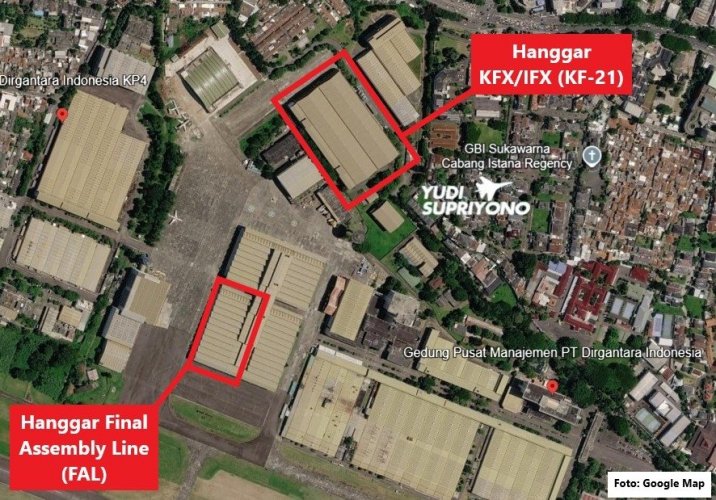
1000173188.jpg

KFX/IFX (KF-21) PTDI hangar viewed from above. There are two hangars: one for the production line and for composite materials

Both hangars started construction on 2 September 2015 on 4 hectares of land. If you look at their size, the hangars are wider and longer than the FAL (Final Assembly Line) hangar because from the beginning they were specifically built not just for assembly but also for component production. So, there was indeed a joint production plan for the KF-21 and its derivative versions (IF-21) from the start. Likely deal fell of with Rafale procurement causing financial issues.

Every production of the KF-21 and IF-21 will use airframe components from both South Korea and Indonesia. Indonesia will supply the Right Main Wing, Tight Tail Wing, Pylon, and After Fuselage Part components for every KF-21 and IF-21 produced (assuming our facilities pass the qualification process).

The rest of the airframe components will be supplied by South Korea. This was the original plan.
 
Last edited:
That's the sound of desperation. They started with the fighter and it later adopted attack roles. Not only doesn't it back your claim, it supports the opposite:

"I find that a strange choice since bleeding edge fighter technology tends to begin with attack versions then become fighters. Programs like the F-15 or ATF are extremely rare to create an air superiority fighter first using bleeding edge technology."
While it's obvious that F4 is a fleet all-weather interceptor in DNA, iirc USMC was there from the earliest days (as was the case with the Daemon).

It's a bit different from the KF-21, which has it in a pipeline, but in a separate installment(major block).
 
I do have a question. Has the funding for block 2 been approved yet? How about the final actual stealth block 3 version? Because from the news I read occasionaly it looks like its going to be furthur delayed because of cost reasons?
 
I do have a question. Has the funding for block 2 been approved yet? How about the final actual stealth block 3 version? Because from the news I read occasionaly it looks like its going to be furthur delayed because of cost reasons?

Yes. Block 2 involves adding air-to-ground weapon capabilities to the KF-21, and a budget of $448 million was allocated in December 2025, with evaluations currently underway. The Block 2 project runs until December 2028, and weapons that pass testing will be sequentially applied to the KF-21 starting in 2027.

As for Block 3 (or KF-21EX), it currently exists only as a proposal from KAI. Judging by the fact that SK Air Force has commissioned ADD to conduct full-scale research on a tailless stealth fighter to replace the F-16 in the future, it appears that SK Air Force, the closest potential customer, has no interest in Block 3.
 
As for Block 3 (or KF-21EX), it currently exists only as a proposal from KAI. Judging by the fact that SK Air Force has commissioned ADD to conduct full-scale research on a tailless stealth fighter to replace the F-16 in the future, it appears that SK Air Force, the closest potential customer, has no interest in Block 3.
Seems weird, since there's supposed to be space set aside internally for a weapons bay!
 
Seems weird, since there's supposed to be space set aside internally for a weapons bay!
Bay is expensive and protracted release testing; in fact, it can easily be that the current space allocated for the bay isn't usable in its current state.
Bay alone won't make you LO. "Even" going Su-57 will take changing the entire plane and developing a lot KF-21 currently doesn't have.

At this point, you may as well invest in a modern VLO.
 
Yes. Block 2 involves adding air-to-ground weapon capabilities to the KF-21, and a budget of $448 million was allocated in December 2025, with evaluations currently underway. The Block 2 project runs until December 2028, and weapons that pass testing will be sequentially applied to the KF-21 starting in 2027.

As for Block 3 (or KF-21EX), it currently exists only as a proposal from KAI. Judging by the fact that SK Air Force has commissioned ADD to conduct full-scale research on a tailless stealth fighter to replace the F-16 in the future, it appears that SK Air Force, the closest potential customer, has no interest in Block 3.

I've heard the same thing as well..
the AF is preferring to skip over a BLK III and go for a full on new more modern design.
 
As Maro.kyo previously mentioned, I was also quite surprised by this decision made by the ROK Air Force. It appears the ROK Air Force headquarters took a pessimistic view regarding the likelihood of the U.S. selling the F-47—much like the situation with the F-22—and concluded that a more radical platform was necessary to maintain a minimum level of force-multiplying capability beyond the 2040s.

The "Stealth Bridge" program, led by the ADD with participation from various companies, is a project designed to create a testbed for developing and demonstrating technologies for next-generation fighter jets. Running until 2031, the program involves constructing a full-scale ground-test aircraft (minus the engine) and developing systems—such as an AESA radar with LPI modes and integrated electronic warfare capabilities, internal weapon bays, EOTS, EODAS, and flight control systems—to a level ready for integration into an actual airframe. Additionally, the program encompasses research on the overall airframe configuration, including DSI intakes, low-observable radomes, and composite materials.

Returning to the KF-21, since the technologies developed under the Stealth Bridge program are slated for transfer to industry partners, KAI could potentially derive new capabilities from these technologies to reduce development time and costs. The crucial factor, however, is the emergence of a customer interested in the Block 3 variant.
 
The crucial factor, however, is the emergence of a customer interested in the Block 3 variant.
The unfortunate reality for proponents of the Block 3 is that there are already twin engine and single engine fighters on the market or coming to the market that don't require the customer to fund the development into a 5th Generation platform. Country X could pick from a multitude of jets in the coming years (F-35, Su-57, J-35, KAAN, T-75) which just need a signing of a contract and payment, oversimplified but I think the point is clear. Block 3 puts a burden on an interested customer that simply doesn't exist with other offerings, a substantial burden. And it's doubtful that the KF-21 is technologically superior in a way that justifies that cost for any would be customer.
 
Exports of fifth-generation fighter jets from China, the United States and Russia are all subject to geopolitical constraints. Generally speaking, smaller importers are reluctant to bear the political fallout that comes with purchasing warplanes from these three powers. The Kaan, by contrast, is largely an option for Muslim-majority nations. As for the KF-21 (prior to its Block 3 variant), setting aside the fact that its technology has not yet fully attained true fifth-generation standards, it delivers a cost-effective alternative free of geopolitical baggage. Furthermore, I do not believe the countries looking to acquire the KF-21 will realistically face large-scale armed conflicts, so they have little need to prioritize the aircraft’s extreme performance thresholds — this is in no way a disparagement of the KF-21.So the sole question for prospective buyers is whether the KF-21 Block 3 can truly deliver sufficient cost performance, and I harbor some doubts on this front.
 
Yes. Block 2 involves adding air-to-ground weapon capabilities to the KF-21, and a budget of $448 million was allocated in December 2025, with evaluations currently underway. The Block 2 project runs until December 2028, and weapons that pass testing will be sequentially applied to the KF-21 starting in 2027.

As for Block 3 (or KF-21EX), it currently exists only as a proposal from KAI. Judging by the fact that SK Air Force has commissioned ADD to conduct full-scale research on a tailless stealth fighter to replace the F-16 in the future, it appears that SK Air Force, the closest potential customer, has no interest in Block 3.
but why? why not go for a low level stealth fighter to gain experience compared to a tailless fighter than will almost certainly take a very long time(possibly on the same timeline as the FCAS but unlike the French 6th gen but unlike that one they havent done the same level of research).
 

Similar threads

Back
Top Bottom