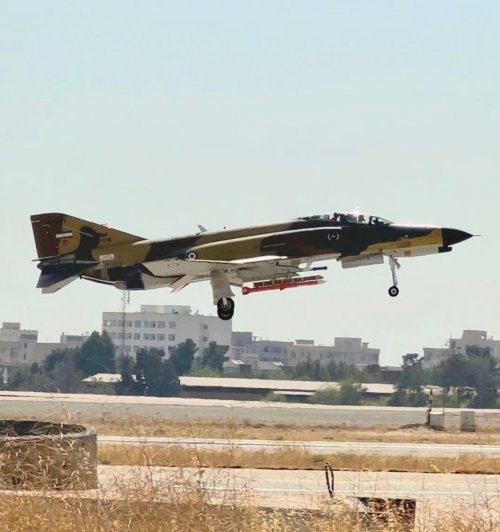
The AIM-23 is a hopelessly obsolete system.
Most attempts to modernize it have proven to be as futile as its transformation into an air-to-air weapon. The Fakour-90 is essentially a Hawk missile dressed up in a Phoenix's clothing, but with a range far below expectations (somewhere between 50–100 km). The proposed upgraded variant, the Maghsoud, with its longer range and ARH, would make sense only if upgrading the entire Tomcat fleet to the F-14AM standard were also justified. However such a modernization is prohibitively expensive and inefficient, given the Tomcats' remaining service life, their rapidly shrinking fleet size, and the type's high operational demands.
Meanwhile, Iran is capable of developing and, on a very limited scale, producing highly advanced SAM systems with modern missiles (the Sayyad family and the missiles for the new Mehran mobile system), including variants with ARH. The problem lies in insufficient serial production capacity and - until recently - a general reluctance to allocate resources to the Artesh and especially the IRIAF at the expense of the missile program. The latter had absolute priority, consuming all the effort, funding, and fruits of Iran's top-tier R&D in fields like composite materials, nanotechnology and microelectronics.
The recent conflict with Israel has significantly changed many fundamental aspects. It demonstrated both the advantages and the considerable limitations of the previously promoted missile-centric doctrine. Even before the war, there was a visible political effort to diversify financial flows and strengthen defense funding, including allocating more resources to the Artesh. Now, it is clear that the situation has been understood: a major effort must be made to rebuild the air force, which is irreplaceable by ground-based SAMs (especially in the country without any AEW&C capability) and is crucial for detecting and neutralizing threats like cruise missiles and UAVs, which recently inflicted enormous damage on the Iranian economy.
The development of a new missile, reportedly named Baz with a range of around 100 km, was certainly underway before 2025. However, the events of this past June can only accelerate this program and steer it towards serial production in the near future. It will be interesting to watch this development, as well as any potential attempts to integrate it onto various platforms of Western and Soviet/Russian origin.